What Seven of Swords means in tarot — and in love
The Seven of Swords is the tiptoe: deception in the connection — hidden phones, edited stories, a person taking what they need without declaring it. As feelings, the Seven of Swords means concealment — whatever they feel, they are not showing you the full hand.
Jump to FAQAt a glance
- Yes or no
- No — reversed flips it
- Element
- Air
- Upright, in a line
- deception, someone not playing fair
- Reversed, in a line
- a confession, secrets coming home
Want a yes or no on your own situation rather than this card? Pull one card and get the verdict with the reason behind it.
Ask your own yes-or-no questionIn the Golden Dawn tradition this card rules 20–30° of Aquarius. A planet standing at that degree is read through it: Venus in Aquarius · Moon in Aquarius · Mars in Aquarius
Upright in love
The Seven of Swords is the tiptoe: deception in the connection — hidden phones, edited stories, a person taking what they need without declaring it. Sometimes it is strategy, sometimes cowardice, occasionally an exit performed sideways. If you asked whether they are honest with you, this card answers with a man sneaking away carrying your swords. Watch what is done, not what is said.
The range of this card is wider than its reputation, and getting the range right is most of the work. At the heavy end it is betrayal. At the light end it is a person who cannot bear a direct conversation and manages the situation instead — softening a fact, delaying an answer, letting you assume something convenient rather than saying the inconvenient thing out loud. Both ends are dishonesty. Only one of them is malice, and treating the light end as the heavy end tends to produce the heavy end.
In a new connection it usually means the account you have been given is edited. Not fabricated, edited. Something has been left out — an ongoing arrangement, a recent ending that is not as ended as described, a circumstance that would change how you were weighing this. The tell is not inconsistency, because careful people are consistent. The tell is vagueness that survives direct questions, and answers that describe feelings where you asked about facts.
In an established bond it more often describes withdrawal than infidelity. Money moved without mention. A decision taken alone and announced afterwards. A whole area of life that has quietly become private. The person doing it usually experiences it as avoiding a fight rather than as deceiving anybody, which is why confronting it with the word deception produces denial that is, in their own head, sincere.
What the card asks of you is unglamorous. Verify one specific thing rather than interrogating the person. Ask a question with a factual answer and see whether you get one. And stop accepting explanations for behaviour that has already repeated, because an explanation covers an incident and this card is describing a method.
Reversed in love
Reversed, the Seven of Swords is the sneak exposed: secrets surfacing, confessions arriving, or a pattern of self-deception finally caught in the mirror. Trust rebuilds only on the whole truth — a partial confession is just better-organised theft. Ask for the full inventory back.
The reversal is movement rather than judgement, and it moves in three directions worth telling apart.
The first is exposure from outside. It comes out. Somebody sees something, a story fails to hold, a coincidence does the work. This version has no repentance in it and should not be mistaken for any. What you are watching is a person managing a discovery, and their first account will be the smallest version that fits the known facts.
The second is voluntary. They tell you before they have to. This is rare and it is materially different, because it costs them something to do and nothing forced it. It is the only version from which trust has a plausible route back, and it deserves to be recognised as different even while you are angry.
The third points at the reader rather than the other person. Reversed Seven of Swords is one of the deck's plainest cards for self-deception — the thing you have decided not to know, the explanation you have accepted twice, the specific question you have been careful not to ask because the answer would require you to act. If nothing in your situation is hidden by anybody else, take this reading seriously rather than looking harder at them.
The practical measure is completeness. Truth arriving in instalments, each one appearing only after the previous one stops working, is not disclosure. It is a negotiation, and the card is clear that a partial return of the swords is not a return.
Seven of Swords As feelings
As feelings, the Seven of Swords means concealment — whatever they feel, they are not showing you the full hand. The motive can be fear, guilt or strategy. The feeling underneath may even be genuine; the packaging is still deception.
Because this card names a method rather than an emotion, the four situations diverge more than usual.
If you are single and asking about someone new. They are interested and they are managing what you know. Sometimes that is ordinary early-stage self-presentation, edited the way everyone edits. Sometimes there is a specific fact being held back, and the reliable sign is that they keep the two of you out of contexts where other people could contribute information. Warm in private, unavailable in public, is the shape this card makes.
If you are in a relationship. They have a private area and they are guarding it. It is not automatically another person. It is often something they are ashamed of, and shame produces the same behaviour as guilt at a distance. What they feel about you may be unchanged. What has changed is that they no longer bring you everything.
If you are asking about an ex. They want access without accountability. The feeling is real enough and it arrives on terms that cost them nothing: late messages, ambiguous warmth, presence without any statement of intent. Nothing they say will be false. What is missing is the part that would commit them to something.
If you are asking about someone long-term. A private life running alongside the shared one. Frequently it is small and old — a habit, a sum of money, an ongoing contact — kept secret so long that revealing it now would be a bigger event than the thing itself.
In all four the card says the same thing: judge the behaviour, because the stated feeling is the part they control.
Seven of Swords For your ex
For an ex, the Seven of Swords warns of unfinished dishonesty: sliding back into your life without accountability, keeping other options quietly open, or old lies still unconfessed. Any return costs a full-transparency toll. No receipts, no re-entry.
The pattern this card describes with an ex is specific and recognisable. Contact resumes without ever being defined. They are around, in a low-cost way — a message at an odd hour, an unexplained appearance in your notifications, warmth with no statement attached. Nothing is claimed, so nothing can be held against them, and the arrangement is comfortable for exactly one of the two people involved.
The reason it works is that you supply the definition yourself. In the absence of a stated position, people fill the gap with the most hopeful reading available, and the card is describing somebody who has learned that leaving the gap open is more effective than filling it. Often no lie is told at any point. The dishonesty is structural rather than verbal.
There is also a plainer version. Something from the original ending was never disclosed, and you have been reconstructing events from an incomplete set of facts. If your account of what happened has a hole in it that nothing explains, this card is often pointing at the hole rather than at anything current.
The practical move is to require a stated position before granting anything. Not a promise and not an apology — a clear answer to what this is, given in daylight and in plain words. People who intend something can say it. People running this card go quiet when asked, then return a fortnight later as though nothing was ever requested.
What Seven of Swords means in general
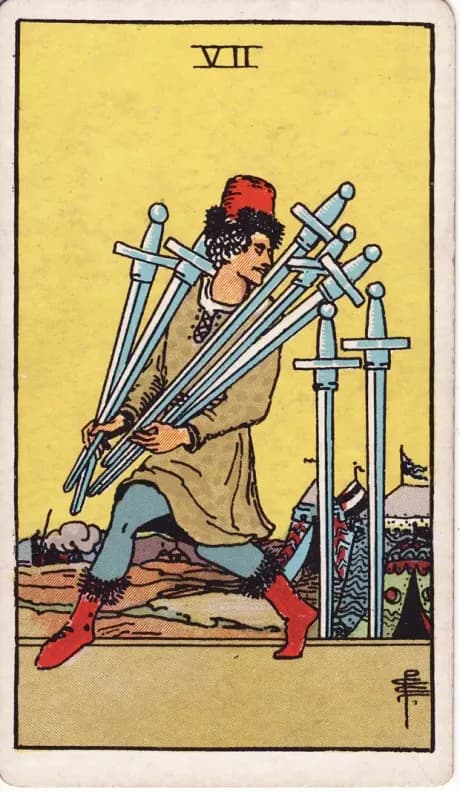
A figure creeps away from an encampment with five swords bundled in his arms, glancing back over his shoulder. Two swords are left standing in the ground behind him. The card's subject is the indirect approach: getting something by avoiding the confrontation that would decide it fairly. That covers theft and it also covers stealth, cunning, working around a rule, and acting alone because the group would only slow you down.
Upright it says something is being concealed and the method in play is evasion rather than force. The two abandoned swords are the important detail — whatever is being taken is incomplete, and the plan will later be short of exactly the piece that was left behind. Reversed the concealment ends: exposure, a confession, an attempt to return what was taken, or the reading that the deception is aimed inward and the one being fooled is the person holding the swords.
Sevens in this deck are about testing a position and holding it. The Seven of Wands defends ground, the Seven of Pentacles waits and assesses, the Seven of Cups cannot choose between possibilities. This is the one that declines the contest altogether and takes a route around the edge of it.
At work it is the project built quietly before anyone can vote on it, the shortcut that will not survive review, the credit taken for a piece of work with several authors. Around money it is the corner cut in a way that produces a real short-term gain and a specific later problem. In creative practice it is borrowing without attribution, which the card treats less as a crime than as a debt that becomes payable at an inconvenient moment.
The card is not automatically an accusation. Sometimes going around is correct. What it always says is that the route chosen avoids a test, and that the test is still out there waiting.
Seven of Swords as a yes or no
As a yes or no, the Seven of Swords upright is a no. The reason is not failure but incompleteness: the picture shows somebody getting away with five of seven swords, which means the thing succeeds partially and comes apart on the part that was left behind. Answers built on that shape do not hold, so the card refuses the yes even when the short-term result looks like one.
There is a narrow exception and it is worth stating precisely. If the question is whether something can be done quietly, alone, without seeking approval, this card says yes. It is genuinely good at that: the private attempt, the plan kept off the shared record, the move made before anyone can object. What it will not say yes to is that the quiet route ends well once everybody knows about it.
Reversed it is a yes for questions about the truth coming out, and a strong one — exposure, confession, the discovery of what was being withheld. For questions about whether trust can be rebuilt, reversed is a maybe that depends entirely on completeness. A full disclosure leaves a route open. A partial one, arriving only as each previous version stops working, is the same no in a better suit.
If the card keeps landing on your question, consider that the question itself may be the problem. Are they lying is difficult for a deck to answer and easy to answer wrongly in either direction. What has not been said, what have I chosen not to ask, and what would I need to see: those are answerable, and they are what this card is actually about.
Seven of Swords as advice
As advice, the Seven of Swords is read two ways depending on which end of it you are standing at, and the first job is deciding which.
If somebody is being indirect with you, the advice is to verify rather than to confront. Pick one factual claim and check it against something outside the person who made it. Interrogation is the wrong instrument here, because it teaches a careful person which questions to prepare for and produces a cleaner story rather than a truer one. Ask short questions with factual answers, once, and pay attention to the shape of what comes back rather than to its warmth.
Stop accepting explanations for a repeat. An explanation is appropriate for an incident. When the same thing happens a third time you are looking at a method, and the method deserves a decision instead of another explanation.
If you are the one being indirect, the advice is blunter. Say the thing. The card is describing an approach whose costs are all deferred, and deferred costs in situations involving other people compound quietly. Whatever you are managing by omission is currently cheap and gets more expensive every week it stays managed. A conversation you are dreading now is smaller than the same conversation after discovery, by a wide margin.
And take the last two swords. If a plan is worth doing, do the version that includes the difficult part rather than the version that leaves it behind. The picture is precise about what happens otherwise: you get away, and you are two pieces short of what you needed.
Reversed, the advice is to complete the disclosure yourself, before circumstances complete it for you on worse terms.
Seven of Swords as an outcome
As an outcome, the Seven of Swords ends with something got away with, and the getting away with it is the problem rather than the resolution. Somebody obtains what they were after by going around the obstacle instead of through it, and the situation closes without the underlying question ever being tested. That leaves the question live. It surfaces later, usually at a worse moment, usually attached to something else.
In practice this looks like a matter that quietly ends without being settled. Nobody says the honest sentence. A version of events becomes the official one because nobody with an interest in correcting it is present. Things carry on, structurally unchanged, and the person who left with five swords assumes the file is closed. It is not closed. Two swords are still standing in the ground where anyone can find them.
The card is also a common outcome for situations where you will simply never be told. That is a hard result to accept and it is a genuine one. If it lands on a question about somebody else's motive or conduct, the honest reading is that the full account is not going to be provided to you, and that continuing to pursue it costs more than it can possibly return.
Reversed as an outcome is the better ending, though rarely the comfortable one: it comes out. The withheld thing becomes known, by confession or by accident, and the situation finally gets decided on real information. Whether that decision goes your way is not this card's business. What it settles is that the deciding happens with the facts on the table rather than under it.
What the Seven of Swords card shows
The 1909 card shows a man walking away from a military encampment on tiptoe, his body turned back over his shoulder, wearing an expression that is somewhere between a smirk and a grimace. He carries five swords clutched against his body. Two more stand upright in the ground behind him, planted where they were left.
The detail that carries the card is how he is holding them. He has them gripped around the blades rather than by the hilts, bundled awkwardly against his chest with the points trailing backward. It is the wrong way to carry a sword and he cannot carry five any other way. Everything about the grip says that the load is more than the method can manage, and that he will be cut by his own haul before he gets far.
Behind him, on the yellow ground, stand red and orange tents. Small figures are visible near them at a distance, and one has an arm raised. Whether they have seen him is left deliberately unclear, and that ambiguity is the actual emotional content of the picture: not the theft, but the moment immediately after it, when you do not yet know whether you got away.
He is looking backward while walking forward, which is the posture of somebody whose attention is entirely on what is behind them. Nobody in this position is watching where they are going.
The two swords left standing are the quiet argument. They were not dropped in a struggle and nothing prevented him taking them. He simply could not carry seven. Whatever the plan required, it now proceeds without two of its pieces, and the picture places them upright and undisturbed in full view, exactly where their owners will look first.
Frequently asked
Does the Seven of Swords mean cheating?
+
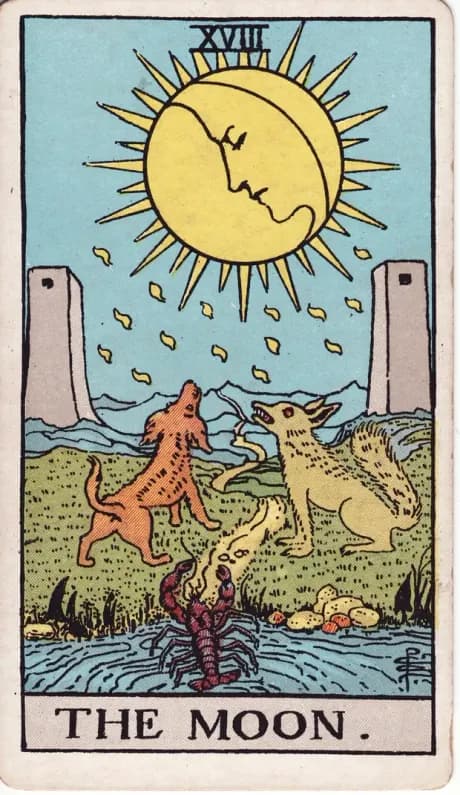
It means deception or a hidden agenda, and infidelity is one version among several. In established situations it more often describes withdrawal — money moved without mention, a decision taken alone, an area of life gone private. At minimum, information is being managed. Cards like the Moon or the Three of Swords alongside it push the reading toward the heavier end.
Can I trust them if I pull the Seven of Swords?
+
Verify before trusting. The card counsels watching actions, checking one specific factual claim against something outside the person who made it, and requiring honesty proven rather than promised. Interrogation is the wrong tool — it teaches a careful person which questions to prepare for and produces a smoother story, not a truer one.
Is the Seven of Swords a yes or a no?
+
Upright it is a no, and the reason is incompleteness rather than failure: five swords out of seven means it half works and comes apart on the missing part. The one narrow yes is for doing something quietly and alone. Reversed it is a strong yes for the truth coming out.
What should I do when I draw the Seven of Swords?
+
Check one fact instead of confronting a person, and stop accepting explanations for something that has already repeated — an explanation covers an incident, and this card describes a method. If you are the one being indirect, say the thing now, because everything about this approach is cheap today and dearer every week.
Can the Seven of Swords be about me deceiving myself?
+
Yes, and it is one of the most common readings people skip. Reversed especially, it points at the question you have avoided asking because the answer would oblige you to act, or the explanation you have now accepted twice. If nothing in your situation is being hidden by anybody else, take that reading first.