What Seven of Cups means in tarot — and in love
The Seven of Cups is love among mirages: too many options, fantasy inflation, a crush built mostly in your head. As feelings, the Seven of Cups means they are dazzled but undecided — you are one of several open tabs, or they love a fantasy version of you more…
Jump to FAQAt a glance
- Yes or no
- No — reversed flips it
- Element
- Water
- Upright, in a line
- too many options, fantasy over reality
- Reversed, in a line
- clarity arriving, choosing with open eyes
Want a yes or no on your own situation rather than this card? Pull one card and get the verdict with the reason behind it.
Ask your own yes-or-no questionIn the Golden Dawn tradition this card rules 20–30° of Scorpio. A planet standing at that degree is read through it: Venus in Scorpio · Moon in Scorpio · Mars in Scorpio
Upright in love
The Seven of Cups is love among mirages: too many options, fantasy inflation, a crush built mostly in your head. It flags choice paralysis — talking to five people and connecting with none — or projecting a dream onto someone's raw material. If you asked "is this real?" — some of it. Pick one cup and test it against daylight.
The trouble this card describes is rarely a shortage. It is abundance that has stopped being useful. Seven possibilities look like riches until you notice that none of them has been examined, and that examining one means the other six stop being possible. So the examining does not happen. The situation stays pleasant, undemanding, and completely static — which is the state the card is actually pointing at, more often than it points at anything dramatic.
In a new connection it usually means you are in love with potential. You have met someone perhaps three times and built a whole future from the material, and the future is genuinely lovely, and almost none of it has been tested. That is not a warning that they are wrong for you. It is a warning that you do not yet know, and that the feeling of knowing is being supplied by your own imagination rather than by them.
In an established relationship the card lands differently. Here it is usually about a fantasy running alongside the real thing — an idealised version of your partner you keep comparing them to, or a daydream about a different life that has quietly become more vivid than the one you are in. Neither is a betrayal. Both are corrosive if they stay unnamed, because the real person cannot compete with a version of themselves that never has a bad morning.
The instruction the card carries is unglamorous: reduce. Not choose forever, just reduce. Take one cup down from the cloud, put it on the table, and find out what is actually inside it.
Reversed in love
Reversed, the Seven of Cups is clarity cutting through: illusions dropping, choices narrowing, the real option distinguishing itself from the decorative ones. You finally see who someone is versus who you cast them as. Decisions made here stick — commit to the actual, not the imagined.
The reversal is one of the more genuinely welcome in the deck, and it is worth saying why, because "illusion ends" sounds like bad news. What ends is the exhausting part. Holding seven possibilities open is work — every one of them needs maintaining, imagining, keeping warm — and the reversed card is the moment that labour stops. What remains is smaller and real, and real is something you can act on.
Sometimes the clarity arrives gently: you simply notice you have stopped thinking about the others. Sometimes it arrives as disappointment, and the disappointment is information. Finding out that the person you built was not the person in front of you hurts in proportion to how much you built. That pain is not a sign you misread the situation — it is the cost of having read it at last.
In a relationship, reversed Seven of Cups often marks the end of a comparison you were not admitting to. The idealised partner stops being the standard, and the actual partner becomes visible again — with the specific, unromantic, load-bearing things they do that a fantasy never had to do.
There is a harsher version. Occasionally the reversal means the fog cleared and what it revealed was empty: the options were never real offers, only ideas you had about people who were not offering anything. That reading is bleak in the moment and useful afterwards, because it stops you spending another season on a lineup that does not exist.
Seven of Cups As feelings
As feelings, the Seven of Cups means they are dazzled but undecided — you are one of several open tabs, or they love a fantasy version of you more than they know the real one. Attraction, yes; focus, not yet.
This is the card's most-asked reading and its least comfortable, so it is worth breaking down by situation rather than leaving it as one line.
If you are single and asking about someone new. They find you genuinely attractive and they have not decided anything. There may be other people; there may just be other lives they are imagining. Either way the feeling is real and unfocused, and pressing for a decision at this stage usually produces a decision you would not have wanted. What moves this is contact with reality — being an actual person with actual availability rather than another possibility in the cloud.
If you are in a relationship. They are idealising or drifting. Sometimes it is flattering: they hold a picture of you that is better than you feel, and they are a little in love with the picture. Sometimes it is distance: they are elsewhere, in a life they imagine rather than the one you share. The distinguishing question is whether they still see your ordinary days, or only the highlights.
If you are asking about an ex. They think about you among other things they think about. You appear in a rotation of what-ifs, and the rotation is comfortable precisely because nothing in it requires action.
If you are asking about someone long-term. Here the card is less about other people and more about restlessness — a sense that some other version of their life is still available, which has attached itself to nothing in particular.
Across all four, one thing is constant: the Seven of Cups never says they feel nothing. It says the feeling has not been aimed.
Seven of Cups For your ex
For an ex, the Seven of Cups suggests they entertain the idea of you among other ideas — fantasy reunions, what-ifs, no committed step. Don't compete with a daydream lineup. Reality either gets chosen or it walks.
What makes this card specifically painful about an ex is that the thinking is real. They genuinely do think about you. It is not indifference, and telling yourself it is indifference will not survive contact with the evidence. But thinking about someone costs nothing, and this card is precisely the difference between the thought and the move.
Often the version of you they are thinking about is not current. It is you at a particular time, edited — the good weekend, the early months, the version before whatever went wrong went wrong. That person is easy to miss because that person has no unresolved argument attached. This is why so many Seven of Cups reunions collapse quickly when they happen: the returning partner came back for an edit, and met the whole film.
If you want a practical read: watch for a single concrete action. Not a message at midnight, not a story reply, not a vague "we should talk sometime". One specific, scheduled, daylight thing. Until that exists, the card is telling you the situation is happening entirely inside their head, and nothing you do can make a daydream commit.
What Seven of Cups means in general
Seven cups float in a cloud, each holding something different, and only one is worth having. The card's subject is choice made impossible by abundance: too many options, most of them projections rather than offers. It covers fantasy, wishful thinking, and the paralysis of a decision where every path is still hypothetical.
Upright it says the situation calls for elimination rather than exploration — get the options out of the cloud and onto the ground where they can be judged. Reversed the fog clears and one cup is chosen, or the opposite: the illusion is finally seen for what it was.
Outside love, the card behaves the same way with different furniture. In work it is the person with six side projects and no shipped one, or an offer that looks better in the telling than on the contract. In money it is the plan that depends on something arriving. In creative work it is the stage where everything is still possible because nothing has been committed to paper — a genuinely pleasant stage, and one you can stay in indefinitely.
Sevens across the deck are about testing and holding. The Seven of Wands defends, the Seven of Swords takes a shortcut, the Seven of Pentacles waits and assesses. The Seven of Cups is the one where the test never begins, because choosing to test one thing means letting six others go.
The card is not a moral judgement about daydreaming. Imagination is how anything gets wanted in the first place. What the card marks is the point where imagining has replaced finding out — and the tell is simple. If you can describe the possibility in detail but cannot say one verifiable fact about it, you are looking at a cup in a cloud.
Seven of Cups as a yes or no
As a yes or no, the Seven of Cups upright is a no — not a refusal, a "not as asked". The card describes a situation that has not resolved into anything answerable yet, and forcing a verdict out of it produces a verdict about your hopes rather than about events.
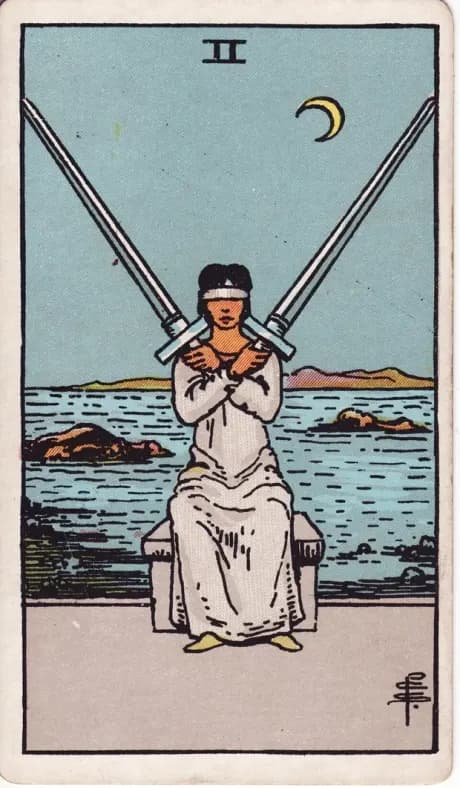
This is one of the small group of cards that genuinely resists the format. The Two of Swords and the Hanged Man do the same thing. Where most cards lean one way or the other, these three describe suspension, and a suspended situation gives a false yes as easily as a false no.
Reversed it flips to yes, and the yes is more useful than most: it means the fog has lifted enough for the answer to exist. Something has been ruled out, someone has become visible as they are, a choice has narrowed to one. That is why the reversed card reads as a stronger yes here than its upright reads as a no — it is not just permission, it is the arrival of enough information to act on.
The practical move when this card lands upright on a yes-or-no question is to change the question. "Will he choose me" becomes "what is he actually weighing". "Is this real" becomes "what part of this have I verified". The deck answers the second kind well and the first kind badly, and the Seven of Cups is the card that says so most plainly.
Seven of Cups as advice
As advice, the Seven of Cups says: stop collecting and start checking. Pick one option — not the best one, not forever, just one — and find out something true about it. The card is not asking you to commit. It is asking you to convert a possibility into a fact, because possibilities do not decay and facts do.
The practical form of that varies. If you are talking to several people, the advice is to have one real conversation rather than five pleasant ones. If you are imagining a future with someone, the advice is to test one small piece of it in the present. If you are stuck between two paths, the advice is to notice which one you keep researching and which one you keep avoiding — the avoidance is data.
There is a second instruction folded into this card, and it is the harder one: name what you are actually choosing between. Very often the seven cups are not seven options. They are one real option and six ways of not deciding about it. Written down, that reduces fast, and the discomfort of writing it down is exactly proportional to how badly it needs doing.
Reversed, the advice becomes simpler and more demanding. You already know. The card reversed rarely tells anyone something they had not privately worked out; it tells them to act on the thing they worked out and stopped pretending not to know.
What the card never advises is waiting for the options to sort themselves. They do not. Left alone, seven cups stay seven cups, and the only thing that changes is how long you have been standing there.
Seven of Cups as an outcome
As an outcome, the Seven of Cups is an unresolved ending — the situation arrives at a point where several things are still possible and none has happened. That is a real outcome, not a failure to answer, and it is worth reading as one: it means whatever you are asking about will not decide itself in the timeframe you asked about.
In a love question this usually looks like a connection that stays exactly where it is. Contact continues, warmth continues, definition does not. Nobody ends it and nobody names it. If you are hoping for a landing, this card says the plane keeps circling, and the fuel for that circling is the fact that the current state is comfortable enough for both people.
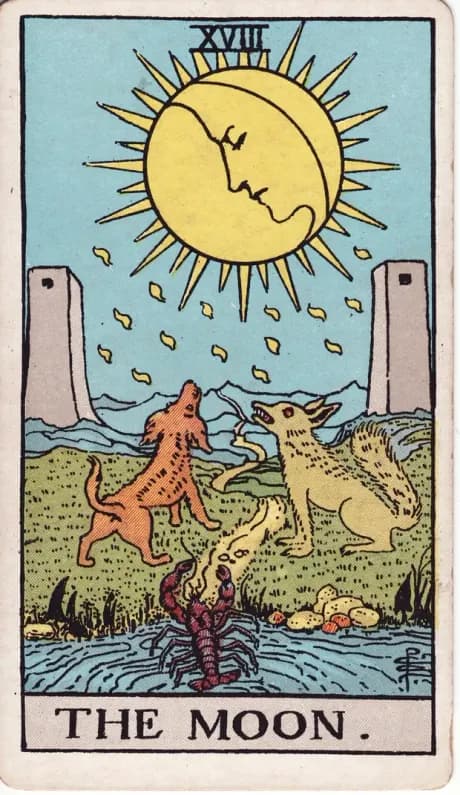
There is a better-lit version. Occasionally the Seven of Cups as outcome means genuine abundance — the situation ends with you having more than one good option, and the difficulty is a difficulty worth having. The way to tell which reading you are looking at is the cards around it. Grounded, practical company (Pentacles, the Emperor, the Hierophant) tilts it toward real choices. Foggy company (the Moon, Two of Swords, Eight of Swords) tilts it toward the circling.
Reversed as an outcome is one of the cleaner results in the deck: it ends with clarity. One option is chosen, or one illusion is dropped, and either way the situation is smaller and solid by the end of it. People sometimes read that as a downgrade because the possibilities shrink. It is the opposite — it is the point at which something finally becomes real enough to build on.
What the Seven of Cups card shows
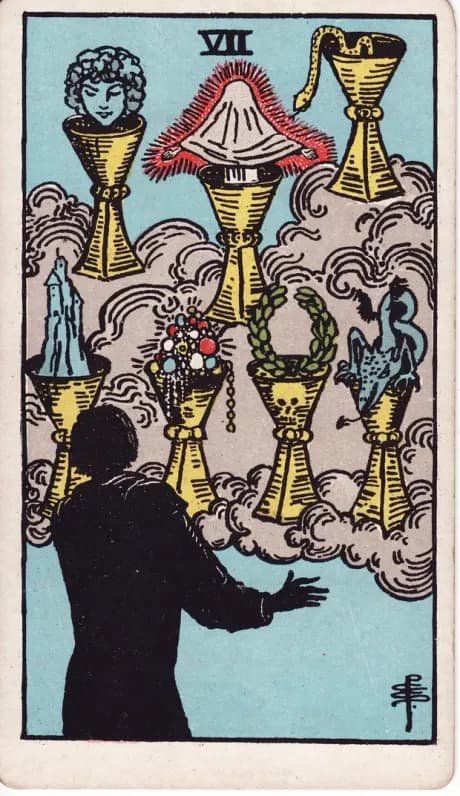
The 1909 card shows a figure in silhouette, seen from behind, facing seven golden cups that rise on a cloud. The figure is dark and featureless, and that is deliberate: you cannot see their expression because the card is not about what they feel, it is about what they are looking at.
Each cup holds something different, and the seven contents are the argument of the card. There is a human head — a person, or the idea of one. A veiled glowing figure, the only one whose face is hidden, usually read as the thing wanted most and understood least. A snake. A castle on a crag. A pile of jewels. A laurel wreath, which in some printings sits above a skull. And a dragon.
Two things are worth noticing. The first is that the desirable and the dangerous are drawn identically — same gold, same scale, same cloud. Nothing in the picture tells you which cup is safe, and there is no perspective trick marking one as nearer. The card refuses to rank them, and that refusal is the point: from where the figure stands, everything looks equally available and equally real.
The second is the cloud. The cups are not on a table. They have no ground under them, no support, and no way to be picked up from where the figure is standing. Every other Cups card in the suit puts its cups on solid earth or in a hand. Here they float, which is the visual form of the word "hypothetical".
The figure's arms are slightly raised, in the gesture of someone presented with something rather than someone reaching. They have not moved toward any cup. That is the whole scene: a person, standing still, in front of everything they could possibly want, none of which is within reach until they walk toward one.
Frequently asked
What does the Seven of Cups mean in love?
+
Illusions and options: fantasy outpacing fact, or too many choices blocking one real connection. It rarely means someone feels nothing — it means the feeling has not been aimed at anything yet. Reality-check before investing.
Does the Seven of Cups mean they're seeing other people?
+
It can — multiple options or wandering focus. But it just as often means they are entertaining several imagined futures rather than several actual people. At minimum, their attention isn't singular yet.
Is the Seven of Cups a yes or a no?
+
Upright it reads as a no, though the honest phrasing is 'not as asked' — the situation has not resolved enough to answer. Reversed it flips to yes, and a fairly strong one, because it means the fog has cleared enough for a real answer to exist.
What should I do when I draw the Seven of Cups?
+
Pick one option and check it against something verifiable. Not commit — check. The card describes possibilities that have never been tested, and testing one is the only move that changes the situation. Waiting does not, because seven cups left alone stay seven cups.
Is the Seven of Cups about cheating?
+
Usually not. It describes divided attention and idealisation more than betrayal — a fantasy running alongside the real relationship rather than a second relationship. When infidelity is genuinely the subject, the Seven of Swords, the Moon or the Three of Cups tend to appear alongside it.