What Six of Cups means in tarot — and in love
The Six of Cups is nostalgia knocking: an ex resurfacing, a childhood-flavored sweetness, love that feels like coming home. As feelings, the Six of Cups means they feel nostalgic tenderness toward you — safety, sweetness, the comfort of being known.
Jump to FAQAt a glance
- Yes or no
- Yes — reversed flips it
- Element
- Water
- Upright, in a line
- nostalgia, an ex resurfacing, innocent affection
- Reversed, in a line
- stuck in the past, idealizing what was
Want a yes or no on your own situation rather than this card? Pull one card and get the verdict with the reason behind it.
Ask your own yes-or-no questionIn the Golden Dawn tradition this card rules 10–20° of Scorpio. A planet standing at that degree is read through it: Venus in Scorpio · Moon in Scorpio · Mars in Scorpio
Upright in love
The Six of Cups is nostalgia knocking: an ex resurfacing, a childhood-flavored sweetness, love that feels like coming home. It's the most 'person from the past returns' card in the suit. The warmth is real; just check whether you miss the person or the era. If you asked about someone familiar — expect softness, memories, and possibly a message that starts with 'remember when.'
The reason this card is so easy to like and so easy to get wrong is that memory is a good editor. What comes back under the Six of Cups is not the past; it is a version of the past with the boring parts and the arguments removed. That version is genuinely lovely and it is also incomplete, and the card does not tell you which one you are being handed.
In a new connection it describes ease that arrives too fast to be explained. Someone feels familiar by the second meeting. Conversation runs without effort, there is no audition phase, and something about them is restful in a way that is hard to name. That is worth having and it is worth checking, because familiarity is not the same as compatibility. Sometimes it is only recognition of a pattern you grew up inside.
In an established relationship it is one of the gentler cards in the deck. It marks a return to an earlier mode — the two of you remembering who you were before the logistics arrived. It also shows up around shared history in the ordinary sense: family, the place you both come from, the joke that is fifteen years old. Long relationships run on this and rarely give it credit.
What the card asks is one honest question, uncomfortable in exactly one direction. Do you want the person, or do you want the year? Both are real wants and only one of them can be met by another human being. If the answer is the person, this is good news and the next move is contact. If the answer is the year, no reunion will deliver it, and the sooner that is admitted the less time gets spent on the return trip.
Reversed in love
Reversed, the Six of Cups is the past overstaying: idealizing what was, comparing every new person to a museum piece, or clinging to an ex because familiar beats good. Memory photoshops; presence doesn't. Leave the museum — the gift shop was overpriced anyway.
What the reversal changes is not the sweetness but the tense. Upright, the past is a resource being drawn on. Reversed, it has become the residence. The comparison never stops running: every new person is measured against an edit, and the edit does not have bad mornings, does not misread a message, and has had years to be improved by remembering. Nobody available loses to that fairly.
In a connection this often shows as somebody who is present and unavailable at once. They are here, they are warm, and part of the account is held elsewhere. Sometimes it is a specific person. Sometimes it is a period — a city, a job, an age — and the person in front of them is being asked to compete with a decade.
It also covers the return that should not have happened. Upright is the reunion; reversed is often the reunion three months in, when familiarity has done its work and what remains is the reason it ended. Nothing was repaired by the reappearance. Being known is a powerful feeling and it is not the same as being suited.
There is one more version, and it is worth naming because people rarely say it out loud: being stuck at an age. Reversed, this card sometimes describes somebody conducting adult relationships with the equipment of a much younger person — the same needs, the same defences, the same reflexes formed at fourteen. That is not a character flaw and it is not fixed by a partner. It simply explains a great deal about why the same shape keeps recurring.
Six of Cups As feelings
As feelings, the Six of Cups means they feel nostalgic tenderness toward you — safety, sweetness, the comfort of being known. It's affection with history in it. Lovely, and occasionally a costume that longing wears.
Nostalgic feeling is warm and it points backwards, so it matters a great deal which situation you are in.
If you are single and asking about someone new. They feel comfortable with you, which sounds tepid and is not. Comfort this early is rare, and it usually means something in you reads to them as safety. The risk is category confusion: they may not yet have separated the pleasure of your company from attraction, because at this stage both feel like ease. Time apart tends to separate them quickly.
If you are in a relationship. They feel tenderness with history in it. This is affection that has stopped needing to be proved — the fondness of somebody who has watched you go through things. It is undramatic, and it is what most long partnerships are actually made of. People frequently draw this card hoping for fire and misread quiet devotion as decline.
If you are asking about an ex. This is the card's loudest position. They remember you vividly and warmly, and the memory is in colour. They may well act on it, because this is the most reliable contact-from-the-past card in the suit. The one thing to hold on to is that what they miss is a specific edition of you, and that edition does not have the last six months attached to it.
If you are asking about someone long-term. Gratitude and belonging, with an undertone of wanting a simpler stretch back. Often what they miss is not another person but an earlier version of the two of you, and that is a request which can actually be granted.
Across all four the feeling is genuine, gentle and slightly out of date. What the card never answers is whether they intend to bring it forward.
Six of Cups For your ex
For an ex, this is the reunion card: they remember the good version of you two vividly and may act on it. If they return, verify they want the future too — some people only visit the past.
Of all seventy-eight cards, this is the one most likely to precede an actual message. Not a like on a photograph — a message, with something specific in it, usually referring to a shared memory. The card is reliable about the contact happening. It says nothing at all about what the contact is for.
What they are returning to is worth being precise about. They are not missing the relationship you had at the end. They are missing an earlier chapter of it, the one before whatever accumulated, and that chapter is easy to miss because it has no unresolved argument attached to it. This is why so many Six of Cups reunions feel wonderful for a fortnight and then arrive back at exactly the point where things stopped. Nothing was solved. It was skipped.
The test is simple and it is about tense. Somebody visiting the past talks about what things were like. Somebody proposing a future talks about a specific week and a specific plan. Both can be sincere; only one of them requires anything. Give it one conversation and listen for which tense they live in — it is audible almost immediately, and it saves months. If it is the past tense, you are welcome to enjoy the visit, as long as you know that is what it is.
What Six of Cups means in general
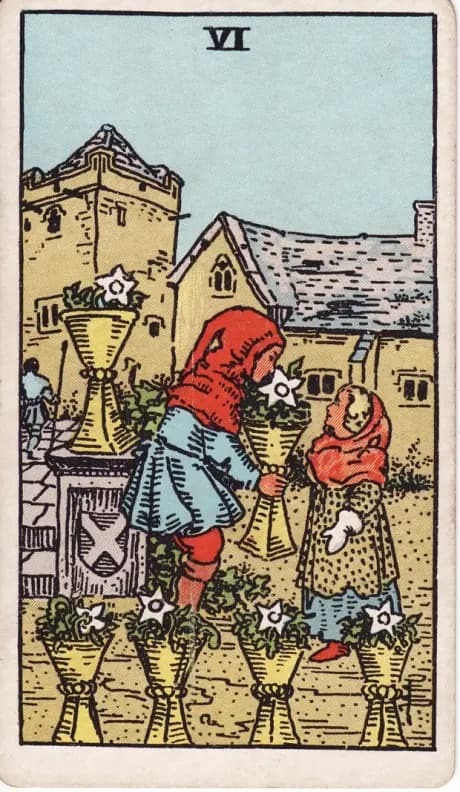
The Six of Cups is memory. A child hands another child a cup of flowers in a scene lit like a recollection rather than an event. Its subject is the past made present — nostalgia, a return to somewhere formative, someone from earlier reappearing, an old kindness repaid. Upright it says the past is a resource here: innocence recovered, a simpler arrangement that still works, generosity given without calculation. Reversed nostalgia turns into a trap — the past preferred to the present, an idealised version of what was actually difficult, or being stuck at an age you have outgrown. In a practical reading it often points at something you already own — an old contact, a former employer, a skill learned young — that is more useful now than it was then.
The sixes in this deck all describe an exchange arriving after the damage of the fives. The Six of Wands is recognition given, the Six of Pentacles is charity weighed out, the Six of Swords is passage away from a bad place. This one is where what changes hands is neither owed nor counted — a gift from somebody who has not yet learned to keep score. That is the quality the card measures in any situation: generosity without arithmetic attached.
At work it is the former colleague who calls, the company that would take you back, the technique learned in a first job that turns out to be the thing nobody else in the room can do. This is the deck's argument for keeping old contacts warm, and it is usually right — a great deal of what gets called luck is a message from somebody who worked with you years ago.
In creative work it is returning to early material and finding it better than you remembered, or drawing on childhood sources deliberately. Around money and possessions it points at what is already owned rather than at acquisitions: the resource sitting unused, the thing inherited, the skill that was never turned into anything.
The failure mode is consistent across all of them. Memory is selective by design, and a returning past has been edited before it arrives. Upright, the card assumes the edit is harmless and the material genuinely useful. Reversed is what happens when somebody starts living inside the edit.
Six of Cups as a yes or no
As a yes or no, the Six of Cups upright is a yes, and a particularly reliable one for a specific question: will somebody from the past come back into contact. That is the thing this card does. It is the most dependable reappearance card in the suit, and drawn for that question it answers plainly.
For broader questions it is a softer yes. It says the thing is available, familiar and low-friction — that whatever you are asking about will arrive gently rather than dramatically, and probably by a route you have used before. It is a weak yes to anything genuinely new, because almost nothing about this card is new.
Reversed it turns to no, and the reason matters. It is not a no caused by an obstacle. It is a no because the thing being asked for belongs to a time that has closed. Reversed Six of Cups very often answers a question about restoring something exactly as it was, and the honest answer to that question is almost always no, whatever the cards say, because the people involved have moved and the conditions were not preserved.
If the question was whether an ex will make contact, upright is yes. If the question was whether it will work this time, this card is the wrong instrument and should not be asked to carry it. Return and repair are separate events, and this one only describes the first. Draw again for the second.
Six of Cups as advice
As advice, the Six of Cups says use what you already have. The answer to this situation is not new: it is an old contact, a skill you stopped using, a place you know, a person who knew you before. Make the list of what is behind you and read it as inventory rather than as history.
Then make the call. This card's most common practical instruction is contact — the message you have been not sending to somebody from an earlier chapter. It is not asking for a grand reconnection. One message, specific, with no agenda declared.
Give something without pricing it. The picture is a gift handed over by someone too young to be running an exchange, and that is the behaviour the card recommends: the favour done without expectation, the introduction made for free, the kindness that is not part of a transaction. This is the least strategic advice in the deck and it is unusually effective in practice.
There is a boundary attached, which is why the card has a reversal. Visit; do not move in. Draw on the past for material, contacts and comfort, and notice the moment when drawing on it becomes living there. The tell is simple. If you are using memory to plan, it is a resource. If you are using it to avoid deciding something in the present, it has become a hiding place.
And ask the awkward question before acting on any of it. Do you want the person, or the year you met them?
Six of Cups as an outcome
As an outcome, the Six of Cups ends in something familiar. The situation resolves in a way you have seen before, with people you already know, on ground you recognise. It is a soft landing rather than a triumphant one, and one of the more comfortable outcomes in the deck.
In a love question it very often means reappearance. Somebody from the past returns, or a connection returns to an earlier and better mode. The card is dependable about the return itself and silent on the duration, which is why it is worth reading with whatever sits beside it: the Ten of Cups or the Two of Cups tilt it toward something that lasts, while the Eight of Cups or the Tower suggest a visit rather than a homecoming.
There is a quieter version of this outcome that has nothing to do with a person coming back. Sometimes the ending is simply that the situation becomes easy — the pressure comes off, the arrangement simplifies, and things arrive at a state that feels like somewhere you used to live. That is a good outcome, and people frequently overlook it while waiting for the message.
Reversed as an outcome is the one to watch. It ends with the past not delivering: either the return does not happen, or it happens and does not fit. Nothing about that is catastrophic. It is the outcome where a door you were holding open finally closes, and the practical value of it is that you stop holding the door.
What the Six of Cups card shows
The 1909 card shows a walled courtyard in what looks like an old manor or village. Two children stand near the centre. The larger one, in a red hood and heavy clothing with the hands covered, leans down toward a smaller child in a pale gown and offers a cup. The gesture is careful, and the whole posture is bent toward the receiver.
Six cups appear in total, and every one of them is filled with white five-petalled flowers rather than with liquid. That is unusual for the suit and it is the point: the cups have been repurposed for something with no practical use. One stands on a stone plinth in the foreground, the rest sit around the courtyard. Nothing here is being drunk or consumed. The contents are given away.
The setting is warm and yellow, which in this deck usually marks daylight and safety. The buildings are solid and old. There are no threats visible and no adults involved in the exchange — which is the detail that makes the card what it is. Nobody is supervising, so nobody is keeping score.
In the background a figure walks away up a path, carrying what appears to be a polearm. He is usually read as a guard leaving his post, and whatever else he means, his direction matters: he is going, and the scene he leaves behind is unwatched.
Look at the size difference between the two children. This is not an exchange between equals. One has more and gives some of it to the one who has less, with no suggestion of return. Pamela Colman Smith drew generosity at the age before it becomes a transaction, and the card asks whether that is still available to you.
Frequently asked
Does the Six of Cups mean an ex will return?
+
It's the strongest nostalgia-return card in the suit — reappearance or renewed contact is very plausible, and it often takes the form of a message referring to a shared memory. Check their motive: visit or move-in? The card is reliable about the contact happening and says nothing about what the contact is for.
Is the Six of Cups good for new love?
+
Yes when it means innocent, easy sweetness — somebody who feels familiar early and requires no performance from you. Careful only if new people keep losing contests against a memory, because the memory has been edited and nobody available beats an edit fairly.
Is the Six of Cups a yes or a no?
+
Upright it is a yes, and an unusually reliable one for questions about somebody from the past making contact. It is a weaker yes to anything genuinely new. Reversed it is a no, specifically to restoring something exactly as it was.
What should I do when I draw the Six of Cups?
+
Use what you already have — an old contact, a skill you stopped using, a place you know. Send the one message you have been not sending. Give something without pricing it. And visit the past rather than moving into it: if memory is helping you plan, it is a resource; if it is helping you avoid a decision, it is a hiding place.
Why are there children on the Six of Cups?
+
The card is not about children, and the scene it draws is not a romantic one. The children are there to show an exchange with no calculation in it — one figure gives, the other receives, and nobody keeps score because nobody has learned to yet. That is the quality the card measures in any situation: generosity without arithmetic.