What Six of Swords means in tarot — and in love
The Six of Swords is the quiet crossing: leaving turbulent love for calmer water — moving on, moving out, the grief and the relief that arrive… As feelings, the Six of Swords means transition — they are moving away from the turbulence and processing toward acceptance.
Jump to FAQAt a glance
- Yes or no
- No — reversed flips it
- Element
- Air
- Upright, in a line
- moving on, calmer waters ahead
- Reversed, in a line
- dragging baggage into the next chapter
Want a yes or no on your own situation rather than this card? Pull one card and get the verdict with the reason behind it.
Ask your own yes-or-no questionIn the Golden Dawn tradition this card rules 10–20° of Aquarius. A planet standing at that degree is read through it: Venus in Aquarius · Moon in Aquarius · Mars in Aquarius
Upright in love
The Six of Swords is the quiet crossing: leaving turbulent love for calmer water — moving on, moving out, the grief and the relief that arrive together. It is not dramatic. It is a boat, some luggage, and a shoreline getting smaller. If you asked about recovery, it is under way even while the water still feels heavy. You are being carried somewhere better. Do not row backward.
The thing to understand about this card is that it is not a decision. Decisions are the Two of Swords and the Lovers. This is what happens after the decision, when the leaving is already in progress and there is nothing left to weigh. That is why it feels so strange. People expect to feel resolved once they have chosen, and instead they feel flat, tired and slightly seasick, which is the actual texture of a crossing and not evidence that they chose wrong.
In a new connection it usually means one of you is arriving from somewhere difficult. The pace will be careful, the trust will be assembled rather than assumed, and someone will need more reassurance than the length of the acquaintance seems to justify. That is not a defect. It is a person who has recently been in worse water. The mistake people make here is treating a crossing as a rescue, which puts a weight on a new connection it was never built to hold.
In an established bond the card is more encouraging than its reputation suggests. Couples do this together. The two of you leave a way of living that was making both of you worse — a city, a job, a set of arguments, a period around a family — and the boat holds both of you. Nothing about the image requires that the passengers be leaving each other. They are leaving the water behind them.
What the card asks is patience with a slow process and refusal of the one temptation it contains. Do not go back for anything. The crossing is not made faster by returning to check that the far shore was really that bad.
Reversed in love
Reversed, the Six of Swords is baggage in the boat: leaving a relationship but hauling its patterns into the next one, or turning back mid-crossing because the known storm feels safer than the unknown shore. Transition resisted only prolongs the water. Unpack what you are carrying, or the next harbour repeats the last one.
The reversal does not cancel the journey. It stalls it, and there are three common ways it stalls.
The first is the return. Somebody goes back. Not always physically — often it is the return of contact, the resumed conversation, the arrangement quietly restored on the old terms. The reason is almost never that anything improved. It is that the middle of a crossing is the worst part, with the old shore out of reach and the new one not yet visible, and going back is the only available way to make the discomfort stop immediately.
The second is the cargo. The move happens and nothing changes, because the six swords came along. New person, same argument, arriving faster than last time. This is the reading people least want and it is the most useful one, because it is the only one where the fix is available to you alone.
The third is being unable to leave at all. The boat is loaded and it does not depart. Practical reasons will be produced, and some of them will be real, and the card's opinion is that the reasons were true for a long time before the leaving became necessary and have not changed since.
The honest test is whether the water ahead is actually calmer than the water behind. If you cannot say what specifically will be different, you are not crossing. You are drifting, and drifting looks like progress for a surprisingly long time.
Six of Swords As feelings
As feelings, the Six of Swords means transition — they are moving away from the turbulence and processing toward acceptance. Feeling persists as an echo, softening with distance. The boat is in motion.
What this card does not describe is a decision made against you. It describes somebody already in the passage, which is a different emotional state and behaves differently.
If you are single and asking about someone new. They are interested and they are carrying something. Not necessarily another person — often a period of their life that has just ended badly. What you will get from them is genuine warmth delivered slowly, with pauses that are not about you. Rushing this produces a retreat, because the last thing a person mid-crossing can manage is intensity.
If you are in a relationship. They are moving away from how things have been. That is not the same as moving away from you, and the difference is worth establishing before you assume the worst. Often they are relieved that a bad stretch is ending and have not said so, because saying it means naming the bad stretch out loud. If they have gone quiet and calm rather than quiet and cold, this is usually the reading.
If you are asking about an ex. They are further along than you are. The feeling has not disappeared, it has been put at a distance and it no longer directs anything they do. This is the specific pain of the card: they still care and it does not translate into movement toward you, and both of those things are true at once.
If you are asking about someone long-term. Acceptance, in the plain sense. Something old has been laid down. What is left is quieter than it was and more durable than it looks.
In every version, feeling is present and pointed forward.
Six of Swords For your ex
For an ex, the Six of Swords usually means they are crossing away — healing by distance, choosing calmer water. Return mid-crossing is rare. Focus on your own shore. Parallel journeys occasionally reconverge, but never by dragging an anchor.
The part of this card that people struggle with is that it contains no anger. There is no grievance to argue with, no accusation to answer, nothing to correct. They are not against you. They have simply put distance between themselves and a period of their life, and you are inside that period. Being remembered without hostility and left behind anyway is harder to metabolise than being hated, because there is nothing to push against.
This is also why contact tends to be polite and go nowhere. They will reply. They will be kind. Nothing will move. The kindness is real and it is not an opening, and reading it as an opening is the standard mistake with this card.
One genuine possibility is worth naming, since it appears in the artwork. The boat carries more than one passenger, and in some readings the crossing is shared. Two people occasionally do leave a bad version of themselves together and meet again on the other side of it. What that requires is time apart that is actually spent apart, and neither person supervising the other's progress. It cannot be arranged, only discovered later.
The useful instruction is the plain one. Make your own crossing. If you spend it watching theirs, you arrive at the same shore with all six swords still in the boat, and the next passage will look identical to this one.
What Six of Swords means in general
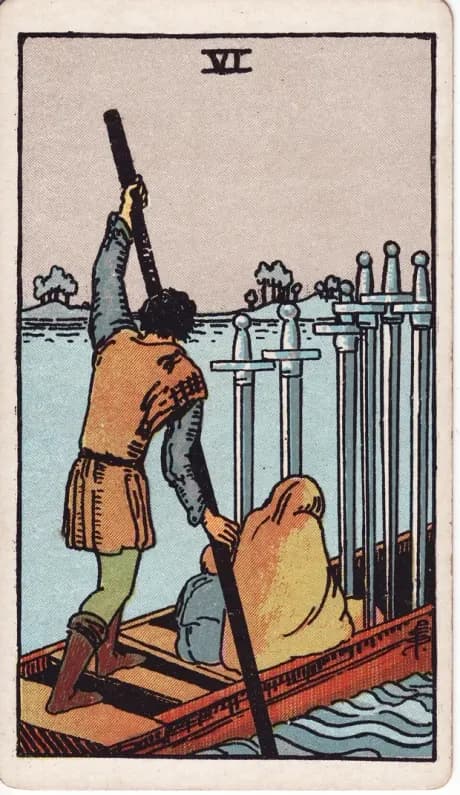
A ferryman poles a boat across shallow water, carrying a hooded passenger and a child. Six swords stand upright in the hull. The water on one side is choppy and the water ahead is smooth. The card's subject is passage away from difficulty: relocation, recovery, the gradual movement out of a bad stretch and into a survivable one.
Upright it says the transition is under way and the direction is correct, with two qualifications the picture insists on. The journey is slow — a pole in shallow water, not a sail. And the swords come along. Nothing is left behind at departure; what changes is the conditions you carry them in. Reversed the passage stalls: unable to depart, turning back part way, or arriving somewhere new with every old pattern intact and reassembling itself on schedule.
Sixes in this deck are all recoveries after the disruption of the fives. The Six of Wands returns in triumph, the Six of Cups returns to memory, the Six of Pentacles rebalances what was unequal. This one recovers by leaving, and it is the only card in the group where the improvement is achieved by physical distance rather than by anything being resolved.
At work it is the resignation already handed in, the transfer, the quiet migration of a team out of a department that was making everyone worse. In money questions it is the cost of moving — the deposit, the removal van, the months of reduced income that a change of situation runs through before it starts paying for itself. In creative practice it is abandoning a style, a medium or a collaborator, which is usually less a decision than a long slow drift that gets noticed after the fact.
The card's one instruction is about direction of gaze. Everything in the picture faces forward except the water.
Six of Swords as a yes or no
As a yes or no, the Six of Swords upright is a yes with a delay attached. Things do improve, the direction is right, and the improvement arrives at the speed of a boat being poled rather than at the speed you would like. If your question had a deadline in it, treat the answer as yes and the deadline as wrong.
The card is specific about what kind of yes. It says the situation gets better. It does not say the thing you lost comes back, and those get confused constantly. If you asked whether you will be all right, this is one of the more reassuring cards in the suit. If you asked whether they will return, the same card reads as no, because the whole image is of movement in one direction with nobody looking back.
Reversed it becomes a no, and usually a no about timing rather than about possibility. The crossing is stalled, the departure has been postponed, or the move has happened without the change that was supposed to come with it. The situation is not closed. It is stuck, and it stays stuck until something specific is put down.
If the card resists your question, the reason is normally that you asked about somebody else's movement rather than your own. Change it. Ask what has to be left behind, or how long the crossing takes, or what the far shore actually looks like. Those the deck answers plainly, and they are what the picture is about.
Six of Swords as advice
As advice, the Six of Swords says go, and go now rather than well. The card is not asking for a good exit. It is asking for an exit, on the understanding that most of the recovery happens after the departure rather than before it, and that waiting until you feel ready is a way of not going.
Concretely: book the thing. Take the flat, take the job, put the date in the calendar and tell one person the date so it becomes real. Pack light in the specific sense the card means — decide in advance which arguments, comparisons and rehearsed conversations are not coming with you, because they will board unless they are refused at the dock.
Accept help. This is the only card in the suit with somebody else doing the steering, and that is a deliberate feature of the picture. A friend who drives the van, a professional who handles the difficult part, someone who takes the phone away for a week: the passenger in the boat is not rowing and is not expected to. If you are trying to make this crossing entirely alone, you have chosen a harder version for no gain.
Do not go back for anything. Not for a possession, not for one last conversation, not to check whether it was really as bad as you remember. It was, and the checking costs a month.
Reversed, the advice narrows to a single question with an uncomfortable answer. What did you bring. Name it specifically — the assumption, the habit, the way you read silence — because a crossing made with the cargo intact deposits you on a shore that looks remarkably like the one you left.
Six of Swords as an outcome
As an outcome, the Six of Swords ends somewhere calmer than it started, and less resolved than you were hoping. The turbulence stops. The situation improves. Nothing is repaired, forgiven or explained, because the mechanism of this card is distance rather than resolution, and distance does not settle arguments. It just puts them out of range.
In practice this looks like a life that has moved. Different rooms, different routine, different people in the daily traffic, and a version of the difficulty that still exists but no longer runs anything. People often report the shift arriving quietly and being noticed weeks late — a day that went by without the thought, then a week. That is what this card looks like when it completes, and it is worth knowing in advance, because it does not announce itself and it is easy to mistake for nothing happening.
On timing the card is honest and unwelcome. It is slow. Poling a boat is the slowest form of travel in the deck, and the outcome it describes measures in months.
Reversed as an outcome is the stall rather than a disaster. The situation ends with the move not made, or made and undone, or made with every old pattern rebuilt on the far side. The distinguishing feature is repetition: if the ending you are looking at is recognisably the same as an earlier one, that is the reversed card, and it is telling you the passage has not actually happened yet no matter how much has visibly changed.
What the Six of Swords card shows
The 1909 card shows a small flat boat in shallow grey-green water. A ferryman stands at the stern working a long pole. He is standing, hooded, and doing all the labour in the picture. Seated in front of him are two passengers, a cloaked figure with the head bowed and covered, and a child pressed close beside them. Neither passenger is doing anything. That is the point of the composition: the crossing is being made for them.
Six swords stand upright in the front of the hull, driven through the boards. They are the detail everyone notices and it is worth being precise about it. They are inside the boat, they are being carried, and they do not go through the bottom into the water. The trouble travels with the passengers and does not sink them.
The water is the card's clearest statement. On the right, beside and behind the boat, it is drawn with visible ripples and small choppy marks. Ahead and to the left it is flat, smooth, almost unmarked. The boat is moving from one texture into the other, and Pamela Colman Smith drew the boundary between them plainly enough that it cannot be missed.
The pole matters too. A pole works only in shallow water. This is not an ocean voyage but a short crossing, close to land, at walking pace, which fixes the scale of what the card describes: not escape to somewhere unimaginable, just the far side of a river.
On the far bank stands a low line of land with trees. The sky is pale and uneventful. Nobody in the boat is looking back, and nobody is looking at anybody else. The hooded figure faces forward with the head down, which is not despair so much as the posture of a person getting through the middle of something.
Frequently asked
What does the Six of Swords mean in love?
+
Moving on toward calmer water — gradual healing and necessary distance after a difficult stretch. It describes the passage rather than the decision, which is why it often feels flat rather than resolved. That flatness is normal and is not evidence that the leaving was a mistake.
Does the Six of Swords mean the relationship is ending?
+
Often it confirms a transition already under way rather than announcing a new one. But the boat carries more than one passenger, and couples do make this crossing together — leaving a city, a job, a period, a set of arguments that was making both of them worse. Same boat, new water.
Is the Six of Swords a yes or a no?
+
Upright it is a yes with a delay: things improve, slowly, in the direction you are already heading. It is a yes to recovery and a no to return, because nothing in the picture is looking back. Reversed it is a no about timing — the crossing is stalled, not cancelled.
What should I do when I draw the Six of Swords?
+
Go, and go before you feel ready, because most of the recovery happens after the departure. Book the concrete thing and tell somebody the date. Accept help — the passenger in this card is not rowing, and doing it alone buys you nothing. And do not go back for one last look.
Why are the six swords in the boat?
+
Because nothing is left behind at departure. The swords are carried across, standing upright in the hull, and they do not pierce the bottom. It is the card's most honest detail: leaving changes your conditions, not your history. Reversed, the same swords are the reason the new place ends up resembling the old one.