What Four of Swords means in tarot — and in love
The Four of Swords is the mandated rest: a pause in the relationship or the search — not a breakup, a breath. As feelings, the Four of Swords means depletion — they feel drained and need distance from intensity, including yours.
Jump to FAQAt a glance
- Yes or no
- No — reversed flips it
- Element
- Air
- Upright, in a line
- rest and distance, a needed pause
- Reversed, in a line
- restlessness, returning before healed
Want a yes or no on your own situation rather than this card? Pull one card and get the verdict with the reason behind it.
Ask your own yes-or-no questionIn the Golden Dawn tradition this card rules 20–30° of Libra. A planet standing at that degree is read through it: Venus in Libra · Moon in Libra · Mars in Libra
Upright in love
The Four of Swords is the mandated rest: a pause in the relationship or the search — not a breakup, a breath. After conflict or burnout, hearts repair in stillness. If you asked why the silence, someone's nervous system requested it. Respect the quiet; regeneration does not announce itself.
The difficulty with this card is that from the outside it looks exactly like being left. Messages slow down. Plans stop getting made. The temperature drops. Leaving looks like that too, which is why people usually draw this card in a state of alarm and read it as the worst option on the table. The difference is not in the behaviour, and no amount of studying the behaviour will settle it. The difference is in what came just before: a stretch of strain heavy enough that carrying on at the same intensity stopped being possible for at least one of you.
In a new connection it generally means slow down or lose it. The pace has outrun somebody's capacity, often yours, and often without your noticing, because early excitement does the work of energy for a while and then stops doing it. Four evenings in one week is not devotion, it is a sprint, and this card is the point where the person sprinting sits down. Nothing has gone wrong. Something is being asked to move at a speed a human being can actually keep up.
In an established bond it is the ceasefire that is not a settlement. The argument has not been resolved, the underlying thing has not been fixed, and you have both stopped for now because neither of you can survive another round tonight. That pause is legitimate and it is not the answer. It buys the conditions in which an answer becomes possible.
What the card asks is unfashionable: do nothing, deliberately, with an end date. Not vanishing, not avoidance dressed as calm. Rest with a return time, and say the return time out loud, so the other person is not left reading your silence as a verdict.
Reversed in love
Reversed, the Four of Swords is rest refused: pushing conversations onto an exhausted person, or a pause that has quietly stretched into avoidance. Restlessness that heals nothing. Either take the real break — full silence, actual recovery — or admit the rest became hiding and come back honestly.
Reversal here does not turn a good card into a bad one. It moves the rest out of its proper place, and it can move in either of two directions.
The first is refusal. Somebody is running on empty and treating the emptiness as a discipline problem. Conversations get forced at midnight. The unsettled thing gets picked at daily, because leaving it alone feels like conceding it. This version usually has insomnia somewhere in the background, and it is the one where the card is genuinely warning you: the strain is no longer being repaired between rounds, so every round starts lower than the one before.
The second is the opposite, and it is welcome. The rest is over. The figure gets up off the tomb. Reversed Four of Swords very often marks re-entry — contact resuming after a withdrawal, the person who went quiet walking back into the room. If you drew this after weeks of nothing, check that reading first, because it is common and almost nobody considers it.
There is a third possibility and it is the uncomfortable one. The pause was real once and has become a residence. Nobody has ended anything, nobody is repairing anything, and the quiet is simply where the situation lives now. Recovery has a shape: it improves. If several months have gone by and nothing has improved, what you have is not convalescence.
The test between the three is quick. Ask whether the stillness is producing any change at all. Rest that is working shows up as returning energy and, eventually, as someone talking to you again. Rest that is not working shows up only as a calendar.
Four of Swords As feelings
As feelings, the Four of Swords means depletion — they feel drained and need distance from intensity, including yours. It is recovery, not rejection. The kindest move is patience without a visible countdown.
This card gets drawn most often by people who have just been left on read, so it is worth separating the situations.
If you are single and asking about someone new. They are interested and they have nothing left to give it this week. Something outside the two of you — work, family, illness, an ending they have not finished processing — is using everything they have. The interest is real; the bandwidth is not. Pressure at this point does not speed anything up. It just becomes one more thing they lack the energy for, and being that thing is difficult to come back from.
If you are in a relationship. They feel worn out by the state the relationship has been in, not by you as a person, and those are genuinely different things. The exhaustion is with the arguing, the negotiating, the version of the two of you that has been running lately. What they want is not distance from your existence. It is one evening where nothing has to be decided.
If you are asking about an ex. They are numb rather than cold. The feeling has not gone anywhere; it has been put down because carrying it was costing more than they had. This is the phase where people genuinely do not know what they want, and it is not evasion when they say so.
If you are asking about someone long-term. It reads as quiet fondness in a low-energy state. Nothing is wrong and nothing is being tended either. Long attachments arrive here regularly, and the risk is not conflict. The risk is the pause becoming the permanent setting.
Across all four the card says the same thing about intensity: theirs is switched off, and yours cannot switch it back on.
Four of Swords For your ex
For an ex, the Four of Swords means the silence is medical: they are resting from the relationship's noise. Contact during this phase gets weak returns. Let the quiet complete; what wakes up will speak more honestly.
The important thing about this card in an ex question is that it does not describe a decision. It describes a person who has stopped being able to make one. Whatever happened between you cost them something, and they have lain down. That is not the same as having chosen against you, and it is not the same as having chosen for you either. Nothing is being chosen. The machinery is off.
This is why messages sent into a Four of Swords come back flat. You are writing to somebody asleep, in the practical sense of the word, and the reply you get is not a measurement of what they feel. It is a measurement of what they can currently produce. People read that flatness as the verdict. It is not a verdict; it is a state, and states end.
What the card asks of you is unwelcome and simple: leave it alone, and use the same stretch of time for the same purpose. Your own recovery is not a consolation prize awarded while you wait. If you spend the pause checking their profile and drafting messages you do not send, you arrive at the far end of it in worse condition than the person who was actually resting.
If contact comes, it will come from them, and it will come after the rest is finished rather than during it. Anything that arrives mid-pause is usually loneliness rather than intent, and it tends to be withdrawn the following morning.
What Four of Swords means in general
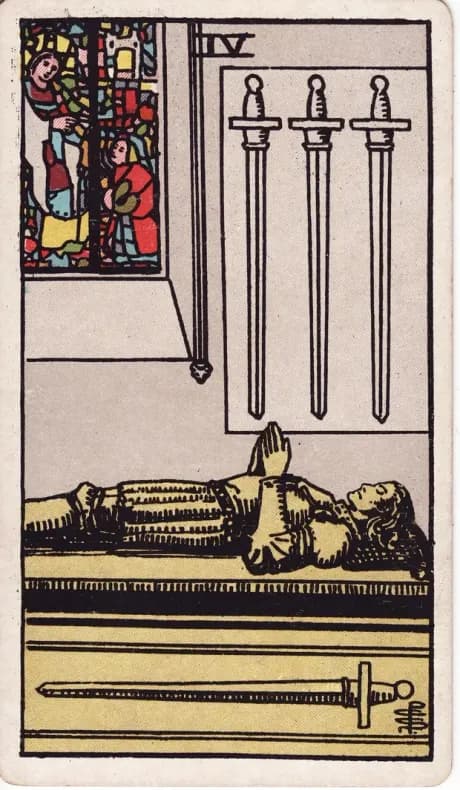
A carved knight lies full length on top of a stone tomb, hands together, three swords fixed to the wall above him and a fourth carved along the side of the stone. The scene is not a death. It is a recovery ward drawn in stone. The card's subject is the deliberate halt: convalescence, retreat, the decision to stop and let a system repair itself before it gets used again.
Upright it says stillness is the correct move rather than a failure of nerve. Nothing in the picture is broken and nothing needs solving today. The fourth sword stays within reach, which is the detail that separates this card from surrender — the tools are still there, they are simply not in anybody's hands. Reversed the halt goes wrong in one of two directions. Either it is refused, and exhaustion accumulates until something gives, or it has run its course and the figure gets up.
Fours in this deck all hold a position. The Four of Wands celebrates one, the Four of Pentacles grips one, the Four of Cups is bored inside one. This is the one where holding the position means doing nothing whatsoever, and it is the only card in the seventy-eight whose instruction is to stop.
At work it is sick leave, a sabbatical, or the far more common version nobody schedules: the week after a launch, when the sensible move is to ship nothing at all. In money questions it is the deliberate hold — the account left alone, the decision postponed until the person deciding has slept. In creative practice it is the fallow stretch between projects, which people who last treat as part of the work and beginners treat as evidence of failure.
The tell for this card is simple. If the question is whether you can push through, the answer it gives is that you probably can, and that the bill arrives later.
Four of Swords as a yes or no
As a yes or no, the Four of Swords upright is a no, and the honest translation of that no is not yet. Nothing here is being refused. The situation is on hold while somebody recovers, and an answer produced during the hold would describe the exhaustion rather than the question.
That distinction matters, because the two kinds of no behave nothing alike. A refusal is finished. A pause has a far side. If you ask whether they still want this and draw this card, it is not saying they do not want it. It is saying they are in no condition to answer, and neither are you if you have been losing sleep over it.
Reversed splits. Where the reversal means rest refused, it hardens into a straightforward no: pushing on a depleted system does not produce the result you asked about, it produces a worse version of the current state. Where the reversal means the rest is finished, it tips to yes, and it is one of the clearer signals in the deck for resumption — contact restored, movement returning after a stall.
This is one of the few cards that improves when you change the question. Whether has no good answer here. When does. So does what would have to recover first, and what would tell me the pause is working. Those the deck answers well, and they are the questions that actually decide the outcome, because a pause that is respected ends and a pause that is poked at does not.
Four of Swords as advice
As advice, the Four of Swords tells you to stop. Not stop forever and not stop caring — stop today, on purpose, with the intention of being usable again. The card is not describing a mood. It is prescribing a period of doing nothing, and it treats that period as work rather than as a gap between real work.
Concretely: sleep before you decide anything. Do not send the message tonight. Take the argument off the table for a named number of days, and tell the other person the number, because an unexplained withdrawal reads as punishment and a scheduled one does not. Cancel something. Put the phone in another room for the evening rather than face down in your hand, which is not the same thing and you know it is not.
If you are the one who has gone quiet, the advice is to be explicit about it. Say you need a week. Say when you will be back. The quiet costs almost nothing when it is announced and a great deal when it is left for somebody else to interpret.
If you are the one waiting, the advice is harder, because doing nothing while somebody else does nothing feels like losing ground. Use the time the way they are using it. Sleep, eat, see people who have no connection to this. You are not passing time until the verdict. You are recovering from the same stretch they are.
Reversed, the advice reverses: get up. If the rest has done its job and the stillness has hardened into a habit, the card stops recommending it. Recovery that has stopped producing improvement is not recovery any more, and the only way to learn which one you are in is to stand up and see what happens.
Four of Swords as an outcome
As an outcome, the Four of Swords is a situation that arrives at a full stop and stays intact. Nothing resolves, nothing collapses, and everybody involved is in better condition at the end than at the beginning. That is a genuine result even though it looks like the absence of one, and it is worth reading properly rather than treating it as the deck declining to answer.
In practice it looks like a stretch of quiet that everyone survives. The conflict does not get settled during it. The question you asked does not get decided during it. What happens instead is that the exhaustion driving the worst behaviour drains out of the situation, and whatever gets decided afterwards gets decided by people who have slept. Anyone who has watched a serious argument continue past two in the morning knows what that is worth.
The card also carries a warning about timing. If you are asking when, this is one of the slowest cards in the deck. It does not accelerate under pressure, and attempts to accelerate it reliably produce the reversed version.
Reversed as an outcome splits along the same line as everywhere else. In the better version the pause ends and activity resumes: contact returns, the frozen thing starts moving, the recovery worked. In the worse version the rest never happened at all, and the situation ends with somebody pushed past their limit — a collapse, an outburst, a resignation, a person who simply stops answering. That ending is not caused by the difficulty you asked about. It is caused by nobody stopping while stopping was still cheap.
What the Four of Swords card shows
The 1909 card shows the carved effigy of a knight lying full length on top of a stone tomb, inside what looks like a chapel. He is in armour, on his back, and his hands are pressed flat together on his chest in the posture of prayer. His eyes are closed. He is not dead in any sense the card is interested in. He is a monument, which is to say a picture of a person holding perfectly still.
Three swords hang on the wall above him, points down, parallel and evenly spaced. They are not in his hands and they are not threatening him. They are stored. A fourth sword is carved along the side of the tomb directly beneath him, running the length of his body. Three put away and one kept close: the card is precise about the fact that stopping is not the same as being disarmed.
Above and to the left is a stained glass window, the only colour in an otherwise grey scene. It shows a standing figure inclined toward a smaller kneeling one, the small figure reaching upward. It reads as a blessing being given, or a request being received. In some printings a single word meaning peace is worked into the stone of the tomb.
Almost everything in the composition is horizontal — the body, the slab, the fourth sword, the base of the window. This is the suit of upright blades, and this is the card where they all lie down or hang out of the way.
The setting matters as much as the figure. He is indoors, in a cold stone building, deliberately away from whatever was happening outside. Rest in this card is not comfort and it is not pleasant. It is a place chosen because nothing can reach you there.
Frequently asked
What does the Four of Swords mean in love?
+
A healing pause — rest and distance, not the death of feeling. The quiet is recovery in progress rather than a decision being made. It usually follows a stretch of strain that one of you could no longer sustain, and it ends when the strain has drained out, not when somebody is convinced to end it.
Should I reach out during the Four of Swords?
+
Wait. Contact lands better after the rest completes, and messages sent into this card come back flat because the person receiving them has nothing to answer with. One short, undemanding message that expects no reply is the ceiling. Guard your own recovery in the meantime — you are in the same period they are.
Is the Four of Swords a yes or a no?
+
Upright it is a no meaning not yet: the situation is on hold and no honest answer exists during the hold. Reversed it splits. If the rest is being refused it hardens to a no. If the rest is finished it becomes a yes, and one of the deck's clearer signs of contact resuming.
What should I do when I draw the Four of Swords?
+
Stop, on purpose, with an end date, and say the end date out loud. Do not decide anything tonight and do not send the message. If you are the one waiting rather than the one resting, use the same time the same way — sleep, eat, see people unconnected to this. Waiting is not a use of time.
Does the Four of Swords mean death?
+
No. The picture shows a stone effigy on a tomb, which is why the card alarms people, but the figure is a carving of stillness rather than an image of dying. Waite described it as repose, and the whole suit treats it as the recovery card. Nothing in the traditional meaning points at a literal ending.