What Four of Wands means in tarot — and in love
The Four of Wands is the milestone card: celebration, homecoming, a relationship reaching stable joyful ground — moving in, engagements, being… As feelings, the Four of Wands means they feel at home with you — settled, celebratory, proud to have you visible in their life.
Jump to FAQAt a glance
- Yes or no
- Yes — reversed flips it
- Element
- Fire
- Upright, in a line
- celebration, homecoming, a stable happy milestone
- Reversed, in a line
- shaky foundations under the party
Want a yes or no on your own situation rather than this card? Pull one card and get the verdict with the reason behind it.
Ask your own yes-or-no questionIn the Golden Dawn tradition this card rules 20–30° of Aries. A planet standing at that degree is read through it: Venus in Aries · Moon in Aries · Mars in Aries
Upright in love
The Four of Wands is the milestone card: celebration, homecoming, a relationship reaching stable joyful ground — moving in, engagements, being welcomed by their people. It's love with a foundation and banners on it. If you asked about where this leads: toward something worth celebrating. Stability here isn't boring; it's the party's venue.
What separates this from the rest of the deck's happy cards is that the joy is public. Something private has become visible: you are introduced, you are on the invitation, their mother knows your name. That visibility is the actual content of the card. A connection that exists only between two people is not this card, however good it feels.
In a new connection it marks the point where the thing stops being provisional. It is not necessarily fast or dramatic. Usually it is a small structural change — a drawer, a key, a weekend that includes their friends — after which both of you would have to actively undo something in order to go back. The card is about that change of state, not about the ceremony some readers attach to it.
In an established relationship it is the milestone itself: moving in, an engagement, a home made, an anniversary that means something. It can also mark a homecoming after a hard stretch, and that is the reading people forget. A period of strain ending in relief looks exactly like this card, and it deserves the same acknowledgement an engagement gets.
What the card asks is easy and frequently skipped: mark it. Say aloud that this is good, in front of other people, on a specific day. Milestones that go unmarked do not stop counting, but they stop being shared, and a foundation nobody names is one that both people quietly forget they are standing on.
Reversed in love
Reversed, the Four of Wands is festivity on a cracked floor: tension behind the celebration, family friction around the couple, or a home that doesn't quite feel like one yet. The bones are good; the foundation needs honest mortar. Fix the base before hanging more garlands.
Reversed does not usually cancel the celebration. It relocates it. The milestone is still real and something about the setting is wrong: the timing is early, the audience is hostile, the house is not yet a home, or the party is being held for other people's benefit and neither of you is enjoying it.
The most common version is family. Somebody's people are not on board, and the couple is absorbing that pressure without discussing it between themselves. The card reversed puts the fault line under the floor rather than inside the couple, and that distinction is worth hearing precisely, because two people in this position often start blaming each other for weather that is coming from outside the house.
The second version is the premature milestone. Moving in to fix something. Getting engaged because the alternative conversation is harder. The structure gets built to hold weight it was not designed for, and it holds for a while, which is what makes it dangerous rather than obvious.
The instruction is unromantic and specific: repair the base before adding to it. Have the conversation about the family. Name the step that got skipped. Delay the announcement by a season if a season is what it needs. Nothing about this card reversed says the thing is doomed. It says the celebrating is running ahead of the building, and that gap only closes in one direction.
Four of Wands As feelings
As feelings, the Four of Wands means they feel at home with you — settled, celebratory, proud to have you visible in their life. It's the feeling that introduces you at the party without being asked.
This is one of the warmest feelings cards in the deck, and it has a particular flavour: settled rather than dazzled.
If you are single and asking about someone new. They are already imagining you inside their ordinary life rather than on dates. You have been mentioned to people. There is a version of this in their head that involves your shoes by their door, and it does not feel risky to them, which is unusual this early and worth taking seriously.
If you are in a relationship. They feel safe and proud, in that order. You are not a source of anxiety for them, which after a certain age is close to the highest compliment on offer. If you have been reading their calm as indifference, this card argues the opposite: the calm is the feeling, not the absence of one.
If you are asking about an ex. They associate you with belonging, and that association is stronger than whatever ended it. That is genuinely warm, and it carries a warning. What they miss may be the home more than the person, and those two things are very easy to confuse from a distance.
If you are asking about someone long-term. Contentment with roots. They are not evaluating the relationship, because it stopped being a question for them and became the ground they stand on. The risk in this feeling is not coldness. It is being taken for granted by somebody who would be genuinely shocked to hear it.
In all four the feeling is stable and outward-facing. The Four of Wands is not a secret. If somebody feels this way about you, other people already know.
Four of Wands For your ex
For an ex, the Four of Wands recalls the home you two built or almost built — they associate you with belonging. Reunions here aim at stability, not flings. Verify the cracks that ended it got actually repaired.
The pull here is toward what was built, and that is a specific kind of missing. It is not desire and it is not quite regret. It is the memory of a life that worked — a routine, a kitchen, a particular set of Sundays — and it can be far stronger than the memory of the person, which is the trap sitting inside this card.
Reunions under the Four of Wands aim at permanence rather than at a night. If this comes back, it comes back asking for the whole structure again. That is flattering, and it is a heavier request than it sounds, because rebuilding a house is not the same activity as remembering one.
So the useful question is structural rather than emotional. What actually broke it? Has that specific thing changed, in a way you could point at and describe? A shared history of comfort is a real asset and it is not a repair. Plenty of couples reunite on the strength of how good the home felt and find the crack in the floor exactly where they left it.
If you want a test, talk about the future rather than the past. Nostalgia is easy for both of you and proves nothing at all. A concrete conversation about how the old problem would be handled differently is uncomfortable, and it is the only part of this that tells you anything.
What Four of Wands means in general
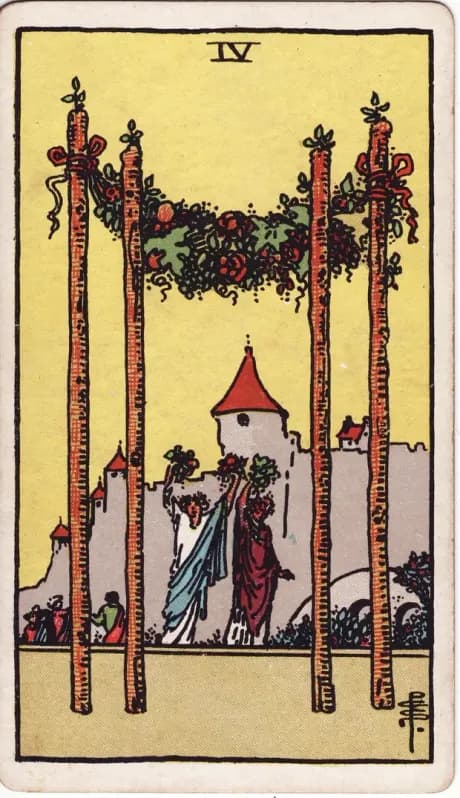
Four staves stand in the foreground with a garland strung between them, and a small crowd celebrates behind. The card's subject is the threshold — a completion solid enough to be marked in public, and the brief, legitimate pause between finishing one structure and starting the next.
Upright it says the work holds. Whatever was being assembled has reached a state where it can bear weight and be shown to other people, and the moment deserves acknowledgement rather than an immediate move to the next task. This is the deck's most dependable card for ceremonies, formal beginnings and arrangements that stop being temporary: a contract signed, a probation ended, a team made official, a harvest brought in.
Reversed, the marking goes wrong rather than the structure. The event is early, the audience is unwilling, or the achievement is real and nobody involved feels able to enjoy it. Occasionally it points at a transition that never got a closing ceremony at all, which sounds sentimental and is not: workplaces and households both misbehave for years over endings nobody was permitted to name.
At work it is the launch, the opening night, the day a pilot becomes permanent. In money it is the completed purchase, the closing rather than the offer. In creative life it is the finished piece leaving the studio and being seen by strangers.
Note what is actually drawn: a canopy, not a house. Open on every side, temporary by design, put up for an occasion and taken down afterwards. Whatever this card marks is a station rather than a destination.
Every Four in the deck describes a settled state, and three of them are ambivalent about it. The Four of Pentacles grips. The Four of Swords rests because it must. The Four of Cups has stopped noticing what it holds. This is the only one that enjoys the arrangement, and the only one that invites other people in to look.
Four of Wands as a yes or no
As a yes or no, the Four of Wands upright is one of the strongest yeses in the deck. It does not answer conditionally and it does not wait on anybody finding courage. The structure is up, the thing works, and the card's whole content is public confirmation. If the question was about stability, commitment, a home, an official step or a celebration, take the yes at face value.
The one caution is scope. The card says yes to the milestone you asked about, not to everything that follows it. A canopy is not a roof. It confirms that the current arrangement is solid enough to stand on and to show people, which is genuinely a great deal, and it makes no claims about the decade.
Reversed it becomes a qualified yes rather than a no, which is unusual. The thing is still happening. The timing is off, or the setting is wrong, or somebody's family is going to be difficult about it. Read reversed as yes with friction, and expect the friction around the announcement rather than around the substance.
The only situation where this card is a real no is when the question was about escape: will this end, will I get out, is this finally over. The Four of Wands answers those the other way, because it describes something settling into place rather than coming apart. If that was the question you were holding, the answer you just got is worth sitting with before you ask again.
Four of Wands as advice
As advice, the Four of Wands says: mark it, and invite people. That is not decoration. Acknowledging a milestone in front of other people converts it from something two of you believe into something with witnesses, and things with witnesses are much harder to quietly abandon.
Concretely: name what has been achieved, pick a date, and tell somebody outside the situation. Have the dinner. Make the introduction you have been putting off. Sign the thing rather than agreeing to it verbally for another six months. If a small structural step has been available for a while — the key, the lease, the shared calendar — this card is telling you to take it, and telling you it will hold.
There is a second instruction, quieter and easier to skip: rest here for a moment. The card is a pause by design. People who cannot stop building tend to walk straight past the only stable ground in the sequence and start digging again, then wonder why nothing ever feels like arriving.
Reversed, the advice inverts. Do not add anything yet. Look at the base, find the part everybody is being polite about, and deal with it before the next commitment. That usually means one specific conversation, often with a relative or about one, and almost always one that both of you have been managing around rather than having. Fix the floor. The garlands can wait a season.
Four of Wands as an outcome
As an outcome, the Four of Wands is arrival at solid ground. Whatever you asked about settles into a defined, public, workable shape — an agreement made formal, a home established, a period of instability ending in something that has a name. It is one of the few outcome cards where the result is both good and unambiguous.
In a question about two people it usually means the situation stops being private and provisional. Living together, meeting the families, an engagement, a shared address, a reunion that lasts. What it does not promise is drama or transformation. The outcome is stability, and stability announces itself quietly even when there is a party involved.
There is a smaller version that turns up just as often and gets overlooked. Sometimes this card is simply a good weekend: a homecoming, a celebration, a stretch of genuine ease after a hard run. Not every arrival is a permanent one, and the card is content either way.
Reversed as an outcome, the arrival happens and the landing is awkward. The milestone is reached without the relief that should accompany it, or it is reached in the wrong order, or the people around it make it hard work. Occasionally it means the celebration is postponed rather than cancelled: the same result, later, with the difficulty dealt with first. What it rarely means is collapse. Reversed, this card usually describes a good thing arriving in bad conditions.
What the Four of Wands card shows
The 1909 card puts four staves upright in the immediate foreground, tall and evenly spaced, with a heavy garland of flowers, leaves and fruit slung between their tops. You are looking through them at the scene beyond, which quietly makes the viewer somebody approaching rather than somebody already inside.
Under and past the garland, two figures raise bouquets above their heads. They are dressed brightly and their arms are up in an unmistakable gesture of welcome. Behind them a small crowd has gathered, and beyond that a bridge crosses a moat toward an old manor house with towers. The whole background is a place that already exists: built, inhabited, not under construction.
The sky is flat yellow, the simplest and strongest colour statement in the suit. There is no cloud and no shadow anywhere in the frame. Whatever this card is about, the picture makes no attempt at ambiguity.
The four staves are the detail worth dwelling on. They are planted in open ground and they support only a garland. This is a canopy, not a building — four uprights and a decorated span, of the kind put up for one specific day and taken down again. It is deliberately temporary and deliberately open on all sides. Anyone can walk in, and anyone can walk out.
Notice too what the staves are not doing. In the Five of Wands they are being swung. In the Seven they are being fended off. In the Nine they are a fence. Here they are structural and at rest, holding up something purely ornamental, and this is the only card in the suit where the wands are doing a job nobody has to defend.
Frequently asked
Does the Four of Wands mean marriage?
+
It is a milestone and celebration card — engagements, moving in, family welcomes and formal commitments all live here. It does not name the specific ceremony. What it reliably marks is the moment a private arrangement becomes a public one, whatever form that takes for the two people involved.
What does the Four of Wands mean as feelings?
+
You feel like home to them: safety plus joy, which is the combination people build lives on. It is settled rather than dazzled, and outward-facing — somebody feeling this way has already told other people about you, or is looking for the chance to.
Is the Four of Wands a yes or no?
+
One of the clearest yeses in the deck, and it does not depend on anybody being brave. Reversed it stays a yes with friction around it — bad timing, an unwilling audience, a difficult family — rather than turning into a no.
What should I do when I draw the Four of Wands?
+
Mark the milestone, publicly and on a specific date, and take the small structural step you have been putting off. Then stop building for a moment. This card is the pause in the sequence, and walking through it without noticing is the common mistake.
What does the Four of Wands reversed say about family?
+
It is the most frequent reading of the reversal: the couple is sound and the people around them are not on board. The important part is where it locates the problem — outside the two of you. Couples in this position often start blaming each other for pressure arriving from somewhere else entirely.