What Five of Wands means in tarot — and in love
The Five of Wands is friction in the flame: bickering, rivalry, passion expressed through sparring. As feelings, the Five of Wands means agitation — you stir them up, and it comes out as teasing, testing, or friction.
Jump to FAQAt a glance
- Yes or no
- No — reversed flips it
- Element
- Fire
- Upright, in a line
- friction, rivalry, passionate sparring
- Reversed, in a line
- tension released, conflict avoided
Want a yes or no on your own situation rather than this card? Pull one card and get the verdict with the reason behind it.
Ask your own yes-or-no questionIn the Golden Dawn tradition this card rules 0–10° of Leo. A planet standing at that degree is read through it: Venus in Leo · Moon in Leo · Mars in Leo
Upright in love
The Five of Wands is friction in the flame: bickering, rivalry, passion expressed through sparring. It can mean competing for someone's attention — literal rivals — or a couple whose fire keeps finding fights. The energy isn't hate; it's heat without coordination. If you asked why it's turbulent: everyone's swinging, no one's listening. Drop the sticks, keep the fire.
The distinguishing feature of this card is that nobody is being hurt. Five people are swinging sticks and not one of them has landed a blow. Read that literally: the conflict here is loud, exhausting and largely without damage. That is not a reason to dismiss it. Noise without injury still burns an enormous amount of energy, and people leave situations because they are tired far more often than because they are wounded.
In a new connection it often looks like competition. Real rivals sometimes — other people around the same person, an unclear field, nobody having declared anything. It can also be the friction of two people who are attracted and defending themselves at the same time, which comes out as teasing, contradiction and arguments about nothing in particular. Both versions are the same problem: energy with no agreed direction.
In an established relationship it is the season of small fights. Not one issue but a scattering of them, each too minor to solve, arriving daily. Couples in this state usually believe they are fighting about the specific things. They are almost never fighting about the specific things. The pattern is what to look at, and the pattern is that neither person is currently getting heard.
What the card asks for is coordination, not peace. Do not aim for a household where nobody argues; that is a different card, and often a worse one. Aim for one conversation at a time, in order, where one person speaks and the other repeats back what they heard before answering. The fire is not the problem. Five people swinging at once is the problem.
Reversed in love
Reversed, the Five of Wands is the ceasefire: conflict resolving or being dodged entirely — tension swallowed to keep fake peace. Released friction heals; buried friction composts into resentment. Have the one honest fight instead of seventeen decorative ones.
The reversal splits sharply into two states that look nothing alike and get read the same way. In the first, the fight ends properly. The argument gets had, somebody concedes, the tension leaves the room. That is a genuine resolution, and the card is straightforwardly good news.
In the second, the fight goes underground. Nobody raises anything, both people are polite, and the house is quiet. This reads as improvement for a few weeks and is worse than the upright card, because upright conflict is at least visible and therefore available to be solved. Swallowed friction does not disappear. It converts, slowly, into contempt, and contempt is far harder to reverse than an argument.
The tell between them is simple. After a real resolution you feel lighter, and you can remember what was decided. After avoidance you feel careful. If you are choosing your sentences inside your own home, the peace is not real.
What to do depends on which one you are in. If the conflict genuinely resolved, let it stay resolved and resist relitigating it a week later. If it was avoided, pick the single most important thing and raise it once, plainly, without the other four attached to it. One honest disagreement is cheaper than a year of decorative harmony, and it is the only thing this card reversed responds to.
Five of Wands As feelings
As feelings, the Five of Wands means agitation — you stir them up, and it comes out as teasing, testing, or friction. Attraction is often hiding inside the sparring. Annoyance this energetic is rarely indifference.
This is one of the harder cards to read as feelings, because the emotion is genuinely mixed and the card refuses to separate the strands for you.
If you are single and asking about someone new. They are provoked by you. Attention is high and composure is low, which comes out as banter, contradiction and a slight need to win. Attraction hides in that pattern regularly, and so does plain competitiveness. The way to tell is what happens when you stop playing: real interest softens, and pure rivalry escalates.
If you are in a relationship. They are frustrated and still engaged, which is an important combination. Frustration takes effort. This is not withdrawal; it is friction from somebody who is very much still in the room and not managing to say the actual thing. Ask what they wish they had said this week, and be quiet while they answer.
If you are asking about an ex. Unfinished business, felt as irritation. You occupy a place in their head that is charged rather than warm, and they may be quietly keeping score. It is one of the least peaceful ways to be remembered and it is a long way from indifference.
If you are asking about someone long-term. Competing pressures rather than competing feelings. They feel pulled at from several directions at once — work, family, obligations — and you are receiving the overflow. The frustration is frequently not about you at all, which is easy to say and very hard to believe while it is being aimed in your direction.
In every version there is heat and no aim. The Five of Wands never says somebody feels nothing about you. It says the feeling is coming out sideways.
Five of Wands For your ex
For an ex, the Five of Wands means unresolved combat: the same argument in reruns, or competition over who's winning the breakup. Contact stays charged. Peace requires someone to disarm first — voluntarily.
The thing to notice is that both people are still participating. A fight requires two, reruns require two, and a great deal of what feels like being pursued by an ex is a game neither side has agreed to stop playing. That is not a moral point, it is a practical one: it means you are holding half the controls.
Competition over the breakup is common with this card and it takes recognisable forms. Who moved on faster. Who is doing better. Who was more hurt, reported to mutual friends. Every one of those requires an audience, and every one of them keeps the relationship alive in the only form it has left.
There is a warmer reading available. Sometimes this heat is unfinished attraction, badly disguised. People who are genuinely done tend to be boring about each other. If contact stays charged for months, something is still connected, and that something is not necessarily hostility.
Either way, the move is the same and it is unilateral. Disarm first, deliberately, without announcing that you are doing it. Stop responding to provocations, stop supplying material, stop keeping the score. If a real conversation remains underneath, you will find out quickly. If nothing remains, you will find that out just as quickly, and either answer beats another season of the same argument.
What Five of Wands means in general
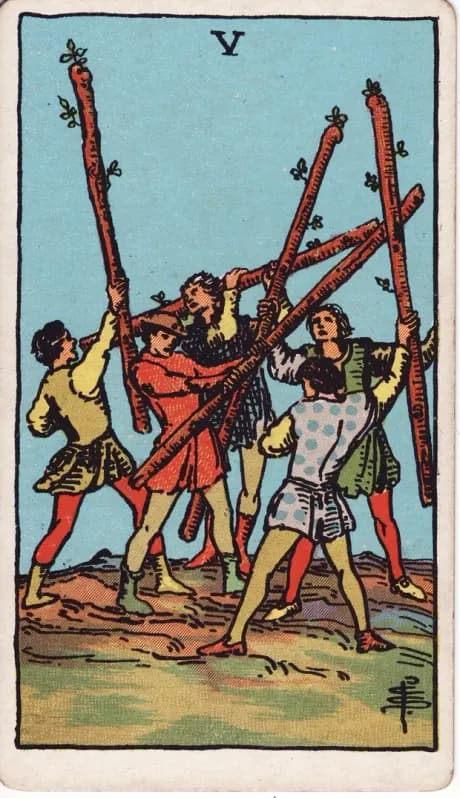
Five figures brandish staves in what is clearly not a battle. Nobody is wounded, nobody is winning, and the staves cross without connecting. The card's subject is friction without resolution: competition, crossed purposes, and the particular exhaustion of a room where everyone is talking and nothing is being decided.
Upright it says the conflict is real, low in stakes, and often productive. This is how the strongest version of an idea gets found, provided somebody eventually calls order. Left alone it does not resolve, because none of the five participants has any reason to be the one who stops.
Reversed the struggle ends or goes underground. That covers a genuine resolution, a harmony imposed too early, and the tired aftermath of a fight that consumed more than it was ever going to return. Avoidance is the version to watch, because a suppressed disagreement keeps costing energy without producing anything at all.
At work it is the brainstorm, the pitch process, the crowded market, the meeting with five agendas and no chair. In money it is competing claims on the same limited pot. In creative life it is the stage where a project has too many possible directions and each one has a champion. In sport and training the card is entirely positive: it is what practice looks like, and the whole point of a scrimmage is that the blows are not real.
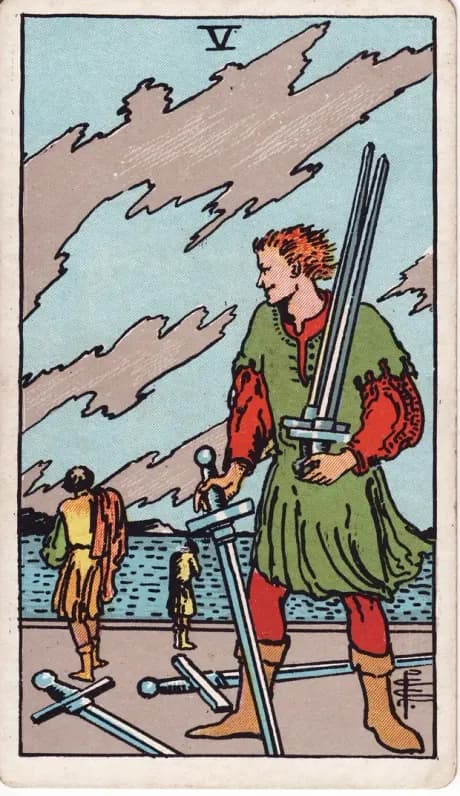
The other Fives in the deck all describe a loss. The Five of Cups is grief, the Five of Pentacles is exclusion, the Five of Swords is a victory not worth having. This is the only one where nothing has been taken from anybody yet. Its disruption is a surplus of energy rather than a shortage of something, which is why it is the most fixable of the four.
Five of Wands as a yes or no
As a yes or no, the Five of Wands upright is a qualified no — not a refusal, a not yet. Nothing here is settled enough to answer, because the situation is still being contested. Something can absolutely go your way from this position, and it will require competing for it, and the card is honest that the competing has not finished.
Read it as a firm no if the question assumed a clear field. Will this be easy, is this uncontested, am I the only one, is this settled. All of those get a plain no. Read it as a possible yes if the question was about whether the thing is worth engaging with, because the card says the contest is genuine and winnable, which is more encouragement than it first appears to be.
Reversed is more ambiguous than upright, which is unusual. If the conflict genuinely resolved, it is a yes and the obstacle has cleared. If the conflict was avoided rather than resolved, it is a no wearing a yes, and the thing you asked about will resurface, because nothing was actually settled.
This is one of the cards where the format does you a disservice. A yes or no question assumes a fixed situation, and this card describes a moving one. A better question is what is being contested here, and by whom. That version has an answer, and knowing it changes what happens next, which is more than any verdict would have done.
Five of Wands as advice
As advice, the Five of Wands says: engage, but bring order to it. The card is not telling you to avoid the conflict. It is telling you that the conflict as currently conducted is producing nothing, and that the missing ingredient is structure rather than restraint.
Concretely: take one issue at a time and finish it before starting the next. Say what you actually want instead of arguing the surrounding details. Let one person talk without interruption for a full minute, which is much longer than it sounds and is where most household arguments would have ended. If there are literal competitors, stop competing on their terms — the person who stays calm in a scrum is usually the one still standing when it breaks up.
There is a second reading of this advice that applies when the friction is external. Sometimes the card is telling you to compete, properly and without apology. Put your name in. Ask for the thing. The five figures are not enemies, they are participants, and standing at the edge of the field to avoid the mess is not the neutral choice it feels like.
Reversed, the advice reverses with it. If you have been avoiding, raise the thing once and plainly. If you have been fighting on every front, choose one and drop four. Either way the instruction underneath is identical: reduce the number of simultaneous arguments to exactly one, and let that one reach an end.
Five of Wands as an outcome
As an outcome, the Five of Wands is an unresolved contest. The situation stays competitive, energetic and undecided through the timeframe you asked about. Nothing collapses and nothing is settled. If you were hoping for a clean result, this card says the field is still crowded when the question closes.
In a question about two people it usually means continued friction rather than a break. The arguments carry on, the attraction carries on, and neither of them wins. That sounds discouraging and is not automatically bad news — two people in this state are still thoroughly occupied with each other, which is more than several better-looking outcome cards can claim.
The card also frequently indicates that other people are still involved by the time this concludes. Rivals, families, former partners, friends with opinions. Whatever this is, it does not happen in private.
Reversed as an outcome, the fighting stops, and which way to read that depends entirely on the surrounding cards. Alongside resolution cards — the Two of Cups, the Six of Wands, Temperance — it is a genuine ceasefire and the difficulty is over. Alongside cold or withdrawn cards — the Four of Cups, the Eight of Cups, the Ten of Swords — it is the quiet that arrives after somebody gave up. Both look like peace from outside, and only one of them is.
What the Five of Wands card shows
The 1909 card shows five young men in an open field, each holding a long staff, in the middle of what looks like a fight and is not one. Their staves cross overhead at odd angles. Not a single one is connecting with a person, and nobody on the card is hurt, defending, or even looking particularly angry.
Their clothing carries the meaning. Every figure wears a different colour and a different pattern — green, red, yellow, blue, striped hose, a spotted tunic. Pamela Colman Smith drew very few crowd scenes with this much variation in them. These are not a faction. They are five separate people who arrived with five separate agendas and are now standing in the same small patch of ground.
Their positions are uncoordinated. One stands with his back to us at the left, one is turned away entirely, one raises his staff while looking somewhere else. There is no formation, no leader and no line. If you cover the staves, the picture reads as a group of people gesturing past each other, which is close to what the card means.
The ground is bare pale earth and the sky behind is a plain washed grey-blue. There is no landmark, no building and no boundary anywhere in the frame. Nothing indicates what they are fighting over or where the edges of the contest are, and that absence is doing real work: the picture shows a struggle with no visible prize.
Compare the Five of Swords, where a winner walks off with the weapons and two figures leave defeated. Here there is no winner and no exit. Everybody is still in it, and the staves are still up.
Frequently asked
Does the Five of Wands mean fighting in a relationship?
+
Yes — friction and competition, usually passion poorly channelled rather than an absence of feeling. The detail that matters is that nobody on the card is hurt. This is noise rather than damage, and the fix is coordination rather than silence.
Does the Five of Wands mean I have rivals?
+
It can — competing interests around the same person, often with nothing declared by anyone. It just as often means competing pressures rather than competing people. Either way, compete by being unbothered: chaos loses to calm, and the calm figure is the one still standing when the scrum breaks up.
Is the Five of Wands a yes or no?
+
Upright it is a not yet — the situation is still contested, so nothing is settled enough to answer. Reversed it depends on how the conflict ended: a genuine resolution is a yes, an avoided argument is a no in disguise that will come back.
What should I do when I draw the Five of Wands?
+
Reduce the number of arguments running at once to exactly one, and finish that one. Say what you actually want instead of debating the details around it. If the competition is external, enter it properly rather than standing at the edge hoping to avoid the mess.
Is the Five of Wands a bad card?
+
It is the least damaging of the Fives. The other three describe loss — grief, exclusion, a victory not worth having — and this one describes too much energy with nowhere agreed to send it. Nothing has been taken from anybody yet, which makes it tiring rather than serious, and the most fixable of the four.