What Two of Cups means in tarot — and in love
The Two of Cups is mutuality made visible: attraction flowing both ways, a bond where what you give comes back in kind. As feelings, the Two of Cups means reciprocity — they feel the connection the way you do, drawn toward a real 'us.' Mutual recognition: two people…
Jump to FAQAt a glance
- Yes or no
- Yes — reversed flips it
- Element
- Water
- Upright, in a line
- mutual attraction, a true partnership forming
- Reversed, in a line
- imbalance, a bond losing its reciprocity
Want a yes or no on your own situation rather than this card? Pull one card and get the verdict with the reason behind it.
Ask your own yes-or-no questionIn the Golden Dawn tradition this card rules 0–10° of Cancer. A planet standing at that degree is read through it: Venus in Cancer · Moon in Cancer · Mars in Cancer
Upright in love
The Two of Cups is mutuality made visible: attraction flowing both ways, a bond where what you give comes back in kind. It's the deck's partnership card — first kisses that feel like agreements, connections with natural balance. If you asked 'do they feel it too?' — this card's answer is yes, it's mutual. Meet them at the middle of the bridge.
The word doing the work here is equal. Two people, two cups, the same size, held at the same height. Nobody is being rescued and nobody is being managed. That sounds ordinary until you count how much of what gets called connection is actually one person carrying and one person receiving, and how rarely both cups are full at the same time.
In a new connection it is the clearest confirmation the deck offers. What you are feeling is being felt back, at roughly the same strength, at roughly the same time. That symmetry is rarer than the number of times people hope for it, which is why the card lands so hard when it turns up. It does not promise the thing will last. It confirms that what you thought was one-sided is not.
In an established relationship the Two of Cups is usually a repair or a renewal rather than a beginning. It marks the moment two people turn back toward each other after a stretch of running in parallel — a real conversation, an apology accepted, the return of the small exchanges a long bond actually runs on. It can also mark a formal step: an agreement, a promise, a decision made together instead of announced.
What the card asks is that you show up to the exchange rather than wait to be met. Both figures are holding their cup out. Neither is waiting to see the other's first. Mutuality cannot be detected from a safe distance. It only becomes visible once both people have already risked something small. Go first, in a small way, and see what comes back.
Reversed in love
Reversed, the Two of Cups is the bridge tilting: imbalance, miscommunication, one person carrying the 'us.' Small cracks — scores kept, affection rationed — widen if unspoken. The bond isn't doomed; it's lopsided. Rebalance honestly or watch the cups drain unevenly.
The reversal keeps the bond and removes the symmetry. That is a precise and useful thing to know, because the two problems have different solutions. A broken bond needs deciding about. A lopsided one needs correcting, and correcting stays possible right up until the person carrying it gets tired.
It shows up as effort that has quietly become one-sided: who initiates, who apologises first, who rearranges their week. It shows up as a mismatch in what each of them thinks is happening, where one is building something and the other is enjoying something. And it shows up as scorekeeping, which is what an imbalance turns into once it has been ignored long enough to harden into a grievance.
There is a version that is nobody's fault. Two people can be genuinely matched and out of phase — one available, one consumed by something else, temporarily. The card reversed does not distinguish between unwillingness and unavailability. The reader usually can, and the distinction matters more than anything else here, because one of them ends when circumstances change and the other does not.
The correction is not a grand conversation. It is a specific and slightly awkward sentence: here is what I have been doing, here is what I have not been getting, is this what you want as well. Imbalance survives almost everything except being named out loud by the person carrying it. If it gets named and nothing changes, the card has already answered the question you were going to ask next.
Two of Cups As feelings
As feelings, the Two of Cups means reciprocity — they feel the connection the way you do, drawn toward a real 'us.' Mutual recognition: two people quietly deciding the other one matters.
This is the answer most readers are hoping for when they ask a feelings question, so it is worth being exact about what it claims in each situation and what it does not.
If you are single and asking about someone new. They feel it too, at close to the same strength, and they are aware of it. This card does not describe a hidden or unconscious feeling. Both people know. What it does not say is who moves first, and a surprising number of well-matched pairs stall exactly here, each waiting for a confirmation the other has already given.
If you are in a relationship. They feel it as a shared thing rather than as a preference. You are not something they enjoy; you are somebody they are with. This card often turns up when one person has been privately worried about where they stand, and the answer is that the other one considers the question closed.
If you are asking about an ex. The bond registered on both sides and it still does. That is genuinely what the card says, and it is not the same as wanting to return. Mutual feeling and mutual willingness are different things, and the Two of Cups only reports the first. What it does establish is that you were not imagining it, which is often the real question underneath.
If you are asking about someone long-term. They still choose it. After enough years a feeling stops being an event and becomes a position, and this card describes the position: two people who would pick each other again, without needing the intensity that made the decision the first time.
Across all four the card says one thing in different registers. Whatever is happening, it is not one-sided.
Two of Cups For your ex
For an ex, the Two of Cups says the bond itself was real and its echo persists on both sides. Reconciliation under this card tends to be mutual and tender — if both show up to the bridge, not just one.
That last condition is the whole card. The Two of Cups cannot be performed by one person. Everything it describes — the exchange, the balance, the meeting in the middle — needs two people moving at once, and a version where you do all of the approaching is not this card at all. That version is the reversal.
What it does confirm is the thing most readers want confirmed. It was mutual. You did not overestimate it, invent it, or feel it alone. For a lot of people that is the actual question sitting underneath the reunion question, and this card answers it cleanly and in your favour.
Whether anything reopens depends on material the card does not contain: whether the reason it ended has been dealt with, whether both lives still have room, whether either of them will say so first. The Two of Cups describes a bond, not a plan. Bonds can persist for years without producing a single decision.
If contact resumes under this card, expect it to be gentle and genuinely warm on both sides. The risk here is not coldness. It is a long, mutual, comfortable exchange that never converts into anything, because both people are happy standing at the middle of the bridge and neither one wants to cross it.
What Two of Cups means in general
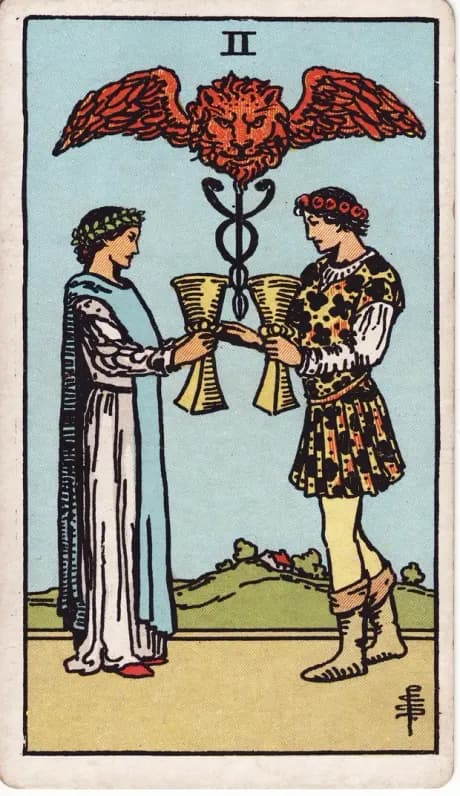
The Two of Cups is the suit's card of exchange. Two figures stand facing each other, each holding a cup, and between them rises the caduceus of Hermes. Nothing is being poured from one vessel into the other. Both are held level, and both are full.
Its subject is reciprocity between equals: an alliance, a truce, a mutual recognition, an agreement that leaves both sides better off than the negotiation found them. It appears for business as readily as for private life, and its condition never changes — two parties, each giving, each receiving, neither depleted by the arrangement.
Upright it says the exchange is genuine and worth formalising. Whatever has been running informally between two people has enough substance to be made explicit. Reversed the balance has broken: one side carrying the effort, a rupture between people who were well matched, or an arrangement that looks two-way and is being sustained by a single person's work.
In working life it is the co-founder, the collaboration where the skills complement rather than duplicate, the contract negotiated by two people who both intend to honour it. In money it is a fair deal — not a bargain, a fair one, which is a different and rarer thing. In creative work it is collaboration in the strict sense: two people producing something neither would have produced alone, which is the only real test of whether a pairing is a pairing.
Twos across the deck are about pairs and the tension inside them. The Two of Swords cannot choose. The Two of Wands looks outward from a position already won. The Two of Pentacles keeps two demands in the air. The Two of Cups is the one where the second thing is another human being, and the tension resolves into agreement.
Two of Cups as a yes or no
As a yes or no, the Two of Cups upright is a yes, and one of the least ambiguous in the deck. The card describes something that is already mutual. If you asked whether the feeling goes both ways, whether there is something real between two people, whether an agreement will hold, the answer is yes.
It is worth naming what kind of yes it is. This card does not promise an outcome, a timeline or a future. It confirms a present condition: right now, both sides are in it. Cards like the World and the Ten of Cups answer questions about how something ends. This one answers whether it is real, which is usually the question people are actually asking and rarely the one they type.
Reversed it is a no, and a conditional no rather than a final one. What is missing is symmetry, not feeling. If the question was whether this works as it stands, the answer is no as it stands. If the question was whether anything is there at all, the reversed card still says yes — badly balanced, but there.
Where it resists the format is on questions that need a decision from somebody. Mutual feeling and mutual action are different, and this card only guarantees the first. If what you meant was whether they will do something about it, ask that instead and read what comes with it.
Two of Cups as advice
As advice, the Two of Cups says go first, in a small way, and then watch what comes back. Not a declaration. One clear, slightly exposed move — the message that says what you actually mean, the invitation with a date in it, the apology without the clause that shifts half of it back onto them.
The card is specific about size. Both figures are holding a cup, not emptying one. You are not being told to give everything and hope. You are being told to put something real on the table, of a size you can afford to lose, and see whether it gets matched. Mutuality can only be tested by somebody taking a small risk first, and this card says be that person once.
Its second instruction is to make the informal explicit. If something has been running for months on assumption, name it. Ask what this is. Say what you want it to be. The Two of Cups is the card of agreements, and an agreement that has never been spoken aloud is not an agreement. It is two private hopes running in parallel.
Its third instruction is about accounting and it is uncomfortable. Look at the last month honestly. Who initiated, who adjusted, who apologised. If the answer is you, every time, the advice is not to try harder. It is to stop compensating and let the actual shape of the thing become visible, which it will do inside about two weeks.
Two of Cups as an outcome
As an outcome, the Two of Cups is a bond that forms and holds. The situation ends with two people in agreement — an understanding reached, a connection made explicit, an arrangement both sides actually consented to rather than drifted into. Of the outcome cards this is one of the warmest and one of the most stable, because what it describes is not a peak but a balance.
It usually means the thing you asked about becomes mutual and stays that way. Not dramatic, not a resolution with a scene attached. Two people arrive at the same understanding of what is happening between them, which is a quieter result than it sounds and a much rarer one.
The card is often literal about the form this takes. Agreements, meetings, reconciliations, a decision made together. If your question involved another person at all, expect the outcome to include an actual exchange between you rather than a change that simply happens to you.
Reversed as an outcome, the situation ends lopsided. Something real exists and it does not settle into balance — one person more invested at the end than at the beginning, an agreement only one side is honouring, a reconciliation that repairs the contact without repairing the terms. This is not a catastrophic result and it is a stubborn one. Imbalance is stable in its own way, and left alone it tends to last far longer than the person carrying it expects.
What the Two of Cups card shows
The 1909 card shows a young man and a young woman standing face to face on level ground, each holding a cup, in the act of pledging one another. The cups are the same size and are held at the same height. Neither is pouring. Nothing has been transferred yet.
Both wear wreaths. Hers is a wreath of green leaves, his a wreath of red flowers, and the pairing is deliberate: victory and desire, two different reasons for standing there. He wears a patterned tunic, steps slightly toward her, and reaches his free hand toward her cup. She holds her ground. The approach is his; the granting is hers.
Above and between them rises the caduceus of Hermes — a rod with two serpents twined around it in opposite directions, meeting at the top. It is the emblem of trade, messages and negotiated agreement rather than of medicine, and its presence turns the scene from an embrace into a contract. Two serpents, mirrored, is the same idea as the two cups.
Above the caduceus is the head of a lion, red and winged, facing forward. It is the least explained element on the card. It is usually taken as passion given a higher form, or as the heat that makes a union more than an arrangement.
In the middle distance behind them stands a small house on a green hill, with trees. It is the only thing in the picture that suggests a future, and Smith drew it deliberately far off and small.
The ground beneath the two of them is flat and shared. There is no obstacle between them, no water, no gate and no third party. Whatever happens next is entirely up to the two people standing there.
Frequently asked
Is the Two of Cups a yes in love?
+
One of the clearest yeses in the deck. It means mutual attraction and genuine two-way investment: the feeling flows in both directions and both people are aware of it. What it does not promise is a timeline or an outcome. It confirms that something real exists right now, which is usually the question underneath the question.
Does the Two of Cups mean soulmates?
+
It means a genuinely reciprocal bond, which is the foundation the soulmate stories are built on. The card itself makes no claim about destiny or past lives. It claims balance: two cups the same size, held at the same height, neither person carrying the other. Names are optional. The balance is not.
Is the reversed Two of Cups a no?
+
A conditional no. What has broken is the symmetry, not the bond, so the card still says something real is there — it is just being sustained by one person. If you asked whether this works as it stands, the answer is no as it stands. If you asked whether anything is there at all, the answer is still yes.
What should I do when I draw the Two of Cups?
+
Go first with something small and exposed, then watch what comes back. Send the message that says what you actually mean, or make the invitation with a date in it. Then make the informal explicit: if something has been running on assumption for months, ask what it is. Unspoken agreements are two private hopes, not one agreement.
What is the difference between the Two of Cups and the Lovers?
+
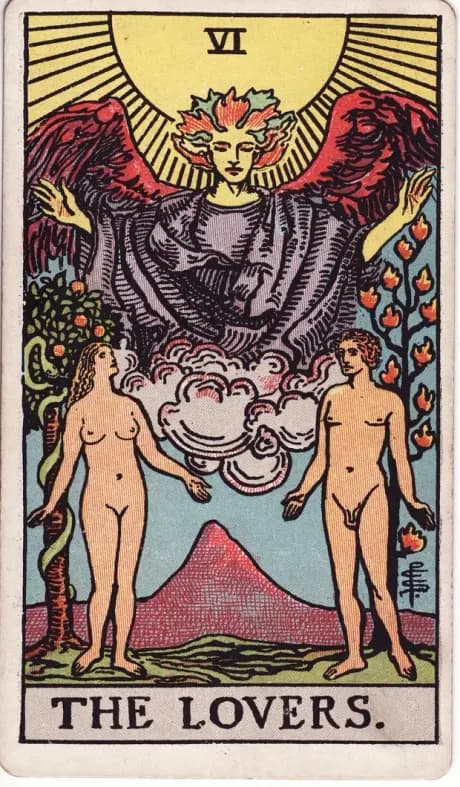
The Two of Cups is about exchange between two people who are already matched — a pledge, a bond, a fair trade. The Lovers is about choice, and usually a choice with a cost: which path, which person, which set of values. One confirms that a connection is mutual. The other says a decision is being asked of you.