What Two of Wands means in tarot — and in love
The Two of Wands is love at the map table: planning a future together, weighing a bold move — the trip, the relocation, the next level. As feelings, the Two of Wands means they picture a future with you in it — actively imagining next steps, weighing what committing would take.
Jump to FAQAt a glance
- Yes or no
- Yes — reversed flips it
- Element
- Fire
- Upright, in a line
- planning a future together, choosing boldly
- Reversed, in a line
- fear of leaving the comfort zone
Want a yes or no on your own situation rather than this card? Pull one card and get the verdict with the reason behind it.
Ask your own yes-or-no questionIn the Golden Dawn tradition this card rules 0–10° of Aries. A planet standing at that degree is read through it: Venus in Aries · Moon in Aries · Mars in Aries
Upright in love
The Two of Wands is love at the map table: planning a future together, weighing a bold move — the trip, the relocation, the next level. It's the card of choosing a shared horizon while still holding your own world. If you asked where this is going: somewhere, if someone finds the nerve to propose the plan out loud. Vision needs a volunteer.
The tension here is not between a bad option and a good one. It is between something that already works and something that might work better. The figure on the card is not trapped. He is standing on a wall he built, which is warm and defensible and his, looking at a coast he has never visited. That is the exact discomfort the card names: nothing is wrong, and something is still unfinished.
In a new connection it usually means you are further ahead in private than the conversation is. You have already thought about how this would work, whether the distance is manageable, what would have to give. None of it has been said aloud. The card is not warning you off the thinking, because the thinking is the useful part. It is pointing out that a plan held by one person is not a plan. It is a wish with a schedule attached.
In an established relationship it is usually one specific question sitting in the room: the move, the shared lease, the year somewhere else, whether this is the shape the thing stays. Both people can feel it. Very often both are waiting for the other to raise it, on the private theory that whoever raises it wants it more and therefore has less power. That theory has cost couples years.
What the card asks is small and uncomfortable. Say the plan aloud, and attach a date to it. Not a promise, a date. Where do you see this going is a question two people can circle for a decade. Would you come with me in March is a question that ends in an answer. The Two of Wands is the moment before that sentence, and it does not resolve by itself. The view from the wall stays exactly the same view for as long as you keep standing there.
Reversed in love
Reversed, the Two of Wands is the future postponed: playing it safe, planning without acting, or a partner who loves the idea of tomorrow but keeps you in today's waiting room. Fear of leaving the comfort zone stalls the plot. If the map never becomes a ticket, it's decor.
The reversal does not say the plan was wrong. It says the plan has started doing a different job. Held long enough, a shared future stops being an instruction and becomes reassurance — proof that the thing is going somewhere, produced on demand, costing nobody anything. Plans in that state can be maintained indefinitely, and both people can be entirely sincere the whole time.
There is a second reading worth checking before you accuse anyone of stalling. Sometimes this is a scope correction rather than a failure of nerve. The big version was never proportionate to what either of you actually has, and the small version is the honest one. Moving countries was fantasy. Moving four streets is not. The card reversed does not distinguish between cowardice and good judgement. One simple test does: the honest small version has a date on it. Cowardice never does.
In an established relationship it often appears as an imbalance of imagination. One person does the planning and the other enjoys being planned about. That arrangement is comfortable for a long time and then stops being comfortable all at once, usually for the planner, usually with more force than either of them expected.
The move here is to say the unsaid thing and accept that the answer might be no. A no is a smaller loss than another year of the map. And if the answer is yes, you have just learned that the waiting was never about the other person.
Two of Wands As feelings
As feelings, the Two of Wands means they picture a future with you in it — actively imagining next steps, weighing what committing would take. Interest with a horizon. The hesitation is logistical, not emotional.
That last sentence carries most of the card, and it is worth splitting by situation, because logistical hesitation looks exactly like coldness from the outside.
If you are single and asking about someone new. They are interested and they are calculating. Timing, distance, capacity, what starting this would mean for everything else they are already carrying. That is not an absence of feeling. It is what feeling looks like in a person who takes it seriously enough to check whether they can hold it. The risk is that the calculation runs privately for months and reads to you as disinterest.
If you are in a relationship. They are thinking about scale. Something larger has occurred to them and has not been raised — living together, a move, a formal step. Often the delay is not doubt about you but doubt about whether you want the same thing, and they are waiting for a signal clear enough to act on. Give them one that cannot be misread.
If you are asking about an ex. They are weighing you as a decision rather than missing you as a mood. They have run the scenario and it is still running. This is one of the least sentimental ways somebody can hold you in mind, and also one of the more likely to produce an actual move, because decisions eventually get made and feelings are under no such obligation.
If you are asking about someone long-term. Restlessness with a direction attached. They want the next chapter, not a different book. Left alone long enough, that energy finds something to point at, and you would rather it pointed at a plan the two of you made.
In every version the feeling is present and the announcement is missing. This card almost never describes indifference. It describes somebody holding a plan and waiting for permission to say it.
Two of Wands For your ex
For an ex, the Two of Wands suggests they contemplate returning as a strategic question: could it work, what would change, is it worth the leap. They're at the map stage. Whether they ever leave the castle is the real reading.
This is a colder card about an ex than most people want, and colder is not worse. Somebody thinking strategically has actually considered the practical parts: what would be different this time, what they would have to change, whether the thing that broke it can be repaired. Nostalgia never asks any of that. Nostalgia only asks how it felt.
The problem is the wall. One wand is fastened to the stone and one is in his hand, and a person can hold the second one for years. Contemplating a return is pleasant, costs nothing, and can be done from a safe distance while the rest of their life continues undisturbed. The card does not say they will not come. It says they have not started.
The practical read is to watch for a proposal with a specific change named inside it. I miss you is the map. I stopped doing the thing that ended us, and I would like to see you on Saturday, is the ticket. Until the second kind arrives, treat the first kind as weather.
And note the part of the picture nobody mentions. You are somewhere in that landscape he is studying, and you are under no obligation to stand still in it while he decides.
What Two of Wands means in general
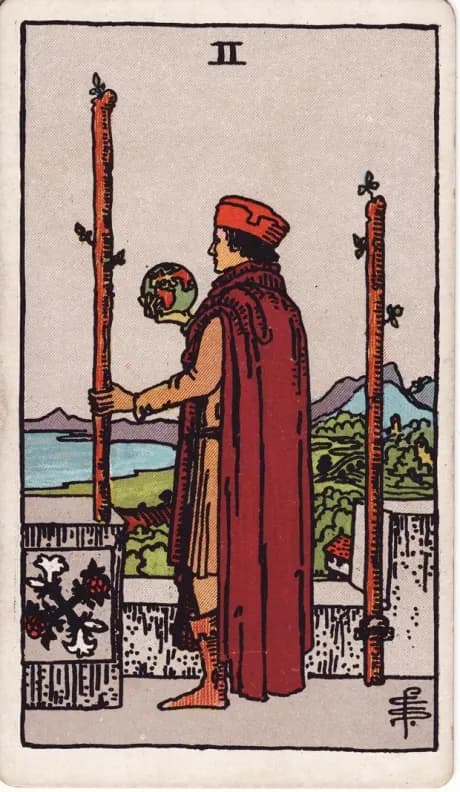
A figure stands on a battlement holding a small globe, one wand fastened to the stonework and one in his hand. He has built something already, and he is looking past it. The card's subject is the restlessness that arrives after success rather than after failure — the point where what you have is secure enough to be dull, and the only remaining question is how much larger you are prepared to make it.
Upright it describes the act of scoping. Two possibilities are in view at once, the safe consolidation and the bigger risk, and enough is known about both to choose deliberately instead of drifting toward whichever needs less nerve. The card favours the deliberate version. It is not a promise that the ambitious road is correct.
Reversed, the view stops being used. Ambition stays theoretical, the globe becomes an ornament, and the energy that should have gone into departure goes into rehearsal instead. It can also mark a legitimate scaling down, where the grand version was never proportionate to the resources on hand and the modest one is simply honest.
At work this is the profitable business measured against the version of itself that might earn far more, or the professional who has mastered a role and is deciding whether mastery is a ceiling. In money it is the difference between guarding a position and deploying it. In creative life it is an artist with a finished body of work, standing in front of a medium they have never tried.
Across the suit, the Two charts, the Three watches the venture travel, and the Four arrives. This is the earliest of the three and the only one where nothing has left port. Nothing has been risked yet, which is exactly why the card feels so pleasant, and why a person can stand in it for years.
Two of Wands as a yes or no
As a yes or no, the Two of Wands upright is a yes with a condition, and the condition is you. The card describes potential that has been correctly identified and not yet acted on. Everything needed to make the answer yes is present — the view, the information, the resources — and none of it moves without a decision. So the honest verdict is: yes, if somebody does something.
That makes it one of the less satisfying yes cards, because it hands the question back. Compare it with the Three of Wands, which is a plain yes because the thing is already in motion, or the Four of Wands, which is a yes that has effectively happened. The Two is the yes still sitting in your pocket.
Reversed it reads as no, or more precisely as not yet and not on this course. The plan is stalled, the nerve is missing, or the scale was wrong from the start. A reversed Two of Wands rarely means the door was locked. It usually means nobody walked to it.
If the question was a simple will they or won't they, the card is quietly saying that the wrong person is being asked about. Try instead: what would I have to say aloud for this to become real, and am I willing to hear the answer. The Two of Wands handles that question much better, and it answers it the same way every time.
Two of Wands as advice
As advice, the Two of Wands says: decide the size of the thing, then say it to the person it concerns. Both halves matter. Deciding privately and saying nothing is the position the card already describes, and repeating it is not progress.
Concretely: write down the version of this you actually want, in one sentence, with a date on it. Then work out the smallest first step that only exists if the plan is real — a booked ticket, a viewing, a conversation with a landlord, an amount saved. Take that step before you have made peace with the whole plan. The whole plan is not the kind of thing anybody makes peace with in advance.
The card also advises you to look at what you already hold. The figure keeps one wand fixed in the wall for a reason: expansion here is not escape. You are not being told to abandon the good thing in order to chase the interesting one. You are being told that both are on the table, and that pretending otherwise is what keeps the situation still.
Reversed, the advice narrows. Either shrink the plan until it is something you would genuinely do, or admit the plan is a comfort object and stop describing it as a future. Both are honest. What is not honest is a third year of describing a move that has never had a month attached to it.
One more instruction, and it is the part people skip: ask the other person what they want at full scale, and listen to the answer rather than negotiating with it. You may find the map was always more ambitious than the appetite.
Two of Wands as an outcome
As an outcome, the Two of Wands is a situation that ends at the decision rather than after it. The groundwork is done, the options are visible, and the story stops at the point where somebody has to choose. That is a real result and a frustrating one, because it means the timeframe you asked about closes before the move gets made.
In practice this usually looks like a connection that has clearly arrived somewhere new and has not been named. The feeling is mutual, the direction is obvious, and there is a conversation nobody has had. Left there, this card does not decay into an ending. It simply persists, which is why it can describe the same situation twelve months apart.
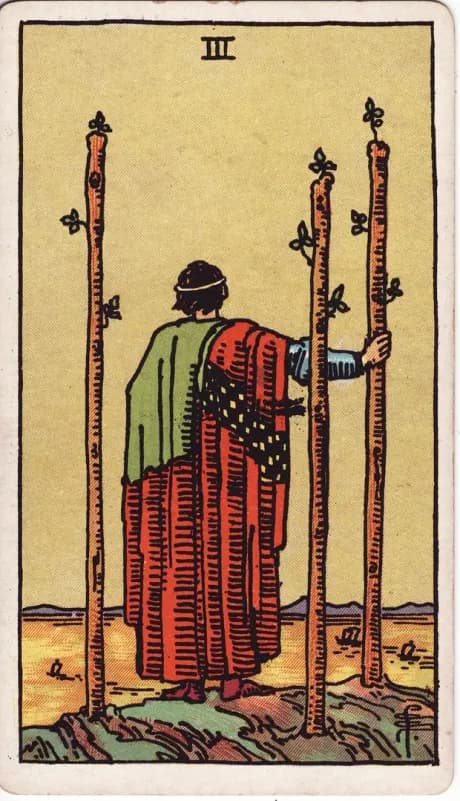
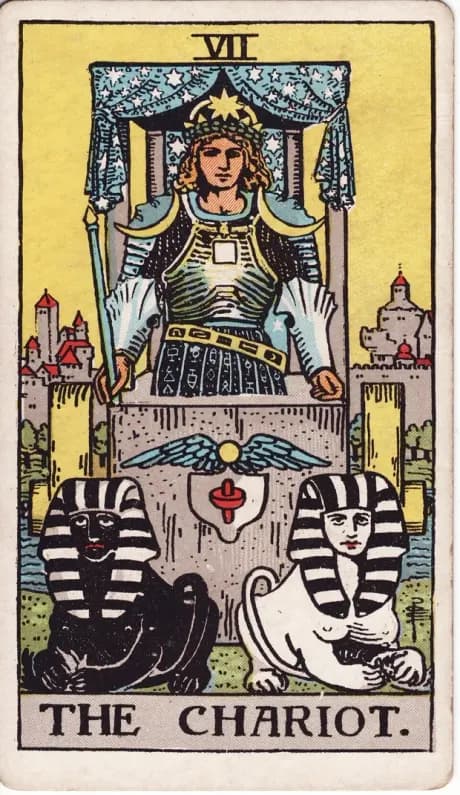
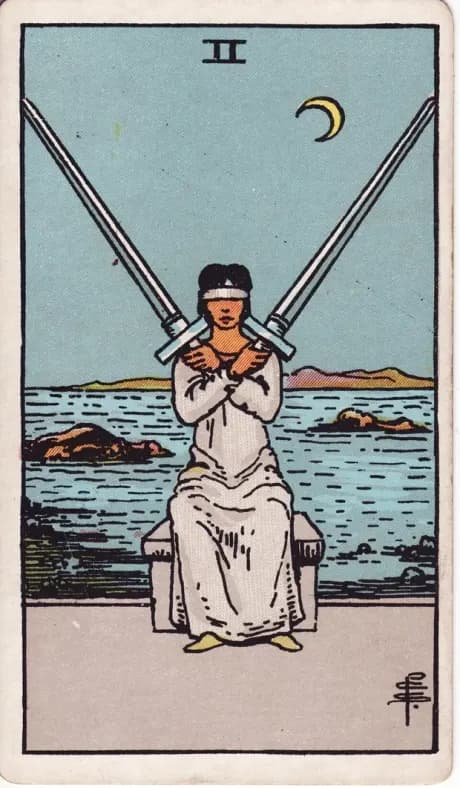
There is a more forward-moving version, and the surrounding cards decide which one you are looking at. With movement around it — the Knight of Wands, the Eight of Wands, the Chariot — it becomes a decision taken and a plan launched. With static or fearful company — the Four of Pentacles, the Two of Swords, the Nine of Swords — it stays a view from a wall.
Reversed as an outcome, the plan is shelved. Sometimes that is a loss: the moment passed, and the person who could have spoken did not. Sometimes it is a correction, and the smaller life that replaces the grand one turns out to be the one that was actually wanted. The card will not tell you which. It tells you only that the big version does not happen on this timeline.
What the Two of Wands card shows
The 1909 card shows a tall figure standing on the roof of a battlemented tower, seen from behind and slightly to the side, looking out over a coastline. He holds a small globe in his right hand. A staff rests under his left hand on the parapet, and a second staff is fastened to the wall behind him by an iron ring.
The two staves are the argument of the card. One is fixed and one is loose. What he has already built is bolted down and cannot be taken from him; what he might do next is only being held. Nobody in the picture is being forced to let go of anything, which is precisely why nothing is moving.
The globe is the detail that separates this card from every other Two in the deck. He is not weighing two objects against each other. He is holding the whole world in one hand while standing on a very small piece of it. The scale of what he is imagining and the scale of what he owns are wildly different, and both are in the same frame.
On the wall beside him, roses and lilies are set in a crossed pattern. Roses read as desire and lilies as thought, and crossing them is the picture saying that this decision requires both and goes badly with only one.
Below and beyond him the land runs out to grey water. The landscape is muted, distant and empty of people. It is a view rather than a destination — nothing in it is drawn clearly enough to walk to.
And the essential thing: he is above all of it, standing on stone he laid himself, and he has not come down. The whole card takes place at a height from which travel is easy to picture and impossible to begin.
Frequently asked
What does the Two of Wands mean in love?
+
Future-planning energy: choosing a shared direction and daring the next step. It usually appears when one person has already thought the whole thing through in private and has said none of it aloud. The momentum is real, and it is waiting on a sentence.
Is the Two of Wands a yes?
+
A yes pending courage. The potential is mapped and the resources are there; somebody still has to book the journey. Reversed it becomes a not yet, which is usually less about circumstances and more about nobody wanting to speak first.
What should I do when I draw the Two of Wands?
+
Say the plan aloud and put a date on it. Not a promise and not a commitment forever — a date, small enough that you would actually keep it. This card describes a situation that cannot change without a spoken sentence, and the sentence is the entire task.
What is the difference between the Two of Wands and the Three of Wands?
+
Timing. The Two is before the decision: the plan exists and nothing has left. The Three is after it: the plan is on the water and you are waiting for it to come back. If you are wondering whether to act, you have the Two. If you are wondering when it lands, you have the Three.
Does the Two of Wands mean moving away or long distance?
+
Often literally, yes — relocation, travel, a connection that would require somebody to change where they live. But it means the same thing at any distance: a step bigger than the current arrangement, visible to both people, and not yet agreed to by either.