What The Emperor means in tarot — and in love
The Emperor brings structure to romance: a protective partner, defined labels, a relationship with walls and a roof. As feelings, the Emperor means they feel protective and possessive of you in a steady way — they want to be your answer, your fixer, your fortress.
Jump to FAQAt a glance
- Yes or no
- No — reversed flips it
- Upright, in a line
- stability, protection, a partner who shows up
- Reversed, in a line
- control issues, rigidity, emotional walls
Want a yes or no on your own situation rather than this card? Pull one card and get the verdict with the reason behind it.
Ask your own yes-or-no questionUpright in love
The Emperor brings structure to romance: a protective partner, defined labels, a relationship with walls and a roof. He favors showing up on time, meeting the friends, planning beyond Friday. If you asked whether this is serious — the Emperor's whole personality is serious. Stability is his love language; expect fewer sonnets, more solved problems.
What the card describes is not a smaller feeling. It is a feeling that has been converted into arrangements. The Emperor says very little about how he feels, and then the tyre gets changed, the rent gets covered, the difficult phone call gets made on your behalf. If you grew up around people who said everything and did almost nothing, this can take a while to recognise as affection at all.
In a new connection he moves quickly toward definition. Titles get used early, plans extend further out than the length of the acquaintance justifies, and you are introduced to the people who matter to him. Whether that reads as intense or as a relief depends entirely on what you have been used to. The thing worth watching is not the speed. It is whether the structure is being built with you or around you — whether you are being consulted or informed.
In an established relationship he is the one carrying weight. Things get handled. The risk here is specific and slow: a partnership can quietly become an administration, two competent people running a household efficiently and touching each other mostly by calendar. If you have not done anything pointless together in months, that is the Emperor's shadow arriving on schedule.
What the card asks of you is plainness. Hints do not work on this energy — not because he is dense, but because he treats a hint as noise and waits for a specification. Say the thing you want in the flattest language you can manage. Then ask the harder question: whether you want someone to be your structure because building your own keeps getting postponed.
Reversed in love
Reversed, the Emperor turns control into a cage: jealousy dressed as protection, rules replacing conversation, or an emotional wall no one gets over. Alternatively, total absence of structure — someone allergic to any commitment. Either way the imbalance of power is the story. Love shouldn't need a permission slip.
The reversal does not make the card cruel. It makes it inflexible. Upright, the structure exists to protect something. Reversed, the structure has become the thing being protected, and the person inside it will defend a rule long after the rule stopped serving anyone. That is why arguments in this territory feel unwinnable. You are not disagreeing about the subject; you are being told the subject is not open.
In a new connection this usually shows up as a test you never agreed to take. Standards presented as facts. Approval extended and withdrawn. An early warmth that turns out to be conditional on behaviour which keeps being clarified after the fact. Or the mirror image of all that: someone who refuses every form of definition, treats an ordinary word like boyfriend as an accusation, and calls the refusal freedom.
In an established relationship it is the slow version. Decisions stop being joint. One person's preference has become the house policy without ever being voted on, and the other has learned which subjects cost too much to raise. Nobody is shouting. The tell is not conflict, it is the absence of it — count how many topics you have stopped bringing up.
What the card asks reversed is that somebody be named as the author of the rules. Written down, most of them turn out to belong to nobody: inherited from a family or an earlier partnership and never actually chosen. Rules with an author can be renegotiated. Rules that pretend to be the weather cannot, and living under weather is not the same as living with a person.
The Emperor As feelings
As feelings, the Emperor means they feel protective and possessive of you in a steady way — they want to be your answer, your fixer, your fortress. Softness lives underneath armor here; it's real even when it's quiet.
This card almost never describes someone who is unsure. It describes someone who has decided and will not make a performance of it, which is why it gets misread as coldness so reliably.
If you are single and asking about someone new. They have already placed you. In their head you have a category and a future, and they are working out logistics while you are still working out whether they are interested. The evidence arrives as usefulness rather than as words — they remember what you said you needed and turn up with it. Ask directly and you will get a direct answer. Wait for a spontaneous confession and you may wait a long time.
If you are in a relationship. They feel responsible for you, which is this card's version of tenderness and also its standing risk. Responsibility slides into management without anyone deciding it should. They are not bored and they are not drifting. They may simply have stopped distinguishing between caring about you and handling things for you.
If you are asking about an ex. Pride and feeling are both present, and pride is currently louder. They have not stopped caring. They have filed it somewhere that does not require any action from them.
If you are asking about someone long-term. This is the steadiest result the card gives. You are not in question. You are the arrangement their life is built around, and they would be genuinely disoriented without you — which they will probably never say in those words, because saying it would mean admitting the fortress has a door in it.
The Emperor For your ex
For an ex, the Emperor suggests pride is running the show. They may want you back but consider reaching out a loss of control. Don't confuse a stiff jaw with an empty heart — and don't wait forever for either.
The difficulty with this card is that the feeling and the silence are both genuine. They are not running a strategy and they are not indifferent. They have decided that whoever moves first from the weaker position has conceded something, and that belief usually predates you by decades. It is not really about what happened between you. It is about what they were taught losing looks like.
Sometimes the Emperor here is the other reading entirely: not silence out of pride, but silence because they consider the matter closed, and closed things do not get reopened. That version is colder and quieter, and the tell is the absence of any residue at all — no half-messages, no turning up where you might be, no mutual friends carrying information back and forth.
Practically: if you want contact, you will almost certainly have to make it, and you should decide in advance what you are prepared to hear. The Emperor does not soften a no to spare your feelings and he does not qualify a yes. That bluntness is the one useful thing about asking him. You will get an actual answer, which is more than most cards in this position offer, and you will get it once.
What The Emperor means in general
The Emperor is structure. Where the Empress grows things, he builds the container that keeps them from spilling — rules, boundaries, hierarchy, the long view enforced against short impulses. His subject is authority that has been earned and is being used: a decision made and held, a framework that lets other people rely on you.
Upright it says the situation needs order more than it needs inspiration, and that discipline applied now buys freedom later. Reversed the structure has hardened past its purpose — control for its own sake, rigidity that cannot absorb new information, domination, or the absence of any spine at all where one is required.
He is the fourth card of the major arcana, and four is the number of things that stand up on their own: four legs, four corners, the shape you can put weight on. That is his function in a spread. He is what stops a situation from being renegotiated every week.
In work he is the person who writes the process down so it survives whoever wrote it, and the manager whose refusal is worth something because it does not get reversed under pressure. In money he is the constraint accepted in advance — the limit set while you are calm rather than discovered while you are not. In creative practice he is form: the fixed length, the deadline, the frame that makes a choice possible by removing several thousand others.
His failure is always the same one and it arrives slowly. A container built to protect something eventually becomes the thing being protected, and the rule outlives the reason. What separates the upright figure from the reversed one is not how strict the rule is. It is whether anybody can still say what it was for.
The Emperor as a yes or no
As a yes or no, the Emperor upright is a yes, and a solid one — but it is a yes with terms attached rather than a yes with enthusiasm. He confirms that the thing you asked about has enough structure under it to hold weight. Commitments made in his territory tend to stick, which cuts both ways: a strong yes to anything you want durable, a weak one to anything you were hoping would stay flexible.
That distinction matters more than it sounds. If you asked whether something will last, whether a person is serious, whether a plan will hold together, he says yes and means it. If you asked whether something will be easy, spontaneous or free of obligations, he is answering a different question than the one you asked, and the answer to that one is no.
Reversed the verdict flips to no. Usually not because the situation is doomed, but because the structure is wrong. Someone is holding a position they cannot justify, a rule is doing damage it was never designed to do, or there is no foundation at all where you assumed one existed. A reversed Emperor no is an instruction to look at who is deciding and by what authority. It is not an instruction to abandon the plan.
If you are asking whether another person will approve something, upright this is close to a straight yes. He does not hedge, and he does not quietly change his mind after the fact.
The Emperor as advice
As advice, the Emperor says: decide, write it down, and stop reopening it. The card's core instruction is that you are spending energy on questions you have already answered, and the cost is not the questions themselves. It is that nothing else can be built while they stay open.
Concretely that means a few things. Set one boundary this week in plain sentences, out loud, to the person it concerns — not a hint, not a mood, a sentence. Put the thing you keep deferring on an actual date rather than in the vague future. If a recurring argument keeps happening, decide the rule once and hold it for a month before evaluating, because a rule changed under pressure is not a rule.
The card also advises taking the position rather than waiting to be handed it. If you are the person who knows what should happen, say so and accept the consequence of having said so. Authority here is not permission that arrives from above. It is what you get for having made a call and stayed with it.
There is a limit built into the advice and the card is honest about it. Structure serves something. If you cannot name what a rule protects, you are not being disciplined, you are being rigid, and rigidity is what the reversed card is made of. Review your own rules once and delete the ones that exist only because they always have.
Reversed, the advice inverts cleanly. Loosen the grip somewhere specific. Pick one thing you are controlling and let someone else do it badly.
The Emperor as an outcome
As an outcome, the Emperor means the situation settles into a defined shape. Something becomes official, gets a name, acquires terms. Whatever has been provisional stops being provisional, and the arrangement that results is durable — good news if you like the arrangement, worth thinking about if you do not, because this is not a card that comes apart easily afterwards.
In a question about two people it is one of the more concrete endings the deck offers. Titles. Plans that extend past the season. A place in each other's practical lives. It is rarely dramatic. It looks like an ordinary decision made once and then simply kept, and it stays kept.
The other upright reading is that the outcome gets decided by someone with authority. The person who has the final say uses it and the matter closes. Sometimes that person is you. The cards around it usually make clear which.
Reversed as an outcome splits in two. Either the structure holds but suffocates — you get the arrangement and discover it has fewer doors than you expected — or the opposite happens and it turns out nothing was load-bearing at all. The plans were not backed by a decision, the authority belonged to nobody, and the whole thing goes soft at exactly the point where it was supposed to take weight.
Either way the reversed outcome is rarely a collapse into chaos. It is the discovery of what the framework was actually made of, and that discovery tends to arrive at the moment somebody leans on it.
What the The Emperor card shows
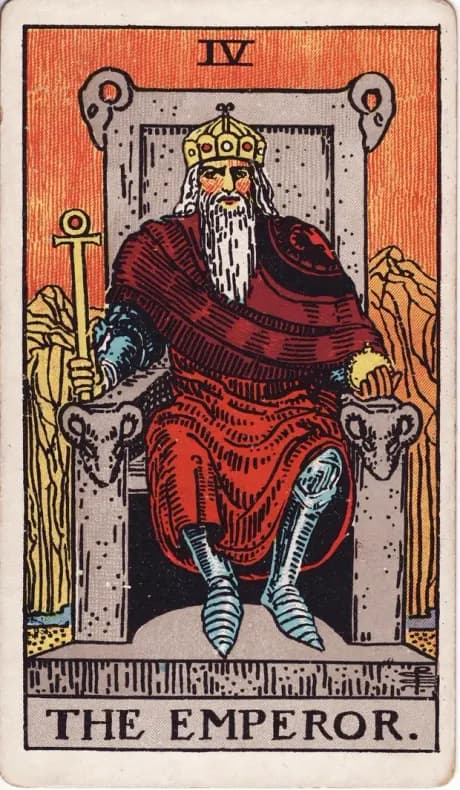
The 1909 card shows a bearded man in a red robe seated on a heavy grey stone throne, facing the viewer straight on. He wears a gold crown and, under the robe, armour: his legs are in metal greaves and mail shows at the wrists. The armour is the first thing to notice, because he is not at war. He is sitting on a throne, dressed for a fight he is not currently having.
Four carved rams' heads sit on the throne, one at each front corner and two at the top of the backrest. Rams belong to Aries, and the sign is his: initiative, force, the head-down push. But they are carvings. The animal energy has been turned into furniture and put somewhere it can be sat on.
In his right hand he holds an ankh-headed sceptre, the old sign for life, and in his left a plain gold orb, the world reduced to something that fits in a palm. His beard is white, which says the authority is old rather than assumed.
Behind him the landscape is bare orange rock, mountain after mountain, and nothing grows on any of it. A thin river runs along the base of the range on the right, the only moving thing in the picture and the only water. That river is the whole argument about this figure. Feeling exists here, it is narrow, and it is a long way behind him.
His posture repeats the throne. Knees apart, feet planted, back vertical, both hands occupied. He does not lean. The throne is a block of stone that cannot be moved, and neither, in any hurry, can he — which is exactly what makes him reliable and exactly what it costs him.
Frequently asked
Is the Emperor good for love readings?
+
Yes for stability and commitment, with a caution about control. He is a strong card if you want a builder — someone who defines the relationship, plans past the weekend and treats your problems as his to solve. He is a hard card if you want spontaneity, because the same instinct that makes him dependable makes him resistant to being redirected. Reversed, the caution becomes the whole reading.
What does the Emperor mean as feelings?
+
They feel protective and serious about you — less flutter, more foundation. They show love by handling things: turning up, fixing what is broken, remembering what you said you needed. It rarely means uncertainty. A person under this card has usually decided already and simply has not narrated it, which is why the card gets mistaken for coldness.
Is the Emperor a yes or a no?
+
Upright, yes — a firm one, especially for questions about whether something will last or whether someone is serious. It is a weak yes for anything you hope will stay casual or unofficial. Reversed it reads as no, and usually the reason is that the structure is wrong rather than that the situation is hopeless.
What should I do when I draw the Emperor?
+
Make one decision you have been leaving open, state it plainly to the person it affects, and then leave it alone long enough to see whether it works. The card is not asking for a better decision. It is asking for a decision that stops being reconsidered every few days, because nothing can be built on top of a question.
Does the Emperor mean a controlling partner?
+
Upright, no. It means someone who builds structure, which is not the same thing. The line between them is whether the structure is built with you or around you: a person who says what he wants and then negotiates is upright, a person who issues conditions and calls them protection is reversed. Beside the Devil or the Eight of Swords, the controlling reading firms up considerably.