Is He Cheating? What Tarot Can and Can't Say
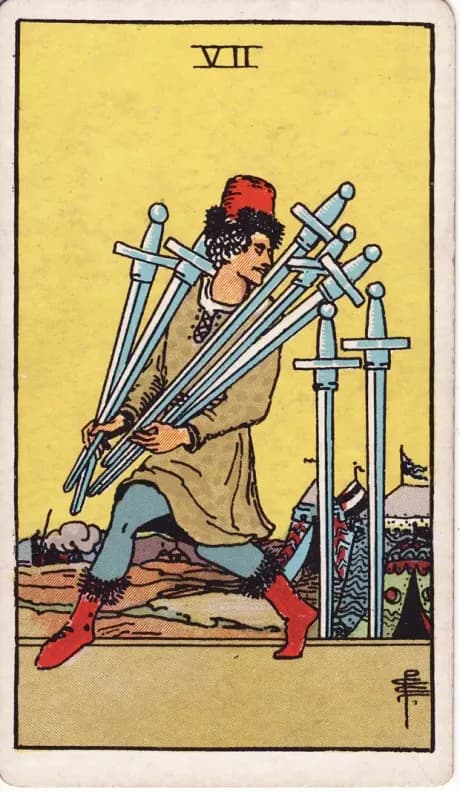
No card is evidence and tarot is not surveillance. What the deck reads accurately is the honesty in the connection: the Moon for concealment, the Seven of Swords for something kept back, the Devil for a bond running on secrecy. If you are asking at all, trust is the thing that actually needs solving.
Pull my cards on thisCards deal the moment you tap. First reading free, no signup.
First, the honest disclaimer: no card is a court verdict, and tarot is not surveillance. What the cards read brilliantly is the energy of concealment — whether something in the connection is being hidden, managed or rationed. Sometimes that's an affair. Sometimes it's emotional withdrawal, secret doubts, or a hidden struggle that has nothing to do with another person. The cards point at the shadow; naming it precisely requires a conversation.
Which cards speak to this
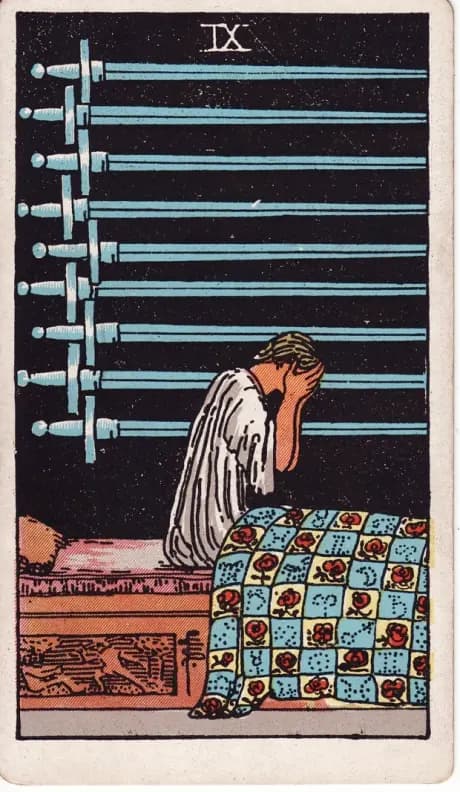
The Seven of Swords is the concealment card — something is being taken without your knowledge. The Moon means the situation is genuinely not what it looks like: hidden factors, your fears amplifying them. The Three of Cups reversed hints at a third presence in the dynamic. The Emperor upright, by contrast, is stability and loyalty energy. And the Nine of Swords asks whether the evidence is real or manufactured at 3am by your anxiety.
What actually tells you
Start with the honest frame: no card, and no article, can confirm infidelity. What can be described is the pattern people notice in hindsight, and it is about change rather than about any single behaviour.
The consistent one is a change in the shape of his attention combined with a change in his account of his time. Either alone is ordinary — people get busy, people get distracted. Together, and sustained over weeks, they are worth taking seriously.
Second: the phone becoming a subject. Not privacy, which is normal, but a change in how it is handled — face down where it was not, taken where it was not, tension where there was none.
Third, and the one most people report afterwards: an unexplained shift in the emotional weather. Sudden generosity, sudden irritation, or a new distance that has no visible cause. Guilt and concealment both leak, usually as inconsistency.
And a caution that belongs here: every one of these has innocent explanations, and depression, work stress and a private difficulty produce a near-identical picture. That is precisely why suspicion alone cannot settle it.
How long this usually takes
What has a timeline here is not his behaviour but yours. Suspicion has a course, and it is worth knowing because it is the part you can manage.
The first days are usually a single observation that will not settle. The following weeks are the dangerous phase: attention narrows, ordinary events start fitting the theory, and a case builds that feels like evidence and is mostly pattern-matching. Left alone, that phase does not resolve — it deepens, whether or not anything is happening.
Which is why the practical window is short. If a suspicion is still with you after two or three weeks, it needs to be spoken rather than investigated, because the investigating is now doing damage of its own regardless of what is true.
There is no useful timeline on the other side of that conversation, and be wary of anyone who offers one. What you get from speaking is not certainty. It is a return to a relationship in which you are a participant rather than a surveillance system.
What to do with this
Say what you have noticed, not what you suspect. "You have been distant for a month and I do not know why" is answerable. "Are you cheating" is a question with one socially available answer, and you will not learn anything from it.
Do not search his phone. Beyond the ethics, it does not work: you either find nothing and feel worse, or find something ambiguous and now cannot ask about it without admitting how you found it. Either way you have converted a problem you could raise into one you cannot.
Give the conversation room to produce a different answer. A large share of these conversations uncover something real that is not an affair — depression, debt, a work situation, a family thing he has been carrying alone. Going in certain of the conclusion makes that outcome much harder to reach.
And if the answer is unsatisfying and the feeling does not lift, that is information too. A relationship in which you cannot get a straight answer to a direct question has a problem worth addressing whatever its name is.
What this question usually gets wrong
The central misreading is treating suspicion as evidence. It feels like knowledge — it has the same texture — and it is not. Anxiety produces exactly this sensation, and the more attention it gets the more convincing it becomes.
Second: the belief that finding out would end the pain. People imagine confirmation as relief. It is not; it is the beginning of a much harder period. This matters because it is often what drives the searching, and the searching is what damages the relationship in the cases where nothing was happening.
Third: reading distance as betrayal. Withdrawal has many causes and infidelity is not the most common one. Stress, illness, shame about money and depression all present the same way from the outside.
And the limit, stated as plainly as it can be: tarot cannot tell you whether someone is cheating. Any reading, from anyone, that claims to has crossed from insight into fortune-telling about a third party's private conduct. What a spread can honestly show is what is happening in the connection — where the distance sits, what is unspoken, whether the thing you are feeling is coming from him or from you. That is real, and it is what this site will give you.
If the cards show concealment, the next tool isn't another spread — it's a direct question asked in daylight.
Tarot locates the shadow; only honesty dissolves it. And whatever you find, you were never crazy for noticing.
Cards in this answer





Questions people ask next
Can tarot tell me if he's cheating?
+
No. It cannot confirm another person's private conduct, and a reading that claims to is telling a story. It can describe the distance you are sensing and where it sits, which is the part you can act on.
Should I check his phone?
+
No — and not only for ethical reasons. It rarely resolves anything and it usually removes your ability to raise the subject openly, because you then have to explain how you know.
He's distant but says nothing's wrong. Is he cheating?
+
Distance has many causes and infidelity is not the most likely one. Stress, depression, money and shame all look identical from outside. Ask about the distance itself rather than about the conclusion you fear.
Which cards come up around betrayal?
+
The Seven of Swords for concealment, the Three of Swords for the wound, the Moon for something not being seen clearly, the Devil for a compulsive pattern. Read them as descriptions of atmosphere — none of them is proof of an act.