What Nine of Swords means in tarot — and in love
The Nine of Swords is the 3am mind: anxiety about them, replayed conversations, catastrophes rehearsed in detail the daytime never delivers. As feelings, the Nine of Swords means anguish — they lose sleep over you two: guilt, worry, regret, fear of losing you or of having ruined it.
Jump to FAQAt a glance
- Yes or no
- No — reversed flips it
- Element
- Air
- Upright, in a line
- anxiety spiraling at 3am over them
- Reversed, in a line
- the fear examined and shrinking
Want a yes or no on your own situation rather than this card? Pull one card and get the verdict with the reason behind it.
Ask your own yes-or-no questionIn the Golden Dawn tradition this card rules 10–20° of Gemini. A planet standing at that degree is read through it: Venus in Gemini · Moon in Gemini · Mars in Gemini
Upright in love
The Nine of Swords is the 3am mind: anxiety about them, replayed conversations, catastrophes rehearsed in detail the daytime never delivers. Relationship dread, jealous spirals, the ceiling as a cinema of worst cases. If you asked "is it as bad as I fear?" — the card says the fear is louder than the fact. The night lies with confidence. Verify by daylight.
What makes this card specifically about love rather than general anxiety is the shape of the worry. It is nearly always about a gap in information — a message unanswered, a tone you could not read, a change in someone you have not asked about. The mind fills gaps, and at three in the morning it fills them with the worst available material.
In a new connection the card usually means you are ahead of the evidence. Something real may be wrong, but what you are currently suffering is not that thing, it is your model of it. The distance between those two is exactly the size of the question you have not asked.
In an established relationship it more often means something unspoken has been unspoken too long. The anxiety here is doing a job: it is a signal that a conversation is overdue. Suppressing the anxiety without having the conversation reliably makes it louder.
The instruction attached is unglamorous and specific. Take one item out of the spiral and check it against reality — ask the question, look at the actual message again, say the fear out loud to somebody. Not all of them. One. The card describes a state that survives on being kept internal, and it does not survive contact well.
Reversed in love
Reversed, the Nine of Swords is dawn arriving: the spiral loosening, fears voiced and shrinking on contact with air, help accepted. Or the last concentrated squeeze of anxiety before release. Speak the 3am thoughts to a daylight person — monsters are terrible at surviving witnesses.
The good reading is the more common one. Something got said, and saying it made it smaller. This is the card of the conversation you dreaded that turned out to be twenty minutes long and mostly fine, or of the fear you finally described to a friend who said the obvious thing you could not see from inside it.
The harder reading is the intensification. Occasionally the reversal is the worst night rather than the morning after — the point where the anxiety peaks before it breaks. If that is the reading, the surrounding cards usually show it, and the useful information is that it is a peak rather than a plateau.
There is a third version worth naming: denial. Reversed, the card sometimes describes someone who has stopped feeling the anxiety by refusing to look at what caused it. That is not relief, it is postponement, and it is distinguishable by one thing — genuine relief comes with information, and this version comes with the subject being changed.
Whichever reading applies, the mechanism is the same. This card gets better when the contents of the night are moved into daylight and spoken to another person. Nothing else reliably works on it.
Nine of Swords As feelings
As feelings, the Nine of Swords means anguish — they lose sleep over you two: guilt, worry, regret, fear of losing you or of having ruined it. The intensity is real; its accuracy usually isn't. Anxious love still needs honest words.
If you are single and asking about someone new. They are overthinking it. Something about you matters enough to them that they are anxious about getting it wrong, and the anxiety is currently producing silence rather than action. What looks like disinterest here is very often the opposite.
If you are in a relationship. There is something they have not said, and not saying it is costing them sleep. Guilt is a common flavour, but so is fear of your reaction to something ordinary. The card describes a person rehearsing a conversation, not a person who has stopped caring.
If you are asking about an ex. They are replaying it. This is the card of the unsent message at two in the morning, and it is important to be clear about what it does and does not mean: it is genuine suffering, and it is not the same thing as intending to return. Some people find familiar insomnia more bearable than a vulnerable action.
If you are asking about someone long-term. Usually accumulated worry rather than one event — a fear about the shape of the future that has never been named out loud.
Across all four the feeling is real and the story attached to it is probably wrong.
Nine of Swords For your ex
For an ex, the Nine of Swords means the breakup haunts their nights — replays, remorse, the unsent-message hour. Suffering alone doesn't equal returning; some people prefer familiar insomnia to vulnerable action. Watch for daylight moves.
This is one of the cards people most want to over-read, so it is worth being precise. What it certifies is that you are on their mind painfully. What it does not certify is any intention whatsoever. Regret is a feeling, and feelings do not require anyone to do anything.
The specific texture is usually guilt rather than longing. They are turning over what they did, what they said, what they should have handled differently. That is a self-directed loop, and self-directed loops can run for months without producing a single external action, because acting would mean risking a second version of the same pain.
If you want a practical test, it is the same one that applies to every card in this suit: look for something that happens in daylight. A message sent at four in the afternoon means something. A message sent at four in the morning means the loop got loud, and by lunchtime they may well wish they had not.
What Nine of Swords means in general
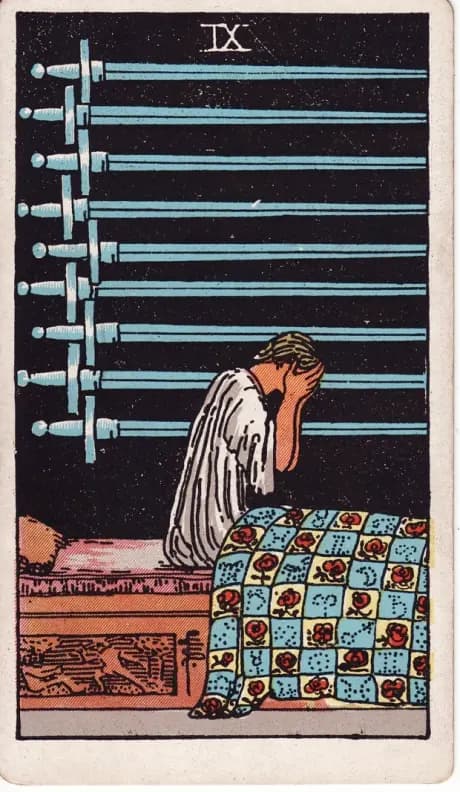
A figure sits up in bed with their face in their hands, nine swords hanging in the dark behind them. Nothing in the room is actually threatening. The card's subject is anguish at three in the morning — the specific state where the mind produces catastrophe faster than evidence, and does it with total conviction.
Upright it describes mental suffering that is genuine and disproportionate at the same time. Both halves matter. Dismissing it as "only anxiety" misses that the pain is real; treating it as accurate misses that the swords are on the wall, not in anybody.
Reversed the state breaks. Either the worst passes and dawn arrives, or the sufferer stops looking at what caused it and calls the numbness recovery. Those two look similar from outside and are told apart by one thing: real relief arrives with information attached.
Outside the personal, the card behaves the same everywhere. In work it is the project you are certain has failed at midnight and can fix in an hour on Tuesday. In money it is the calculation you keep redoing. In health it is worry ahead of any diagnosis, which is precisely where this deck stops and a doctor starts.
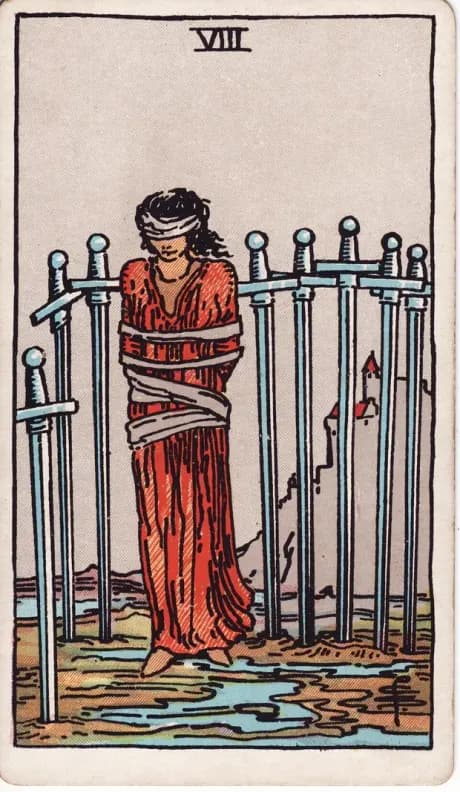
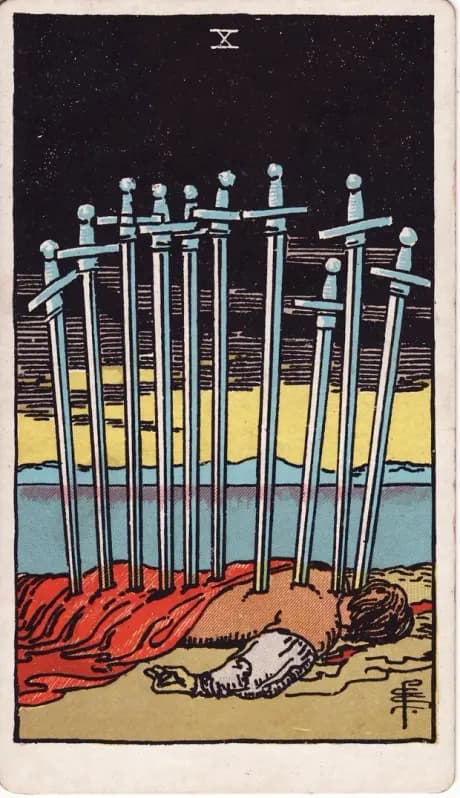
Among the Swords, the nine is the point where the suit's thinking turns against itself. The Eight is feeling trapped, the Ten is the ending. Nine is the night in between, and it is the one that does the most damage per unit of actual event.
The card's oldest practical instruction is still the best one: say it out loud to another person, in daylight.
Nine of Swords as a yes or no
As a yes or no, the Nine of Swords upright is a no — but it is a particular kind of no, and reading it flatly does the querent a disservice. It is a no that comes from inside the person asking rather than from the situation.
Very often what this card is answering is not the question that was asked. Somebody asks "will this go wrong" at the end of a bad night, and the card says yes to the fear rather than yes to the event. That is why the honest handling is to note the no and immediately ask a second question in daylight, because the same spread pulled at noon frequently returns something entirely different.
Where the no is substantive rather than emotional, it usually points at something unspoken. The situation is blocked by a conversation nobody has had, and until that conversation happens the answer stays no for reasons that have nothing to do with fate.
Reversed it becomes yes, and the yes is one of the more genuinely encouraging in the suit — relief, the fear being smaller than expected, the thing you dreaded turning out to be survivable. It is the card of the answer being better than the anticipation, which is common enough in life and rare enough in the Swords to be worth noting.
Nine of Swords as advice
As advice, the Nine of Swords says: stop consulting yourself. The card describes a mind that has become a closed system, and closed systems do not correct themselves — they intensify. The instruction is to introduce an outside voice, and to do it before you feel ready, because feeling ready is not something this state produces.
Concretely: tell one person the actual sentence. Not a summary, not a lightened version, the actual thing you are afraid of. This is uncomfortable and it is nearly always the entire treatment. Fears lose most of their size in the gap between thinking them and saying them, and no amount of thinking harder reproduces that effect.
The second instruction is about timing, and it is almost embarrassingly practical. Do not make decisions at night. Do not send messages at night. The card is specifically about the hours when judgement is worst, and it is asking you to notice that the same situation looks different at ten in the morning — not because you have solved anything, but because you are a different instrument at different hours.
Reversed, the advice becomes: accept the help that is being offered. The reversed card often shows relief arriving from outside, and the failure mode is refusing it out of pride or a sense that you should manage alone. You should not. Nothing about this card rewards managing alone.
Nine of Swords as an outcome
As an outcome, the Nine of Swords is a situation that ends in worry rather than in event. That is a strange result to report and it is a real one: the thing you asked about resolves without anything much happening externally, and what you are left holding is the anxiety it generated.
In love questions this often means a period of not knowing that goes on longer than you can comfortably tolerate. Nothing breaks and nothing is confirmed. The outcome is the waiting, and the card is telling you the waiting is going to be the hard part rather than whatever it resolves into.
It can also mean that the outcome is fine and you will not experience it as fine, because by the time it arrives you will have spent so long rehearsing the alternative that relief will not land properly. That reading sounds unkind and it is one of the more useful things this card does, because being warned about it changes it.
Reversed as an outcome is the better result: the situation ends with the fear disproven or spoken and shrunk. Not necessarily with everything going your way — reversed Nine of Swords is compatible with an unwelcome answer — but with the ending being survivable and clear rather than a continuation of the not-knowing. In this suit that counts as a good outcome.
What the Nine of Swords card shows
The 1909 card shows a figure sitting upright in bed, face buried in both hands, against a black background. Nine swords hang horizontally in that blackness behind and above them, stacked in parallel like shelves.
The most important detail is where the swords are. They are on the wall. Not one of them touches the figure, and none of them is falling. Every other Swords card in the suit puts the blades in bodies or in the ground; here they are hung, arranged, and inert. That is the entire argument of the card: the threat is displayed rather than active.
The bed is worth looking at. The blanket is a quilt of red roses and blue astrological symbols — the roses being passion and life, the symbols being the mechanics of fate. It is a warm, decorated, entirely ordinary bed, which is the point. The room is not a dungeon. The setting is somebody's normal life.
Carved into the side of the bed frame is a small scene: one figure standing over another who has fallen, apparently in a duel. It is the only actual violence in the picture, and it is a carving — an image of a conflict, not a conflict.
The figure's posture is the last piece. They are sitting up, which means they woke. They are not asleep and dreaming this; they have surfaced into it. The blackness behind is total, with no horizon and no light source, and that absence of any visible edge is what the card is describing more precisely than the swords are.
Frequently asked
What does the Nine of Swords mean in love?
+
Anxiety about a relationship that outruns the evidence — replayed conversations, worst cases rehearsed at night. The suffering is genuine and the story attached to it is usually wrong. It typically points at one question that has not been asked.
Does the Nine of Swords mean my partner is doing something wrong?
+
Rarely on its own. The card describes your mind rather than their behaviour. It can mean something real is unspoken between you, but it is far more often about the gap you are filling with worst-case material than about what is actually in the gap.
Is the Nine of Swords a yes or a no?
+
Upright it is a no, but one that comes from inside you rather than from the situation. It often answers the fear rather than the question. Reversed it becomes a genuinely encouraging yes: relief, and the thing turning out smaller than anticipated.
What should I do when I draw the Nine of Swords?
+
Say the actual fear out loud to one other person, and do not make decisions or send messages at night. The card describes a closed mental system, and closed systems intensify rather than correct themselves. Outside contact is the whole treatment.
Why are the swords on the wall in this card?
+
Because nothing in the picture is attacking anyone. Every other card in the suit puts blades in bodies or in the ground; here they hang inert against a black background. The threat is displayed rather than active, which is the card's entire argument.