What Nine of Cups means in tarot — and in love
The Nine of Cups is the wish card wearing love's face: emotional satisfaction, a desire granted, contentment you can actually feel in your chest. As feelings, the Nine of Cups means they feel satisfied and happy around you — you are close to their idea of what they were hoping for.
Jump to FAQAt a glance
- Yes or no
- Yes — reversed flips it
- Element
- Water
- Upright, in a line
- emotional satisfaction, a wish granted
- Reversed, in a line
- smugness, satisfaction that rings hollow
Want a yes or no on your own situation rather than this card? Pull one card and get the verdict with the reason behind it.
Ask your own yes-or-no questionIn the Golden Dawn tradition this card rules 10–20° of Pisces. A planet standing at that degree is read through it: Venus in Pisces · Moon in Pisces · Mars in Pisces
Upright in love
The Nine of Cups is the wish card wearing love's face: emotional satisfaction, a desire granted, contentment you can actually feel in your chest. If you asked whether you will get what you are hoping for, this is the closest thing the deck has to a wink. It also praises self-sufficiency: a heart already full attracts, and never has to beg. Enjoy it without auditing it.
The card has one condition and it is worth taking seriously. It grants the wish as stated. Not the wish you would have made if you had thought about it longer, not the deeper thing underneath it — the one you actually made. So it is worth knowing what you asked for. People wish for a specific person and receive that person. People wish to stop feeling alone and receive company. Those are not the same wish, and this card will hand over either one without comment.
In a new connection it means the pleasure is real and you are allowed to have it. This is not the card of great depth or tested loyalty; those belong further along the suit. It is the card of a season that is simply good, with someone who makes you feel well fed rather than anxious. The most common mistake here is treating enjoyment as suspicious, and interrogating something that has not done anything wrong yet.
In an established relationship it describes a stretch where the thing you built is working and you can feel it working. Nothing needs fixing this month. That is unusual enough to be worth noticing out loud, because contentment is quiet and easy to walk straight past on the way to the next problem.
What the card asks of you is small and difficult: receive. Say thank you, stay in the good stretch, and stop checking whether you have earned it. Satisfaction does not have to be justified to be kept.
Reversed in love
Reversed, the Nine of Cups is the wish with a hollow centre: getting what you wanted and feeling oddly unfed, smugness covering loneliness, pleasure standing in for connection. Ask what the wish was actually for. Sometimes the dream needs editing rather than achieving.
The reversal does not usually take the good thing away. That is the part people misread. More often the good thing arrives exactly as ordered and produces none of the feeling it was supposed to produce, which is a far stranger experience than simple disappointment. You got it. You are still standing there. That gap is the entire card.
The usual reason is that the wish was borrowed. Somewhere along the way you adopted a picture of a satisfying life — the relationship at a certain stage, the person who looks correct on paper, the milestone by a certain age — and pursued the picture rather than anything you personally wanted. Borrowed wishes are granted just as reliably as real ones, and they are the reason this card reversed so often looks like success from the outside.
There is a second reading about excess. Comfort used as an anaesthetic: eating, spending, scrolling, a person kept around mainly because their attention is soothing. Nothing in that is a catastrophe, and all of it works, briefly. The card notes only that the appetite is being fed and the hunger is somewhere else.
The gentler version, worth checking before the harsh ones, is that the satisfaction is genuinely present and you cannot feel it yet. That happens after long strain. The nervous system does not switch over the moment conditions improve. If that is your version, the instruction is patience rather than change.
Nine of Cups As feelings
As feelings, the Nine of Cups means they feel satisfied and happy around you — you are close to their idea of what they were hoping for. Contentment this stable is quieter than passion and outlasts it.
The caution attached is small but real: satisfaction is a comfortable state, and comfortable states do not generate urgency. Here is how that plays out across the four situations people ask about.
If you are single and asking about someone new. They enjoy you. Being around you is pleasant in a way that requires no effort from them, and they are aware of that and glad about it. It is a warm, favourable card to draw here. What it does not promise is momentum — enjoying someone and pursuing someone are different behaviours, and this card confirms only the first.
If you are in a relationship. They are content, and the contentment is not a performance. Whatever you have built meets their idea of a good life closely enough that they have stopped shopping. Read that as the compliment it is, and notice the flat side of it: someone this satisfied may also have stopped noticing, because nothing is prompting them to look.
If you are asking about an ex. They are at peace, and this is the version that stings. Their peace does not necessarily include you. The card can mean they remember the good of it fondly and feel no lack, which is an answer even though it is not the one the question was fishing for.
If you are asking about someone long-term. They are quietly happy and would say so if asked, which nobody has asked. Long contentment goes unspoken because it produces no incidents. There is nothing to fix here, only something to say aloud.
Nine of Cups For your ex
For an ex, the Nine of Cups can mean they have found their peace — with you or without you — or that the reunion is specifically your wish rather than a shared one. Check whose wish you are reading. Your fulfilment may not require their participation at all.
That is the question the card keeps returning to, and it is uncomfortable because the answer is often the second one. This is the wish card, and in a reading about an ex, the wish being described is frequently the one held by the person asking. The deck answers what is in front of it, and what is in front of it is your hope, sitting there in full colour.
When the card genuinely describes them, it says they are doing well. Not triumphantly, not to prove a point — well. They have arrived somewhere comfortable and are not looking backward from it, because looking backward is what people do when the present is thin. This is hard to hear and useful to know, because it closes off a whole category of waiting.
There is a warmer version. The Nine of Cups can mean the memory of you has settled into something good in them: no bitterness left, the difficult parts filed, real fondness available. That is worth having and it is not the same as a return. Fondness is a completed feeling. It asks for nothing further.
The practical use of this card is to point the wish back at yourself. If what you actually want is to feel like this again, that is achievable and this card says so. It just does not name a required person.
What Nine of Cups means in general
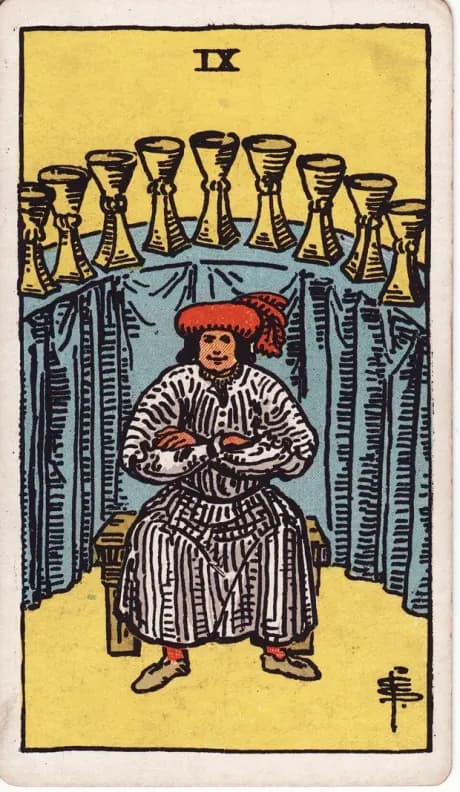
Nine cups stand in an arc behind a well-fed figure with folded arms, and the tradition around this image is older than the deck: it is called the wish card. Its subject is arrival. A goal reached, comfort earned, the particular sweetness of getting the thing you genuinely wanted rather than the thing you were supposed to want.
Upright it says the outcome is favourable and pleasure in it is not premature. Reversed the achievement rings hollow: a granted wish that turns out to have been the wrong one, self-congratulation, indulgence taking the place of fulfilment, or a target hit with none of the expected feeling.
In work it is the promotion or the finished contract, the moment where the effort visibly paid and the room agrees. In money it is sufficiency rather than wealth — enough, with margin, which is a rarer and better condition than most people aim for. In creative life it is the piece that came out the way you meant it, and the odd flatness that sometimes follows, because making a thing and having made a thing are different pleasures.
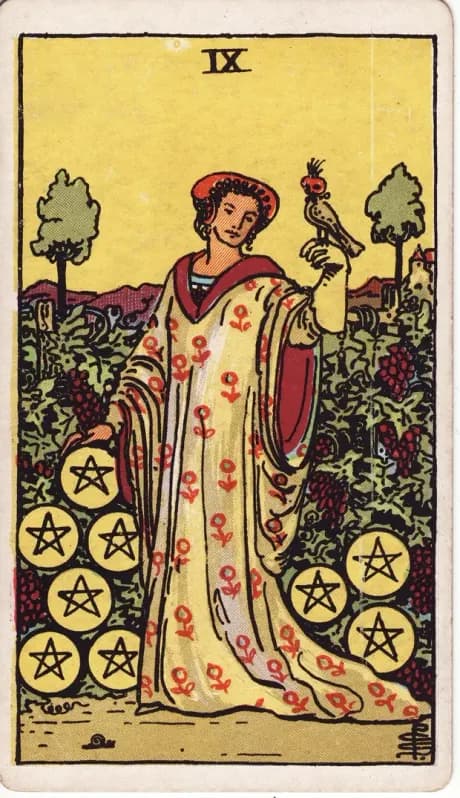
The Nines are all near-completion under strain. The Nine of Wands guards a position while injured. The Nine of Swords sits awake at three in the morning. The Nine of Pentacles enjoys independence it built alone. The Nine of Cups is the only one that is comfortable, and its risk is exactly that comfort — the figure is seated, arms crossed, facing away from what he owns.
The card's warning is never about enjoying yourself. It is about stopping there. Satisfaction is a fine place to rest and a poor place to settle permanently, because nothing further gets built from a chair.
Nine of Cups as a yes or no
As a yes or no, the Nine of Cups upright is the strongest yes in the deck. It is called the wish card for exactly this reason: whatever you asked for is available, likely, and close. If a single card had to answer a hopeful question, this is the one you would want turned over.
The one qualification is precision. The card grants what was asked, not what was meant. A yes here answers the literal question, so it is worth checking the wording before you celebrate. Will he contact me and will we be together are different questions, and this card will say yes to the first with no opinion whatsoever about the second.
Reversed the answer becomes a qualified yes or a soft no, depending on which reversal you are in. The most common version is yes with the feeling missing: it happens, and it does not deliver. The second version is a straight no aimed at the wish rather than at the odds — the thing is achievable and would not satisfy you, and the deck is declining to encourage it.
Because the upright card is so agreeable, it is the easiest one in the deck to over-read. A yes about a wish is not a yes about a lifetime. Take the win at the size it is actually offered, get specific about the next question, and ask that one separately rather than assuming this answer stretches to cover it.
Nine of Cups as advice
As advice, the Nine of Cups says two things that sound contradictory and are not: be precise about what you want, then let yourself have it.
Start with the precision, because it is the part people skip. Write the wish down in one sentence, in plain words, with no hedging and no noble framing. Most wishes shrink under that treatment, and what is left is usually more specific and more embarrassing than the version you tell other people. That smaller honest version is the one to work with. Vague wishes get granted vaguely.
Then the harder half. This card advises you to accept something good without immediately looking for the catch, the debt, or the reason you do not deserve it. If a situation is currently fine, the advised action is to stop improving it for a while. Say the appreciative thing out loud. Spend the pleasant evening being present in it rather than assessing it.
There is a practical instruction folded in about self-sufficiency. Fill your own cup first — not as a strategy for attracting anyone, but because a person whose contentment depends on somebody else's behaviour is unpleasant to be near, and knows it. Build one source of satisfaction this month that nobody else controls.
Reversed, the advice sharpens. Go back to the wish and interrogate whose it is. Cross out anything you are pursuing because it would look correct. What remains, however small, is the thing to spend the next season on, and the relief of dropping the rest usually arrives immediately.
Nine of Cups as an outcome
As an outcome, the Nine of Cups is a good ending, and unusually for the deck it is a good ending with no sting attached. The situation resolves in your favour and feels the way you hoped it would feel. Whatever you were hoping for is what arrives.
The detail worth holding on to is that it arrives at the size you asked for. This card completes a wish rather than transforming a life. If the question was about a specific outcome, expect that outcome, delivered cleanly, without the surrounding changes you may have been quietly bundling into it. That is not a disappointment unless you were bundling.
In a question about a person it usually describes a comfortable, warm result: things settle, and the settling is pleasant rather than dramatic. It is a card of arriving, not of building, so it tends to describe the moment of getting there rather than what the arrangement looks like a year later. For the year later, look at the cards around it.
Reversed as an outcome the result still happens and lands wrong. The thing is obtained and the feeling does not follow, which reads as anticlimax rather than defeat. Sometimes the reversal means the outcome gets postponed by your own ambivalence, because part of you already suspects the wish was borrowed and is not fully pushing for it.
Either way this card is not a disaster in the outcome position. Upright it is close to the best result the suit offers. Reversed it is a good result attached to the wrong question, which is a problem you can fix by changing the question.
What the Nine of Cups card shows
The 1909 card shows a stout, comfortable man seated on a low wooden bench, arms folded across his chest, wearing a red cap set at an angle. He faces the viewer directly, openly pleased with himself. He is the only figure in the picture and there is no landscape at all — no horizon, no sky, no ground detail. The background is flat yellow, the colour this deck uses for daylight certainty.
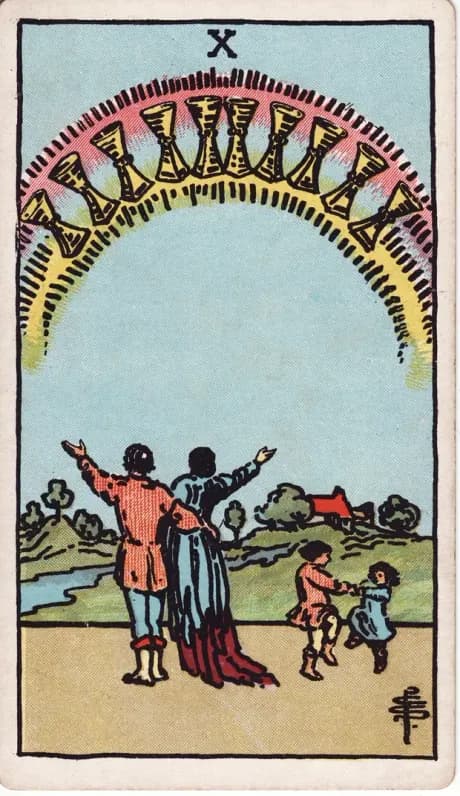
Behind him a curved counter is draped in blue cloth, and nine golden cups stand along it in an arc, evenly spaced, above the level of his head. The arc is worth noticing. It is the same shape the rainbow takes in the Ten of Cups, drawn here in furniture rather than in sky, which is one way of saying that this satisfaction is arranged rather than given.
Two details do the quiet work. The first is that the cups are behind him. He is not looking at them and cannot reach one without standing up and turning around. What he owns is at his back, taken as settled. The second is the blue drape. It hangs to the floor and conceals whatever is under the table, and a card about complete satisfaction that hides part of its own furniture is making a point about how much of this is display.
His folded arms carry the same double reading. They are the posture of a man who is content and needs nothing, and also a closed body, the one gesture in the picture that keeps something out.
There is no other person here, no meal in progress, nobody being served. The banquet is set and the host is enjoying it alone.
Frequently asked
Is the Nine of Cups a yes?
+
The famous wish-card yes: what you are asking about is achievable and likely, and the card is close to the strongest affirmative in the deck. The one condition is precision — it grants the question as worded, not the hope underneath it, so read your own question back before you celebrate.
What does the Nine of Cups mean emotionally?
+
Satisfaction and self-contentment: a full cup you bring with you rather than demand from somebody else. It is a quieter feeling than passion and it lasts longer. The flat side is that comfort creates no urgency, so nothing here is pushing anybody to act.
What should I do when I draw the Nine of Cups?
+
Write the wish down in one plain sentence with no hedging, because vague wishes get granted vaguely. Then stop improving the parts of your life that are already fine. If something is good right now, the advised action is to be in it rather than to audit it.
Is the reversed Nine of Cups still a yes?
+
It becomes a qualified yes: the thing usually still happens and delivers less feeling than expected. The other common reversal is a no aimed at the wish rather than the odds — you could have it, and it would not satisfy you. Both point at the same fix, which is to check whose wish it was.
Why is the Nine of Cups called the wish card?
+
The name comes from older fortune-telling tradition, where drawing it in answer to a hope was read as the hope being granted. The imagery supports it: a set banquet, a satisfied host, everything already arranged. Treat it as a favourable sign rather than a promise — this is entertainment, and the card describes a condition, not a forecast of events.