What Nine of Pentacles means in tarot — and in love
The Nine of Pentacles is wholeness before partnership: thriving in your own garden — independent, self-funded, romantically optional. As feelings, the Nine of Pentacles means admiration of your completeness — they're drawn to your independence, standards and self-possession.
Jump to FAQAt a glance
- Yes or no
- Yes — reversed flips it
- Element
- Earth
- Upright, in a line
- self-worth, thriving whole on your own
- Reversed, in a line
- seeking validation outside yourself
Want a yes or no on your own situation rather than this card? Pull one card and get the verdict with the reason behind it.
Ask your own yes-or-no questionIn the Golden Dawn tradition this card rules 10–20° of Virgo. A planet standing at that degree is read through it: Venus in Virgo · Moon in Virgo · Mars in Virgo
Upright in love
The Nine of Pentacles is wholeness before partnership: thriving in your own garden — independent, self-funded, romantically optional. It's the energy that attracts by not needing. In love it favors relationships between complete people, or a season of luxurious self-reliance. If you asked what to do about them: keep building your vineyard. The right person buys a ticket; the wrong one gets outgrown.
The card is frequently received as disappointing and it is one of the strongest positions in the deck. What it describes is a person whose life works, into which somebody may be invited. That is a completely different negotiating position from a person waiting to be completed, and every relationship formed from it starts on better terms.
In a new connection it usually means you are being approached by someone who wants what you already have rather than someone who needs you to supply what they lack. That distinction takes a year to become visible in ordinary circumstances and this card names it immediately.
In an established relationship the Nine marks the version where both people have their own life. Nobody dissolved. There is a shared garden and there are also two separate ones, and the shared one is better for it.
Where the card frustrates people is on questions about a specific person, because it declines to answer them. It says: your position is strong, keep building. That is not evasion — it is the card's actual claim, which is that the outcome with any particular person matters less than the state you negotiate from, and the state is the thing you control.
Reversed in love
Reversed, the Nine of Pentacles is independence with a hairline crack: self-sufficiency as armor, loneliness redecorated as freedom, or worth outsourced to a partner's wallet and validation. The garden is real; the "I need no one" sign on it is cope. Wanting love doesn't demote your independence — it completes its purpose.
The armour version is the common one and it is hard to see from inside, because it is built out of true statements. You are fine alone. You do not need anyone. Your life is good. All of that is accurate and none of it explains why the door is locked. Reversed, the card asks what the self-sufficiency is protecting against, and the answer is usually one specific past event rather than a philosophy.
The second version inverts the card entirely: dependence dressed as partnership. Worth measured by someone else's provision, or by their approval, in a way that has quietly removed the ability to leave. This reading is the reason the reversal is worth taking seriously rather than treating as a mild caution.
There is a third version about the garden itself — a life that looks enviable and is not enjoyed. Everything acquired, nothing tasted. The card is about earned pleasure as much as earned independence, and reversed, the pleasure is the part that has gone missing.
The correction is not to need someone. It is to admit wanting, which is a different thing and considerably harder for anyone who has built this card upright.
Nine of Pentacles As feelings
As feelings, the Nine of Pentacles means admiration of your completeness — they're drawn to your independence, standards and self-possession. You read as a luxury, not a rescue. They approach as a guest, which is exactly right.
If you are single and asking about someone new. They find you impressive and slightly out of reach, and both of those are true and neither is a problem. The risk with this card is not disinterest but hesitation: people are sometimes slow to approach what looks complete, on the theory that there is no room for them.
If you are in a relationship. They admire your life and are glad to be in it rather than necessary to it. That is a mature form of affection and an underrated one, and it is often quieter than the other kind.
If you are asking about an ex. Your independence is what they see and what they are reacting to. This is the card of the ex watching a life that visibly does not require them, and the feeling it produces is a mixture of respect and regret rather than longing.
If you are asking about someone long-term. Comfortable, appreciative, unanxious. They are not worried about you and they are not taking you for granted, which is a narrow space to occupy and this card is in it.
Across all four: they see you as whole, and they are right.
Nine of Pentacles For your ex
For an ex, the Nine of Pentacles means your thriving-without-them is the loudest message in their feed. Any return is upward — toward someone who no longer needs them. Keep the garden gates selective; entry fee is changed behavior.
What makes this card powerful in an ex-reading is that it is entirely passive. You are not doing anything to them. You are living, visibly, well, and that is the whole mechanism. There is no strategy in this card and it outperforms every strategy, which is inconvenient for anyone hoping to be told what to send.
The feeling it produces on their side is specific: not jealousy exactly, but a recalibration. They are seeing evidence that the version of you that existed inside the relationship was not the whole of you, and that evidence is more persuasive than any conversation would have been.
If contact comes, it comes from a position of disadvantage, and that is worth being conscious of rather than triumphant about. The useful posture is the same as the card: a life that continues either way, a door that is neither locked nor propped open, and a standard for re-entry that is about behaviour over a period rather than about a good conversation.
The card's caution is against curating the garden for an audience. The moment it becomes a performance, it stops being the thing that works.
What Nine of Pentacles means in general
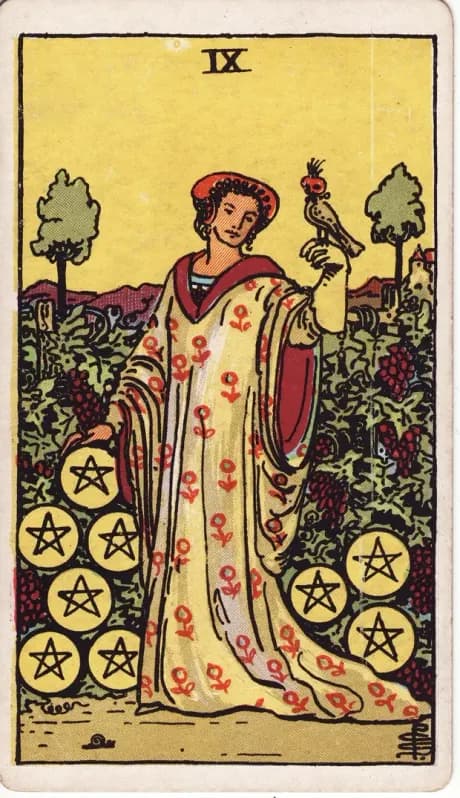
A woman stands alone in a walled garden with a hooded falcon on her wrist. Everything in the scene she built, including the discipline the falcon represents. The card's subject is earned independence — self-sufficiency, refinement, and the enjoyment of a result that took years.
Upright it means arrival at a standard of living, in the broad sense: financial, personal, or in a skill. The emphasis is on earned rather than given, and on the capacity to enjoy it rather than merely to have accumulated it.
Reversed it fractures. Self-sufficiency turned defensive, dependence disguised as security, or a life acquired and not inhabited. The reversal is one of the deck's better descriptions of a comfortable trap.
Outside the personal, the card is direct. In work it is the point where competence bought autonomy — choosing the projects, setting the terms. In money it is security actually reached rather than pursued. In creative life it is the stage where taste is developed enough that you can enjoy your own work.
Among the Pentacles the sequence is legible: the Eight is the labour, the Nine is the result, and the Ten extends it to a family and a generation. Nine is the only one of the three that is enjoyed alone, and the deck does not frame that as a lack.
The hooded falcon is the card's argument rather than its decoration. A hawk is wild; a hooded hawk on a glove is a wild thing that has agreed to a discipline. The freedom in this card was produced by restraint, not by its absence.
Nine of Pentacles as a yes or no
As a yes or no, the Nine of Pentacles upright is a yes — but frequently a yes to something other than what was asked. The card affirms your position, your resources and your capacity to be fine, and it is noticeably reluctant about questions that depend on another person.
Where the question was about you — will I be okay, is this the right move, can I afford this, will I manage alone — it is one of the strongest yeses available. Where the question was will they come back, the card tends to answer sideways: you will be fine either way, which is true and is not the answer that was requested. Reading it as a straight yes to a question about someone else's behaviour usually overpromises.
Reversed it becomes a no with a particular flavour: isolation, or a comfort that is costing more than it appears. The reversed card sometimes answers a question about a relationship by pointing at the security in it rather than the affection, which is unwelcome and worth saying.
On timing this suit is slow and this card is at the end of a long process, which makes it a poor answer to "when". If pressed, it indicates something that arrives after a period of work rather than on a date.
Nine of Pentacles as advice
As advice, the Nine of Pentacles says: build your own life and let that be the strategy. Not as a tactic to attract someone — the card is explicit that performing this does not work — but because the state it describes is the one from which every other decision gets easier.
Concretely, the instruction is usually to invest in yourself in a way that has nothing to do with the question you asked. The skill, the money, the home, the health. This card's counsel on relationship questions is famously indirect and it is not evasion: it argues that most relationship problems are negotiated from a position, and that improving the position beats improving the argument.
The second instruction is to enjoy what already exists, which people holding this card skip almost universally. The figure in the picture is not acquiring anything; she is standing in a garden she made, present in it. If your version of self-sufficiency contains no pleasure, the card is describing something you have not finished building.
Reversed, the advice changes to letting someone in. Specifically: admit that you want something, out loud, to a person. The reversed card describes independence that has become a way of never being disappointed, and the only thing that opens it is being explicit about a want rather than continuing to demonstrate that you have no needs.
Nine of Pentacles as an outcome
As an outcome, the Nine of Pentacles is a situation that ends with you self-sufficient and well. Whatever was in question, you come out of it standing in your own garden — resourced, capable and not dependent on the thing you were asking about.
In love questions this outcome divides people sharply. It genuinely means you will be fine. It does not promise the relationship, and where the question was specifically about a person, this card's answer is that the person is not the determining factor in how the story ends for you. Some querents hear that as cold comfort and it is, in the moment, the most accurate thing the deck can say.
There is a version where the relationship is included. The Nine alongside Cups or an Ace often means a partnership formed between two complete people rather than instead of one — the garden with a guest in it. On its own, the card describes the garden and leaves the guest an open question.
Reversed as an outcome is comfort without contentment: the situation ends materially fine and emotionally hollow, or ends with an independence that was chosen defensively rather than freely. That result is worth naming plainly rather than softening, because it is one that people can live inside for years without noticing.
What the Nine of Pentacles card shows
The 1909 card shows a woman standing alone in a walled garden, wearing an elaborate robe patterned with the astrological symbol of Venus repeated across the fabric. A hooded falcon perches on her gloved left hand. Her right hand rests on a grapevine.
The vines are heavy with fruit and grow on trellises, and six golden coins are set among the leaves on her left, two more on her right. Behind her, a manor house is visible above the hedge, and beyond the garden wall is open country and hills.
The falcon is the detail that changes the reading. Hooded, it is a hunting bird that has been trained — a wild thing operating under discipline and doing so by arrangement. It is not caged and it is not free. Everything this card describes was produced by exactly that trade: restraint accepted in exchange for capability, over years.
Her glove is the only piece of protective equipment in the picture, and it exists so the bird can land without hurting her. Read that as the card's note on intimacy with anything wild.
The garden is walled and cultivated, in a suit that elsewhere shows open fields and workshops. This is enclosed, deliberate, and finished space.
In the lower right corner, easy to miss, a small snail crawls across the ground. It is the slowest creature in the deck, placed in the card about the longest process, and its shell is the only house in the picture that its owner carries.
Frequently asked
What does the Nine of Pentacles mean in love?
+
Wholeness before partnership — a life that works, into which someone may be invited. It describes attracting people who want what you have rather than people who need you to supply what they lack, which is a different negotiating position entirely.
Does the Nine of Pentacles mean I will be alone?
+
No. It means you are complete alone, which is not the same thing. The card describes the position rather than the outcome, and relationships formed from this position start on better terms than those formed from need.
Is the Nine of Pentacles a yes or a no?
+
A strong yes to questions about you — will I be okay, can I manage, is this right. To questions about someone else's behaviour it answers sideways: you will be fine either way, which is true and is not what was asked.
What should I do when I draw the Nine of Pentacles?
+
Build your own life, and enjoy what already exists — the second half is what people skip. If your version of self-sufficiency contains no pleasure, the card is describing something unfinished. Reversed, admit a want out loud to a person.
What does the falcon mean on the Nine of Pentacles?
+
A wild bird operating under discipline by arrangement — not caged, not free. It is the card's argument that the freedom shown here was produced by restraint accepted over years rather than by its absence.