What Eight of Pentacles means in tarot — and in love
The Eight of Pentacles is love as craft: working on the relationship deliberately — learning their love language, fixing your patterns, showing up… As feelings, the Eight of Pentacles means dedicated focus — they're working on themselves for you, or carefully building toward you.
Jump to FAQAt a glance
- Yes or no
- Yes — reversed flips it
- Element
- Earth
- Upright, in a line
- working on the relationship with care
- Reversed, in a line
- going through the motions, effort misplaced
Want a yes or no on your own situation rather than this card? Pull one card and get the verdict with the reason behind it.
Ask your own yes-or-no questionIn the Golden Dawn tradition this card rules 0–10° of Virgo. A planet standing at that degree is read through it: Venus in Virgo · Moon in Virgo · Mars in Virgo
Upright in love
The Eight of Pentacles is love as craft: working on the relationship deliberately — learning their love language, fixing your patterns, showing up better each week. Devotion measured in repetitions. It also favors self-work that precedes great love. If you asked how to improve things: exactly like this, one honest stitch at a time. Mastery in love looks like consistency.
The card's claim is unfashionable and well supported: relationships are a skill rather than a compatibility. Two people who are willing to practise outperform two people who simply fit, over any period longer than a year. This card is the practice.
In a new connection it usually describes someone paying careful attention — learning how you take your coffee, remembering the name of your colleague, adjusting after you said something once. That is not intensity and it accumulates into something intensity does not reach.
In an established relationship the Eight marks deliberate repair. Somebody has decided to get better at this specific thing rather than to feel more strongly about it. Therapy sits here, and so does the much smaller version: one recurring argument that somebody has committed to handling differently.
The instruction attached is about scale. This card never recommends a transformation. It recommends the next repetition — one conversation handled better, one habit changed for a month, one thing you keep doing until it stops requiring effort. People who receive this card and respond with a grand resolution have misread it. The craftsman in the picture is on his eighth coin, and the eighth is the only one he is working on.
Reversed in love
Reversed, the Eight of Pentacles is effort misfiled: going through relationship motions without heart, perfecting the performance instead of the connection, or workaholism starving the romance entirely. Busy hands, absent presence. Requalify: the craft is the bond itself, not its appearance.
The first version is the going-through-motions relationship. Dates happen on schedule, messages are answered promptly, the observable behaviour is impeccable, and nobody is actually there. This is genuinely hard to name because there is nothing to point at, and the card names it.
The second version is optimisation of the wrong thing. Enormous effort spent on how the relationship looks, or on being the correct kind of partner in some abstract sense, while the specific person in front of you needs something entirely different and has probably said so.
The third and most common version is simple displacement: work has eaten the relationship. Not through any decision — through a series of individually reasonable choices about where the evening went. Reversed Pentacles cards are frequently about literal work, and this one is the most literal of them.
There is also a version that is about you rather than a partner: self-improvement pursued past the point of usefulness, treating yourself as a project that must be finished before you are allowed to be loved. That reading is worth checking for, because the card's upright meaning makes it easy to disguise.
The correction in every case is to redirect the same effort, not to reduce it.
Eight of Pentacles As feelings
As feelings, the Eight of Pentacles means dedicated focus — they're working on themselves for you, or carefully building toward you. Undramatic, accumulating love. The person studying you quietly is holding this card.
If you are single and asking about someone new. They are paying attention and getting things right on purpose. Look at the small evidence: something you mentioned once that came back later, a preference remembered without being repeated. That is this card, and it is a much stronger signal than enthusiasm.
If you are in a relationship. They are trying. Possibly at something you have not noticed, because the effort in this card is characteristically quiet and rarely announced. People holding this card often feel unappreciated without saying so, because saying so would feel like invoicing.
If you are asking about an ex. Self-work, usually genuine. This is the card of the person actually in therapy rather than the person who says they have changed. If they return, the difference will show in behaviour before it shows in any statement.
If you are asking about someone long-term. Steady, deliberate maintenance. Not passion and not habit — chosen effort, repeated, over a long time.
Across all four, the feeling is expressed as work rather than declaration, and it is easy to miss precisely because it does not perform. Look at what has been done repeatedly.
Eight of Pentacles For your ex
For an ex, the Eight of Pentacles is the self-improvement arc: therapy, growth, becoming the partner they failed to be. If they return, they'll want the work acknowledged. Verify the craftsmanship on contact — new skills show in behavior, not announcements.
The card is genuinely more favourable than most ex-readings, because it describes something real happening rather than a mood. Somebody is doing work. That is different from missing you, and it is much rarer.
The verification is straightforward and it takes one situation rather than a conversation. Whatever the recurring failure was — the avoidance, the temper, the disappearing under stress — wait for the circumstance that used to trigger it and watch what happens. Skills show up under load. A person who has actually changed behaves differently in the specific situation that used to defeat them, and a person who has narrated change explains why this time was an exception.
One thing to expect if contact comes: they will want the work seen. That is not manipulation, it is how this card feels from inside — a lot of unglamorous effort with no audience. Acknowledging it costs nothing. Treating it as sufficient by itself is the mistake, because effort is not the same as result, and this suit is the one that insists on the difference.
What Eight of Pentacles means in general
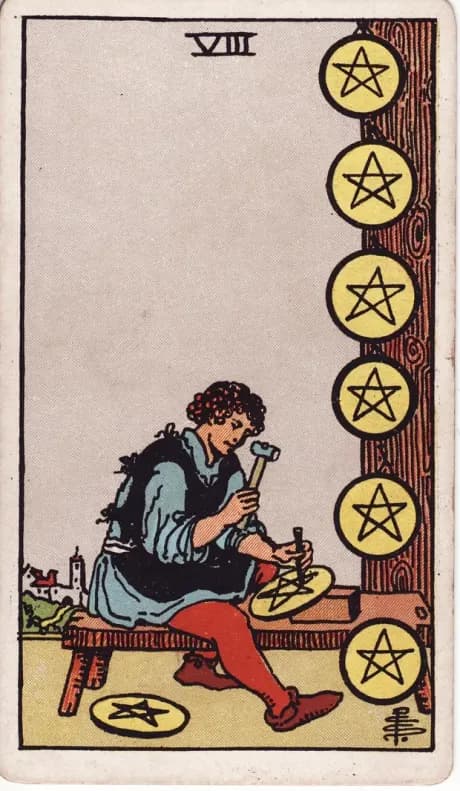
A craftsman sits at a bench carving the eighth identical coin, with seven finished beside him. The card's subject is repetition as mastery — training, diligence, the unglamorous middle where skill is actually acquired.
Upright it means deliberate practice. Not talent and not inspiration: the specific, boring, cumulative activity that converts an ability into a competence. It is the deck's clearest argument that quality is a quantity of attempts.
Reversed the effort loses its direction. Perfectionism that never ships, motion without improvement, or work that has expanded to fill a life that used to contain other things. The reversal is rarely about laziness and almost always about effort pointed badly.
Outside the personal, the card is literal. In work it is apprenticeship, training, the tenth draft. In study it is the phase after the interesting part where the actual learning happens. In money it is income earned by labour rather than by luck. In health it is the routine that only works because it is repeated.
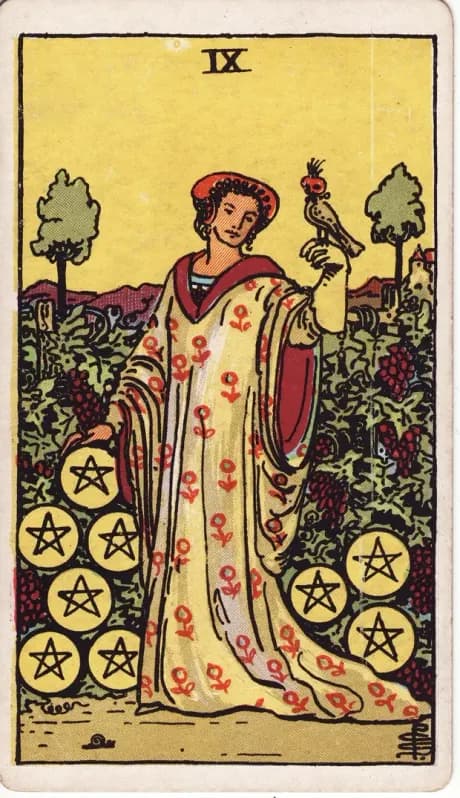
Among the Pentacles, the eight is the suit's engine. The Ace offers, the Seven assesses, the Nine enjoys the result. Eight is the part in between that produces all of it, and it is the only card in the sequence where anyone is depicted actually working.
The card's underlying claim is worth stating plainly because it applies far beyond craft: most things that look like ability are accumulated repetition, and most people abandon them somewhere around the fourth coin, at the point where the work has become dull and the skill is not yet visible.
Eight of Pentacles as a yes or no
As a yes or no, the Eight of Pentacles is a yes with a condition: yes, if you do the work. The card does not describe an outcome that arrives on its own, and reading it as a straight yes sets a querent up to be disappointed by their own inaction.
In practice it is one of the more encouraging cards to receive, because the condition is entirely within your control. Where other conditional yeses depend on someone else's decision or on timing you cannot influence, this one depends on repetition you can start today.
For a relationship question the translation is direct: this can work, and it will require deliberate effort rather than compatibility. Some querents hear that as a downgrade. It is the opposite — a yes that depends on effort is more reliable than one that depends on chemistry, because effort can be sustained deliberately and chemistry cannot.
Reversed it becomes a no, and the reason is misdirected effort rather than insufficient effort. Someone is working hard on something that is not the problem. That reading is worth delivering carefully, because the querent is usually exhausted and hearing "no" as "you did not try", when the card is actually saying the trying went somewhere it could not help.
On timing, this suit is slow and this card is the slowest part of it: the answer arrives through accumulation.
Eight of Pentacles as advice
As advice, the Eight of Pentacles says: get better at this specific thing, deliberately, and keep doing it after it stops being interesting. The card is the deck's plainest instruction and the one most often skipped, because it recommends the least dramatic action available.
Concretely, pick one thing rather than several. One recurring argument handled differently. One habit changed and kept for a month. One skill practised on a schedule. The card's power is entirely in the narrowness — attention divided across five improvements produces five abandoned improvements.
The second instruction is about the phase people quit in. The craftsman is on his eighth coin, and the eighth is dull. That is precisely where skill is being acquired and precisely where it is invisible, which is why almost everyone stops there and concludes they were not suited to it. If the thing you are doing has become boring and you cannot yet see the result, this card says you are exactly where the work happens.
Reversed, the advice is to check the target before adding more effort. You are working hard. The question is whether you are working on the actual problem, and the honest answer is often no. Ask the person what would help rather than continuing to improve the thing you decided was the issue.
Eight of Pentacles as an outcome
As an outcome, the Eight of Pentacles is competence earned. The situation ends with you better at something than you were, and with that improvement being the actual result rather than a side effect. It is one of the deck's most durable outcomes because nothing can take it back.
In love questions it usually means a relationship that works because both people learned how to do it. That is a less romantic result than the one people hoped for and a considerably more stable one. It can also mean the outcome is that you become someone capable of the relationship you want, which frequently precedes getting it.
The card also appears as an outcome where the situation resolves through steady work rather than through any event. Nothing dramatic happens. The problem is not solved by a conversation or a decision but by three months of doing something differently, and at the end of it the problem has quietly stopped existing.
Reversed as an outcome is effort that does not pay. Work done, and done in the wrong place or without heart, ending in exhaustion and a situation unchanged. This is a genuinely unhappy result and it carries specific information: the failure was not of commitment, and repeating the same effort harder will produce the same outcome again.
What the Eight of Pentacles card shows
The 1909 card shows a young man sitting on a low wooden bench, working a golden coin with a hammer and chisel or burin. He wears a leather apron over a red tunic. His head is bent and his full attention is on the coin in his hands.
Beside him is a wooden post or tree trunk, and six finished coins are nailed to it in two columns, one above another. A seventh lies on the ground at his feet, propped against the base. The eighth is the one he is working on.
The arrangement is the argument. The finished coins are identical — there is no visible improvement from the first to the sixth — and yet he is making another. That is the picture's claim about mastery: it does not look like progress while it is happening, and the repetition is the method rather than a sign that something is going wrong.
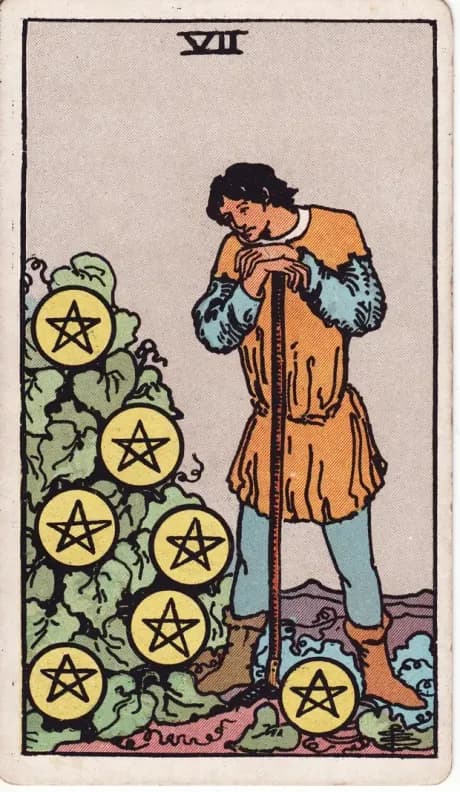
The coin at his feet is unmounted and slightly apart. Read alongside the Seven of Pentacles, where a single coin also lies on the ground, it is the same idea in a different register: something completed and set down while the work continues.
In the background, a path leads away to a small town under a pale sky. The town is drawn distant and small. He is working outside it, alone, in the direction away from company — the card's note about what sustained practice costs socially.
His posture is bent, close, and entirely absorbed. He is not looking at the finished work, the town or the viewer.
Frequently asked
What does the Eight of Pentacles mean in love?
+
A relationship treated as a skill rather than a compatibility — deliberate practice, one thing improved at a time. It is the card of the person who remembers what you said once and adjusts, which accumulates into something intensity does not reach.
Does the Eight of Pentacles mean someone is working on themselves?
+
Often, yes, and genuinely — this is the card of the person actually in therapy rather than the one who says they have changed. Verify by watching the situation that used to defeat them, because skills show up under load.
Is the Eight of Pentacles a yes or a no?
+
A yes with a condition: yes, if you do the work. The condition is entirely within your control, which makes it more reliable than a yes depending on chemistry. Reversed it is a no of misdirected effort, not insufficient effort.
What should I do when I draw the Eight of Pentacles?
+
Pick one thing and repeat it past the point where it stops being interesting. Attention split across five improvements produces five abandoned improvements. The dull phase is where the skill is actually acquired and where almost everyone quits.
Why are the finished coins identical in this card?
+
Because that is the point about mastery: it does not look like progress while it is happening. Six finished coins show no visible improvement, and he is making a seventh anyway. The repetition is the method, not evidence that something is wrong.