What Eight of Cups means in tarot — and in love
The Eight of Cups is the dignified exit: walking away from something emotionally incomplete — not out of hate, but because staying has started to cost… As feelings, the Eight of Cups means emotional withdrawal — they are detaching, possibly preparing to leave, or already gone in spirit.
Jump to FAQAt a glance
- Yes or no
- No — reversed flips it
- Element
- Water
- Upright, in a line
- walking away from what no longer fills you
- Reversed, in a line
- fear of leaving, one more try
Want a yes or no on your own situation rather than this card? Pull one card and get the verdict with the reason behind it.
Ask your own yes-or-no questionIn the Golden Dawn tradition this card rules 0–10° of Pisces. A planet standing at that degree is read through it: Venus in Pisces · Moon in Pisces · Mars in Pisces
Upright in love
The Eight of Cups is the dignified exit: walking away from something emotionally incomplete — not out of hate, but because staying has started to cost more than it returns. It is leaving the situationship that never defines itself, or the person who almost loves you. If you asked whether you should go, the card shows you already packing. What you are looking for is not in that harbour.
What makes this card hard is that nothing in the picture is broken. No cup is spilled. There was no betrayal, no fight that settled it, no single event you can point to when people ask why. On paper the case for staying is intact, and that is exactly the situation the Eight of Cups describes: something that works well enough to defend and not well enough to live inside.
In a new connection it usually means several months of warmth with no definition, and a growing private certainty that definition is not coming. The card does not ask you to prove that the other person did something wrong. It says the proof you are waiting for will not arrive, because there is nothing to prove. They are not cruel. They are simply not going any further, and you have already read that correctly.
In an established relationship the reading is more careful. Sometimes it means the whole thing ends. Often it means a version of it ends: a role you have been playing, an arrangement about who carries the emotional work, a routine that quietly replaced the thing it was supposed to serve. Walking away from the shape is not the same as walking away from the person, and this card can mean either.
What it asks you to do is go without the speech. The figure on the card delivers no explanation and waits for no agreement. You are allowed to leave something that is fine. Wanting more is a sufficient reason, and it is the only reason this card offers you.
Reversed in love
Reversed, the Eight of Cups is the hesitation in the doorway: knowing it is time and staying anyway, or leaving and drifting back for one more almost. Fear of the unknown keeps renegotiating with something you already outgrew. Either recommit properly or actually go — half departures cost double.
The reversal does not turn the situation bad. It stops the walking. Everything the upright card describes is still true — the thing is still incomplete, you still know it — and the only difference is that the movement has been suspended. That is why reversed often feels heavier than upright. Upright is difficult and finished. Reversed is difficult and ongoing.
There is a good version of this, and it gets missed because the phrase illusion of change sounds better than it is. Sometimes reversed means you turned around on purpose. You looked at the exit honestly, decided the thing was worth another attempt, and stayed with your eyes open. That is a real choice and it reads as a strong card. The test is whether anything actually changed when you stayed. A decision to stay that changes nothing is not a decision, it is a delay with better wording.
There is also a version where the reversal warns against leaving too early. Restlessness can dress itself up as growth. If you have a pattern of walking out of things at the same point — around the time they stop being new and start requiring maintenance — this is the card that notices the pattern. The problem there is not the current situation. It is that you have never stayed long enough anywhere to find out what comes after the difficult part.
Which of the three you are looking at is usually obvious to the person asking. One describes fear, one describes care, one describes habit. You know which one you are doing.
Eight of Cups As feelings
As feelings, the Eight of Cups means emotional withdrawal — they are detaching, possibly preparing to leave, or already gone in spirit. It is quiet, not dramatic. The absence of a fight is itself the message.
The withdrawal is rarely aimed at you as punishment, which is what makes it so hard to read and almost impossible to argue with. It lands differently in each of the four situations people ask about.
If you are single and asking about someone new. They are pulling back, and it probably began before you noticed. There was interest and it has been spent. The card does not say they found somebody better. It says they have concluded, privately, that this is not what they were looking for, and they are unlikely to announce that conclusion — this card does not do announcements.
If you are in a relationship. They are still present and something has left. Look at what stopped rather than at what was said: the small unnecessary contact, the plans made more than a week ahead, the willingness to argue. People who are staying argue. People who have decided go quiet and become unusually easy to be around.
If you are asking about an ex. They have moved on in the specific sense this card means. Not indifferent, not over you, simply no longer walking in your direction. They may remember the whole thing warmly. Warmth and return are different states, and the Eight of Cups separates them cleanly.
If you are asking about someone long-term. This is the version worth catching early. They are not leaving. They are drifting, and the drift points at something they could not name if you asked them. Named now it is often fixable, because what they are walking away from is usually a pattern rather than a person. Left alone another year it becomes the upright card, and by then the figure is already on the hill.
Eight of Cups For your ex
For an ex, the Eight of Cups usually confirms departure: they walked away to find something, and this card tends to keep walking. If they come back, ask what changed in them — the card only respects returns with new self-knowledge attached.
The particular cruelty of this card is that it does not hand you a villain. They did not leave because you failed. They left because whatever they were looking for was not there, and it may not have been anywhere near you. That is harder to sit with than betrayal in some ways, because there is nothing to correct and nobody to be usefully angry at.
It also means the leaving was not sudden to them. By the time it became visible to you it had been decided for a while. People go back through the final months hunting for the moment it turned, and this card says there was no moment. There was a slow accumulation, and then a morning when the accumulation became a decision.
Whether they return depends on one thing, and it is not how much they miss you. It is whether they found what they went looking for. If they did, they come back as a different person, and the old arrangement is not available to be resumed — only replaced by something built from scratch. If they did not find it, the return is a retreat, and retreats are unstable. The same restlessness that emptied the harbour the first time is still on board.
What the card asks of you is unglamorous. Stop reconstructing the ending. It was not a puzzle, and solving it would not have kept them.
What Eight of Cups means in general
A figure walks away from eight stacked cups, up a hill, at night, without looking back. Nothing in the scene is broken, and that is what makes the card difficult. Its subject is the deliberate departure from something that still works but no longer satisfies: a job, a city, an arrangement everyone else considers good enough.
Upright it says the leaving is correct and the timing is now, and that no further explanation will be forthcoming. Reversed the departure is stalled — circling the exit, going and returning, or abandoning something that deserved another attempt.
In work it is the resignation written before the next position exists, and the card is unusually unbothered about that sequence. In money it marks the point where somebody stops defending a plan that has been quietly failing for a year. In creative life it is the project you have to abandon in order to get anywhere, which is the hardest kind to abandon, because unfinished work keeps making a case for itself.
Eights across the deck are about effort applied under pressure. The Eight of Wands moves fast. The Eight of Swords is held still by belief. The Eight of Pentacles repeats a skill until it becomes real. The Eight of Cups spends its effort on subtraction — here the leaving itself is the labour, and it is genuinely laborious.
The card carries no judgement about what is being left behind. The stack is neat and clearly valuable. Whatever was built was built properly. It simply turned out to be incomplete in a way that no amount of further building was going to fix, and the only honest answer to that is distance. Nobody in this picture is being punished. Someone has finished measuring, and gone.
Eight of Cups as a yes or no
As a yes or no, the Eight of Cups is a no to continuation and a yes to leaving, and which of those you get depends entirely on how you phrased the question.
If you asked whether something will continue, whether they will stay, whether waiting will improve it — the answer is no. The card describes a departure already underway, and waiting is the single strategy it rules out. If you asked whether you should go, whether it is time, whether walking away is justified — the answer is yes, plainly, and this is one of the few cards that gives permission without attaching conditions to it.
Reversed it is a no in both directions. The situation is stalled: nobody is leaving and nothing is being repaired. A reversed Eight of Cups on a yes-or-no question usually means the answer has not been decided by anyone yet, including you, and the deck is declining to decide it on your behalf.
Because the card splits so cleanly on phrasing, it is a good argument for asking better questions. Will he come back gets a flat no here and tells you almost nothing. What would have to be true for this to be worth returning to gets an answer you can act on. The Eight of Cups is a card about movement, so movement questions suit it. Verdict questions get a verdict that is technically accurate and practically useless, which is the worst combination a reading can produce.
Eight of Cups as advice
As advice, the Eight of Cups says go. Not dramatically, not with a final conversation that settles everything, not once you have collected enough evidence to justify the decision to an audience. Just go.
The concrete form depends on what you are standing in. If it is undefined, stop being endlessly available while you wait for it to define itself — your availability is the thing keeping it comfortable for everyone but you. If it is a relationship, the first move is often not leaving the relationship but leaving the pattern: decline the role once, and watch what happens to the room. If it is a job or a city, start the practical work now, before you feel ready, because feeling ready is not a stage this card includes.
The second instruction concerns the explanation. You are going to want to be understood. The card advises against spending much on that. Explanations addressed to someone who benefits from your staying get negotiated, and negotiation is how three more months disappear. Say the short true version once, then let the leaving be the argument.
Third, and least popular: do not line up the replacement first. The figure walks toward mountains, not toward another town. This card is honest that the next thing is not visible from where you stand, and it still says walk. If you can only leave once you know what is on the other side, you will not leave.
Reversed, the advice inverts. Stop half-going. Either commit properly, with something actually different about the arrangement, or stop rehearsing an exit you keep declining to take. The rehearsal costs more than either real choice would.
Eight of Cups as an outcome
As an outcome, the Eight of Cups means the situation ends by somebody walking away from it. Not exploding, not resolving, not being forced. Walking. Whatever you are asking about reaches a point where continuing stops making sense to one of the people inside it, and that person leaves.
Most often that person is you. As a result this card tends to describe your own decision rather than something done to you, which reads harsher than it is — an outcome you choose is one you can time and shape, and this one usually arrives with less drama than expected. The people around you will be more surprised than you are.
When it describes the other person leaving, the tell is that no confrontation is attached. The Eight of Cups ending is quiet. There is no scene to remember afterwards, which is one reason it is difficult to grieve properly. Nothing gave the ending a shape.
The card also says something about what comes next, and it is deliberately vague: the thing being sought exists, and it is not here. That is the entire promise. No estimate of how long the walk takes, no picture of the destination, no assurance you will like the mountains once you reach them.
Reversed as an outcome is stalling rather than staying. The situation ends unchanged: nobody goes, nothing improves, and the arrangement survives on nobody being willing to end it. Occasionally reversed means a genuine return, done deliberately and repaired. The difference shows in whether anything about the arrangement is different afterwards, and you can usually tell already.
What the Eight of Cups card shows
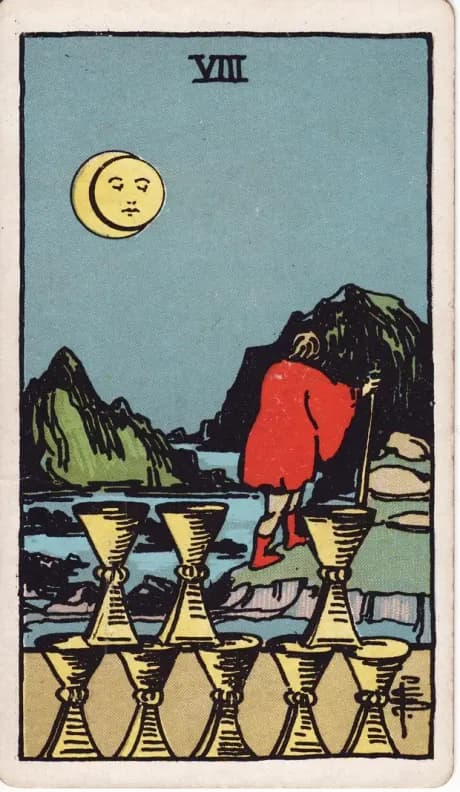
The 1909 card shows a figure in a red cloak and red boots, seen from behind, climbing away from the scene with a staff in hand. Red is the colour of will in this deck, and it matters that the traveller is dressed in it. This is not collapse and not exile. It is a decision being carried out by someone who still has energy left.
In the foreground stand eight golden cups, and the arrangement is the whole argument of the card. Five sit in a row along the bottom, three are stacked above them, and there is a gap in the upper row where another would go. Nothing is spilled. Nothing is knocked over. The cups are neat, upright and clearly valuable, and the only thing wrong with them is that something is missing from the top. The card is precise about this. What is being left behind is not damaged, it is incomplete.
Between the cups and the mountains lies water, a river or inlet the figure has to cross. The element of the suit sits directly in the path out of it, which is the picture saying that you do not leave an emotional situation by feeling less.
Above, the moon hangs in eclipse, a crescent laid over a full disc, with a faint face on it looking down. The light is partial by design. The figure is not walking in daylight and does not have the full picture; the guidance available here is intuition, and it is enough to start on.
The ground underfoot is bare rock, rising. The back is turned, there is no gesture of farewell, no last look, and nobody in the frame is watching them go. The departure has no audience, which is exactly what makes it credible.
Frequently asked
Does the Eight of Cups mean I should leave?
+
It signals that what you are looking for is somewhere else, and that part of you already knows. Departures made under this card tend to age well. It does not require the other person to have done anything wrong — wanting more than this is a sufficient reason, and it is the only reason the card offers.
Will they come back after the Eight of Cups?
+
Unlikely soon. This is committed walking-away energy, and the decision was usually made long before it became visible. Returns happen only after genuine inner change, and the way to test one is simple: ask what they found while they were gone. A return with no answer to that question is a retreat, not a reunion.
Is the Eight of Cups a yes or a no?
+
It depends on the question. A no to continuation — will they stay, will waiting help, will this improve on its own. A yes to leaving — is it time, am I right to go. Reversed it is a no both ways, because nothing is moving in either direction and the decision has not actually been made yet.
What should I do when I draw the Eight of Cups?
+
Take one concrete step toward the exit rather than one more step toward certainty. Certainty is not coming. Stop being automatically available, decline the role you have been playing, or begin the practical work of going. And skip the long explanation — it gets negotiated, and negotiation is how another season disappears.
Does the Eight of Cups always mean a breakup?
+
No. Often what ends is a version of the arrangement rather than the arrangement itself: a role, an imbalance, a routine that replaced the thing it was meant to serve. The card describes leaving something incomplete behind, and sometimes the incomplete thing is a pattern that two people can walk out of together.