What Four of Cups means in tarot — and in love
The Four of Cups is love offered to someone staring elsewhere: apathy, emotional burnout, a good option ignored because the heart is busy sulking over… As feelings, the Four of Cups means disengagement — they feel flat, distracted, wrapped in their own weather.
Jump to FAQAt a glance
- Yes or no
- No — reversed flips it
- Element
- Water
- Upright, in a line
- apathy, missing the love being offered
- Reversed, in a line
- waking up to an opportunity in front of you
Want a yes or no on your own situation rather than this card? Pull one card and get the verdict with the reason behind it.
Ask your own yes-or-no questionIn the Golden Dawn tradition this card rules 20–30° of Cancer. A planet standing at that degree is read through it: Venus in Cancer · Moon in Cancer · Mars in Cancer
Upright in love
The Four of Cups is love offered to someone staring elsewhere: apathy, emotional burnout, a good option ignored because the heart is busy sulking over an old one. If you asked why they seem indifferent — they're withdrawn into themselves, not necessarily rejecting you. And if the meh one is you: look again at the cup being held out. Boredom misses miracles.
What the card describes is not rejection, and it is not sadness exactly. It is the state where the receptors are down. Something happened earlier — a disappointment, a long stretch of too much of the same thing, a person who took more than they gave — and attention quietly stopped going outward. From the inside it feels like nothing is good enough. From the outside it looks like being ignored.
In a new connection this usually means one of you is not registering the other. If it is them, pushing harder is the wrong tool: the offer is not being weighed and declined, it is not being seen at all. If it is you, the honest question is whether this person is genuinely wrong or whether nobody has felt like anything for a while. Those two produce the same shrug and require opposite responses.
In an established relationship it is one of the most accurate cards in the deck and one of the least dramatic. Nothing is wrong. That is the complaint. The relationship is functional, familiar and unregarded, and the small daily offers a partner is still making have stopped being counted because they arrive every day. Contempt is not the risk here. Blindness is.
The instruction is not to cheer up. It is to look at what is actually in front of you and say what it is. Name the three cups you already have. Then decide honestly about the fourth, because the card's real cruelty is that an offered hand does not stay out forever, and the person holding it is receiving your silence as an answer.
Reversed in love
Reversed, the Four of Cups is the wake-up: apathy lifting, renewed interest in what was tuned out, readiness to accept the offer previously waved away. Someone snaps out of their fog and notices what's been standing there. Second looks under this card tend to land — take yours.
It is worth being precise about what changes, because "apathy lifting" makes it sound like a mood improving. What actually changes is attention. The card turns and the person in it looks up. Whatever was in front of them the whole time becomes visible, and its value does not need to be argued — it was never in doubt, it was outside the field of vision.
In a connection this often shows up as somebody coming back into contact after a flat stretch, and coming back specifically. Not a general reappearance: a message about something particular they noticed. That specificity is the tell. Withdrawal ends with detail.
There is a second reading that is quieter and gets missed. Reversed, the card can mean the withdrawal was necessary and is not finished. Some people need to be uninterested in everything for a while, and pulling them out early does not work; it only moves the fog somewhere else. Under this version the reading is patience with a limit on it, not permanent waiting.
And a harsher one. Occasionally the reversal means the cup was withdrawn. The offer had a duration, the duration ran out while nobody looked up, and the person waking now is waking to an empty hand. That is not a punishment. It is what offers do.
Either way, reversed the card puts the initiative inside the person who checked out. Nobody wakes anybody else up.
Four of Cups As feelings
As feelings, the Four of Cups means disengagement — they feel flat, distracted, wrapped in their own weather. It's rarely about your worth; their receptors are down. Don't pour your best wine for a closed mouth.
That is a hard reading to receive, so it is worth separating the situations, because flatness means different things depending on where it came from.
If you are single and asking about someone new. They are not thinking about you much, and that is the whole message. It is rarely dislike; there is usually nothing sharp enough in it to be dislike. Their attention is elsewhere — work, a previous person, a private difficulty — and you are one of the things arriving at a closed door. Interest here can return, but it returns from inside them. Nothing you send speeds it up, and volume makes it worse.
If you are in a relationship. They have stopped noticing. The feeling underneath is usually not resentment but satiety: they have you, they are used to having you, and the fact of you has moved into the background where the furniture is. This is repairable and it is not repaired by argument. It is repaired by something that breaks the pattern of the day.
If you are asking about an ex. They are numb rather than longing. The card is clear that this is not pining — there is no ache in it, no torch being carried. They have folded the whole thing away and are not looking at it. That is worse news than grief and better news than hatred.
If you are asking about someone long-term. Fatigue rather than a change of heart. The feeling has not gone; the ability to feel it has thinned out. People in this state often cannot tell you what is wrong because nothing is wrong, and that answer, given honestly, is worth more than a manufactured explanation.
In all four the constant is the same. The Four of Cups describes attention, not affection. What has gone is the looking.
Four of Cups For your ex
For an ex, the Four of Cups suggests emotional fatigue rather than new love: they're not pining, not chasing, just withdrawn. Reconnection requires them to wake up on their own — external noise, including yours, mostly annoys.
The distinction that matters here is between someone who has moved on and someone who has switched off. This card is the second. There is no new person in the picture and no resolution either; they have simply stopped engaging with the subject. If you have been reading their silence as strategy, it is almost certainly not strategy. It is nothing at all, which is harder to argue with.
Practically, this means the usual instruments do not work. A carefully written message lands in a closed room. A reminder of the good part does not create interest; it creates one more thing they do not have the appetite to answer. People in a Four of Cups state find effort aimed at them mildly irritating, which is unfair and is what the card says.
If there is a way back it looks like this: they wake up on their own, notice the absence rather than the person, and reach out with something specific in hand. Until then the only thing that changes the situation is time, and the only thing you control is whether you spend it waiting. Waiting is a choice with a cost attached, and this is one of the cards most often drawn by people who have been paying that cost for a long time.
What Four of Cups means in general
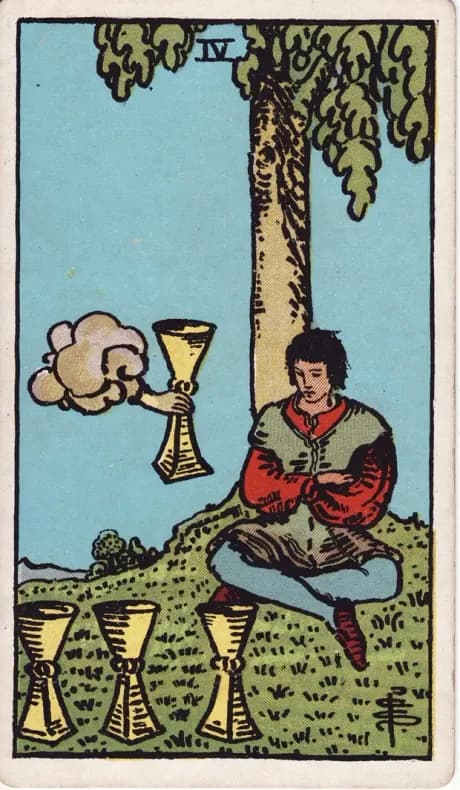
A figure sits under a tree with three cups ignored in front of him while a hand offers a fourth. The card's subject is dissatisfaction that has become a habit of attention: what is on offer is not registering, because the looking has stopped. It covers apathy, boredom, and the withdrawal that follows a disappointment. Upright it says the opportunity is present and being overlooked, and that the problem is perception rather than supply. Reversed the fog begins to clear — re-engagement, an offer finally noticed, curiosity returning — or the deeper reading: the withdrawal was necessary and is not yet finished.
Fours in this deck are stability. The Four of Wands is celebration on solid ground, the Four of Pentacles is holding tight, the Four of Swords is deliberate rest. Stability is the achievement of the number and also its hazard, and this is the version where the achievement has gone stale. Nothing is failing. That is exactly the complaint.
At work it is the competent, adequate, entirely tolerable job that has stopped producing any signal at all — and, beside it, the message left unopened for eleven days because opening it would require caring about something. It is the meeting where you are physically present and have not heard a sentence since it began. The card is not saying the work is bad. It is saying the person doing it has stopped looking at it.
In creative work it is the stage after a project that did not land, when new ideas arrive and none of them registers as interesting. Everything looks like a smaller version of something already done. Around money and possessions it describes having enough and feeling nothing about it, which is a real and unremarkable condition rather than an ingratitude problem.
The tell, in any of these, is arithmetic. Ask what is actually available right now and count it out loud. If the count comes out higher than the feeling, the card is describing perception. If the count comes out genuinely low, this is a different card and the answer sits somewhere else in the spread.
Four of Cups as a yes or no
As a yes or no, the Four of Cups upright is a no, and one of the more specific noes in the deck. It is not a refusal from outside and it is not an obstacle. It is a no produced by disengagement: the thing you are asking about is available, and nobody is picking it up.
That distinction matters because it changes what the no means. Most no cards describe something blocking. This one describes something being declined by default, through inattention rather than decision. If you asked whether they will reach out, the answer is not yet, because reaching out requires an interest that is currently switched off. If you asked whether an opportunity will come to you, the answer is that it already has.
Reversed it flips to yes. The attention returns, the offer is finally seen, the person looks up. Reversed Four of Cups is one of the cleaner yes cards for questions about renewed contact and second chances, because that is literally the picture: something that was in front of somebody the whole time being noticed at last.
There is a warning attached to the upright no, and it is worth carrying. This no has an expiry date built into it. The hand in the picture is holding a cup out, and hands get tired. If you are the one being offered something, the honest question is not whether the answer is yes or no. It is how much longer the offer stands while you decide not to look.
Four of Cups as advice
As advice, the Four of Cups says look up and count. Not think positively — count. Write down what is actually in front of you right now, in plain items, and read the list. The card's entire claim is that the list is longer than the feeling, and a list is the only way to check that, because a mood cannot audit itself.
Then deal with the offered cup. Somewhere in this situation there is something being held out — an invitation, a message, an opening, a person who has made themselves available twice. You know which one it is. The advice is not to accept it. It is to look at it directly and give an answer, because what this card describes is not refusal, it is the endless deferral that feels like refusal to everyone else involved.
If the flatness is genuine fatigue, the advice changes shape but does not disappear: rest deliberately, and put a date on it. Withdrawal that has been chosen ends. Withdrawal that merely continues becomes a personality.
One more thing, and it is the practical core. Change something small and physical. This card responds badly to insight and well to disruption — a different route, a room rearranged, one plan made with someone for a specific day. Attention comes back through the body long before it comes back through analysis.
Reversed, the advice is simply to act on what you have just noticed, quickly, while you can still see it.
Four of Cups as an outcome
As an outcome, the Four of Cups ends in stalemate with something still on the table. The situation does not collapse and it does not resolve. It arrives at a point where an offer is present, the person who should take it does not, and everybody stays exactly where they were.
In a love question this usually means no movement. They do not end it and they do not step forward. Contact may continue at a low, unsatisfying level, and the low level is stable — this is not a card that describes a situation about to break. It describes one that can hold this shape for a long time, because nothing in it is uncomfortable enough to force a change.
There is a version of this outcome that is genuinely fine. Sometimes the Four of Cups as an ending means a period of withdrawal that has run its course honestly: you stop pursuing, the noise stops, and the outcome is quiet rather than disappointing. Which of the two you are looking at is usually decided by whether the withdrawal was chosen or fallen into.
Reversed as an outcome is better and quite specific. It ends with somebody looking up. The offer gets taken, contact resumes, interest returns from a real source rather than from pressure. Reversed, this is one of the more reliable cards for the ending where a thing that had gone flat starts again — not restored to what it was, but noticed again, which is the part that had actually gone missing.
What the Four of Cups card shows
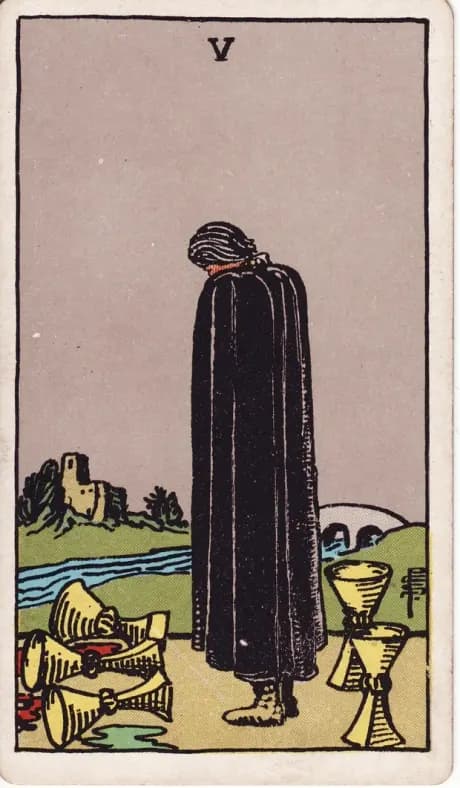
The 1909 card shows a young man sitting on the ground beneath a broad green tree, on a small rise. His arms are folded across his chest and his legs are crossed. Every joint in the picture is closed. Nothing about the posture is aggressive; it is the posture of someone who has stopped receiving.
Three golden cups stand on the grass in front of him, in a neat row. They are upright, full and untouched. This is the detail the card lives on: nothing has been lost. The situation contains three intact cups and one dissatisfied man, and the picture makes no attempt to explain the gap between those two facts.
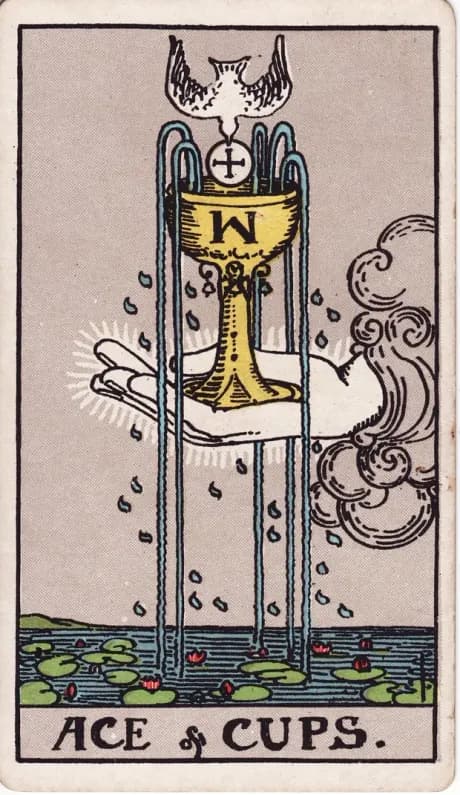
A fourth cup is offered by a hand emerging from a grey cloud on the left. That hand is the deck's own recurring gesture — it appears in all four Aces, and each time it means the same thing: something arriving from outside, unearned and unrequested. The Four of Cups is the card where the gift is on offer and not being taken. Placing it in a cloud rather than in a person's hand matters too. Nobody is standing there to be refused, which is precisely why it is easy to refuse.
His eyes are lowered toward the three cups, not raised to the fourth. He is looking at what he already has and finding it insufficient, which is a stranger and more accurate depiction of dissatisfaction than staring into space.
The setting is mild and pleasant — green, sheltered, safe, with hills behind. There is no threat anywhere in this card, no ruin, no storm, no other person. The problem is entirely internal, and the artwork pointedly refuses to give it an external cause.
Frequently asked
Does the Four of Cups mean they're not interested?
+
It means checked out — apathy or inner fog rather than active rejection. There is usually nothing sharp enough in it to be dislike; their attention is elsewhere and you have arrived at a closed door. Interest can return, but only from inside them, and pushing harder reliably delays it.
What should I do with the Four of Cups in love?
+
Stop over-offering to the distracted. Tend your own cup; renewed attention comes when they wake, not when you pour harder. And if the checked-out one is you, the move is to count what is actually available before deciding it is not enough.
Is the Four of Cups a yes or a no?
+
Upright it is a no, produced by disengagement rather than by any obstacle — the thing is available and nobody is picking it up. Reversed it is a yes, and a good one for questions about renewed contact, because reversed is literally the moment the offer is finally seen.
What should I do when I draw the Four of Cups?
+
Look up and count. Write down what is actually in front of you, in plain items, and read the list. Then find the offer you have been deferring an answer on and answer it. Change one small physical thing — a route, a room, a plan on a specific day. This card responds to disruption, not to insight.
What is the fourth cup in the Four of Cups?
+
Whatever is being offered and not looked at. In the artwork it is held out by a hand from a cloud, the same gesture the deck uses in all four Aces for something arriving unearned. In a reading it is usually ordinary and already present: an invitation, an unanswered message, a person who has made themselves available more than once.