What The Hermit means in tarot — and in love
The Hermit in love is honest solitude: someone needs space to hear their own heart — maybe them, maybe you. As feelings, the Hermit means they feel the need to step back and process — feelings exist but are being examined in private.
Jump to FAQAt a glance
- Yes or no
- No — reversed flips it
- Upright, in a line
- soul-searching before loving, needing space
- Reversed, in a line
- isolation, loneliness disguised as independence
Want a yes or no on your own situation rather than this card? Pull one card and get the verdict with the reason behind it.
Ask your own yes-or-no questionUpright in love
The Hermit in love is honest solitude: someone needs space to hear their own heart — maybe them, maybe you. It's the healing-era card: learning what you actually want before handing anyone the map. If you asked why they're distant, they've gone inward, and it likely isn't about you. Lanterns can't be rushed downhill.
The card arrives as bad news and usually is not. It is the only card in the deck that treats absence as work rather than as loss. Somebody has stepped out of the noise on purpose, and the purpose has a subject, and the subject is very often not the person asking. That is hard to believe while it is happening, because silence from someone you want reads as a verdict about you no matter what caused it.
If you are single, the Hermit frequently is not about a person at all. It says the useful move right now points inward: work out what you are actually looking for, because the pattern running through your last three attempts is visible from where you are standing and was invisible from inside them. When it does describe someone new, it describes a slow one. Private, self-contained, hard to read early, and considerably more serious than they look.
In an established relationship it means one of you has gone quiet, and the quiet is not a punishment. Telling the Hermit's silence apart from stonewalling matters more than anything else in this reading, and there is one reliable test. The Hermit says when he is coming back. A person who is processing tells you they are processing. A person who is avoiding says nothing and lets you fill it in.
What the card asks for is space with an edge on it. Not take all the time you need, which is generous, unlimited and useless to everybody. A named day to talk again. And while you wait, do your own version of the same work rather than sitting outside the cave listening for movement.
Reversed in love
Reversed, the Hermit warns the cave became a hiding place: isolation sold as independence, loneliness rebranded as standards. Or someone shuts you out to avoid a conversation they owe you. Space heals only when it has an exit. If you've been alone long enough to know the answer — come out and say it.
The reversal is a question about duration, not about solitude itself. Solitude is the whole point of the card. What flips it is time: the retreat outlasting its own purpose, and then quietly turning into the shape of a life.
One version is the person who has been alone so long that being alone has become the identity rather than the phase. The standards keep rising, the availability keeps shrinking, and every candidate fails a test that gets harder each year. From inside this feels like discernment. From outside it looks like fear with a good vocabulary.
The other version is somebody using the language of processing to avoid a conversation. Needing space is real and it is also the most respectable exit line available, which is exactly why it gets borrowed. The tell is the same as it is upright, in reverse: no end date, no update, no acknowledgement that anyone is waiting. Processing has a shape. Avoidance just has a duration.
There is a third reading and it is the one people least want. Reversed, the Hermit sometimes means the withdrawal is yours and it should end. You already know the answer. You have known it for weeks, and you are still calling the knowing part unfinished because finishing it means saying it to someone's face.
The instruction in all three cases is the same and it is small. Set a date. Solitude with a date on it is work. Solitude without one is just where you live now.
The Hermit As feelings
As feelings, the Hermit means they feel the need to step back and process — feelings exist but are being examined in private. Their silence is a workshop, not necessarily a verdict. What that looks like from your side depends entirely on what you are asking about.
If you are single and asking about someone new. They are interested and they are being careful, and the care is slowing everything down. This card describes someone who thinks before answering, who will not perform enthusiasm they do not yet feel, and who is quietly building a real opinion of you rather than an instant one. It is a bad card for fast momentum and an unusually good one for accuracy. Whatever they eventually say, they will mean it.
If you are in a relationship. They have gone inward and it is probably not about the two of you. Work, family, some private reckoning about who they are turning into — something is taking up the room. The feeling toward you has not changed. Their capacity to demonstrate it has, temporarily, and asking them to demonstrate it right now is asking for the one thing currently unavailable.
If you are asking about an ex. They are thinking about it alone, seriously, and without any intention of telling you. This is the card of the person who reviews the relationship in their head on long walks and never sends the message. Something real is happening in there. Nothing about it is aimed at you yet, and it may never be.
If you are asking about someone long-term. The feeling has gone underground rather than away. Long partnerships produce quiet stretches where one person is essentially living inside their own head for a season. It is not a warning. It becomes one only if nobody names it and both of you get used to the silence.
In all four, the Hermit is the least performative card in the deck. Anyone waiting for a demonstration will conclude there is nothing there, and be wrong.
The Hermit For your ex
For an ex, the Hermit says they're reflecting on the relationship at their own pace, out of view. Chasing them into the cave backfires. If they emerge with clarity, you'll know; meanwhile, do your own lantern work.
The useful thing about this card in an ex question is that it is honest in both directions. Yes, they are genuinely thinking about it, and no, the thinking is not a countdown to a message. Reflection is not an intention. People can carry a considered, even affectionate understanding of an old relationship for years while doing absolutely nothing about it, and this card describes exactly that state without dressing it up.
Pursuit is worse than useless here. It is specifically counterproductive, because the Hermit's process runs on not being observed. Every message you send moves them from thinking about the relationship to managing you, and the first is what you want while the second is what you get. The cave has one door and it opens outward.
What you can watch for is a change in kind, not in frequency. The Hermit emerging does not send a vague late message; that is a different card and usually a worse one. He comes down the hill and says something specific, in daylight, with a conclusion attached. If what you are getting is fog, the process is still running.
Meanwhile the card is pointing at you too, and it means it. The same solitude available to them is available to you, and yours has the advantage of being under your control. Use the season. The worst outcome here is not that they stay in the cave. It is that you spend the whole winter outside it and come out with nothing of your own.
What The Hermit means in general
The Hermit is the ninth trump, and his subject is deliberate withdrawal for the sake of clarity. He stands alone on a summit holding up a lantern with a single star inside it. Nobody else is in the picture. The card's argument is that certain kinds of understanding cannot be reached in company, at any speed, no matter how good the company happens to be.
Upright it says the answer will not come from more input. You have already asked everyone worth asking, and a sixth opinion is not research, it is avoidance. Time spent apart is not time lost here. The withdrawal is also meant to end, because the lamp is held up rather than carried inside: this is the card of the genuine teacher, and equally of the moment you become one for somebody else without planning to.
Reversed the retreat has outlived its purpose. Solitude has hardened into a habit that calls itself independence, and the light is being kept for private use. The opposite reversal is just as common and easier to miss: refusing to withdraw at all when it is plainly required, filling every hour, canvassing everyone, staying too busy to hear the thing you already know.
Outside the personal questions the card is easy to spot. At work it is the person who disappears for two weeks and returns with the version that actually works, and it is equally the manager who cannot stop collecting opinions on a decision that was always theirs to make. In creative work it is the long unglamorous private stretch behind every finished thing, along with its failure mode, which is never showing anyone. In money it is the review nobody enjoys: an hour spent looking honestly at where things stand.
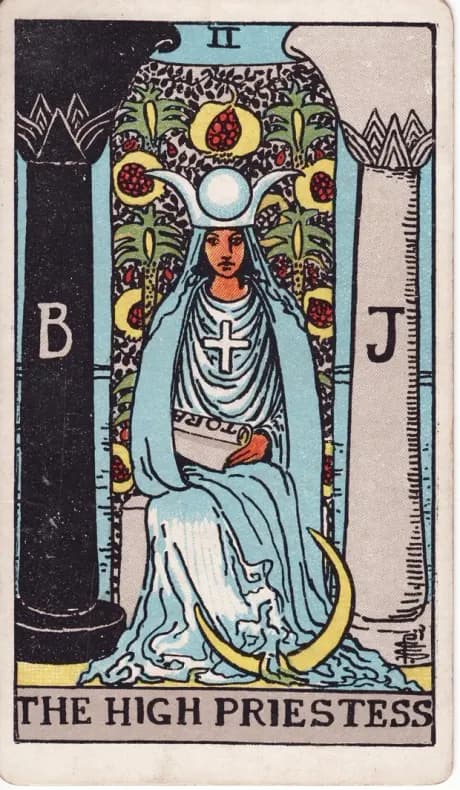
Compare him with the High Priestess. Her knowledge arrives unbidden while she sits still. His has to be walked to, uphill, alone, and it takes exactly as long as it takes.
The Hermit as a yes or no
As a yes or no, the Hermit upright is a no, and the honest phrasing is not yet. Nothing is being refused. Something is unfinished, and the card is saying that the answer exists further along a process that has not run its course, so forcing a verdict now produces a guess wearing a verdict's clothes.
This is one of the handful of cards that genuinely resists the format. The Two of Swords and the Hanged Man do the same thing. Where most cards lean one way, these describe suspension, and a suspended situation hands out false yeses as easily as false noes. Timing questions get the worst of it, because the Hermit's honest answer to how long is always longer than you hoped and never a number.
Reversed it is still a no, for a different and more useful reason. Reversed, the delay has stopped being productive. Either somebody is hiding rather than thinking, or the thinking finished a while ago and nobody has said so. That is a no about the current arrangement rather than about the thing you asked, and it comes with an instruction attached: the situation will not resolve while it stays private.
The better question, and the one this card answers cleanly, is what am I supposed to work out on my own here. Ask that and the Hermit is one of the most direct cards in the deck. Ask him to predict somebody else's decision and he will hold up a lamp, say nothing, and be completely right about how unsatisfying that is.
The Hermit as advice
As advice, the Hermit says stop consulting people and go and find out what you think. Not forever. Long enough to hear your own opinion without three other voices in it, which for most people is considerably longer than an evening.
The concrete version is unfashionable and it works. Put an hour aside with no phone in it. Write down the actual question — the real one, not the polite version you have been asking friends. Write the answer you already suspect. Most people find the writing part takes eleven minutes and the avoiding part took eleven weeks.
If other people are involved, tell them what you are doing and when you will be back. This single move converts your silence from something being done to them into something being done for a reason. Nobody minds a week. Everybody minds an open-ended disappearance, and the difference between them is one sentence.
Stop taking advice for the duration, including the well-meant kind. The Hermit's specific claim is that more input is now making the picture worse, not better. Every additional opinion you collect gives you another voice to argue with instead of a decision.
If the card is pointing at somebody else's withdrawal rather than yours, the advice is harder: leave them alone and use the time. Not as a tactic, which they will feel, but genuinely. Chasing someone into their own head has never once produced what the chaser wanted.
And there is an end to this. The lantern is raised, not hidden. When you have the answer, bring it down and say it out loud to the person it concerns. A conclusion nobody ever hears is indistinguishable from never having reached one.
The Hermit as an outcome
As an outcome, the Hermit is clarity arrived at alone. The situation ends with somebody knowing what they think, and that is the whole result. Nothing external necessarily changes on the way there, which is why this card disappoints people who asked about events and got handed a state of mind instead.
It is a slower outcome than most. If you are asking about a situation involving another person, the Hermit as the ending usually means a period of quiet that runs longer than you would like and then produces something considered. What comes out is generally accurate and generally undramatic. Decisions made under this card tend to hold, because they were not made in front of an audience or in the middle of a feeling.
There is a real risk folded into the upright reading, and it is worth saying plainly: the clarity is guaranteed, the reunion is not. The card promises somebody will know. It does not promise the knowledge will be convenient for you, and it never promises they will come down the hill in your direction.
Reversed as an outcome, the withdrawal simply continues. The situation ends by not ending. Nobody says anything, the distance sets, and eventually the silence stops being a phase and becomes the arrangement. That is a genuinely bad outcome and it is also the easiest one to interrupt, because it requires only that one person put a date on the conversation.
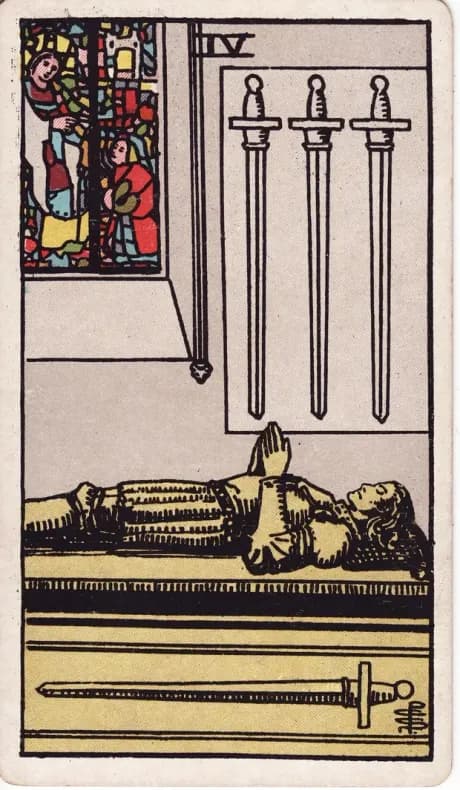
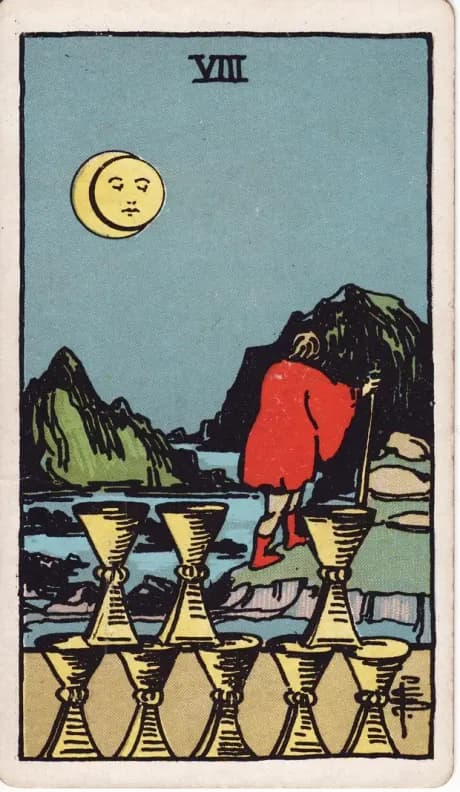
Surrounding cards tell you which way it falls. The Star, the World or the Six of Cups nearby tilt it toward the answer being brought back and shared. The Four of Cups, the Eight of Cups or the Two of Swords nearby tilt it toward the light staying up on the hill.
What the The Hermit card shows
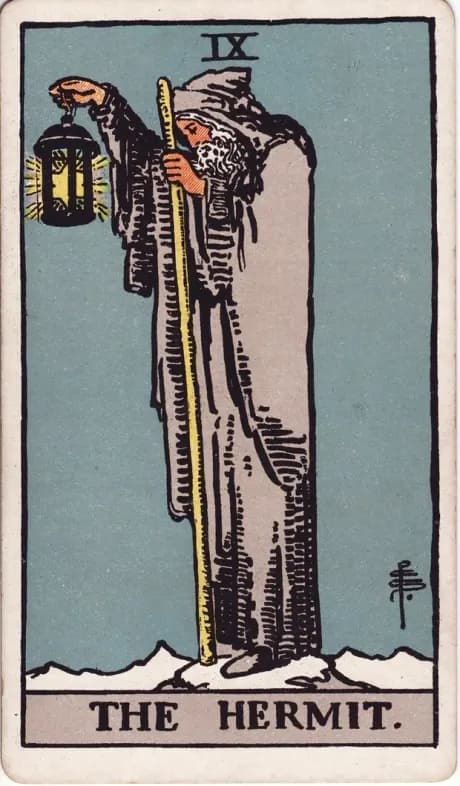
The 1909 card shows an old man alone on a summit, wrapped head to foot in a grey hooded cloak. He faces to the left, head bowed, eyes lowered. You cannot see much of his face and there is nothing to see: he is not looking at anything in the picture, and nothing in the picture is looking at him.
In his raised right hand he holds a lantern, and inside the lantern is a six-pointed star, the Seal of Solomon. This is the detail worth stopping on. The light in his lamp is not fire, it is a symbol — the light is something he understood rather than something he lit. He holds it up and away from himself, at roughly head height, which is the gesture of someone showing rather than someone reading.
In his left hand is a long pale staff that reaches the ground. He leans on it. It is the same staff carried elsewhere in the deck, and here it is doing the plainest possible job: holding up an old man on uneven ground. The card is about the mind and it still gives him something to lean on.
The ground under him is white-grey — snow, or bare rock at altitude — and it is small. There is barely room in the frame for one person to stand, and there is certainly no room for two. Behind and below him the sky is flat grey with no horizon, no path, no village, no other light anywhere.
The cloak is the last thing. It is grey, plain and complete, covering him entirely apart from face and hands. Everyone else in the major arcana is dressed to show you their office: crowns, armour, colours, thrones. He has removed all of it. What remains visible is exactly the two things the card is about, which are the hand holding the light and the hand holding him up.
Frequently asked
Does the Hermit mean they don't love me?
+
No — it means processing over performing. Feelings under the Hermit go quiet to be examined, not because they vanished. The card describes someone who has stepped out of the noise, and the thing taking up the room is usually not you, however much the silence feels aimed.
Is the Hermit bad for relationships?
+
Only for rushed ones. It's excellent for depth: love after self-work outlasts love instead of self-work. Where it does real damage is when the space has no end date, because open-ended solitude stops being a phase and quietly becomes the arrangement.
Is the Hermit a yes or a no?
+
Upright it reads as a no, though the honest phrasing is not yet — something is unfinished and the answer lives further along. Reversed it is also a no, for a worse reason: the delay has stopped being productive and somebody is hiding rather than thinking.
What should I do when I draw the Hermit?
+
Stop asking other people and spend an hour alone with the real question written down. If someone else is waiting on you, tell them when you will be back — that one sentence turns silence into something with a shape. And when you reach the answer, say it out loud to whoever it concerns.
Does the Hermit mean they are ghosting me?
+
Usually not, and there is a test that separates the two. Someone processing tells you they are processing and gives you some sense of when. Someone ghosting says nothing and lets you fill in the rest. If there is no end date, no update and no acknowledgement that anyone is waiting, you are looking at avoidance wearing the Hermit's coat.