What Strength means in tarot — and in love
Strength is love held with a soft grip: patience with someone's rough edges, courage to stay open after being bitten before. As feelings, Strength means they feel calmed by you — you gentle their chaos, and that quietly hooks them deeper than lust would.
Jump to FAQAt a glance
- Yes or no
- Yes — reversed flips it
- Upright, in a line
- patient courage, gentle power, taming the drama
- Reversed, in a line
- insecurity, jealousy, forcing what needs softness
Want a yes or no on your own situation rather than this card? Pull one card and get the verdict with the reason behind it.
Ask your own yes-or-no questionUpright in love
Strength is love held with a soft grip: patience with someone's rough edges, courage to stay open after being bitten before. It signals a bond tamed by gentleness — passion that doesn't need drama to prove it's alive. If you asked how to handle a difficult moment: not louder, softer. The lion calms for the steady hand, never the whip.
People read this card as tolerance, and it is not tolerance. Tolerance is putting up with something and saying nothing. Strength is staying in contact with a difficult thing without letting it set your temperature. The woman in the picture has her hands on the lion. She is not ignoring it, not running from it, and not fighting it either. That distinction is the whole card, and it is also the difference between a person who is genuinely calm and a person who is quietly furious and calling it maturity.
In a new connection it points at the least dramatic quality in the room and says that one wins. Not intensity, not chemistry on the first night — steadiness across several weeks. Someone who does not need to be impressive is being read as someone worth trusting, and they are. If you are the nervous one here, the card is telling you that your nerves are not the problem. Handling them without going cold is what makes the difference.
In an established relationship Strength almost always turns up in the middle of something hard. It says the hard thing is workable, and that how it gets handled will matter more than what it was about. Raising your voice ends an argument fastest and costs the most. The card also has an uncomfortable habit of pointing at your own reaction rather than theirs. Often the animal in the picture is not your partner's temper. It is your own, and it is far easier to notice a difficult person than a difficult minute.
What it asks for is unglamorous. Say the thing once, plainly, and then hold your position without hardening it. Do not escalate and do not withdraw. Both of those are quicker, and neither one works.
Reversed in love
Reversed, Strength exposes the insecurity running the show: jealousy, neediness, tests you set for them to fail, or swallowing hurt to keep fake peace. Force is being used where patience belongs — possibly on yourself. Rebuild your own spine first; love leans on it.
The reversal does not mean weakness, which is the usual guess and the wrong one. It means the balance between the woman and the animal has tipped, and it tips in two opposite directions that look nothing alike from outside.
In the first, the lion is loose. Reactivity is running the relationship — the sharp reply, the checked phone, the argument started at midnight about something that happened in March. None of it is unforgivable and all of it is corrosive, because a person who cannot predict which version of you they are getting stops bringing you anything difficult. They handle you instead. That is the quiet end of honesty in a couple, and it rarely announces itself.
In the second, the lion is sitting on the woman. This is the version people miss, because from outside it looks like the card upright. Endless patience, no complaint, every rough edge absorbed. But the calm is a costume, the cost is being paid privately, and the resentment underneath does exactly what the shouting does in the other version, only slower and with better manners.
In a new connection, reversed Strength often means composure is being performed on one side or both, and the performance will not survive month three. In an established one it usually marks the point where patience stopped being a choice and turned into a habit nobody has examined in years.
The repair starts alone, and that is the awkward part, because the person you want to change is not the one the card is addressing. Work out which of the two versions you are in. If the lion is loose, the fix is a pause before the reply. If the lion is sitting on you, the fix is one honest sentence you have been swallowing since spring.
Strength As feelings
As feelings, Strength means they feel calmed by you — you gentle their chaos, and that quietly hooks them deeper than lust would. There's admiration here, and a wish to be their best self near you. It is a slow feeling, and it shows itself differently depending on what you are asking about.
If you are single and asking about someone new. They feel steadied around you, and they have probably noticed it before they have named it. This is not the loud kind of interest and it does not produce three messages in a row. It produces someone who keeps finding reasons to be where you are, and who is unusually honest with you for how new this is. That last part is the reliable tell: under this card, people say true things early.
If you are in a relationship. They feel safe, and safe is the word they would use if you could hear them think. Strength as feelings inside a couple usually turns up when one of you has been difficult lately and the other one held. The one who was held is grateful in a way they may be bad at saying out loud, and the gratitude runs deeper than the trouble did.
If you are asking about an ex. They feel respect, mixed with something less flattering to them: they remember that you handled them, and some part of them knows they made handling necessary. This is warm and it is not the same as wanting to come back. Regard survives a breakup far more easily than the willingness to try again does.
If you are asking about someone long-term. The feeling has stopped being a feeling and become a fact of their life. That sounds like a downgrade and it is not one. The card is describing a person whose steadiness toward you no longer depends on the kind of week they are having.
Across all four, Strength describes a feeling that does not spike. If you are waiting for evidence in the form of drama, you will misread it completely.
Strength For your ex
For an ex, Strength says the feeling survived the fight. They remember you as the person who could handle them. Reconciliation is possible but requires the tamed version of both of you — bring patience or don't bother.
What makes this card hopeful about an ex is also what makes it demanding. It says nothing was destroyed. The affection is intact, the respect is intact, and the reason it ended is still sitting exactly where the two of you left it. Strength does not erase a cause. It says the cause is workable if somebody works on it, which is a different sentence from saying that anybody will.
The version of you they carry is the one who stayed reasonable when they were not. That memory is flattering and it is a trap, because it turns easily into an expectation: that you will be the calm one again, indefinitely, and that they will never have to build the same muscle. A reunion on those terms is the old relationship with a longer fuse.
If you want something concrete to watch for, watch for self-command on their side, not warmth. Warmth was never in short supply here. Look at whether they can be told something they do not want to hear and stay in the conversation without going cold or going loud. That one test predicts more than any amount of nostalgia does.
And if you are the one deciding whether to reach out, the card asks a blunt question first. Is the patience you would be bringing real, or is it only the ability to stay quiet for longer than they can?
What Strength means in general
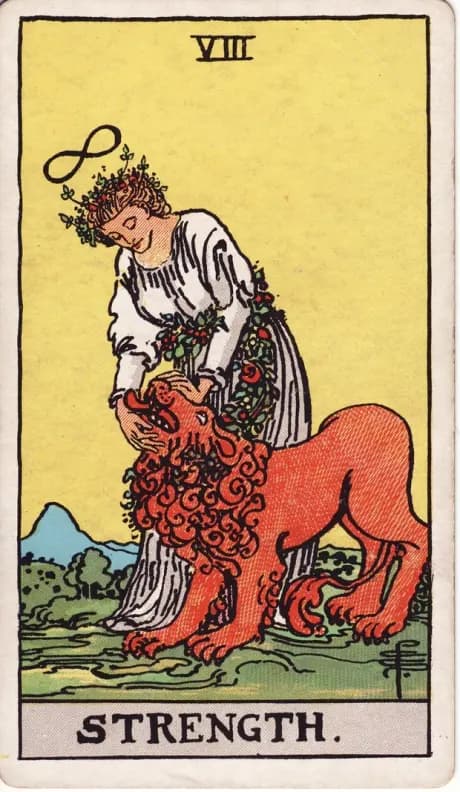
Strength is the eighth trump in this deck, and its subject is influence without force. A woman rests her hands on a lion's jaws and the lion is calm. Nothing in the picture is being overpowered, and nothing has been taken away from the animal. The claim is that the more durable kind of power is the quiet kind: self-command, endurance, the capacity to stay in contact with something wild and remain unchanged by it.
Upright it says the situation calls for holding rather than striking. Your influence here comes from composure, and the appetite or impulse you keep trying to cage is better befriended than crushed, because caged things get out. It is also the deck's patience card in the ordinary practical sense. It marks the stretch of a long effort where nothing visible is happening and stopping would be entirely reasonable.
Reversed the balance has tipped. Either the animal has the upper hand — reactivity, self-doubt, an appetite making decisions that should be made elsewhere — or the composure is a performance and the exhaustion underneath it is real. From outside those two look identical, which is why the reversal is worth sitting with instead of reading fast.
With different furniture the card behaves the same way everywhere else. At work it is the colleague who wins the argument by not raising their voice, or the difficult project that needs another six weeks of unremarkable effort rather than a rescue. In money it is the plan that only fails if you abandon it during its worst month. In creative work it is revision: staying with a draft that is not working long enough to find out why, instead of starting a new one that will not work either.
Compare it with the Chariot, which arrives one card earlier. The Chariot controls by will and direction, and its victory is external and visible. This card has no reins, no armour and no destination. Its work is on the animal, and the animal is usually your own.
Strength as a yes or no
As a yes or no, Strength upright is a yes with a condition attached, and the condition changes how you should use the answer. It is yes if you can be patient, and yes if you can stay soft under pressure. It is not a yes that arrives on its own while you wait, and it is definitely not a yes you can force.
The condition is the whole content of the card, so it is worth stating plainly. Strength never describes a situation where pushing harder produces the result. It describes one where the outcome is available through steadiness: showing up, not reacting, letting a difficult thing stay difficult without needing it resolved today. If that is a fair description of what you are actually able to do right now, the answer is yes. If you are asking the question because you have run out of patience, the card has already told you something more useful than a verdict.
Reversed it reads as a no, and specifically as a no in the sense of not like this. Something is being forced, or someone's calm is fake, or the person in the picture is worn out. None of those produce the outcome you are asking about. None of them are permanent either, which is why reversed Strength is one of the more fixable no answers in the deck. What it names is a state, not a fact.
If you want a sharper question than yes or no, the good one here is this: what would I do differently if I knew the answer was yes but it would take three times as long? Strength answers that well, because time is the resource it is actually talking about.
Strength as advice
As advice, Strength says do not raise your voice, do not raise your stakes, and do not leave. Hold the position you already have, and be pleasant while you hold it. That is much harder than it sounds, which is why the card exists at all.
In practice it usually means one specific thing. Say the difficult sentence once, calmly, and then stop bringing it up. Repeating it is pressure, and pressure is the whip. Withdrawing after saying it is punishment, and punishment buys compliance rather than agreement. What you want is for the thing to be said, true, and still standing in the room tomorrow without you guarding it.
If you are in the middle of a conflict, the concrete action is a delay you announce. Not silence, which reads as a weapon. Say that you want to answer properly and give a time. Nearly everything corrosive in an argument gets said in the first ninety seconds, and this card's advice amounts to spending those ninety seconds somewhere else.
If you are the one who has been difficult, the card is unusually direct. Name it before somebody else has to. Saying that you have been sharp all week and it is not about them costs one sentence and repairs more than a fortnight of good behaviour.
If nothing is wrong and the card still turned up, it is advising endurance. Something you are doing is working slowly, and slowly is not the same as failing. Do not add to it, do not redesign it, do not check it daily. Keep going for longer than feels reasonable and then look.
What the card never advises is control. The woman is not holding the lion's mouth shut against its will. If she were, she would need both arms and a great deal more force than she is using.
Strength as an outcome
As an outcome, Strength is a situation that resolves slowly and then holds. Nothing in this card breaks. Whatever you are asking about arrives at a stable state, and the stability is earned rather than lucky: it comes from someone, quite possibly you, refusing to escalate at the exact point where escalating was the obvious move.
Upright, that tends to look less like a victory than people expect. The difficulty does not vanish. It gets smaller, then manageable, then absorbed, and eventually it stops being the thing that defines the situation. If you are hoping for a dramatic ending, this card does not supply one. What it supplies is durability, and the outcomes it describes are usually still true a year later, which is more than most cards in the deck can promise.
There is a timing note attached, and it is the most common misread. Strength as an outcome takes longer than the timeframe most people have in mind when they ask. Not forever, and not indefinitely. But the card is describing a process with an animal in it, and animals are not persuaded on schedule.
Reversed as an outcome is the same situation with the patience spent. It ends in a flare: something said badly, a limit hit, somebody who held for months and then abruptly did not. Or it ends in the quieter failure, where the holding continues and hollows out the person doing it. The first is loud and usually recoverable. The second makes no noise at all, and it is the one to watch for.
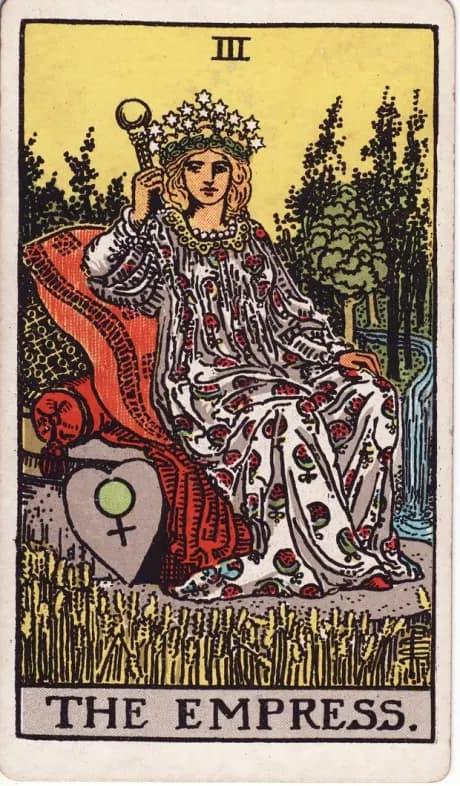
The company decides which. Calm cards nearby — the Star, Temperance, the Empress — tilt it toward the slow good version. Pressure nearby, like the Tower or the Ten of Wands, tilts it toward the flare.
What the Strength card shows
The 1909 card shows a woman in a white robe standing beside a lion with both hands on its head, one under the jaw and one on the muzzle. She is not straining. Her posture is the first thing to read: the shoulders are level, the arms are loose, and there is no bracing anywhere in the figure. Whatever was decided between her and the animal was decided before this moment.
Above her head floats a lemniscate, the sideways figure of eight that also hangs over the Magician. On the Magician it marks power being aimed outward at a table full of tools. Here it sits over someone doing nothing visible at all, and putting the same sign in both places is the argument.
A garland of flowers runs through her hair and around her waist, and it continues as a chain around the lion's neck. Waite wrote that this chain is more potent than one of iron. It is the clearest statement on the card: the animal is being led, and the thing leading it is not a restraint.
The lion is tawny, its head is bowed and its tail hangs down. Its tongue is out. Those are the postures of an animal that has stopped contesting, not one that has been subdued. It is full-sized, loose, standing on open ground beside a woman with no weapon and no cage anywhere in the frame.
The background is plain yellow, the brightest and emptiest sky in the major arcana. There is no storm to survive and no crowd to perform for. A single blue mountain sits far off behind them, and the ground is green and level.
She wears flowers where the deck's other figures of authority wear metal. No crown, no armour, no sword, no staff. The entire apparatus of the card is two bare hands and a chain of blossoms, and it is enough.
Frequently asked
Is Strength a yes for love?
+
A patient yes. The outcome you want is available through gentleness and nerve, not through pushing or ultimatums. The condition is real: this card describes a result arriving on a slower schedule than the question usually assumes, and hurrying it is the one move that removes it.
What does Strength mean as feelings?
+
They feel soothed and strengthened by you — you're where their guard drops. That's rarer than butterflies and worth more. It is also quiet, so it is easy to miss if you are watching for intensity. The usual evidence is that they tell you true things sooner than they tell other people.
Is Strength a yes or a no?
+
Upright it is a yes, conditional on patience. Reversed it is a no, and specifically a not like this: something is being forced, or someone's calm is a performance. That reversed no is one of the more fixable ones in the deck, because it names a state rather than a fact.
What should I do when I draw Strength?
+
Say the difficult thing once, calmly, and then stop repeating it. Do not escalate and do not withdraw, because those are the two fast moves and both of them cost you the outcome. If nothing is currently wrong, the card is telling you to keep doing the slow thing that appears to be doing nothing.
Why is Strength card 8 when older decks number it 11?
+
Arthur Waite swapped Strength and Justice when this deck was made in 1909, to fit the trumps to a different astrological order. Older decks, the Marseille among them, number Justice VIII and Strength XI. The meaning does not change, only the position in the sequence. The scan on this page is the 1909 deck, so here Strength is eight.