What The Empress means in tarot — and in love
The Empress is love in full bloom: warmth, sensuality, being fed in every sense. As feelings, the Empress means someone feels drawn to your warmth — comforted, attracted, at home around you.
Jump to FAQAt a glance
- Yes or no
- Yes — reversed flips it
- Upright, in a line
- nurturing love, sensuality, being adored
- Reversed, in a line
- smothering, neediness, self-neglect in love
Want a yes or no on your own situation rather than this card? Pull one card and get the verdict with the reason behind it.
Ask your own yes-or-no questionUpright in love
The Empress is love in full bloom: warmth, sensuality, being fed in every sense. She signals a relationship — or a person — that nurtures you, where affection is abundant and you don't have to earn softness. If you asked about potential, this is fertile ground. Let yourself be adored without auditing it for a catch.
The part people miss is that she describes conditions rather than events. She is not a moment of falling; she is an environment in which things grow. That distinction matters because it tells you what to do with her. You do not chase this card's result. You make the conditions and then leave them alone long enough for something to happen inside them.
In a new connection she is one of the warmest signs available, and specifically she indicates comfort rather than drama. The attraction has a body to it. Meals, weather, the feeling of an afternoon expanding. If you have been through a run of connections that were exciting and thin, she marks the arrival of something with substance, and it may feel slower than what you are used to. Slower is the point.
In an established relationship she says the ground is good and asks whether you are actually using it. She often appears when a couple has built something genuinely nourishing and stopped noticing, running on the arrangement while paying attention to everything else. Her question is not whether you are loved. It is when you last enjoyed it.
What she asks for is receiving, which is harder than it sounds for a lot of people. Let someone do something for you without immediately balancing the ledger. Accept the compliment without editing it. The Empress is generous, and she is also fairly clear that generosity you refuse does not feed anybody.
Reversed in love
Reversed, the Empress warns of smothering or starving — love that either suffocates with neediness or neglects itself entirely. You may be pouring into someone while your own cup dries out, or mistaking being needed for being loved. Mother yourself first; the garden you keep abandoning is you.
Reversal does not turn her cold. It turns the care sideways, and it is worth naming the specific shapes that takes.
The most common is imbalance disguised as devotion. One person does all the emotional work of the relationship — the remembering, the smoothing, the anticipating — and calls it their nature. It stops being generosity at the point where it becomes the only currency they can pay in. Reversed, she asks what happens if you stop for a month. If the answer is that everything collapses, you were not nurturing something, you were holding it up.
The second is smothering. Care applied at a volume that leaves no room. Wanting to help before help is wanted. It comes from a real place, it produces exactly the distance it was trying to prevent, and the person doing it is almost always the last to see it.
The third is neglect turned inward. Everything gets fed except you. She is unsentimental here: your own upkeep is not the reward you receive once everyone else is fine, and treating it that way is not selflessness, it is a slow refusal to be a person with needs.
Sometimes she also marks a flat period — warmth temporarily unavailable, from you or toward you. That version passes on its own. The other three require a decision.
The Empress As feelings
As feelings, the Empress means someone feels drawn to your warmth — comforted, attracted, at home around you. It's affection with a body to it: they want closeness you can feel, not just read about.
Because her version of feeling is physical and settled rather than urgent, the four situations read distinctly.
If you are single and asking about someone new. They find you attractive in a way that includes wanting to look after you. Expect the interest to show up as food, as offers of practical help, as a wish to be somewhere comfortable with you rather than somewhere impressive. This is not a lukewarm reading. It is a very warm one that expresses itself domestically, and people sometimes mistake it for friendship because it is not performing urgency.
If you are in a relationship. They feel secure and physically fond. She is one of the better cards here because she indicates someone who is not restless — they like the life you have and want more of it rather than something else. If you were hoping for evidence of passion, note that her version of it is unhurried and steady rather than absent.
If you are asking about an ex. They miss the comfort. That is precise, and it is not the same as missing you, and the difference is worth sitting with. What they feel toward is a state of being cared for that they associate with your name.
If you are asking about someone long-term. They feel that you are home. It is the least dramatic feeling on this list and the most durable, and it is almost never said out loud, because it does not occur to people to announce the floor they are standing on.
The Empress For your ex
For an ex, the Empress often means they miss the comfort of you — the care, the physical ease, the way you made things soft. Missing your warmth and deserving it back are different things. Price of re-entry: actual effort.
What makes this reading painful is that the missing is entirely sincere. They are not being manipulative. They genuinely felt better in that environment, they can feel the difference now, and the feeling is strong enough to produce a message at an inconvenient hour.
The problem is what they are missing. She describes someone longing for a condition rather than for a person — the fed, held, looked-after state your care produced. If you were the one who created that condition, you are being missed as a climate rather than as an equal. That is why so many reunions under this card fail the same way the first attempt did: the returning person came back to be nourished, and nothing about the arrangement that exhausted you has been renegotiated.
The workable version exists and looks different from outside. It involves them naming what they took, unprompted, and changing something material about how they operate. Words about missing your cooking are not that. Turning up consistently and doing an unglamorous share of the work is.
Before deciding anything, ask yourself a separate question. When you imagine going back, are you imagining being loved, or being needed. The reversed Empress is the card of confusing those two, and this is exactly the situation in which it happens.
What The Empress means in general
The Empress is abundance as a process rather than a possession: the card of things that grow because the ground was prepared and then left alone. Her domain is fertility in the widest sense — a project, a household, a body, a long creative run — plus the sensory world, comfort, and the patient work of tending.
Upright she says the situation is well supplied and will keep producing if it is not interfered with. This is the deck's clearest instruction to stop optimising. Something is working. Watering a plant twice as often does not double it.
Reversed the tending turns smothering or misdirected: effort poured into what cannot use it, a creative block that comes from over-management rather than from emptiness, neglect of your own upkeep while everything else is fed, or dependence mistaken for closeness.
Read on a general situation, she is strong for anything with a growth curve and weak for anything requiring speed. Her timescale is seasonal. Things under her arrive when they are ready and not on the date you wanted them.
In work she is the mature project, the team that functions because somebody quietly maintains it, and the manager whose contribution is invisible until they leave. In money she is the difference between income that compounds and income that spikes, and she favours building over extracting; she is a description of a pattern, not a recommendation about what to do with your own. In creative practice she is the fertile period — the run where material appears faster than you can use it — and her warning is that such periods end if you spend all of them on output and none on refilling.
Threes are the first result of a pair. Hers is the harvest, which nobody manufactures and everybody has to wait for.
The Empress as a yes or no
As a yes or no, the Empress upright is a yes, and one of the strongest in the deck. She is a card of things flourishing, and the flourishing is already underway rather than promised, which is why she reads as reliable rather than merely encouraging.
The only qualification is speed. She says yes and she does not say soon. Her yes ripens. If your question had a deadline attached, the honest answer is that the outcome is favourable and the timing is not yours to set, and pushing it produces the reversed version of the card rather than a faster result.
She is especially strong for questions about whether something will grow — a connection, a project, a household, a body of work. She is weaker for questions containing a single decisive event, because she does not describe events. She describes conditions, and conditions do not answer yes or no so much as they answer eventually, if you let them.
Reversed she is a no, and usually a solvable one. The refusal is rarely about the thing itself. It is about the state of whoever is tending it: depleted, over-involved, or giving in a direction that does not give back. That produces a no which changes as soon as the tending changes, and it makes her one of the more hopeful reversed cards to draw on a yes-or-no question.
If she keeps appearing, consider that you may be asking whether something will happen when the real question is whether you have anything left to give it.
The Empress as advice
As advice, the Empress says tend it and stop pulling it up to check the roots. Whatever you are asking about needs consistency and time more than it needs another intervention, and the most common way people damage a situation under this card is by improving it.
Concretely, that means the physical and the ordinary. Feed yourself properly. Sleep. Be in a room you like. This sounds unrelated to whatever you actually asked, and it is the card's literal instruction — she works through the body and the senses, and her advice is almost never abstract. A person who is under-slept and eating badly makes worse decisions about everything, and she treats that as the practical fact it is.
Second, receive something. Let a favour be done. Accept help that is offered without offering something back inside the same conversation. If you are the person everyone relies on, this will feel wrong, which is precisely why it is the advice.
Third, give the thing you are asking about actual room. Do not send the follow-up. Do not add the feature. Do not have the same conversation a third time this week. Growth happens in the interval between interventions, and at the moment there is no interval.
Reversed, the advice becomes triage. Find where your care is going and cut one thing off the list — not the smallest one, the one that consumes most and returns least. The card is not asking you to become harder. It is asking you to appear on the list of things you look after.
The Empress as an outcome
As an outcome, the Empress is a situation that ends well and ends slowly. Something takes root. What you asked about does not conclude so much as it establishes itself, becoming a stable part of your life rather than an event you can point at.
Upright, this is one of the better outcome cards available. It indicates comfort, sufficiency and growth — a situation producing more than it consumes. She is also traditionally read as a card of literal fertility and family, and people reach for that meaning fast. It is one possible reading among several, and this site does not answer questions about pregnancy or health, so treat her as a card about things flourishing in general and take the specific ones to someone qualified.
The important caution is temporal. She does not tell you when. If your question was whether this happens by a certain date, she is a yes to the outcome and no help at all on the schedule, and forcing the schedule is the surest way to turn this card into its reverse.
Reversed as an outcome describes something that should have flourished and did not, and the reason is almost always in the tending rather than in the thing itself. Either it was starved of attention or it was crowded with too much of it. Occasionally the reversed card marks an ending that is genuinely a relief: a situation you had been keeping alive by effort is finally allowed to stop, and the energy that went into it becomes available again.
What the The Empress card shows
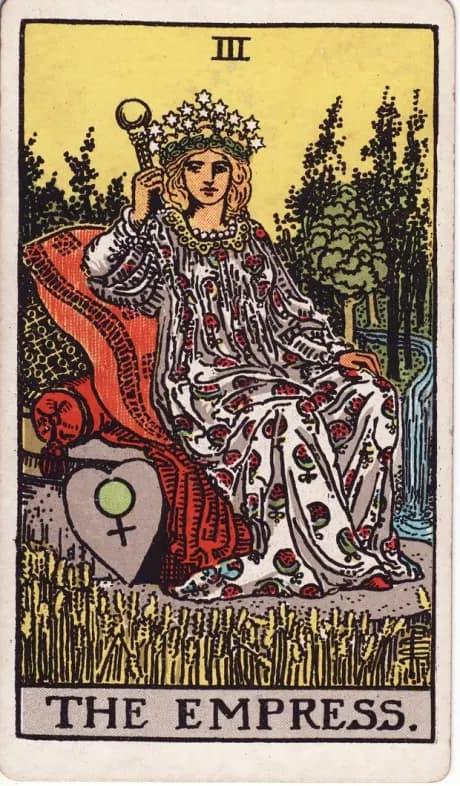
The 1909 card shows a woman reclining on a low cushioned seat set outdoors, in a field, with no walls anywhere in the picture. The number at the top is a three.
She wears a loose white gown printed with red pomegranates. Pomegranates appear on the High Priestess card too, on the veil behind her, and here they have come out from behind the cloth and onto the clothing of someone sitting in the open. On her head is a wreath carrying twelve six-pointed stars, and around her neck a string of pearls. She is not upright on a throne. She is leaning back, one arm resting, in the posture of a person entirely at ease in a place they own.
In one hand she holds a short sceptre topped with a golden sphere, raised without effort. Beside her stands a grey heart-shaped shield bearing the circle-and-cross sign of Venus, drawn in green. The shield is on the ground, propped rather than carried. Her authority in this card does not require holding anything up.
The seat is draped in red and the cushions are worked with a pattern. Behind her a stand of dark cypress trees closes off the middle distance, and to the right a stream falls in a narrow ribbon into a pool, the only movement in an otherwise still picture.
In front of her, filling the whole foreground, is a field of ripe wheat drawn at the stage where it is ready. That crop is the argument of the card. She is not working it, watching it or worrying about it. It grew because she is there, and the picture shows her sitting with her back to it.
Frequently asked
Is the Empress a yes for love questions?
+
A strong yes — she is one of the warmest cards in the deck for relationships, promising growth, affection and abundance. The one qualification is speed: her yes ripens rather than arrives. If your question had a deadline in it, expect the outcome and not the timing.
What does the Empress mean as feelings?
+
They feel nourished and attracted around you, emotionally and physically. You feel like home with better lighting. Her version of feeling is settled rather than urgent, which is why people sometimes misread it as friendly — the warmth shows up as care and comfort instead of intensity.
Is the Empress a yes or a no?
+
Upright a yes, and a reliable one, because she describes something already growing rather than something promised. Reversed a no, but usually a solvable one: the refusal is normally about the state of whoever is doing the tending, not about the thing being tended, and it changes when that does.
What should I do when I draw the Empress?
+
Less, and more slowly. Stop intervening in the thing you are asking about and give it an interval to grow in. Then do the physical and ordinary things she always asks for: eat properly, sleep, and let one person do something for you without paying them back inside the same conversation.
Does the Empress mean pregnancy?
+
It is the question most often asked about her, and it is not one this site reads. She is traditionally associated with fertility, but her real subject is anything that grows because conditions were made right for it — a project, a home, a body of work, a relationship finding its footing. For anything medical, ask a doctor rather than a deck.