What Queen of Cups means in tarot — and in love
The Queen of Cups is emotional depth on the throne: empathy, intuition, love that holds space without drowning in it. As feelings, the Queen of Cups means they feel deeply and steadily about you — caring, intuitive, emotionally invested.
Jump to FAQAt a glance
- Yes or no
- Yes — reversed flips it
- Element
- Water
- Upright, in a line
- deep empathy, emotional safety, being held
- Reversed, in a line
- emotional overwhelm, giving until empty
Want a yes or no on your own situation rather than this card? Pull one card and get the verdict with the reason behind it.
Ask your own yes-or-no questionUpright in love
The Queen of Cups is emotional depth on the throne: empathy, intuition, love that holds space without drowning in it. She signals a relationship where feelings are safe — or a person (often a woman) who loves with quiet completeness. If you asked how to proceed: lead with compassion, including toward yourself. Depth recognizes depth.
What she actually does, put plainly: she feels what you feel without needing it explained, and she does not confuse it with her own. The second half of that sentence is the difficult half, and it is the entire distance between this card and its reversal. Sitting with someone through a bad week without trying to fix it, absorb it, or make it about you is a skill, and almost nobody has it by accident.
In a new connection she often marks a person who reads you accurately from very little. That can be unnerving rather than pleasant at first — being understood before you have done the work of explaining yourself leaves you with nowhere to hide. The card says it is genuine perception and not a technique. It also advises you to move at the pace of your own gut read rather than the pace of the facts on paper. If someone looks correct and feels wrong, this Queen tells you the feeling is the older and better instrument.
In an established relationship she describes a bond where things can be said. Difficult feelings arrive without an argument attached to them, and neither person has to be in crisis to ask for attention. She also names the labour honestly: somebody is doing the emotional maintenance in every couple, and if it is always the same person, that is a problem this card is pointing at even upright.
What she asks of you is concrete. Say the feeling while it is still a feeling and before it hardens into a grievance. Ask what someone needs instead of guessing and being quietly wrong for a month. And extend the same patience to yourself that you would extend to somebody you were worried about.
Reversed in love
Reversed, the Queen of Cups is empathy overflowing its banks: giving until empty, absorbing a partner's every mood, emotional manipulation through guilt or tears — yours or theirs. Boundaries are the medicine. Love that requires self-erasure is co-dependence in a crown.
The reversal does not remove the feeling. It removes the edge between yours and somebody else's. The depth is exactly the same and the container is gone, which is why this position so often shows up in people who are proud of how much they care and exhausted by it in the same breath.
In practice it is the person who cannot have a good day while their partner is having a bad one. Moods travel across the household like weather. Small disappointments get treated as emergencies because there is no filter deciding what deserves the full response. And there is the giving problem underneath it: giving past your own limit, not being asked to stop, and then resenting the other person for accepting what you insisted on handing over.
There is a harder reading and it deserves saying plainly. Reversed, feeling can be used as an argument. Tears that reliably end a conversation before it reaches the point. Hurt deployed where a request belonged. Guilt used as a management tool by somebody who would be appalled to hear it described that way. This can be them, and it can be you, and the card does not care which — it cares that the emotional register has become a way of winning rather than a way of connecting.
The intuition fails here too, and it fails in a specific direction. The same sensitivity that reads a room correctly upright starts reading meaning into a slow reply, building a case out of atmosphere, arriving at a verdict nobody was ever asked to defend. The correction is unglamorous: ask instead of divining. Say the plain sentence and let the answer be information rather than confirmation.
Queen of Cups As feelings
As feelings, the Queen of Cups means they feel deeply and steadily about you — caring, intuitive, emotionally invested. It's mature water: less splash, more depth. They notice your moods before you announce them.
If you are single and asking about someone new. They feel more than they have shown you. This card rarely describes someone who broadcasts, so the absence of dramatic signals is not evidence of absence. They are paying close attention, they have probably noticed things about you that you have not mentioned, and they are waiting to be reasonably sure before they say anything. Warmth from this person is a decision, not a reflex.
If you are in a relationship. They feel safe with you, which is a stronger statement than it sounds. Safety is what allows the other feelings to be honest, and this card says the honesty is available. It may also mean they are carrying something for you at the moment — worry, or the emotional weight of a situation you are in — quietly and without invoicing you for it.
If you are asking about an ex. The feeling survived. It has been processed rather than extinguished, and it sits at a low steady temperature that neither dies down nor demands anything. They are unlikely to contact you first. Silence from this card is not indifference, it is composure, and the two look identical from outside.
If you are asking about someone long-term. Deep, settled, and largely unspoken because it stopped needing to be spoken years ago. That is comfortable to read and worth challenging slightly. Feelings that never get said out loud eventually become invisible to the person they belong to, and this Queen would say it out loud if she were asked to.
In all four the emotion is real and understated. This card never means they feel nothing. It frequently means they have not told you.
Queen of Cups For your ex
For an ex, the Queen of Cups means feelings persist beneath composure — they hold you gently in memory even through silence. If reunion comes, it will be emotionally honest and unhurried. Match that register or leave it be.
The defining trait here is that they are not going to perform any of it. There will be no midnight message, no dramatic reappearance, no essay. This Queen processes privately, and a person processing privately looks exactly like a person who has moved on. If you are reading silence as an answer, this card says you are reading it wrong, without also promising that the silence will end.
What she does hold is an accurate memory. She has not edited you into a villain or a legend. She remembers what was good and what was genuinely wrong with it, both at full size, and that balanced memory is harder to leave and harder to return to than a distorted one. It gives her no urgency in either direction.
If contact does come, it will be calm and it will be honest, and it will not be an attempt to reopen anything by force. The correct response is the same register: no performance, no grand apology, no pressure toward a decision. If you arrive with intensity you will get politeness back, and politeness from this card means the door has closed quietly.
One caution worth naming. Reversed nearby, this Queen becomes an ex who is keeping the wound rather than the memory, and reaching toward that is not reunion, it is maintenance of somebody else's grief.
What Queen of Cups means in general
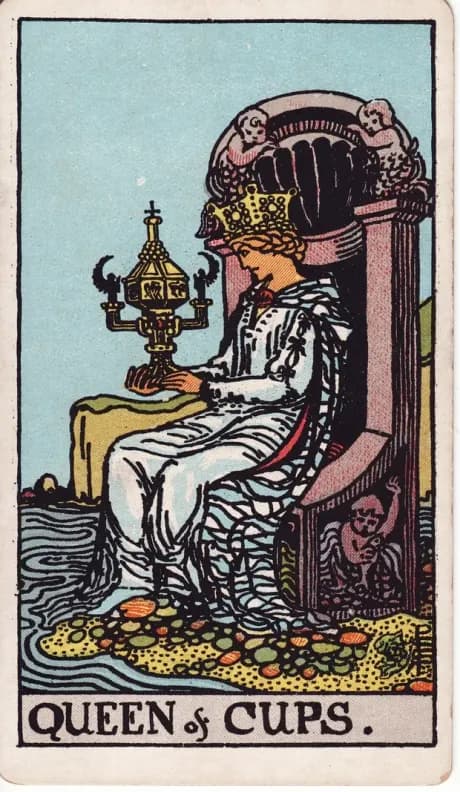
The Queen of Cups sits at the water's edge holding an ornate covered cup, the only vessel in the deck that is shut. What she holds is interior and she is not showing it to anybody. Her subject is emotional intelligence in its mature form: perception that runs ahead of information, attunement to what a room is actually doing, and the capacity to hold somebody else's state without adopting it.
Upright she says the situation calls for feeling combined with a boundary, and that the quiet read is more accurate than the stated facts. Queens sustain rather than direct — where a King decides, she keeps the conditions in which something can survive. When she appears the useful question is not what should be done but what is really going on underneath what people are saying.
Reversed the boundary is gone. Absorbing every mood in the building. Martyrdom that nobody asked for. Feeling used as leverage. Or perception distorted into anxiety, where the same instrument that reads a room correctly starts manufacturing evidence out of tone and silence.
Outside the personal she is the counsellor, the mediator, the manager who notices somebody is struggling three weeks before the resignation, the colleague everybody tells things to. In creative work she is the writer or designer who works from instinct and produces something that lands emotionally without being able to explain the mechanism. In practical matters she advises against deciding while flooded — not against feeling, against signing.
Her failure mode in any of these settings is the same one. The person who can feel what everyone in the building feels will, unless they defend it, end up holding all of it, and holding all of it makes the instrument useless.
Queen of Cups as a yes or no
As a yes or no, the Queen of Cups upright is a yes, and it is a conditional one. Yes, if the thing is handled with emotional honesty. She does not deliver verdicts about events, she describes the state something is in, and the state she describes is favourable as long as nobody in it is pretending.
This is one of the cards that answers a should question far better than a will question. Ask should I reach out and she is an unambiguous yes, provided you are reaching out honestly rather than tactically. Ask will they reach out and she gives you almost nothing, because her characteristic behaviour is to feel a great deal and do nothing visible about it. A yes from this Queen is about the emotional truth of a situation, not about who moves first.
Reversed it is a no. The reason matters: it is rarely a no about the other person and usually a no about the current conditions. Someone in the situation is exhausted, enmeshed, or reading feelings that are not being confirmed, and decisions made in that state get unmade later. The card is saying not like this rather than not ever.
If the format is not giving you what you need, try asking what am I not admitting I already feel about this. That is the question this card is built to answer, and the answer arrives faster than people expect.
Queen of Cups as advice
As advice, the Queen of Cups says: trust the first read and act on it before you talk yourself out of it. You already know how you feel about this and you have probably already known for a while. The advice is not to gather more evidence. It is to stop overruling an accurate instrument with a plausible argument.
Concretely, that comes down to a few things. Say the feeling while it is still small, because a feeling said at week one is a conversation and the same feeling at month six is an accusation. Ask somebody what they need instead of guessing and quietly getting it wrong. If you are worried about a person, contact them today rather than composing the perfect message for a fortnight.
The harder half of her advice is the boundary. Compassion without a limit is not generosity, it is a slow way of disappearing, and this Queen keeps her cup closed for a reason. Decide what you are actually able to carry for somebody and say the rest out loud. You are allowed to care about a situation without being the person who fixes it.
She also advises against deciding while flooded. Not against feeling — against acting at peak intensity. Sleep on it, write it down, and see whether it reads the same in the morning. If it does, act. If it does not, you have just saved yourself an apology.
Reversed, the advice collapses to one instruction: work out which of these feelings are yours. Some of what you are carrying belongs to somebody else and was never handed to you formally. Put it down.
Queen of Cups as an outcome
As an outcome, the Queen of Cups means the situation resolves emotionally rather than practically. Nothing gets won. Something gets understood, and the understanding changes what follows. If you asked about a conflict, the ending here is not a verdict — it is the moment both people finally describe the thing accurately and stop defending positions they had stopped believing in.
In a love question it usually means the connection ends up somewhere honest and unhurried. Feelings get said. Whatever it becomes, it becomes on truthful terms, and this card is one of the better outcomes to draw for anything you want to survive contact with reality. It does not promise excitement. It promises that the thing will be real.
There is a quieter version worth naming. Sometimes the Queen of Cups as an outcome means the situation ends with you being the one who understood it and let it go. That is not a consolation prize. Ending something with an accurate picture of what it was is the difference between grief and a wound that keeps reopening.
Reversed as an outcome is depletion. The situation ends with somebody drained, entangled, or having given so much that they cannot see it clearly any more. Decisions taken at this ending tend to get reversed within weeks, because they were made by somebody in no state to make them. If this is where a situation is heading, the useful intervention is early and simple: stop carrying the part that is not yours, before the ending arrives rather than after it.
What the Queen of Cups card shows
The 1909 card seats her on a heavy stone throne at the water's edge, with the shore in front of her and the sea behind. The throne is carved: two small figures sit at the top corners, and beneath the arm a nereid child is worked into the stone. Water spirits hold up the chair she sits on, which is the picture's way of saying the authority here comes from the element rather than from rank.
The cup is the detail that matters most. It is gold, elaborate, built like a small church with two angel-shaped handles and a cross at the top, and it is closed. Every other cup in the deck is open. Hers has a lid, and she is the only court figure looking directly into her own vessel rather than out at the world. What she holds is interior, and she is the one examining it.
Her robe is drawn in the same rolling wavy line as the stream that runs past her feet. There is no clear place where the drapery stops and the water starts. Pamela Colman Smith drew feeling and clothing with one hand, so the figure is not standing apart from the element she governs, she is continuous with it.
The shore is covered in smooth coloured pebbles, the kind of stones water makes over a long time. Nothing on this card is sharp. The sea behind her is calm, the sky is empty, and the whole scene is at rest.
One last thing worth noticing. She sits at the boundary between land and water and does not go in. That edge is the entire teaching of the card: close enough to read the depth, dry enough to be useful.
Frequently asked
What does the Queen of Cups mean as feelings?
+
Deep, steady, intuitive investment — emotional attachment that runs quieter and truer than dramatic passion. It rarely describes someone who broadcasts, so the absence of loud signals is not evidence of absence. They have usually felt it for longer than they have said.
Who is the Queen of Cups in a love reading?
+
An emotionally deep, perceptive presence — a nurturing partner, or the energy you are being asked to embody yourself. Traditionally read as a woman, though the card describes a way of relating rather than a gender, and it fits anyone who feels accurately and holds a boundary at the same time.
Is the Queen of Cups a yes or a no?
+
Upright, a conditional yes: yes if the situation is handled honestly. Reversed, a no about the current conditions rather than about the person — someone is drained or enmeshed, and decisions made in that state do not hold. She answers should questions far better than will questions.
What should I do when I draw the Queen of Cups?
+
Say the feeling while it is still small, ask what someone needs instead of guessing, and set the limit you have been avoiding. Then stop deciding at peak intensity — sleep on it and see whether it reads the same in the morning. If it does, act on it.
Does the Queen of Cups mean someone is emotionally manipulative?
+
Only reversed, and even then not always. Reversed it more often means empathy without a boundary — absorbing everyone's moods until nothing can be told apart. Manipulation is the sharper end of the same reversal: feeling used to end conversations rather than to open them. Read the surrounding cards before assuming the worst version.