What King of Cups means in tarot — and in love
The King of Cups is mastered feeling: emotional maturity, calm devotion, love that stays steady in weather. As feelings, the King of Cups means composed devotion — they feel deeply and hold it steady, choosing when and how to show it.
Jump to FAQAt a glance
- Yes or no
- Yes — reversed flips it
- Element
- Water
- Upright, in a line
- emotional maturity, calm devoted love
- Reversed, in a line
- moodiness, feelings controlled or suppressed
Want a yes or no on your own situation rather than this card? Pull one card and get the verdict with the reason behind it.
Ask your own yes-or-no questionUpright in love
The King of Cups is mastered feeling: emotional maturity, calm devotion, love that stays steady in weather. He signals a partner who can hear hard things without capsizing — or your own arrival at that skill. If you asked about someone's potential: this is what emotionally available actually looks like. Less fireworks, more lighthouse.
The specific thing he is good at is narrower than it sounds. Almost anyone can stay calm about news that does not threaten them. This card describes staying calm about news that does — hearing that you are unhappy, that something needs to change, that they got something wrong — without making you manage their reaction to it. That is the skill, and it is rare enough that people often mistake it for coldness the first time they meet it.
In a new connection he is the one who does not play. Messages get answered. Plans are made and then honoured. Interest is stated instead of implied and then withdrawn to see what you do. If your reference point has been chaos, this can read as flat, and it is worth saying bluntly: a great many people leave this card for a worse one and call the difference chemistry.
In an established relationship he is the person who holds the structure through a hard stretch — a job lost, a move, a bad year that neither of you chose. He absorbs the shock without transmitting it. The risk hidden inside that, even upright, is that the steady one is never the one anybody thinks to ask about. If this card is describing you, notice how long it has been since somebody checked on you.
What he asks of you has two halves and most people only do the first. Stay level, yes. Then say the thing out loud anyway. Composure that never announces what it contains is indistinguishable from distance, and the person on the other side of it cannot tell the difference from where they are standing.
Reversed in love
Reversed, the King of Cups is the flooded captain: mood swings ruling the relationship, feelings suppressed until they leak sideways as coldness or guilt-trips. Emotional intelligence used for management instead of intimacy. The fix begins where the performance ends — feelings said plainly, sober and on time.
The reversal almost never means a person who feels nothing. It means the lid. The feeling is running at full volume behind the face and none of it is being stated, so it escapes in the only directions left to it: a week of unexplained distance, a sharp remark about something entirely unrelated, warmth withdrawn without an explanation anybody could argue with.
In practice this is the argument that is not happening and is obviously happening. Nothing has been said. Everything has been communicated. The other person is left doing forensic work on tone and timing, which is exhausting and which nobody can do accurately, and being wrong about it becomes its own second argument.
The flooded version runs the other way. Mood governs the house, everyone checks the weather before they speak, and small things get large responses. Both versions come from the same failure — feeling that has not been given a normal-sized channel will find an abnormal one.
There is a manipulative reading and it should be named directly. Composure can be used as a weapon against someone who is upset. Being the calm one in a conversation where the other person is crying, and treating that as having won, is a strategy rather than a temperament. So is answering the content of a complaint by commenting on the volume it was delivered at.
What the reversal changes is where the repair starts. Not with a grand conversation. With one true sentence, at normal volume, before it is an emergency. And if you are on the receiving end of this card, do not escalate in order to be heard. Ask for the sentence.
King of Cups As feelings
As feelings, the King of Cups means composed devotion — they feel deeply and hold it steady, choosing when and how to show it. Don't mistake calm for absence: this is full water behind a controlled dam.
If you are single and asking about someone new. They have decided about you already and they are not going to announce it early. This card describes interest that has been thought about rather than felt at you, which means it arrives slowly and then does not move. Expect consistency before you get any declaration. If you are waiting for a dramatic signal to confirm what you suspect, you may wait a long time and misread the silence entirely.
If you are in a relationship. Settled, deep and deliberately regulated. They are choosing not to burden you with every fluctuation, which is generous and has a cost: you may be getting the edited feed. The card is favourable and it carries one instruction — ask them directly how they are, in a way that makes it hard to answer with fine.
If you are asking about an ex. They have processed it. Whatever they feel has been examined, put in order, and put down somewhere they can reach it. There is care left and no chaos attached to it. This is not somebody nursing an open wound, which means there is also no pressure building that will eventually make them act.
If you are asking about someone long-term. Devotion that has stopped needing announcement. They would describe it as obvious. Long-term, that quiet can turn into something the other person can no longer hear, and this King will say it plainly if asked plainly.
In all four, the volume is low and the level is high. Reading the volume as the level is the standard mistake made with this card.
King of Cups For your ex
For an ex, the King of Cups suggests processed feelings: they've done the emotional math and still hold care for you. If they return, expect a measured, adult conversation — the reunion negotiated in calm rather than tears.
The useful thing about this card is that it removes a whole category of hope, cleanly. There will be no impulsive return. Nothing here is going to happen because they had a bad night and reached for their phone. Whatever they do, they will have thought about it first, and if they have decided against it, that decision will hold under pressure that would break a lesser one.
What remains is genuine and unhurried. They can talk about the relationship without flinching, describe their own part in what went wrong, and be warm to you without that warmth meaning anything is reopening. Warmth from this card is not a signal. It is simply how they are.
If you want to know whether a return is possible, the honest answer is that it depends on something specific being different, and they will want to see the difference rather than hear about it. Arguments will not move this person. Intensity will not either — it tends to produce more politeness, and politeness here is the sound of a door being held shut gently.
Reversed nearby, read it the other way. Then the composure is a lid, the feeling is unresolved underneath, and contact will be correct, cool and quietly punishing. That is not a reunion in progress. It is a grievance being managed.
What King of Cups means in general
The King of Cups sits on a throne in the middle of a rough sea and the water never touches him. His subject is mastery of the element: feeling fully present, fully felt, and not in charge of the decision. Kings direct where Queens sustain, and what this one directs is the hardest material in the deck, because the thing he governs is the same thing that governs most people.
Upright he says the situation needs a level hand and a long fuse, and that the wise move here is a measured one rather than a felt one. He is the counsellor, the diplomat, the person everyone calls when something has gone badly wrong. Crucially, his steadiness is earned rather than achieved by shutting down. He is not numb. He is regulated, and the difference between those two states is the whole card.
Reversed the calm becomes a lid. Emotion suppressed until it escapes sideways as coldness, sarcasm or unexplained withdrawal. Volatility governing a room. Or composure turned into a tool, used to make honest people look unreasonable for having a reaction at all.
Outside the personal he is the manager who takes bad news without raising his voice and asks two useful questions instead. He is the mediator, the negotiator, the editor rather than the writer, the producer rather than the performer. In practical matters he advises the decision made a day later, in a flat tone, with the numbers on the table. In creative work he is the judgement that knows what to cut and does not mind who wrote it.
His characteristic failure is not anger. It is that nobody ever asks the steady one what it costs to be steady.
King of Cups as a yes or no
As a yes or no, the King of Cups upright is a yes, and it is one of the more dependable ones in the deck. It is not an exciting yes. Nothing about this card promises the thing will be thrilling. What it promises is that it will hold, which for most of the questions people actually bring is the more useful property.
He answers reliability questions particularly well. Is this person steady, will they be there in a bad month, can I say a difficult thing to them without paying for it later — yes, and the yes is grounded rather than hopeful. He answers speed questions badly. Anything shaped as will this happen soon gets an unsatisfying reply, because this King does nothing quickly and considers that a feature.
Reversed it is a no. The specific reason is usually that something is unsaid. There is a feeling in the situation that has not been given words, and it is going to decide the outcome from underneath while everyone discusses the visible version. A no here is not permanent — it is a no until the unstated thing gets stated.
If the yes or no is not helping, the question this card answers best is what is not being said here, and by whom. That is a question with a real answer, and it usually turns out to be one sentence somebody has been avoiding for months.
King of Cups as advice
As advice, the King of Cups says: respond instead of reacting. Feel the whole thing, then wait, then decide. The gap between those steps is the entire instruction, and its length is usually about a day.
Concretely, that means writing the message and not sending it until tomorrow, then reading it back and noticing how much of it was for you rather than for them. It means going into the difficult conversation having decided in advance what you want out of it, so that the conversation does not get to choose for you. It means separating the decision from the mood it arrived in — the fact that something feels urgent at eleven at night is information about the hour, not about the thing.
This card also advises you to be the adult in the exchange, which is unfair and is still the fastest route through. Someone has to absorb the first bad delivery without answering in kind. If you can be that person, you get to keep the actual subject in view. If both of you refuse, the subject disappears and you spend the evening on tone.
The half people skip: say what you feel, once, plainly, at normal volume, and early. Composure is not silence. A calm person who never states a position is not being generous, they are outsourcing the emotional labour to whoever cracks first.
Reversed, the advice is narrower. Name the thing you have been not-saying, today, in one sentence, without building a case around it. The case is what has been keeping it unsaid.
King of Cups as an outcome
As an outcome, the King of Cups means the situation ends steadily and by decision rather than by drama. Somebody handles it well. Nothing catches fire, nothing collapses, and whatever gets settled stays settled, because it was settled by someone who was thinking clearly at the time.
In a love question this usually looks like a calm arrival at something durable. Not a spectacular ending — a workable one. A definition agreed on, a difficult conversation completed without wreckage, a commitment made in a low voice on an ordinary evening. If you have been braced for a scene, this card says the scene does not happen, and that some part of you may be disappointed by that, which is worth knowing about yourself.
There is a version of this outcome where the steadiness belongs to you rather than to them. The situation ends with you able to hold your own position without needing the other person to validate it. That is a genuine result and often the more valuable one, because it does not depend on anybody else's behaviour to stay true.
Reversed as an outcome, the unsaid thing decides it. The situation ends cool rather than resolved: a withdrawal nobody explains, a decision announced instead of discussed, a relationship that does not end so much as get administered into silence. The tell is that everyone involved could describe what happened and nobody could say why. If that is the trajectory, the intervention is the same as always and has to come early — one plain sentence, said before the temperature drops.
What the King of Cups card shows
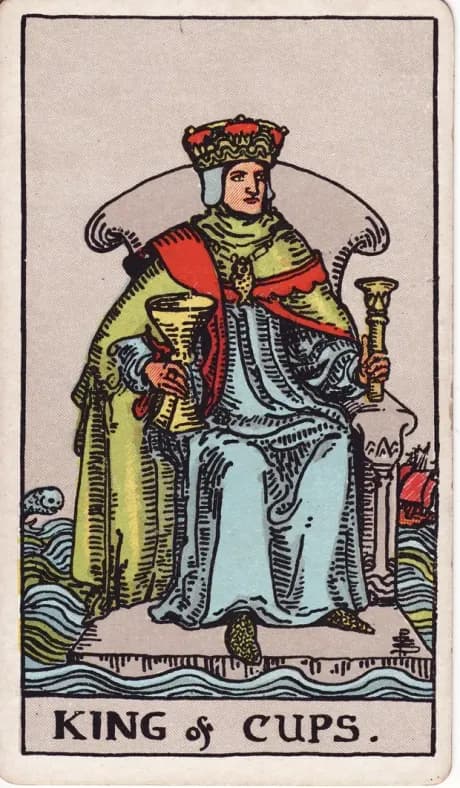
The 1909 card puts him on a heavy stone throne that stands on a small slab in the middle of open water. There is no shore. The sea around him is choppy, drawn in restless lines with broken crests, and his feet rest dry on the block in front of the throne. The water reaches the platform and stops. That is the whole argument of the card made in one visual fact: the element is real, it is moving, and it is not coming in.
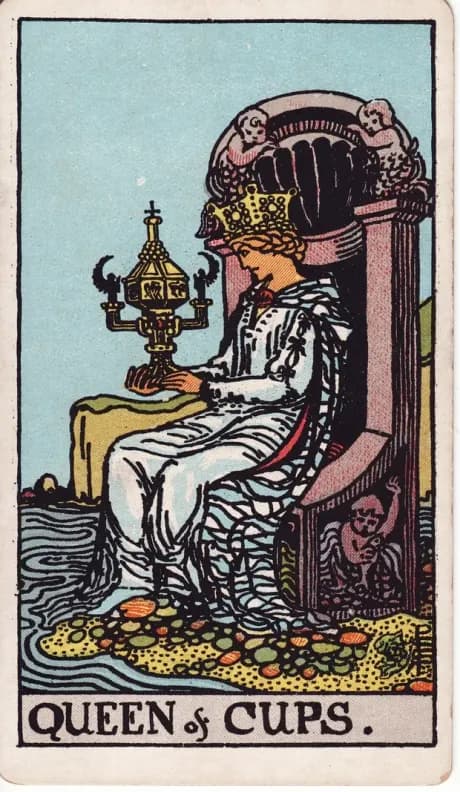
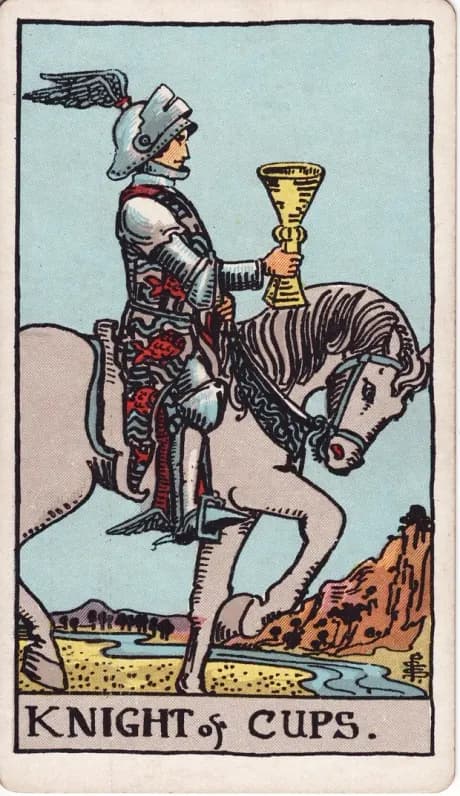
He holds a cup in one hand and a short sceptre in the other, and he is looking at neither. His gaze goes out past the viewer. Compare this with the Queen, who studies her own closed cup, and with the Knight, who watches the cup he is carrying. The King has stopped inspecting his feeling. He simply has it, at arm's length, in a steady grip.
A gold fish hangs on a chain around his neck. To one side of the throne a fish leaps clear of the waves, and to the other a ship rides the same rough water without difficulty. The three details rhyme: the element is worn as an ornament, it is alive in the sea, and it carries traffic safely. Nothing here is being fought.
His robes are layered — blue beneath, a long yellow cloak over it, a red mantle across the shoulder. The colours run from water to sun to action, which is the order the card recommends: feel it, understand it, then move.
The throne is enormous, plain and slightly absurd sitting out there in the sea. It does not float by cleverness. It holds because it is heavy.
Frequently asked
What does the King of Cups mean as feelings?
+
Deep, controlled, mature emotion — devotion carried with composure rather than drama. The volume is low and the level is high, and reading the volume as the level is the standard mistake with this card. If you are waiting for a big signal to confirm what you suspect, you may wait a long time.
Is the King of Cups a good partner card?
+
One of the best in the deck: emotional availability combined with stability. This is the person who answers messages, remembers what you told them, and can hear something difficult without making you manage their reaction. The one caveat is that steady people rarely get asked how they are.
Is the King of Cups a yes or a no?
+
Upright, a dependable yes — unexciting and likely to hold. He is especially reliable on questions about whether someone can be counted on, and unhelpful on questions about whether something will happen quickly. Reversed, a no, usually because something in the situation has not been said out loud yet.
What should I do when I draw the King of Cups?
+
Wait a day before you answer, decide what you want from the conversation before you have it, and then say your position once, plainly and early. Do not confuse composure with silence. Staying calm and saying nothing is not maturity, it is a slower way of avoiding the subject.
Does the King of Cups mean someone is emotionally unavailable?
+
Upright, the opposite — he is the picture of what available actually looks like, just without theatrics. Reversed is where unavailability lives: feeling sealed under a lid, escaping as coldness or unexplained distance. If the card came up reversed and the person seems calm, the calm is the symptom rather than the situation.