What Ten of Cups means in tarot — and in love
The Ten of Cups is the whole picture: lasting love, emotional fulfilment, the rainbow-over-the-house ending — partnership, possibly family, definitely… As feelings, the Ten of Cups means they see forever-shaped potential in you — home, a shared life, the full storyline.
Jump to FAQAt a glance
- Yes or no
- Yes — reversed flips it
- Element
- Water
- Upright, in a line
- lasting happiness, the whole picture of love
- Reversed, in a line
- a picture-perfect facade with cracks
Want a yes or no on your own situation rather than this card? Pull one card and get the verdict with the reason behind it.
Ask your own yes-or-no questionIn the Golden Dawn tradition this card rules 20–30° of Pisces. A planet standing at that degree is read through it: Venus in Pisces · Moon in Pisces · Mars in Pisces
Upright in love
The Ten of Cups is the whole picture: lasting love, emotional fulfilment, the rainbow-over-the-house ending — partnership, possibly family, definitely peace. It is the card of relationships that work in the kitchen and not only on holiday. If you asked about long-term potential, this is as good as the suit gets. Build toward it, then live in it.
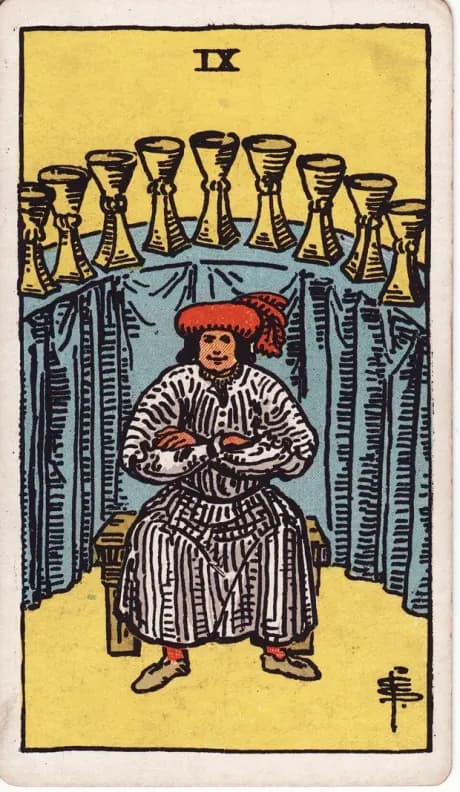
The difference between this card and the Nine of Cups is the difference between a wish and a household. The Nine grants one person what they asked for. The Ten cannot happen alone — it requires other people to also want it and to keep wanting it on ordinary Tuesdays. That is why it sits at the end of the suit. It is not the most exciting emotional state available, it is the most expensive one to maintain.
In a new connection it describes architecture rather than a timeline. It says this one has the shape that could hold a life: compatible daily habits, similar ideas about what a good week looks like, an absence of the low grinding friction that ends most things. It does not say when, and it does not say the work is already done. Early in something, this card is a description of potential that still has to be built out.
In an established relationship it describes maintenance done well. Someone has been doing the unglamorous parts — the repairs after arguments, the boring logistics, the choosing of each other on days when nothing about it felt special. The card is the visible result of invisible labour, and the honest response to drawing it is to notice who has been doing that labour and say so.
What it asks of you is to inhabit the thing rather than photograph it. Stop improving the arrangement for a while. Have people over. Let it be ordinary, because ordinary is what this card is actually made of.
Reversed in love
Reversed, the Ten of Cups is the postcard with cracks: looking correct from outside while something inside aches — disconnection behind the routines, harmony performed rather than felt. The dream is not dead. The honesty that maintained it lapsed. Repair the real thing instead of retouching the photograph.
What the reversal changes is the direction the arrangement faces. Upright, the household is built for the people inside it. Reversed, it is being maintained for an audience: family, friends, an old plan, a version of yourselves you announced years ago and never revised. Everything still functions. The meals happen, the holidays happen, and nobody inside can say when it stopped being for them.
The common form is a quiet drift where nothing is wrong enough to raise. There was no incident. There is nothing to bring to an argument, which is precisely the difficulty — you cannot repair a thing you have no vocabulary for, and the absence of a specific complaint is often read as proof that everything is fine.
A second form is a shared ideal that only one person still holds. One of you is still building toward the picture and the other stopped some time ago and has not said so. That gap is survivable if named early and corrosive if not, because the person still building keeps investing in a future the other has quietly left.
This is one of the more repairable reversals in the deck, and it is worth saying plainly. Nothing here is destroyed. Nothing has been betrayed. What has gone missing is accurate speech between people who still like each other, and that is recoverable at almost any point somebody is willing to start.
Ten of Cups As feelings
As feelings, the Ten of Cups means they see forever-shaped potential in you — home, a shared life, the full storyline. It is deep, settled, future-facing feeling. When someone means this card, you generally know.
That last part is the most useful thing about it. This card does not describe hidden or ambiguous feeling. It describes feeling that has already made itself visible in behaviour, which is why it lands so differently across the four situations people ask about.
If you are single and asking about someone new. They are imagining a life rather than an evening. That is genuinely rare and worth taking seriously, and it carries one caution: they may be further along in that imagining than the actual acquaintance justifies. Warmth this large early on needs the ordinary reality of you to catch up to it, and the card is favourable enough that this is usually a good problem.
If you are in a relationship. They are content in a deep, structural way. You are not a chapter to them, you are the setting. People in this state stop performing effort, which occasionally gets misread as effort disappearing. Look at what they organise their year around rather than at how often they say things.
If you are asking about an ex. They remember the two of you as a whole life rather than as a period, and that memory is warm and complete. Complete is the operative word. The card describes a picture they hold, not necessarily a door they intend to walk back through.
If you are asking about someone long-term. They are at home with you, in the literal sense the card draws. There is no drama in this answer and there is not supposed to be.
Ten of Cups For your ex
For an ex, the Ten of Cups means the dream of what the two of you could have been still lives in them. Reunions under this card can genuinely rebuild toward the whole picture — provided the cracks that broke it got named and repaired rather than simply survived.
That condition carries the entire reading. This card describes a shared life as a possibility, and shared lives are not restored by feeling. They are restored by the specific unpleasant work of identifying what failed. If the answer to what broke it is still unclear to both of you, the card is showing you a picture rather than a plan.
It is also common for the Ten of Cups to appear here as memory rather than as forecast. What they hold is the whole of it, edited into one warm shape: the house, the routines, the years. That shape is easy to love because it has no arguments in it. Nobody misses the arguments, which is exactly why the picture returns so cleanly and so often.
When it does describe a real return, it tends to be slow and boring in a good way. Not a dramatic reappearance — small practical steps, honesty about what went wrong, a rebuilt daily routine before any grand statements. This card has never been in a hurry. Its whole subject is what lasts, and things that last are assembled rather than declared.
One useful test. Ask whether the thing they miss is you or the life. Both are legitimate, and only one of them requires you specifically.
What Ten of Cups means in general
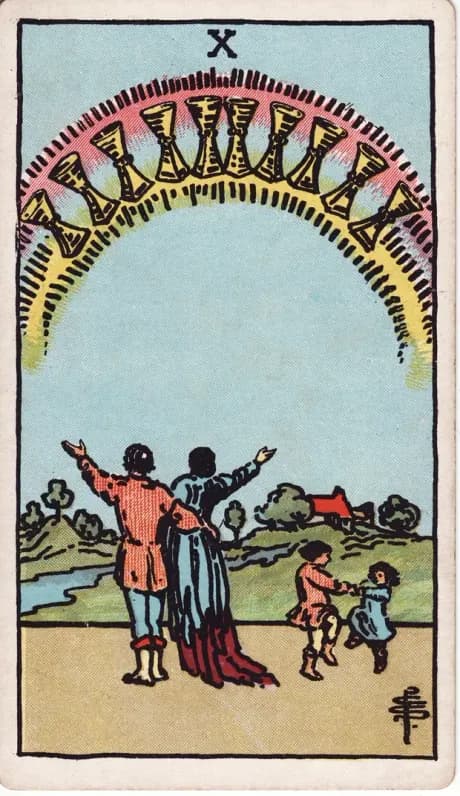
A rainbow of ten cups arches over a family with their arms raised: the completion of the suit, and the emotional counterpart to the Ten of Pentacles. Its subject is fulfilment shared rather than held privately — harmony in a household, a group at peace, the sense that what was being built is finished and good.
Upright it says the situation is not merely successful but sustaining, and that the contentment is durable rather than a peak. Reversed the picture and the reality diverge: performed harmony, disconnection inside something that looks complete from outside, or a collective ideal that only one person still believes in.
In work it is the team that actually functions — where people stay, credit gets shared, and the group outlasts any individual project. In money it is security wide enough to include other people, which is a different achievement from personal comfort and a much harder one. In creative life it is the work that found its community, where what you made now belongs to the people using it.
The Tens are all endpoints, and most of them are heavy. The Ten of Wands carries too much. The Ten of Swords is an ending with nothing left to argue about. The Ten of Pentacles inherits stability it did not personally build. Only this one is unambiguously pleasant, and its price is that no single person can produce it. It requires several people to want the same thing at the same time, repeatedly.
That is the card's real information. The state it describes is not fragile, but it is maintained. It exists because somebody keeps doing the small unremarkable work, and it fades quietly when they stop.
Ten of Cups as a yes or no
As a yes or no, the Ten of Cups upright is a yes, and for long-term questions it is the best yes the suit has. Will this last, is this the real thing, can we build something here — the card answers all of those affirmatively and without hedging.
What it does not answer is when. This card is about durability, not timing, and it will say yes to a question about a decade while remaining silent about a question about next month. If the thing you actually want to know is whether something happens soon, this card is a poor instrument and the honest reading is that the answer is favourable and undated.
Reversed it becomes a no, and a specific kind of no: not a refusal, a discrepancy. The situation is not what it appears to be, and a yes based on appearances would be a yes to the picture rather than to the thing itself. Read reversed as the deck declining to confirm something it can see is being performed.
One warning about over-reading the upright. Because this card is so agreeable, people take it as a yes to whatever they were privately hoping for at the moment they drew it, including specific events and specific dates. This is entertainment, not forecasting, and the card describes a condition rather than a schedule. Ask what would have to be maintained for this to hold, and the answer becomes useful instead of merely encouraging.
Ten of Cups as advice
As advice, the Ten of Cups says build the ordinary version. Not the milestone, not the announcement, not the trip everybody photographs — the Tuesday. This card is made almost entirely of unremarkable repeated behaviour, and its advice is to invest there.
Concretely, that means a few things. Say the appreciative thing out loud, once, unprompted, to the person who has been doing the invisible work. Protect one recurring ordinary ritual and treat it as non-negotiable. Do the repair conversation after the next argument instead of letting time absorb it, because time does not absorb anything, it only files it.
The card also advises widening. Its picture has four people in it, not two. Contentment that has become entirely private tends to thin out. Have someone over. Reconnect the household to people outside it, and let the good thing you have be visible to somebody who is not inside it.
There is one instruction people resist. Define what home means for you in specific terms rather than borrowed ones. The rainbow in the picture is a standard image and most people never check whether they actually want that arrangement. Some do, exactly as drawn. Some want something with a different shape entirely and have spent years feeling defective about it.
Reversed, the advice narrows to one action: say the true sentence. The gap this card describes is maintained by silence and closes the moment somebody stops managing the appearance and describes what the last year has actually felt like from inside.
Ten of Cups as an outcome
As an outcome, the Ten of Cups means the situation ends in something durable. Not a peak, not a triumph, not a dramatic resolution — a settled arrangement that continues after the reading is over and keeps being good.
This is one of the best results the deck produces, with one qualification about pace. It describes where things arrive rather than how quickly, and the state it draws is one that takes time to assemble. If you are asking about something six weeks old, this outcome is real and further away than it looks. Read it as the destination the road actually leads to, not as next month.
In a question about two people it describes a shared life that works: compatible ordinary days, arguments that resolve, a home in whatever form suits you. In a question about a group or a household it describes peace that holds. The card is unusual in that it promises maintenance rather than climax, which is disappointing to read and excellent to live in.
Reversed as an outcome the situation ends up looking finished and feeling unfinished. Everything is in place and something is missing, and because nothing visible is wrong the state can persist for years. That is the actual warning: reversed, this is not a collapse, it is a plateau that nobody names.
Either version can be moved. Upright, the outcome holds as long as the work behind it continues. Reversed, it changes the moment one person says the accurate thing out loud. Both readings depend on behaviour rather than on fate, which is the most useful thing this card has to say.
What the Ten of Cups card shows
The 1909 card shows a man and a woman standing on green ground with their backs to the viewer, his arm around her waist, their free arms flung outward toward a rainbow in which ten golden cups are set. The cups are in the sky. Nobody is holding one. Everywhere else in the suit the cups are on tables, in hands, on the earth — here the fulfilment is weather over a place rather than an object anyone possesses.
To one side two children dance, holding hands, arms lifted. They are not looking at the rainbow. That detail is the most quietly accurate thing in the picture: the people who benefit most from a settled household are usually the ones least aware there is anything remarkable about it.
In the middle distance a modest house stands on a low rise with a tree beside it, and a river curves through the land between the house and the figures. The house is small in the frame and some way off. The couple are not inside it. They are standing at a distance with a view of it, in the posture of people looking at what they have made, which is a different activity from living in it.
The colours are unmixed and untroubled: blue sky, green land, gold cups, no shadow anywhere in the scene. The rainbow itself is the deck's oldest promise image, the sign that appears after weather rather than instead of it.
Nothing in the picture is being worked at. The tools are gone, the day is over, and four people are standing in the open air with nothing left to fix.
Frequently asked
Is the Ten of Cups the best love card?
+
For lasting happiness, yes — emotional fulfilment, family energy, the complete picture. It is the suit's happy ending. What separates it from the Nine of Cups is that it cannot be produced alone: it needs several people to want the same thing repeatedly, on ordinary days, which is why it sits at the end.
What does the reversed Ten of Cups mean?
+
Ideal versus reality: harmony that looks correct and feels off. Usually nothing is broken and nothing has been betrayed — what has gone missing is accurate speech between people who still like each other. Fix the connection rather than the image of it, and start by naming the thing nobody has raised.
Is the Ten of Cups a yes or a no?
+
Upright it is a strong yes, and the best yes in the suit for long-term questions. It says nothing about timing, so a question about next month gets an answer about a decade. Reversed it is a no of a particular kind: the situation is not what it appears to be, so a yes would be a yes to the appearance.
What should I do when I draw the Ten of Cups?
+
Invest in the ordinary version rather than the milestone. Thank the person doing the invisible work, protect one recurring ritual, and have somebody over — the card's picture has four people in it, not two. Then check that the arrangement you are building is one you actually want, rather than the standard image of one.
What is the difference between the Nine of Cups and the Ten of Cups?
+
The Nine is a wish granted to one person: private satisfaction, arms folded, cups behind him. The Ten is satisfaction shared, and it requires other people to keep choosing it. The Nine describes how you feel about what you have. The Ten describes something built between several people that outlasts any one of their moods.