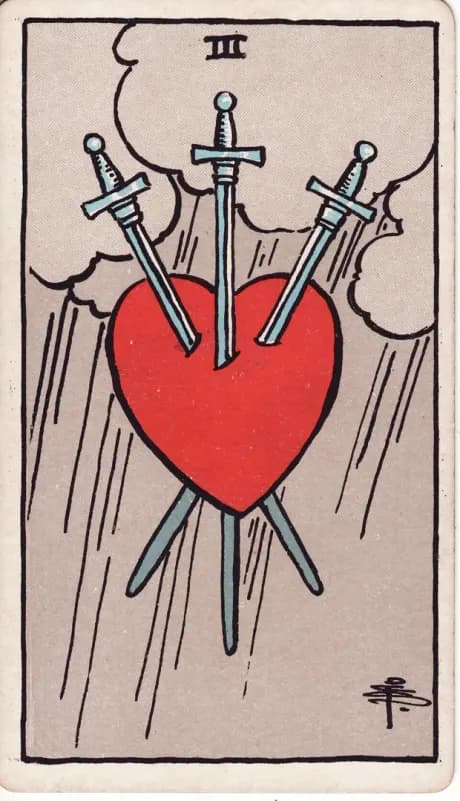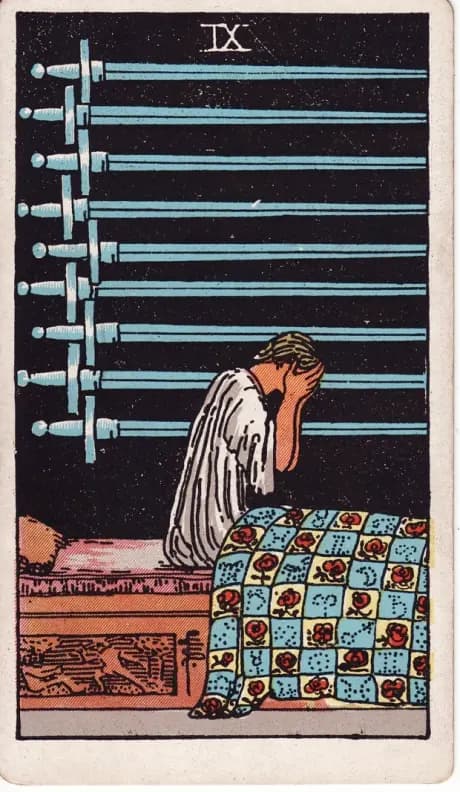
What Ten of Swords means in tarot — and in love
The Ten of Swords is the definitive end: betrayal completed, the relationship's final scene, flat on the ground with ten reasons in your back. As feelings, the Ten of Swords means they feel finished or devastated — an emotional ending has occurred inside them.
Jump to FAQAt a glance
- Yes or no
- No — reversed flips it
- Element
- Air
- Upright, in a line
- rock bottom of the situation, an ending complete
- Reversed, in a line
- survival, the worst already behind you
Want a yes or no on your own situation rather than this card? Pull one card and get the verdict with the reason behind it.
Ask your own yes-or-no questionIn the Golden Dawn tradition this card rules 20–30° of Gemini. A planet standing at that degree is read through it: Venus in Gemini · Moon in Gemini · Mars in Gemini
Upright in love
The Ten of Swords is the definitive end: betrayal completed, the relationship's final scene, flat on the ground with ten reasons in your back. Its gift is finality — no ambiguity to decode, no maybe to nurse. If you asked "is it truly over?" — this card is the deck's clearest yes. And behind it, the detail everyone misses: the sun on that horizon is rising.
The overkill in the picture is intentional and it is merciful. Ten swords is more than anyone needs; one would have done it. The card is describing an ending that has been made unmistakable, and unmistakable endings are easier to survive than ambiguous ones. What kills people slowly is the maybe.
In a new connection it usually means something ended before it began properly — a discovery, a disclosure, a line crossed that cannot be uncrossed. There is no version of this card that recommends salvage. That is not pessimism; it is the card refusing to sell you a repair it cannot deliver.
In an established relationship the Ten is either the moment of the ending or the recognition that the ending already happened some time ago and nobody said so. The second version is more common and more painful, because the grief arrives late and has to cover ground already walked.
The instruction is to stop pulling. The swords are in and taking them out one at a time, examining each, asking whether that one really counted — that is the process that keeps the wound open. Finality is the offer. Accepting it is the fastest route to the sunrise the card has already drawn in.
Reversed in love
Reversed, the Ten of Swords is survival confirmed: the worst has already happened and you're still here — recovery beginning, or an ending resisted past its expiration. Pull the swords out; carrying them isn't loyalty, it's slow bleeding. What refuses to die here is you, not the relationship.
The recovery reading is the main one. You are past the bottom. Something in you noticed that the catastrophe arrived, did its worst, and left you breathing — and that noticing is the beginning of getting up. Reversed, this card frequently appears at the point where someone starts making plans again without having decided to.
The resistance reading is the harder one. Here the ending happened and is being refused: contact maintained for reasons that do not survive examination, hope kept alive on material that would not convince anyone else, a story where they come back that gets edited each time it fails. The card is not scolding. It is pointing out that the pain is now being generated by the holding rather than by the event.
There is a third version people miss. Reversed can mean the ending is being drawn out deliberately by the other person — a slow fade rather than a clean cut, which is crueller and is often mistaken for kindness by the person doing it.
In every version the instruction is the same. Whatever is still attached, detach it. The recovery this card describes is real, and it begins after the last sword comes out, not before.
Ten of Swords As feelings
As feelings, the Ten of Swords means they feel finished or devastated — an emotional ending has occurred inside them. Whatever remains is grief, not fuel. Meet reality where it lies; resurrection requires more than nostalgia.
If you are single and asking about someone new. Something ended for them, and it may have nothing to do with you. This card frequently describes a person who has just come out of something and is not currently able to feel much of anything. That is worth knowing before reading their flatness as rejection.
If you are in a relationship. Something is over for them, internally, and it may not have been said. This is one of the bleakest feeling readings in the deck and it is also occasionally recoverable — but only if it is named, and named soon. The card describes a decision that has already been made in private.
If you are asking about an ex. They consider it finished. Whatever they feel about you is being felt from the other side of a closed door, and the feeling is usually grief rather than resentment. Grief does not reopen doors.
If you are asking about someone long-term. Exhaustion that has passed the point of repair attempts. Not anger — anger still expects something. This is the state after.
Across all four, the card is describing a completed internal event. Whatever the external situation looks like, inside them it has already finished.
Ten of Swords For your ex
For an ex, the Ten of Swords marks the point of no return in its old form — betrayal or exhaustion sealed it. Closure is the gift on offer. New love (with them or anyone) starts only after this body is actually buried.
The phrase "in its old form" is doing real work. This card is absolute about the relationship that existed and says nothing about two people never speaking again. What it forecloses is resumption. Whatever happens next, if anything does, has to be built rather than restarted, and most people asking about an ex are asking about restarting.
The feeling on their side is usually finality rather than hostility. That distinction matters because people prepare for hostility and are unmoored by indifference. There is rarely a fight left here; there is a closed file.
If you want one practical read: this is the card that tells you to stop gathering evidence. The instinct after an ending like this is forensic — rereading messages, reconstructing timelines, trying to locate the exact sword. That process feels like understanding and functions as prolonging. The card has already told you the count. It is ten. There is nothing left to find.
What Ten of Swords means in general
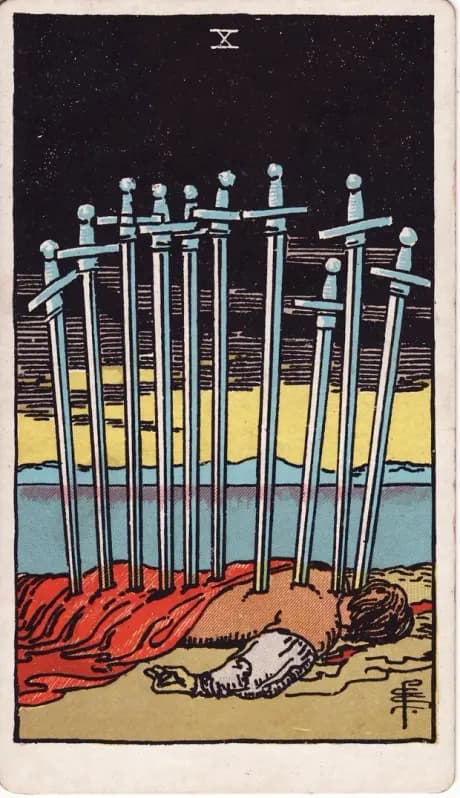
A figure lies face down with ten swords in his back under a black sky with dawn breaking at the edge. The overkill is deliberate: this is rock bottom, and the card is oddly reassuring because nothing worse is available from here.
Upright it means an ending that is complete rather than in progress. Not decline, not difficulty — the finish. The subject is ruin arriving fully, and the specific mercy in it is that ruin arriving fully removes the exhausting work of hoping.
Reversed it turns to aftermath. Survival, slow recovery, getting up. Or the opposite: refusing to accept a conclusion that has already been reached, which converts a finished event into an ongoing injury.
Outside the personal, the card is unusually literal. In work it is the project cancelled, the role eliminated, the venture that failed rather than struggled. In money it is the loss taken. In creative life it is the piece abandoned, which is frequently the correct decision arriving late.
Among the Swords, the number ten completes a suit that has been about thought turning against itself. Eight is feeling trapped, nine is the night, ten is the morning after the thing you feared actually happened. That sequence is a description of how catastrophe is usually experienced: dreaded longer than it lasts.
The rising sun at the horizon is not decoration and it is not consolation. It is the card's factual claim that the lowest point is a point and not a place, and that the direction from here is fixed.
Ten of Swords as a yes or no
As a yes or no, the Ten of Swords upright is the clearest no in the deck. Not a discouraging no, not a "not yet" — a completed one. If you asked whether something will work, whether it can be saved, whether there is anything left, the answer is no, and the card is unusual in leaving no room to negotiate with it.
That bluntness is worth using rather than softening. Most no-answers in tarot come with conditions attached, and readers get used to finding the loophole. This card has no loophole, and hunting for one is the exact behaviour it warns against. The value of an unambiguous no is that it lets you stop spending on the question.
There is one common exception in phrasing. If you asked "is it over" or "should I stop", the ten of swords is a yes — you are asking about the ending itself, and it confirms it. Reading it mechanically as "no" in that case inverts the answer, which is the single most frequent error with this card.
Reversed it becomes a qualified yes: yes, you survive; yes, it gets better; yes, recovery is available. It is not a yes to the original relationship or plan. It is a yes to you, afterwards, which is a different and more reliable thing.
Ten of Swords as advice
As advice, the Ten of Swords says: let it be over. That is the whole instruction and it is harder than any elaborate one. The card is describing a situation where the useful action is cessation — stopping the analysis, the contact, the repair attempts, and the private case-building about what could still be done.
The concrete form is usually about information. Stop rereading, stop reconstructing, stop looking for the detail that reframes everything. The forensic impulse after a bad ending feels like diligence and functions as attachment. There is no sword you have not counted.
The second instruction is about how you talk about it, and it is subtle. This card advises against the story where you were only a victim, not because it is untrue but because it is immobilising. The figure in the picture is face down and the sun is rising anyway. Both facts are in the same frame, and the card's whole position is that you are allowed to acknowledge the first and still act on the second.
Reversed, the advice becomes practical: get up slowly and accept help. Recovery under this card is not heroic, it is incremental, and the failure mode is expecting yourself to be fine on a schedule. Nothing here rewards forcing the pace.
Ten of Swords as an outcome
As an outcome, the Ten of Swords is an ending, complete and unambiguous. The situation you asked about finishes. There is no version of this result that involves a partial continuation, a pause, or a door left open, and reading one into it is wishful.
In love questions this means the relationship, the situation, or the phase concludes. Sometimes badly, with a specific event; sometimes simply, with the last of the energy running out. What is consistent is that afterwards there is no ambiguity to manage, and people frequently report that the certainty was easier than the months of not knowing that preceded it.
The card's own commentary on this outcome is the sunrise, and it should be included in the reading rather than added as comfort. The picture places the worst moment and the beginning of the next day in the same frame deliberately. As an outcome, this card means the bad thing happens and is survivable, and that both of those are certain.
Reversed as an outcome is recovery: the situation ends and the ending is followed by getting up. It can also mean the conclusion drags — an ending stretched out past its natural point, resisted by one party, which produces the same result more slowly and at greater cost.
What the Ten of Swords card shows
The 1909 card shows a man lying face down on the ground beside a body of still water. Ten swords are driven into his back in a line from neck to hip. The sky above him is solid black. At the horizon, a band of pale yellow light is breaking.
The number is the argument. Ten swords is absurd — the first one settled the matter. That excess is the card telling you this is not an injury but a conclusion, and that the question of whether it can be recovered from as it stands has already been answered.
His right hand is the detail most people miss. The fingers are arranged in a benediction, the same gesture the Hierophant makes: two fingers up, the rest folded. A dying figure making a blessing sign is not a defeated figure. Whatever this is, it is not read by the deck as punishment.
The red cloak covering his lower body is the suit's colour of life and passion, and it is intact. The damage is above it.
The water is completely still, and the sky beyond the black is clearing. Those two together are the card's assertion about aftermath: nothing else is coming. The storm is finished, not gathering.
The mountains on the far side of the water are flat and distant, drawn without threat. There is nowhere in this picture that anything more can arrive from, and that emptiness is the point — this is the bottom, and bottoms are stable.
Frequently asked
What does the Ten of Swords mean in love?
+
A complete ending — not decline, the finish. It refuses to sell a repair it cannot deliver, and its mercy is the absence of ambiguity. If the relationship has been ending slowly, this card often marks the recognition rather than the event.
Is the Ten of Swords always about betrayal?
+
No. Betrayal is one route to it, exhaustion is another and more common one. What the card specifies is completeness, not cause. Many Ten of Swords endings involve nobody doing anything villainous at all.
Is the Ten of Swords a yes or a no?
+
The clearest no in the deck, with one important exception: if you asked whether it is over or whether you should stop, it is a yes — you asked about the ending itself. Reading it mechanically as no there inverts the answer.
What should I do when I draw the Ten of Swords?
+
Stop the forensics. Rereading messages and reconstructing timelines feels like understanding and functions as attachment. The card has already given you the count. Reversed, get up slowly and accept help rather than expecting recovery on a schedule.
Why is the sun rising on the Ten of Swords?
+
Because the card places the worst moment and the start of the next day in one frame on purpose. It is not consolation added afterwards — it is the factual claim that the lowest point is a point, not a place, and the direction from it is fixed.