What The Star means in tarot — and in love
The Star is the healing after the storm: hope returning to a scarred heart, faith that love exists after the one that broke you. As feelings, the Star means they feel hopeful and healed around you — you read as their fresh start, their proof that good things still happen.
Jump to FAQAt a glance
- Yes or no
- Yes — reversed flips it
- Upright, in a line
- hope after heartbreak, healing, renewed faith in love
- Reversed, in a line
- discouragement, faith in love running low
Want a yes or no on your own situation rather than this card? Pull one card and get the verdict with the reason behind it.
Ask your own yes-or-no questionUpright in love
The Star is the healing after the storm: hope returning to a scarred heart, faith that love exists after the one that broke you. It promises renewal — a calm, genuine connection, or the self-restoration that precedes one. If you asked 'will I love again?' — the Star's entire job is answering yes. The wound closes; the sky is still there.
What makes this card unusual is that it does not describe an event. Nothing arrives under the Star. Nothing is decided, nobody appears, no message comes. What changes is the internal weather — the return of the assumption that things can be good, which most people do not notice they had lost until it comes back. It is a slow card and an accurate one.
In a new connection it is one of the better signs and one of the least exciting. It describes ease rather than heat: conversations that do not have to be managed, a person you are not performing for, the absence of the low hum of anxiety that you may have started to think was simply what meeting people feels like. Some readers distrust this, because they have learned to read calm as an absence of chemistry. Under this card, the calm is the chemistry.
In an established relationship it usually follows something hard. This is the card of the period after — after the crisis, after the year that took everything, after the long stretch of managing damage. It marks the point where the two of you stop managing and start doing ordinary things again. It is also a card of being seen without defence, which is what the nakedness in the picture is for, and that is harder to allow than most people expect.
The instruction is to stay uncovered. The Star asks you not to armour up in advance: not to test the person, not to hold back a percentage in case, not to be preemptively unimpressed. That is difficult after a bad year, and it is the whole content of the card. Pour the water out. It refills.
Reversed in love
Reversed, the Star is hope running on empty: cynicism after heartbreak, settling because 'they're all the same,' faith in love quietly discontinued. The stars didn't go out — you stopped looking up. Healing needs actual rest and honest grief, not a hardened shell. Refill before you date; despair picks terrible partners.
The reversal does not make this card cruel. It makes it empty. Nothing is attacking your hope here — it has simply been spent, and nobody warned you it was a finite supply that needs restocking. The symptoms are recognisable: the flat scroll through messages you do not answer, the assumption that you already know how this one ends, the conversations in which you are technically present.
One common form is hope aimed at the wrong target. Faith poured into a person who has never returned any of it, kept alive on the smallest available signals, because stopping would mean the last two years were spent on nothing. The reversed Star is often the card that names that, and it is not a punishment. Water poured on stone does not become a garden no matter how long you stand there.
In an established relationship, reversed, it points at discouragement rather than conflict. Nobody is fighting. Somebody has quietly concluded that it will not get better and has stopped asking for it to. That is more dangerous than an argument, because it makes no noise and nothing about it demands attention.
What it asks for is unfashionable: rest and honest grief, in that order, before anything else. Not distraction, not a new project, not immediately meeting someone to prove a point. Upright, the picture shows a person pouring water out. Reversed, the vessels are empty, and the only useful move is to stop pouring and go back to the source.
The Star As feelings
As feelings, the Star means they feel hopeful and healed around you — you read as their fresh start, their proof that good things still happen. It's a gentle, genuine glow rather than a fever. Rare. Value it.
If you are single and asking about someone new. They feel calm about you, which they may find surprising. This card does not describe obsession, and readers hoping for evidence of obsession tend to read it as lukewarm. It is not lukewarm. It is the state of someone who has stopped bracing — not managing you, not strategising, not waiting for the catch. In a person who has been hurt recently, that state is rare and something specific produced it.
If you are in a relationship. They feel restored by you. Often this follows a period when the relationship was hard work, and the card marks the point where it stopped being work for them. There is a particular quality to it: gratitude without debt. They are not grateful in the anxious way that expects to be billed later.
If you are asking about an ex. The wound has closed on their side, and what is left is goodwill without urgency. That is genuinely kind and it is not the same as wanting you back. This is one of the few cards that can mean they think of you warmly and have no intention of acting on it, and the warmth is real either way. People find that combination hard to accept, and it is extremely common.
If you are asking about someone long-term. It suggests settled faith in you — the unglamorous conviction that you will still be there, which is what long attachment eventually becomes. Not a state of high feeling. A state of low doubt, which is worth more and photographs worse.
Across all four, the Star describes feeling that is steady rather than loud. If you are looking for proof in the form of intensity, this card will disappoint you and still be good news.
The Star For your ex
For an ex, the Star suggests wounds are closing and goodwill remains. If there's a future, it's a gentler, honest version — after real healing on both sides. Sometimes its message is simpler: they were the storm; the Star is what comes after.
The card describes the stage where it stops being a fresh wound and starts being history. You can hear their name without a physical reaction. You can remember specific good things without the memory being immediately confiscated by how it ended. That is not the same as being ready to return, and the two get confused constantly, usually at night.
When the Star does point at a reconciliation, it always points at a slow one. Nothing under this card happens quickly, and anything that happens quickly is usually not this card. The version it describes is careful, honest, full of unglamorous conversation and entirely without drama. Both people have to have done the actual repair separately first. A reunion before that is a reunion between two unhealed people, which is the original situation with better lighting.
Sometimes the message is simpler and harder to hear: they were the storm, and this is the weather afterwards. The Star does not always mean a door. Frequently it means you are going to be fine — which is usually the thing you were actually asking about, underneath the question about them.
What The Star means in general
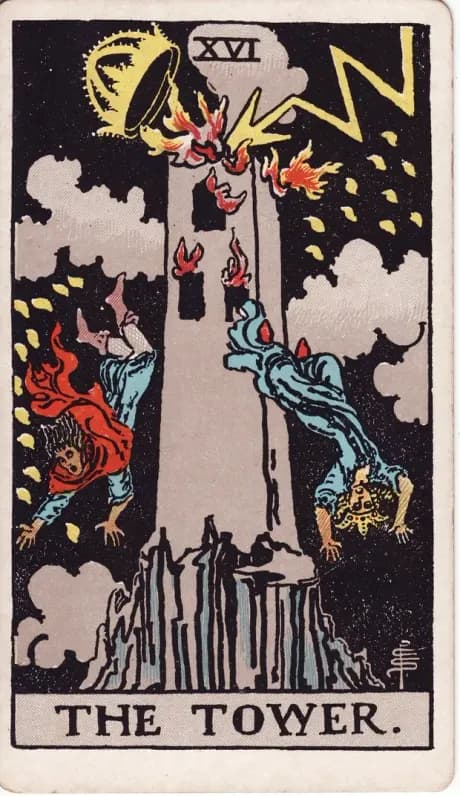
The Star follows the Tower for a reason: after everything falls down, this is what is left. A figure pours water under an open sky, unhurried and uncovered. Its subject is renewed faith — not optimism about outcomes, but the quiet return of the sense that things can be rebuilt and that you have something worth pouring out. Upright it marks healing already in progress, inspiration, and the vulnerability that becomes possible once there is nothing left to protect. It is the deck's most hopeful card and its least dramatic. Reversed the water has run low: discouragement, faith withdrawn, or hope placed somewhere it cannot be repaid.
Read as a general situation, it describes a recovery that is real and not yet finished, and that is the part most people misread. This is not the card of arrival. It is the card of conditions being right: the pressure off, the emergency over, the slow part beginning. Situations under it improve at a rate that is genuinely frustrating if you were promised something faster, and they do improve.
In work it marks the period after a failure when useful ideas start returning — not a promotion, but the recovery of the ability to think, which precedes every promotion anyone ever gets. It also carries visibility: being noticed for what you actually do rather than for what you have been surviving. In money it signals the end of an emergency rather than the start of abundance, which is a smaller and more accurate thing to be told. In creative work it is the strongest card in the deck, because inspiration here is not a flash. It is the return of the willingness to make something without knowing whether it is any good.
Its number sits between destruction and confusion, and that placement is worth noticing. Seventeen is not proof that the difficulty is over. It is proof that you can still pour something out, and the cards that follow will test exactly that.
The Star as a yes or no
As a yes or no, the Star upright is a yes — a soft one, and honest about its own timing. The card does not describe things happening quickly, so a yes here means it works out and takes longer than you would like. If the question had a deadline attached, this card will probably miss the deadline and still be a yes.
It is a particularly reliable yes for questions about recovery: will I be all right, will this heal, will I want things again. That is the card's actual subject, and on those questions it is close to unqualified.
It is a weaker yes for questions about what another person will do. The Star describes a state, not an act. Someone can feel exactly as this card describes and still do nothing about it, because nothing in the picture involves anyone making a move. Kneeling by a pool is not a decision.
Reversed it turns to no, but a specific kind. Not a refusal — a not yet, and usually a not like this. Reversed, the card says the conditions are not in place: something is depleted, and starting from empty produces the outcome you are afraid of rather than the one you asked about. That is more useful than a flat no, because it names something that can be changed.
If it lands upright on an urgent question, the better question is not whether but at what pace, and what you would do with the intervening time. The Star answers that generously. It answers 'when' badly, and it will keep answering it badly no matter how many times you shuffle.
The Star as advice
As advice, the Star says: uncover, and refill. Those are two separate instructions, and most people take only the first one seriously.
Uncover means drop the defence you built during the bad stretch. Concretely: stop testing people before you trust them, stop rehearsing the version of events that makes you look reasonable, stop deciding in advance how something will end so that you cannot be surprised by it. That armour was useful once. It is now the thing holding the situation exactly where it is.
Refill means treating hope as a supply rather than a mood. Sleep. Finish the grieving you interrupted. Spend time on something that produces nothing. The figure in the picture holds two vessels and pours from both, and the water comes from the pool she is kneeling beside — she is not generating it, she is moving it. If you are pouring out and never going back to the source, the card is describing you accurately, and the result is on the reversed side of this page.
There is a third instruction, quieter than the other two: let yourself be seen doing the unimpressive part. This card is about being visible with no story attached, which for most people is more exposing than any confession. Say the plain thing about how you are. Do not make it entertaining.
Reversed, the advice is to stop pouring temporarily. Not permanently, and not with a speech about how you are done with all of it. Just stop, long enough to see what is actually left, and refuse every decision that would have to be made from empty.
The Star as an outcome
As an outcome, the Star is a good ending that arrives slowly and quietly. The situation resolves into something calmer than it is now, with the pressure off and the fear reduced, and there is generally no single moment when it happens. People who draw this as an outcome often say later that they are not sure when things got better.
It is worth being precise about what it promises, because the card gets oversold. It does not promise the specific thing you asked for. It promises that the situation stops damaging you and that you recover the capacity to want things again. In practice those two frequently lead to the specific thing. They are not the same as it.
Upright it also carries a public element that is easy to miss: being seen, recognised, or found. Outcomes here often involve someone noticing you without your having campaigned for it. That is not the same as being chosen, and it is usually the step before.
Reversed as an outcome, the situation ends flat. Not a catastrophe — a fizzle. The hope goes out of it, one side stops trying, and what remains is fine and slightly grey. The reversed Star is the deck's most common description of something that simply never got the fuel it needed.
Around either version, the neighbouring cards set the pace. Wands company speeds it up. Pentacles company makes it durable. Swords company suggests the recovery is happening inside a mind that has not yet stopped arguing with itself, which slows everything down and does not stop it.
What the The Star card shows
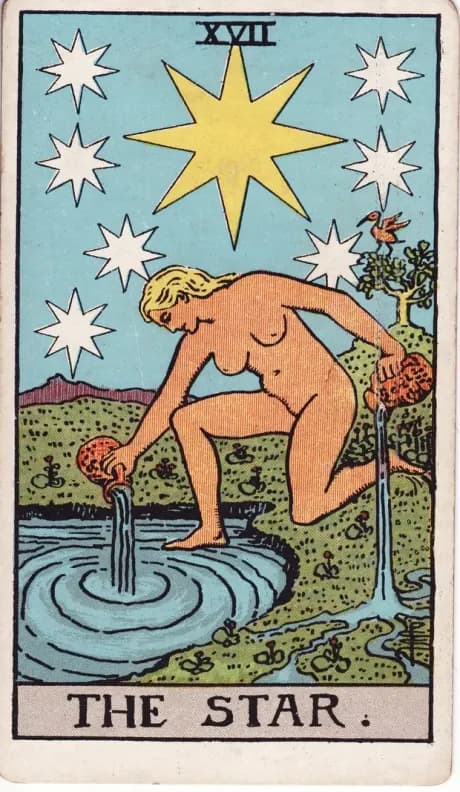
A naked woman kneels at the edge of a pool. One knee rests on the ground; her other foot is on the surface of the water, taking her weight without sinking. She holds two vessels and pours from both — one back into the pool, one onto the earth, where it runs away in five separate streams. Above her, one large eight-pointed star burns yellow, surrounded by seven smaller white ones. Behind her, on rising ground, a tree with a bird perched in it. The sky is clear and open, with no cloud anywhere in the picture.
The nakedness is the first and largest statement. She is drawn without covering, ornament or any mark of rank. Nothing about her is concealed and nothing is defended. This is the card that follows the Tower, and it is showing you the state of a person with nothing left to protect.
The pouring is the mechanism. She is not creating water. She takes it from the pool and returns half of it, and the half that reaches the land does not stay — it divides and drains away. What the picture describes is circulation rather than accumulation. It is a generous image and a slightly uneasy one if you look at it as a system.
The foot on the water is not a miracle in this picture, it is a balance. She has one point of contact with solid ground and one with something that should not hold her, and she is steady on both.
Eight points on the great star, seven smaller stars around it, five streams on the ground: the card is heavily numbered and those numbers have been read many ways. The bird is usually named as an ibis, and it is the only other living thing here. Nothing in the picture is watching her, which is the point of the nakedness. She is not uncovered for an audience.
Frequently asked
Is the Star a yes in love readings?
+
A hopeful yes — healing, renewal and genuine connection are moving toward you. The timing is gentle rather than instant, so treat it as a yes about direction rather than about this week. On questions of recovery specifically, it is close to unqualified.
What does the Star mean after heartbreak?
+
Recovery is real and already underway. You will trust again, love again, and choose better. The card exists to say exactly that, and it says it about you rather than about anyone who might arrive. Nothing in it requires another person to show up first.
Is the Star a yes or a no?
+
Upright it is a soft, slow yes, strongest on questions about healing and weakest on questions about what someone else will do. Reversed it is a not yet: the conditions are not in place, something is depleted, and starting from empty gives the outcome you fear.
What should I do when I draw the Star?
+
Two things. Drop a defence you built during a bad stretch — the testing, the bracing, the deciding in advance how it ends. Then refill deliberately: rest, finish the grieving you interrupted, and refuse any decision that would have to be made from empty.
Does the Star mean my wish will come true?
+
It is often called a wish card, and that reading oversells it. Tarot does not foretell events, and this card in particular describes a state rather than a result: hope restored, capacity returning, the emergency over. Those conditions make good outcomes more likely. They are not a guarantee of one.