What The Tower means in tarot — and in love
The Tower is the truth arriving like lightning: the text discovered, the confession blurted, the illusion collapsing in one evening. As feelings, the Tower means something about you shakes their foundations — you disrupt how they thought love worked.
Jump to FAQAt a glance
- Yes or no
- No — reversed flips it
- Upright, in a line
- sudden truth collapsing the illusion
- Reversed, in a line
- delaying a needed collapse, fear of upheaval
Want a yes or no on your own situation rather than this card? Pull one card and get the verdict with the reason behind it.
Ask your own yes-or-no questionUpright in love
The Tower is the truth arriving like lightning: the text discovered, the confession blurted, the illusion collapsing in one evening. What falls was built on a cracked foundation — that's why it falls. It's brutal and it's mercy: you can't live in a building that lies. If you asked about stability, the answer is renovation by demolition. What survives the Tower is real.
The thing people get wrong about this card is the lightning. The bolt is not the disaster. The disaster was the construction — the agreement nobody examined, the story both people kept telling because stopping to check it would have cost a difficult evening. Lightning only finds what was already conductive. By the time this card turns up, the thing it destroys has usually been unstable for months, and everyone involved has been quietly working around the tilt.
In a new connection it is rarely a breakup, because there is not enough structure yet to fall. It is more often a fact arriving early: they are still married, they are moving abroad in six weeks, the person they presented for three dates is not the one you just met. This is the cheapest possible timing for that information. It feels like being robbed. It is closer to being handed a receipt.
In an established relationship it is heavier and less merciful about timing. Something long hidden surfaces, or something long avoided finally gets said in the worst possible way, at the worst possible hour, with no preparation. Not every Tower ends a relationship. What it always ends is the arrangement — the specific unspoken deal about who does what and what is never mentioned. Couples who survive it are the ones who let that deal stay dead instead of trying to rebuild it exactly.
The instruction is short and nobody likes it: stop protecting the structure. Do not spend the week after a Tower trying to restore the previous version of the situation. That version is the thing that fell. What the card asks for is a straight account of what is true now, said out loud, to the person it concerns — and then the slow work of deciding what to build on ground you can finally see.
Reversed in love
Reversed, the Tower is the collapse postponed: cracks papered over, the conversation avoided, a breakup everyone feels and no one starts. Delaying the fall doesn't cancel it; it moves it to a worse date with interest. Take the controlled demolition — honest words now — over the surprise one later.
The reversal does not make this card gentle. It makes it slow. Upright, the truth arrives in one evening and the pain has an end date. Reversed, the same truth leaks over months: the silences, the phone turned face down, the plans that stop being made past a certain point in the calendar. Both people usually know. Neither will be the one who says it, because whoever says it first becomes the one who caused it, and that arithmetic can hold a household still for years.
There is a second, kinder reading, and it is genuine. Sometimes this is the near miss — the confrontation that could have ended everything and did not, the fall that was survived. The relief is real. The risk is that relief gets mistaken for repair. Nothing was fixed by the fact that nothing broke. If the card lands this way, the honest question is what was almost lost, and whether anything about the structure has actually changed since.
There is also the version where the collapse already happened and is being denied. People go back to a home that is not standing and behave normally in it. That is this card at its most exhausting: enormous daily effort spent maintaining an appearance for an audience of two, both of whom already know.
The move is the same in every version and it does not get easier by waiting. Say the true sentence. Say it in daylight, sober, with time afterwards. Controlled demolition is not pleasant, but you choose the hour, you choose the words, and you are standing outside the building when it goes.
The Tower As feelings
As feelings, the Tower means something about you shakes their foundations — you disrupt how they thought love worked. It can read as fear: strong feelings they experience as danger to their carefully built life. Expect either bravery or bolting.
If you are single and asking about someone new. They feel more than they planned to and it has frightened them. This is not a slow-building fondness; it arrived and rearranged things. People handle that badly. Some become intense very fast, some go silent for a week and cannot explain why afterwards. What you are looking at is a person whose settled picture of their own life has stopped matching what they want, and who has not decided yet whether to admit it.
If you are in a relationship. Something has been building on their side and has not been said. The emotion here is real and under pressure — resentment they have not voiced, or a need they think is unreasonable and therefore keep swallowing. Feelings under this card do not stay stored. They come out all at once, usually badly, usually over something small that was never the actual subject.
If you are asking about an ex. They feel the break as something that broke them, not as something that merely ended. That is not the same as wanting to return. This card is honest about scale and vague about direction: whatever happened is still structural for them, and it can produce a message at midnight or a permanent silence with equal ease.
If you are asking about someone long-term. Here it usually points at a private reckoning — a conclusion they have reached about the shape of their life, which includes you but is not only about you. Ask directly, once, and then believe the answer. This card does not reward guessing, and guessing is what everyone does with it.
Across all four, the Tower never describes mild feeling. Whatever they feel is large, and large is not the same as good news or bad.
The Tower For your ex
For an ex, the Tower marks the breakup that changed the architecture — sudden, revealing, irreversible in its old form. Any rebuild starts from the ground, with new blueprints. Nostalgia for the old tower is nostalgia for the crack in it.
These are the endings people can describe with a date and an hour. Something was discovered, or said, and afterwards nothing was recoverable. That specificity is the card's signature and also its cruelty: you can locate the exact moment, which makes it feel like the moment was the cause. It was not. It was the point at which the cause became visible.
Reconciliation is not impossible here, but it has a strict condition. What you had cannot be resumed, because the arrangement it ran on is the thing that fell. A rebuilt version has to be genuinely different: different agreements, different honesty, usually a different distribution of who gives way. People who try to restore the previous version instead of building a new one tend to reach the same collapse faster the second time, because the crack is now known and is being deliberately stepped around.
The practical read is unglamorous. Look at what has changed since, in behaviour, not in feeling. Feeling changes constantly after a Tower and proves very little. If the same conditions are in place — the same avoidance, the same withheld thing, the same imbalance — then what is being proposed is the old structure with fresh paint, and the lightning already knows the address.
What The Tower means in general
The Tower is sudden structural failure. Lightning strikes a building and the figures fall from it, and the shock is not the point — the point is that the tower was built on something false and the strike only revealed it. Its subject is the collapse of an arrangement that could not have survived scrutiny: an illusion broken, a truth that arrives all at once, a plan that ends without warning.
Upright it is fast, unwanted and clarifying. Reversed the collapse is being deferred — patching a foundation that is already gone, or the disaster passing narrowly, which brings relief and leaves the false structure standing.
Read as a general situation, this card describes an event that removes an option rather than one that offers a choice. Nothing here asks you to decide. It reports that a decision has been taken out of your hands, and that the thing you were managing has stopped being manageable. Most of the difficulty people have with it comes from continuing to negotiate with a situation that is already over.
In work it is the redundancy nobody was warned about, the audit that finds the thing everyone knew, the project cancelled between one Friday and the next. In money it is the arrangement that only functioned while a single assumption held. In creative work it is the draft that has to be abandoned because the flaw is in the premise and no amount of rewriting reaches it — painful, and usually the beginning of the version that works.
Its position in the sequence is the argument. It sits between the Devil and the Star: it is what breaks a hold that would not have loosened on its own, and it is followed immediately by the quietest picture in the deck. Nothing is rebuilt during a fall. Something is rebuilt afterwards.
The Tower as a yes or no
As a yes or no, the Tower upright is a no, and one of the plainest in the deck. Not a no that leaves the door open, either: the card describes something ending, and it usually ends the thing the question was about. If you asked whether an arrangement will hold, whether a plan will survive contact, whether the current shape of things will last, this card says it will not.
Reversed the verdict is much the same with the timing changed. It is a no that has not been delivered yet. Sometimes it reads as a narrow escape, and technically the answer becomes yes because the thing survives — but survival under the reversed Tower usually means the problem was postponed rather than solved, and a yes that has to be defended every month is worth less than the word suggests.
There is one situation where this card gives a genuine, strong yes, and people miss it constantly. If the question is about whether something hidden will come out, whether a truth will surface, whether the thing you suspect is really there — the answer is an unambiguous yes. This is a card about revelation as much as about ruin, and the deck is rarely so willing to confirm a suspicion.
Otherwise it argues for a better question. Yes or no is a question about outcomes, and the Tower is a card about foundations. Ask instead what the situation is resting on, and what you would do if that support were removed tomorrow. Those answers are usable. The verdict, by the time this card turns up, is generally already known by everyone involved.
The Tower as advice
As advice, the Tower says: stop reinforcing it. Whatever you have been holding together with steady daily effort — an arrangement, a story, a position you argued yourself into and cannot now argue out of — the card advises you to let it come down and to be the one who chooses when.
Concretely: say the thing. Not eventually, not after the holidays, not at a better moment, because a better moment is precisely what does not arrive. Write the sentence down first if that helps; the damage under this card usually comes from delivery rather than content. Choose a time with room after it. Say it plainly and once, then stop explaining.
The second instruction concerns the days afterwards and is ignored more often. Do not immediately rebuild. The urge to restore normality is enormous, and it is the reason people reconstruct the exact structure that failed. Give it a week of standing in the rubble and looking at what the rubble is made of. Something was load-bearing that should not have been. Find out which thing.
Practically, this card also advises the dull safety measures nobody wants to take while things still look fine: know what you would do, where you would go, what you would need. Not because collapse is certain, but because the Tower describes situations where the warning and the event arrive together.
Reversed, the advice sharpens to one line: the thing you are avoiding is the thing. You already know what it is. The reversed card rarely delivers new information — it points at information you have been carrying for months and asks how much longer you intend to carry it.
The Tower as an outcome
As an outcome, the Tower is a break rather than a fade. The situation you are asking about does not taper off or drift into something quieter. It ends at a point, and there is usually a day you will be able to name afterwards. If you were hoping for gradual improvement, this card is not describing it.
What it describes is often better than it feels at the time. It removes something that was consuming maintenance: a pretence, an arrangement that only worked while nobody looked at it, a position you were holding at cost. The relief people report afterwards is usually not relief about what happened. It is relief at no longer having to hold it up.
Surrounding cards matter more than usual here, because they say what was standing. Grounded, established company suggests something substantial falls and the loss is real. Foggy company — the Moon, the Seven of Cups, the Devil — suggests what falls was largely a story, and the outcome is closer to waking up than to losing.
Reversed as an outcome, the ending is postponed rather than cancelled. The situation continues in a degraded form: functional, unresolved, quietly expensive. Occasionally the reversal genuinely means the crisis passed, and when it does the outcome is a reprieve rather than a resolution — the same structure standing, with everyone now aware of the crack.
Either way, this is not a final position. It is the deck's most violent transition and it is followed immediately by the Star. What it ends, it ends in order to make room, and the room is real even when the ending was not chosen.
What the The Tower card shows
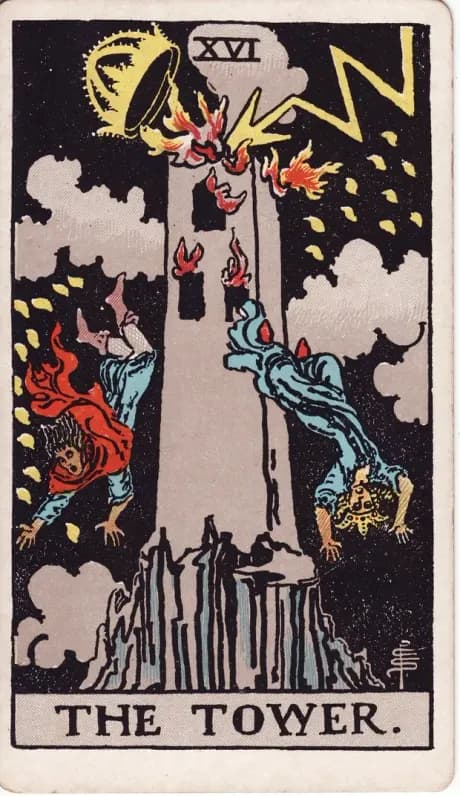
A tall narrow tower stands on a bare rock peak, and a bolt of lightning has just struck its top. The crown that sat on the tower is knocked loose and is falling clear of the roof. Flame pours from three windows. Two human figures fall head first through the air, arms out, one of them crowned. The sky behind them is black.
The rock is the first thing worth noticing. There is no ground under this tower, no earth, no approach, no door visible at the base. It was built on a crag, which is stable until it is not, and the picture gives no indication of how anyone got up there or how they were meant to get down.
The crown is the argument. It is not destroyed, it is displaced — a thing that was placed on top and was never structural. What the lightning removes is the claim the building was making, not the stone. Waite's own note on this card concerns the ruin of a house of false doctrine, and the crown is where the falseness sat.
Three windows show fire, which means the fire is inside as well as at the top. The strike lit something that was already there.
The two figures fall in the same posture but not in the same clothing, and the crowned one falls exactly as fast as the other. That is the plainest statement on the card: a collapse does not respect rank.
Small flame-shaped drops hang in the air on both sides of the tower, in the form of the Hebrew letter yod. Readers usually count twenty-two of them, one for each card of the major arcana. Whatever the count, they are drawn as falling light rather than as debris, and they are the only hopeful mark in an otherwise entirely black picture.
The Tower Spread
The Tower gave its shape to a five-card spread that reads a relationship as a building — the foundation it rests on, the walls that hold it up, the crack, the lightning, and what is still standing after.
Try the Tower spreadFrequently asked
Does the Tower mean a breakup?
+
It means sudden revealing change, which is often a breakup and sometimes a truth that transforms the relationship instead of ending it. What is genuine survives the shake. What was being maintained by silence does not. The card is more reliable about the shock than about the outcome.
Is the Tower ever good in love?
+
Yes, and more often than its reputation suggests. It demolishes illusions quickly, and losing a false story early is a favour. Ask anyone who got the truth after ten years. The card is unkind about timing and honest about content, which is a better trade than it feels like at the time.
Is the Tower a yes or a no?
+
Upright it is a firm no for questions about whether something will hold or last. Reversed it is a no that has not been delivered yet. The exception is worth knowing: if you asked whether a hidden thing will come out, the Tower is a strong yes in either direction.
What should I do when I draw the Tower?
+
Stop reinforcing whatever you are holding together, and say the true sentence yourself rather than waiting for it to arrive as a surprise. Then resist rebuilding for a week. The most common mistake after this card is restoring the exact structure that failed, because normality feels urgent.
Is the Tower the worst card in the tarot?
+
It is the most alarming to look at, which is not the same thing. The Ten of Swords, the Three of Swords and the Devil all describe suffering that lasts longer. The Tower is fast, and what it destroys was already unsound. Its reputation comes from the picture, not from what usually follows it.