What Five of Cups means in tarot — and in love
The Five of Cups is grief with tunnel vision: mourning the spilled cups — the breakup, the betrayal, what should have been — while two full ones wait… As feelings, the Five of Cups means regret and loss dominate — they're grieving something about you two, possibly their own part in it.
Jump to FAQAt a glance
- Yes or no
- No — reversed flips it
- Element
- Water
- Upright, in a line
- grief over what was lost, focusing on the spilled
- Reversed, in a line
- acceptance, turning toward what remains
Want a yes or no on your own situation rather than this card? Pull one card and get the verdict with the reason behind it.
Ask your own yes-or-no questionIn the Golden Dawn tradition this card rules 0–10° of Scorpio. A planet standing at that degree is read through it: Venus in Scorpio · Moon in Scorpio · Mars in Scorpio
Upright in love
The Five of Cups is grief with tunnel vision: mourning the spilled cups — the breakup, the betrayal, what should have been — while two full ones wait behind you. The sorrow is legitimate; the exclusivity of it is the trap. If you asked about moving on: you're allowed to grieve and to turn around. Both. In that order.
The card is honest about the loss in a way many readers are not. Something real went. It is not a lesson, it is not secretly a gift, and the people who tell you it happened for a reason are usually the ones who did not lose anything. The Five of Cups does not argue with grief. It argues with the arithmetic.
In a new connection this card is usually about who you are bringing. You are meeting somebody while still standing over the spill, and everything they do is being read against a previous person. That is not a moral failing and it does not mean you should be alone. It means the new person is being judged in a competition they have not been told about and cannot win, because they are a real person and their opponent is a memory that has finished changing.
In an established relationship it usually means a loss inside the relationship rather than the end of it. A promise that was not kept. A move that cost more than expected. A version of the two of you that ended while you both stayed. Grief for something that happened inside a relationship is real grief, and it is the kind most often skipped, because nothing visibly ended and there is nobody to announce it to.
What it asks is unglamorous and sequential. Grieve on purpose, with the whole weight of it, and then physically turn around. Not feel better. Turn. Look at the two cups still standing and name them out loud, because they are specific, and vague gratitude does nothing while a specific inventory does.
Reversed in love
Reversed, the Five of Cups is the turn: acceptance arriving, forgiveness unlocking, the gaze finally shifting from what spilled to what remains. Healing gets real here — the past loosens its plot armor. New love becomes visible roughly one head-turn away.
What the reversal changes is direction, not weather. It does not mean the loss stopped mattering. It means the person in the picture is no longer standing in the same position, and everything downstream of that follows: the two remaining cups become visible, the spilled ones become a fact rather than a scene, and the story can finally be told in the past tense.
In practice this looks smaller than people expect. Nobody feels healed. What happens is that a day goes by without the replay, and then a week, and the anniversary arrives and does less damage than the one before. Reversed, this card measures recovery in reduced frequency, not in the absence of feeling.
It also carries forgiveness, which is worth being precise about. The forgiveness here is more often self-directed than aimed at somebody else — the part of the loss you are still holding a private trial about, where you were both prosecution and defendant. That case is the one this card closes.
There is a less welcome version. Reversed can mean grief packed away too early: the cups set upright, the cloak folded, the whole thing declared finished on a schedule that suited everybody else. Grief handled that way does not disappear. It stops being available for inspection and turns up later attached to something unrelated. If you turned around quickly and felt nothing at all, that is worth noticing rather than congratulating yourself for.
The reliable sign of the honest version is this: you can describe what happened without needing the listener to take your side.
Five of Cups As feelings
As feelings, the Five of Cups means regret and loss dominate — they're grieving something about you two, possibly their own part in it. The feelings are heavy but backward-facing. Sorrow isn't the same as coming back.
Grief is the easiest feeling to misread as intention, so the situations are worth separating.
If you are single and asking about someone new. They are carrying something. It is usually not about you at all — a previous person, a loss that has nothing to do with anyone they are meeting now, a version of their life that ended recently. What you are receiving is the reduced signal of somebody whose attention is aimed backwards. They may like you a great deal and still have very little available.
If you are in a relationship. They are mourning something inside it. A disappointment never said out loud, a broken expectation, or the gap between the relationship they thought they were getting and the one they have. This is the most useful appearance of the card, because it is fixable and it is almost always about a specific unspoken item. Ask what they lost. Do not defend yourself first.
If you are asking about an ex. They regret it. This is regret with the full weight on it — not a passing thought, an ache with a shape. But the feeling is entirely backward-facing, and that is the sentence people skip. Regret describes where their attention is. It does not predict what they will do with it.
If you are asking about someone long-term. Usually the grief is about something you both lost rather than about you: a period that ended, a plan that did not happen, the shape their life took. Read this one as sorrow shared rather than sorrow aimed.
Across all four the card is heavy, honest and stationary. What it never tells you is whether the person feeling this will turn around. That is a different card, and it is worth asking for.
Five of Cups For your ex
For an ex, the Five of Cups means they sit with the loss — replaying the spill, tasting regret. Some reach out from this place; many just marinate. If they do return, make sure they've seen the remaining cups, not just the puddle.
The reason this card gets quoted so often in questions about an ex is that it gives people what they wanted to hear — yes, they regret it — while quietly withholding the part they actually asked about. Regret is a state, not a step. The figure in the picture has been standing in the same place for a long time, and nothing in the card suggests he is about to move.
There is also the matter of what exactly is being mourned. Frequently it is not you. It is the loss itself, or their own conduct, or the ordinary comfort that disappeared along with the arrangement. Somebody can be genuinely devastated by an ending and have no wish to reverse it, and the Five of Cups covers both people equally well.
If they do come back from this position, the thing to check is where they are looking. Someone who returns while still facing the spill brings the whole apology and none of the future; the conversation will be about what went wrong, repeatedly, and it will not progress. Someone who turned around first arrives differently, with a proposal rather than a confession. That difference is visible within a single conversation, and it is the only reliable test this card offers.
What Five of Cups means in general
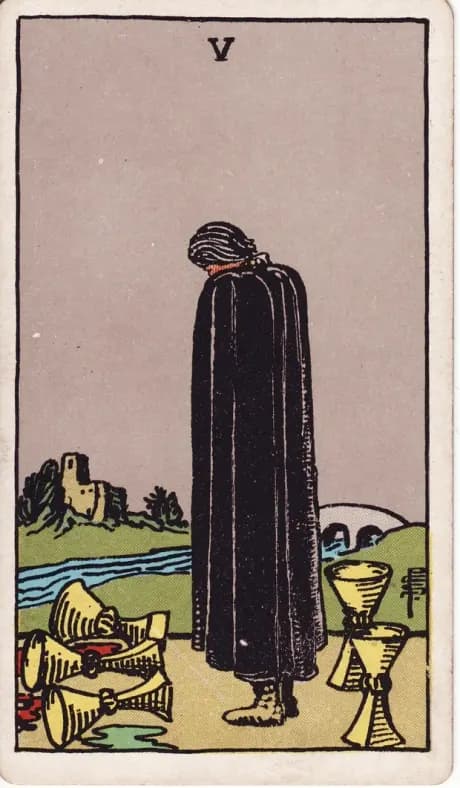
A cloaked figure looks down at three spilled cups and does not turn to see the two still standing behind him. The card's subject is grief and the tunnel vision it produces. It is honest about loss — something real was lost and the mourning is warranted — while pointing out that the accounting is incomplete. Upright it marks regret, disappointment, the period when the damage is all you can see. Reversed the figure turns: acceptance beginning, the remaining cups noticed, forgiveness of yourself or someone else. It can also mean grief being rushed, packed away before it has done its work.
Every five in this deck is a loss of some kind, and each suit loses differently. The Five of Wands loses to competition, the Five of Swords wins and loses anyway, the Five of Pentacles is shut out in the cold. This is the emotional one, and it is the only one of the four where the damage is already finished. Nothing is happening in the picture. The event is over and the person is still standing in it.
At work it is the failed launch, the client that left, the promotion that went elsewhere — and, more precisely, the fortnight afterwards, when the two accounts still running get no attention because all of it is going to the one that stopped. The card is very good at describing a competent person becoming temporarily useless through a single visible failure.
In creative work it is the piece that did not land, and the months spent comparing everything new against it. Around money it is the sunk cost: the thing already spent, gone and unrecoverable, still being counted every time a decision comes up, as though continuing to look at it could change the number.
The instruction is the same two-step in every context, and the order is not negotiable. Count what was lost, honestly and completely, without minimising it. Then count what remains, in specific items rather than general reassurance. Skipping the first step produces a cheerfulness that does not hold. Skipping the second produces somebody who has been standing in the same field for a year.
Five of Cups as a yes or no
As a yes or no, the Five of Cups upright is a no, and it is a no with sympathy in it rather than a refusal. The thing being asked about has already gone. The card does not describe an obstacle to work around or a delay to wait out; it describes something that finished before the question was asked, which is why forcing a yes out of it produces answers that do not hold.
The nuance worth keeping is this: it is a no about the specific thing being mourned, not a no about everything. The two upright cups are in the picture for a reason. If the question was whether a particular arrangement can be restored exactly as it was, this card says no. If the question is whether anything good is available at all, the card is explicitly saying yes, and pointing behind you while you look the other way.
Reversed it becomes a qualified yes. Not yes immediately, and not yes to the same thing — yes to recovery, yes to moving, yes to the possibility that had been standing there unnoticed. Reversed Five of Cups is one of the deck's clearest yes cards for questions about healing and about whether you will feel differently later.
If the question was whether they regret it, both orientations answer yes and neither answers the question underneath. Ask instead what they intend to do about it, and read the next card, because regret and action are separate events and this one only describes the first.
Five of Cups as advice
As advice, the Five of Cups gives two instructions and insists on the order.
First: grieve properly. Set aside real time for it rather than letting it leak into every hour of every day. Say out loud what was lost, in specific terms — not the person, the particular things. The Sunday routine. The phone calls at seven. The version of the future that had them in it. Grief that has been named in detail gets smaller. Grief that stays general does not.
Second, and only after the first: turn around. Physically, deliberately, and before you feel ready, because feeling ready does not arrive on its own from this position. Turning means counting what is still standing — two friendships, a job, an ability, a room you like — in items, out loud. Vague gratitude does nothing here. Specific inventory does.
There is a third instruction that only applies to some readers, and it is the sharpest thing in the card: stop doing the accounting for the other person. A great deal of the time spent staring at spilled cups goes into constructing the case — what they should have done, what they must be feeling, what they will realise eventually. That case will never be heard by anyone. It is the single largest consumer of the time this card describes.
And do not let anybody rush you, including yourself. Grief packed away early does not stay away. It comes back later attached to something small and unrelated, and by then nobody can see where it came from.
Five of Cups as an outcome
As an outcome, the Five of Cups is a loss that has already happened and a remainder that has not been noticed yet. It is a heavy card to land in this position and it is not the worst one, because everything it describes is already true by the time you read it. Nothing new is being predicted; the aftermath is being named.
In a love question it usually means the thing ends and the ending is mourned. Not a clean break and not a dramatic one — a slow, sad settling, with a period of looking backwards attached. The card is clear that the period is temporary and completely silent about how long it lasts, which is the frustrating part and the honest part.
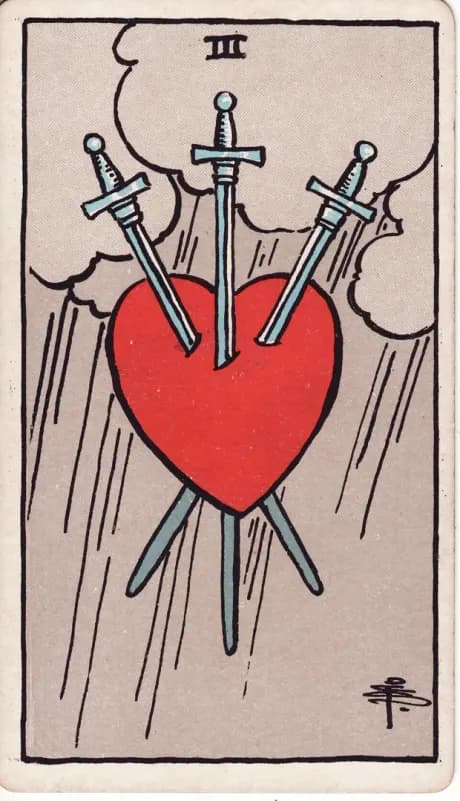
There is a detail that changes how this reads and is easy to miss. The two upright cups are already in the picture at the moment of the outcome. Whatever remains after this is not something that has to be built; it exists now. That is why the Five of Cups is a better outcome than the Three of Swords, which it often gets confused with. One describes damage. This one describes damage plus an unexamined remainder.
Reversed as an outcome is straightforwardly good: the situation ends with the turn completed. Acceptance, the loss placed somewhere it can be carried, attention available again. It rarely means restoration of the specific thing that was lost. It means the ending stops being the centre of the picture, which is the outcome most people were actually asking for.
What the Five of Cups card shows
The 1909 card shows a single figure in a long black cloak, standing outdoors with the head bowed. The cloak covers the body entirely — no hands, no shape, no colour. It is the deck's plainest image of a person reduced to one state.
In front of the figure, three cups lie on their sides. Their contents have run out onto the ground; the liquid is dark red and dull green, and it is not going back in. Behind the figure, two cups stand upright and full. They are close — a step away, well within reach — and unmistakably intact. The composition carries the whole argument: the loss is in the foreground, the remainder is behind, and the only thing separating the figure from the remainder is which way he is facing.
The head is not merely lowered but turned aside, in the specific posture of somebody unable to look directly at a thing. Nothing physical prevents the turn. There is no barrier in this card, no chain, no weather.
Behind everything runs a river, and across the river there is a bridge, and beyond the bridge a small keep or house. The bridge is the most quietly optimistic object in the suit. It is already built. The crossing does not need to be invented, negotiated or waited for. It is standing there, in view, requiring only that somebody walk to it.
The sky is flat grey and the ground is bare. Pamela Colman Smith removed every distraction from the frame, which leaves five cups, one person and a route out. What the card refuses to do is make the route attractive. It simply puts it in the picture and lets the figure keep looking the other way.
Frequently asked
Does the Five of Cups mean they regret losing me?
+
Often yes — it is the card of regret and mourning, and the weight in it is real rather than passing. But regret is a state, not a step. The figure in the picture has been standing in the same spot for a long time. Whether regret matures into action is a separate card entirely, and worth drawing.
How do I move on with the Five of Cups?
+
Grieve honestly and in detail — the specific things, not the general loss — then physically turn: new people, new rooms, the two full cups. The card promises they exist. It also insists on that order, because turning without grieving produces a cheerfulness that does not hold.
Is the Five of Cups a yes or a no?
+
Upright it is a no, but a precise one: no to restoring the exact thing that was lost. It is not a no to everything, and the two upright cups are in the picture to say so. Reversed it becomes a qualified yes — yes to recovery, and to feeling differently later.
What should I do when I draw the Five of Cups?
+
Name what was lost, item by item, out loud. Then count what is still standing, also item by item. And stop building the case against the other person: that argument will never be heard by anybody, and it consumes most of the time this card describes.
What are the two cups behind the figure in the Five of Cups?
+
Whatever survived. In the artwork they are upright, full and about a step away, and the figure has not turned to see them. In a reading they are usually unremarkable and already present — the friends who stayed, the work, the parts of your life that were never involved in what went wrong.