What Five of Pentacles means in tarot — and in love
The Five of Pentacles is love out in the cold: feeling rejected, excluded or unworthy — walking past the lit window of other people's happiness. As feelings, the Five of Pentacles means they feel shut out — unworthy of you, excluded, or ashamed of their current state.
Jump to FAQAt a glance
- Yes or no
- No — reversed flips it
- Element
- Earth
- Upright, in a line
- feeling left out in the cold, lean times
- Reversed, in a line
- recovery, warmth returning after hardship
Want a yes or no on your own situation rather than this card? Pull one card and get the verdict with the reason behind it.
Ask your own yes-or-no questionIn the Golden Dawn tradition this card rules 0–10° of Taurus. A planet standing at that degree is read through it: Venus in Taurus · Moon in Taurus · Mars in Taurus
Upright in love
The Five of Pentacles is love out in the cold: feeling rejected, excluded or unworthy — walking past the lit window of other people's happiness. Hard times shared or endured alone: emotional poverty, distance from support. Its hidden detail: the door to the church is right there. If you asked why you feel abandoned — partly circumstance, partly not asking for help. Knock.
The card is not accusing anybody of inventing their hardship. Something real has happened — a bad season, a loss, a stretch where everything is difficult at the same time — and it has produced the particular loneliness of watching other people's ordinary lives through glass. That part is accurate and does not need arguing with.
In a new connection it usually means one of you is approaching from a position of scarcity. Reaching out while convinced you have nothing to offer, or being reached for by somebody in that state. Connections that start in the snow are not doomed, but they begin unbalanced, and it is worth knowing which of you is cold.
In an established relationship it is the couple going through a hard stretch, and the danger is not the hardship. It is the silence that comes with it. People in this card stop telling each other how bad it is, out of protectiveness or shame, and end up walking side by side in separate weather. Shared difficulty binds people together. Concealed difficulty separates them, and this card is describing the second one.
What it asks for is the least appealing action available: ask for help. Name the situation to one person who can do something about it. The picture puts a lit door in the frame and has the figures walk straight past it, which is not a comment on their bad luck. It is a comment on what people do when they have decided they are not worth letting in.
Reversed in love
Reversed, the Five of Pentacles is the thaw: recovery from rejection, warmth returning, help accepted at last. The lean season ends; connection and self-worth rebuild. What survived the winter is sturdier than what never froze. Come inside; you're allowed.
The reversal is mostly good news, and it is worth being precise about what actually changes. The weather does not clear. The circumstances often stay exactly as hard as they were. What changes is the exclusion — somebody turns their head, sees the window, and goes in. This is a card about access far more than about luck.
In a new connection, reversed usually means somebody has stopped disqualifying themselves. They have decided they are allowed to want this, and the deciding is the whole event. Interest that sat there for months becomes visible inside a week, and from outside it looks like a change of heart when it was a change of permission.
In an established relationship it is the end of a hard stretch, and specifically the moment the silence breaks. One person finally says how bad it has been. The relief in that is out of all proportion to the information, because the isolation was doing more damage than the difficulty.
There is a second reading, which is why this reversal should not be treated as automatic good news. Sometimes it means the hard stretch is only now beginning, and the figures are walking toward the cold rather than out of it. The surrounding cards decide. Recovery nearby means the thaw. Loss nearby means the first snow.
Five of Pentacles As feelings
As feelings, the Five of Pentacles means they feel shut out — unworthy of you, excluded, or ashamed of their current state. Insecurity may read as coldness. Sometimes people leave the ones they love because they can't afford the self they'd need to stay.
If you are single and asking about someone new. They are interested and do not believe they are in a position to act on it. Something is wrong in their life — work, money, a bad year — and it has convinced them they are currently not worth offering. From outside this reads as coldness and it is almost always shame. It does not resolve because you reassure them. It resolves when their circumstances or their self-assessment change.
If you are in a relationship. They feel like a burden. That is the whole reading, and it is often invisible, because the behaviour it produces is withdrawal rather than complaint. They are pulling away in order to stop costing you something. The fix is to say plainly that they are not a cost, in concrete language, more than once.
If you are asking about an ex. They feel exiled. Not necessarily wronged — exiled, as in standing outside something warm they used to be inside. Whether that is guilt, grief or genuine longing is not in this card, and the honest answer is that it is frequently all three, with no action following from any of them.
If you are asking about someone long-term. The reading tends to be somebody who has stopped believing they are chosen and started believing they are tolerated. Long relationships produce that quietly and usually without evidence. Ask what makes them feel that way, and expect the answer to be small and old.
Across all four, this card describes somebody outside looking in, and it never once says the door is locked.
Five of Pentacles For your ex
For an ex, the Five of Pentacles means the breakup left someone in the snow — hardship, loneliness, feeling barred from what you shared. Pity is not a reunion strategy; compassion with boundaries is. If you reopen the door, do it for who they are, not how cold they look.
The card does not tell you which of you is outside. That is worth checking honestly before reading anything else into it, because standing in the cold is so absorbing that it can be genuinely difficult to notice the other person is out there too.
If it is them: expect contact that arrives during their worst weeks and disappears during their good ones. That is usually not manipulation. It is what need looks like from the inside. But somebody who only appears when they are struggling is not proposing a relationship, and answering every time trains a pattern that helps nobody, least of all them.
If it is you: the card is direct about the remedy, and the remedy is not the ex. Support exists that you have not asked for, and it is not romantic — friends, family, a professional, the people who would help if they knew. The figures in the picture walk past a lit door because they have decided they do not deserve to knock. That decision is the actual subject of the card, and it is the one thing here that is entirely in your hands.
What Five of Pentacles means in general
Two figures move through deep snow past a lit window and do not look at it. The card's subject is hardship and the isolation that comes with it — shortage, exclusion, the particular loneliness of being outside something warm while other people are inside. Upright it says the difficulty is real, and that support is nearby and has not been asked for. The isolation is usually doing more damage than the shortage.
Reversed the situation turns. Recovery begins, the window gets noticed, help is finally accepted. It can also carry the opposite warning — that the hard stretch is only now arriving — and the cards around it decide which.
Fives in this deck are all a form of loss, and each suit loses differently. The Five of Wands loses to competition, the Five of Cups mourns, the Five of Swords wins and is diminished by winning. This is the material one: the loss of resources, standing, or a place to be.
At work it is redundancy, the team that gets cut, the shortfall on the account. Around money it is the month where the numbers do not meet, and the misery of that is rarely the arithmetic — it is the assumption that everybody else is managing fine. In creative terms it is the long unrecognised stretch, the years before anybody is paying attention, which almost every working artist has had and almost nobody describes accurately afterwards.
The most actionable content in the card is the least welcome. Help that has not been asked for is not help yet, and the reason it stays unasked is almost never that it would be refused.
Five of Pentacles as a yes or no
As a yes or no, the Five of Pentacles upright is a no, and one of the plainer noes in the deck. The resources are not there, the door has not been opened, the situation is at its coldest point. Whatever is being asked about is being asked from a position of shortage, and the card does not pretend otherwise.
The qualification matters, though, because the picture contains a detail the verdict usually misses. The window is lit. The no describes the current situation, not whether anything can change, and the change available here is specific: asking somebody for help. Rephrased as whether help exists at all, this card answers yes, and does so firmly.
Reversed it is a yes. Recovery, warmth, the door found and used. It is one of the deck's better answers to questions about whether a hard period is ending, because the reversal is the moment of arrival rather than the promise of one.
The best question to bring this card is not whether things will improve on their own. It is who you have not told. The Five of Pentacles is unusually consistent about that being the variable that moves everything else, and unusually unhelpful when the question assumes it away.
Five of Pentacles as advice
As advice, the Five of Pentacles is one of the few cards in the deck that gives an instruction rather than a perspective, and the instruction is: ask. Name the situation to somebody who can do something about it. That is the whole card. Everything else in it is context for why people do not.
Be specific about who. Not a general appeal, not a post, not a hint dropped and hoped for. One person, one clear request, in words that state what is wrong and what would help. Vague requests are the most common way this card gets ignored while technically being obeyed.
Second, stop competing with the window. The card describes somebody measuring their own hard stretch against other people's visible comfort, and that comparison is both automatic and useless. Everything on the far side of the glass has been edited. Nobody's interior is on display.
Third, deal with the practical part practically. This card is not asking for a change of attitude. It is describing a shortage, and shortages respond to actions: the conversation you have been avoiding, the arrangement you have not requested, the form you have not filled in.
Reversed, the advice is to go in, and to let it be enough. People who have been cold for a long time often refuse warmth on the grounds that they should have managed alone. The reversal does not require you to have earned it.
Five of Pentacles as an outcome
As an outcome, the Five of Pentacles is a hard ending, and it is worth reading precisely rather than dramatically. The situation arrives at a point of shortage and exclusion — not usually a catastrophe, but a lean, cold stretch in which something needed is missing and the person going through it feels alone in it.
In a question about two people it generally means distance produced by circumstances rather than by decision. A hard year, a loss, a run of bad luck, and two people who stop being able to reach each other because one or both has gone quiet about how bad it is. The ending is not hostile. It is bleak, and it is reversible in a way that hostile endings are not.
Around work and money it reads literally: the shortfall, the lost position, the stretch without support. The card is honest about that and does not decorate it.
Reversed as an outcome is one of the better results the suit offers, which is recovery. The hard period ends, help arrives or is finally accepted, and the finish is warmer than the middle was. The thing to notice is that in almost every version of this reversal, somebody had to ask. The card very rarely describes rescue that turns up unprompted, and the outcome you get depends on an action taken inside the story rather than on the weather changing.
What the Five of Pentacles card shows
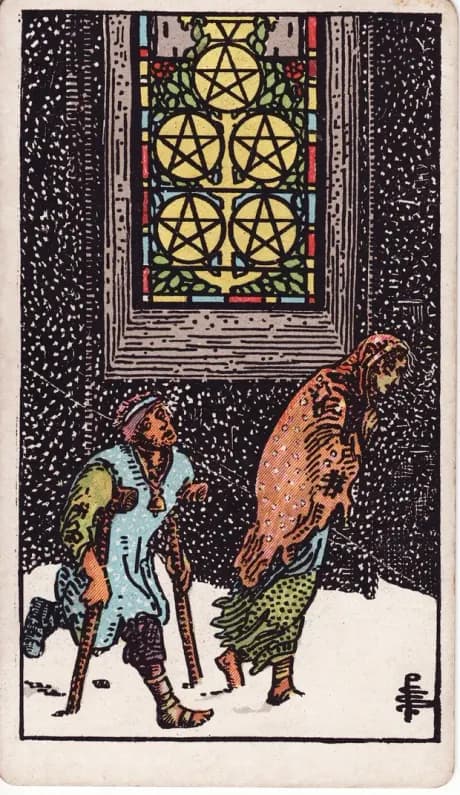
The 1909 card shows two people moving through falling snow at night, past the lit window of a church. Everything in the image is arranged around that window and around the fact that neither of them looks at it.
The first figure walks on crutches. One foot is bandaged, one leg is held stiff, and a bell hangs at the neck — the mark worn by people who were required to announce themselves and were kept out of buildings. The clothes are torn and inadequate for the weather. The second figure walks barefoot in the snow alongside, head down, wrapped in a shawl that is not warm enough either. Neither is looking at the other. They are together and separately miserable, and the card cares about that distinction.
Above and behind them is the window: gold and coloured glass, lit from inside, with five pentacles set into the design in the shape of the Tree of Life. It is the only warm thing in the picture. It is also large, close and impossible to miss from where they are walking.
The snow falls in visible flakes and the ground is white and deep. No path is drawn anywhere in the frame.
Pamela Colman Smith arranged the scene so that the viewer sees the entire problem at once and the two figures see none of it. Shelter is a few steps away, on the other side of a wall, inside a building that exists to take people in. The card never says the door is locked. It does not show a door at all — which is the honest version, because in most situations like the one it describes, nobody has been to check.
Frequently asked
What does the Five of Pentacles mean in love?
+
Feeling rejected or left out during a hard time — real hardship, plus help nearby that has been overlooked. The exclusion is rarely total. The card is unusually insistent that the isolation, rather than the shortage itself, is what does the damage.
Is the Five of Pentacles about feeling unworthy of love?
+
Centrally. It is the card of standing outside the window while other people are inside it. The remedy starts with knocking rather than with deserving, and that order matters, because waiting until you feel worthy is how people spend a whole winter outside.
Is the Five of Pentacles a yes or a no?
+
Upright it is a plain no: the resources are not there and the situation is at its coldest. Reversed it is a yes, and a good one for questions about whether a hard period is ending. Note that the upright no describes now, not forever — the window in the picture is lit.
What should I do when I draw the Five of Pentacles?
+
Ask one specific person for one specific thing. Not a hint, not a general appeal. Then stop measuring your situation against other people's visible comfort, because everything on the far side of the glass has been edited before you saw it.
What does the church window in the Five of Pentacles mean?
+
Help that is present and unnoticed. It is lit, close and large, with five pentacles set into the glass in the shape of the Tree of Life, and the two figures walk past without turning their heads. It is the most hopeful object in the card and the whole reason the card is about asking rather than about poverty.