What Four of Pentacles means in tarot — and in love
The Four of Pentacles is love held too tightly: possessiveness, control, security valued above spontaneity — a partner (or you) gripping the… As feelings, the Four of Pentacles means possessive attachment — they want to keep you, sometimes more than to know you.
Jump to FAQAt a glance
- Yes or no
- No — reversed flips it
- Element
- Earth
- Upright, in a line
- holding on tight, security valued over risk
- Reversed, in a line
- loosening the grip, letting love breathe
Want a yes or no on your own situation rather than this card? Pull one card and get the verdict with the reason behind it.
Ask your own yes-or-no questionIn the Golden Dawn tradition this card rules 20–30° of Capricorn. A planet standing at that degree is read through it: Venus in Capricorn · Moon in Capricorn · Mars in Capricorn
Upright in love
The Four of Pentacles is love held too tightly: possessiveness, control, security valued above spontaneity — a partner (or you) gripping the relationship like a wallet in a crowd. Loyalty is here, calcified into clutching. If you asked why it feels rigid: fear of loss is running the show. What's held this hard can't breathe; what can't breathe eventually stops moving.
It is worth being fair to the card before criticising it. The grip is not malice. It is almost always somebody who lost something once and organised their entire approach around not losing it again. The behaviour is unpleasant to be on the receiving end of and completely coherent from the inside, which is why telling the person they are controlling so rarely lands. From where they stand, they are being careful.
In a new connection it usually shows as premature ownership. Questions that feel like interest and function as an inventory. A pace set by one person's need for certainty rather than by anything the two of you have actually established. Exclusivity that arrives before intimacy does, which sounds flattering and is closer to being catalogued.
In an established relationship it is the season where nothing is allowed to change. Not the routine, not the friendships, not the plans. Security has been chosen over everything, and the price is that nothing develops, because developing means letting go of the current arrangement in order to reach a better one. Couples in this card are rarely unhappy. They are frequently stuck.
What the card asks for is one deliberate loosening. Not a grand gesture of trust. One specific thing you are gripping — an evening apart, a friendship you dislike, a decision you keep making for both of you — released on purpose, to find out what happens. The answer is usually nothing, and the nothing is the point.
Reversed in love
Reversed, the Four of Pentacles is the grip releasing: jealousy examined, control traded for trust, generosity re-entering the emotional economy. Or the fear finally naming itself out loud — the first honest step. Love held with open hands stays by choice, which is the only staying that counts.
That is the good version and it is the common one, because a card about holding has nowhere to go when it reverses except open. What changes is not the fear. The fear stays for a long time. What changes is that it stops making the decisions, which is a smaller and far more achievable thing than becoming somebody who is not afraid.
In a new connection, reversed often means one person has decided to take a risk they would previously have refused. Sharing something. Meeting the friends. Allowing a plan that cannot be controlled. Small from outside, considerable from inside, and worth recognising if you are on the receiving end of it.
In an established relationship it can be the moment a long-running jealousy finally gets named instead of acted on, which is the beginning of it being survivable. It can also be less comfortable: the release of something held well past its usefulness — a grudge, a rule, a version of the two of you that stopped existing years ago.
There is a harder reading. Reversed, the card sometimes means the grip failed rather than opened. What was being held has gone, and the person is standing there with nothing to clutch. That reading is bleak on the day and useful afterwards, because the thing this card protects is never as safe as the holding makes it feel.
Four of Pentacles As feelings
As feelings, the Four of Pentacles means possessive attachment — they want to keep you, sometimes more than to know you. Security-love: real, protective, occasionally suffocating. The feeling is 'mine'; verify it also includes 'yours.'
If you are single and asking about someone new. They have already decided you are theirs and they have not mentioned it to you. The feeling is strong and privately held, which is the specific hazard here: intensity that skipped every step of being agreed to. Expect claiming behaviour before there is anything to claim, and read it as anxiety rather than as devotion.
If you are in a relationship. They are afraid of losing you and are managing that fear by holding tighter. The care is genuine. The method is counterproductive, and they usually know it, which is why this card so often comes with defensiveness attached. What helps is not reassurance in general terms. It is specific, boring, repeated evidence that you are still here.
If you are asking about an ex. They have not released the claim. Not pursuing you, not offering anything, and reliably unhappy to hear about anybody new. This is the most possessive feelings reading in the deck and the least active. A claim can persist for years without a single move being made, because nothing about it requires your participation.
If you are asking about someone long-term. The feeling has become property, in the least sinister sense of that word: you are part of what they have, counted among the things that make their life stable. That is genuinely warm and slightly airless. The question worth asking is whether they would still choose you if you were not already theirs.
Across all four, the card describes strength of feeling combined with a poor relationship with uncertainty. From outside, the two are easy to confuse.
Four of Pentacles For your ex
For an ex, the Four of Pentacles means they still count you among their assets — reluctant to see you with anyone, slow to release the claim even without pursuing it. That's ownership residue, not devotion. Don't stay shelved in someone's vault.
The distinguishing feature is inaction. This person is not trying to get you back. They are not moving on either, and they will react to news of you with somebody else in a way that looks a great deal like feeling. It is feeling. It is simply not aimed at any outcome, and treating it as an opening usually leads back to the same shelf.
It can also point at something more literal. This is the card of the possession that never got returned — the box of things, the shared account, the item nobody has collected. If some practical piece of the old arrangement is still unfinished, the Four of Pentacles is often pointing straight at it, and closing it does more for both people than another conversation about feelings.
If you want a practical read: watch for a request that costs them something. A person holding on will accept contact, accept attention, accept indefinitely. What they will not do is spend. If nothing is ever offered and nothing is ever risked, the claim is on you rather than between you, and a claim is not a relationship.
What Four of Pentacles means in general
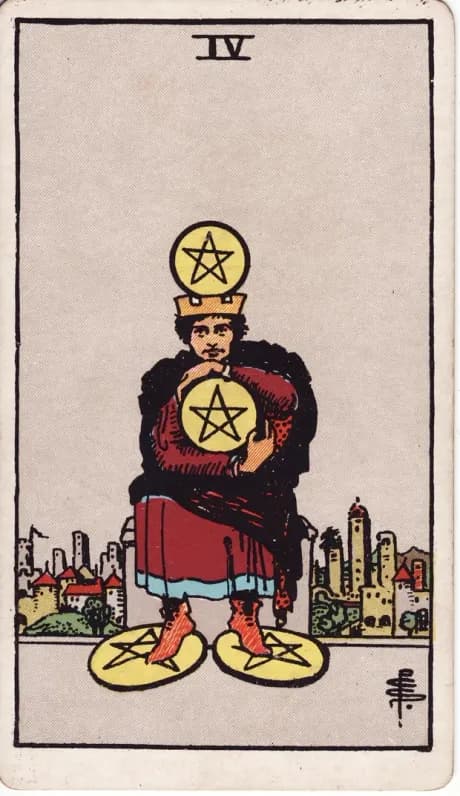
A crowned figure sits outside a city wall, clutching one coin against his chest, balancing a second on his head and pinning two more beneath his feet. He is entirely secure and completely unable to move. The card's subject is holding on: savings, control, boundaries, and the exact point where prudence turns into constriction.
Upright it says conservation is the right instinct here — that keeping what you have is legitimate, and that stability is being bought with flexibility. Reversed the grip changes in one of two directions. Either it opens into spending and generosity, or it closes further into hoarding and a fear of loss that has begun to cost more than the loss itself would.
Fours in this deck are all stability, and each suit stabilises differently. The Four of Wands celebrates, the Four of Cups withdraws, the Four of Swords rests. This one stabilises by refusing to let go, which works, and has a price: nothing can be added to a full hand.
Around money it is the emergency fund and the hoard, which look identical on a statement and differ entirely in what they are doing to the person holding them. At work it is the manager who will not delegate, the department that will not share information, the specialist whose expertise has become a position to defend rather than a thing to use. In creative terms it is the finished piece that never gets shown, kept private because published work can be judged and unpublished work cannot.
The question the card asks is always the same one. What is this protecting you from, and is that still likely to happen?
Four of Pentacles as a yes or no
As a yes or no, the Four of Pentacles upright is a no, and specifically a no to change. Whatever you are asking about, the card says the current arrangement holds. If you wanted it to hold, that is a yes. If you wanted movement, new terms, somebody to open up or something to be released, the answer is no, and the reason is that nobody involved intends to let go.
That makes it one of the few cards whose verdict depends entirely on which side of the question you are standing on. The card is not neutral about the situation. It is describing a grip, and a grip is good news for whoever is holding.
Reversed it becomes a yes, and often a substantial one. Something is being released, and what was blocked by holding stops being blocked. This is one of the clearer reversals in the deck for questions about whether a stuck situation will move, whether money will finally be spent, or whether somebody will finally allow a thing they have been refusing.
If the question was whether they care, this card will mislead you. It answers with a strong yes that has very little to do with what you meant. Ask instead whether they will give you room, and read the answer literally, because room is exactly what this card is about.
Four of Pentacles as advice
As advice, the Four of Pentacles is one of the deck's genuinely two-sided cards, and the first job is working out which side you are on. Sometimes it is telling you to hold: keep the reserve, do not spend it, do not hand over the thing you are going to need. That reading is real and gets ignored because the card has a bad reputation. If you have been over-generous, over-available or too quick to give things away, this card is on your side.
More often it is the other reading. Something is being held past the point where holding helps, and the advice is to loosen one finger at a time rather than to let go all at once, which nobody does and which the card is not asking for.
Concretely: pick the smallest thing you are gripping and release it deliberately. An evening you would normally control. A decision you always make. A sum you would normally keep. Do it on purpose, so you can watch the result, and notice how little collapses.
Second, name the fear rather than the behaviour. The behaviour is a symptom. Sentences that start with what you are afraid of are the only ones that change anything here, and they are considerably harder to say than an apology.
Reversed, the advice simplifies. Open the hand. Spend, share, allow, delegate. The card reversed is already moving that way, and the only mistake available is stopping it out of habit.
Four of Pentacles as an outcome
As an outcome, the Four of Pentacles is stability that does not develop. The situation ends secure, unchanged and closed. Nothing is lost. Nothing new arrives either, and that combination makes it one of the deck's more ambiguous endings: a success by the standards of safety and a failure by the standards of growth, and only you can say which standard applies.
In a question about two people it usually means an arrangement that continues exactly as it is. Nobody leaves. Nobody opens up. The pattern that prompted the question is still there at the end of the timeframe, protected rather than resolved.
Around money and work it reads more favourably. The reserve is intact, the position is held, the risk was not taken and the thing that was feared did not happen. A dull ending, and frequently the right one.
Reversed as an outcome is release, and the deck does not specify whether it is chosen or forced. Sometimes it is somebody deciding to open up, spend, delegate or let a thing go. Sometimes it is the grip failing and what was held leaving anyway. The two look the same from a distance and feel entirely different, and the surrounding cards decide which one you are looking at: generosity and movement nearby point to a choice, loss cards point to the other version.
What the Four of Pentacles card shows
The 1909 card shows a seated man in a red robe with a dark cape over it, wearing a gold crown. He sits on a low stone bench, alone, and behind him at the base of the frame is a grey city — buildings, spires, other people implied and none of them visible. His back is turned to all of it.
Four coins are arranged around his body, and the arrangement is the argument. One is balanced flat on top of his crown, directly above his head. One is clutched to his chest with both arms wrapped around it and the fingers locked. Two are under his feet, one beneath each shoe, taking his weight.
What that produces is a cage made out of the thing it protects. Every point at which the body might move is occupied. He cannot stand without stepping off two of the coins. He cannot use his hands. He cannot tilt his head without the one on his crown sliding off. This is the only figure in the deck immobilised by his own possessions rather than by rope, chain or weather, and nobody did it to him.
His expression is not greedy. It is anxious and a little closed — the face of somebody guarding rather than gloating. The crown says he already has standing. The position of the coins says the standing is not what he is thinking about.
The city behind him matters. It is where the coins came from and where they would go if he spent them, and he is sitting outside it with his back turned. The picture is not about wealth. It is about what a person will give up in order to feel certain that nothing can be taken.
Frequently asked
What does the Four of Pentacles mean in love?
+
Holding too tight: possessiveness and control produced by fear of loss rather than by malice. Security that needs loosening if it is going to stay love. The behaviour is usually coherent from the inside, which is why naming it rarely works and demonstrating it does.
Does the Four of Pentacles mean jealousy?
+
Frequently — guarding a person the way you would guard property. The fear underneath is understandable and often has a real history behind it. The strategy is still unsustainable, because what is held this tightly stops being freely given, and freely given is the only version worth having.
Is the Four of Pentacles a yes or a no?
+
Upright it is a no to change: the current arrangement holds and nobody intends to let go. Whether that is bad news depends entirely on which side of the question you are on. Reversed it is a clear yes, because something is finally being released.
What should I do when I draw the Four of Pentacles?
+
Release one small thing on purpose and watch what happens — an evening you would normally control, a decision you always make. Then name what you are actually afraid of, rather than defending the behaviour it produces. Almost nothing collapses, and that is the information the card wants you to have.
Is the Four of Pentacles always a bad card?
+
No. It is two-sided. Sometimes it is correctly telling you to keep the reserve, protect the boundary and stop handing things over to people who do not give anything back. It becomes a problem only when the holding costs more than the loss it was designed to prevent.