What Three of Pentacles means in tarot — and in love
The Three of Pentacles is love as collaboration: two people building deliberately — learning each other's manuals, dividing effort fairly, treating… As feelings, the Three of Pentacles means appreciative partnership — they value what you two create together and feel invested in improving it.
Jump to FAQAt a glance
- Yes or no
- Yes — reversed flips it
- Element
- Earth
- Upright, in a line
- building together, teamwork in love
- Reversed, in a line
- working alone on a two-person project
Want a yes or no on your own situation rather than this card? Pull one card and get the verdict with the reason behind it.
Ask your own yes-or-no questionIn the Golden Dawn tradition this card rules 10–20° of Capricorn. A planet standing at that degree is read through it: Venus in Capricorn · Moon in Capricorn · Mars in Capricorn
Upright in love
The Three of Pentacles is love as collaboration: two people building deliberately — learning each other's manuals, dividing effort fairly, treating the relationship as a project both signed onto. Unglamorous and priceless. If you asked whether it can work: yes, with teamwork already visible. Love that plans together, lands together.
What makes this card unusual in the suit is that it is about being good at something together rather than about feeling something together. The three people in the picture are not agreeing because they like each other. They are agreeing because each of them can do a thing the others cannot, and all three know it. Applied to two people, that is a rarer basis than affection and a considerably more durable one.
In a new connection it means the practical fit is showing early. Plans you make actually happen. You have already discovered that one of you is better at some things and the other is better at others, and neither of you found that threatening. It is not the most exciting reading in the deck. It is one of the few that predicts a second year.
In an established relationship it usually arrives at a stage of deliberate work — moving in, merging money, raising something, repairing something after damage. The card is favourable about all of it on one condition: the contribution has to be visible to the other person. This is specifically the card of work that gets seen. Effort nobody notices is a different card, and a worse one.
What it asks is that you say out loud who is doing what. Not a fair division held privately in your head, an actual named one. Most of the resentment this card exists to prevent comes from labour that was assumed rather than agreed, and the fix is unromantic, verbal, and takes about twenty minutes.
Reversed in love
Reversed, the Three of Pentacles is the solo project: one person drafting, funding and constructing the entire relationship while the other reviews occasionally. Misaligned effort, unheard input, teamwork in name only. Buildings need both workers. Put down your tools for a week and see if anything gets built.
The reversal does not mean the two of you are unsuited. It means the work has stopped being shared, which is a different and more repairable problem — though only if somebody names it, and almost nobody does. The person carrying the project usually keeps carrying it, gets tired, and reads the tiredness as a verdict on the other person rather than on the arrangement.
In a new connection, reversed usually shows as effort running in one direction. You arrange, you suggest, you remember the details. They are pleasant about all of it and initiate none of it. Pleasantness is not participation, and this card is the deck at its bluntest about the difference.
In an established relationship there is a second version worth watching for, and it is not laziness but dismissal. One person's contribution is real and treated as smaller than it is — the invisible work, the appointments, the maintenance that only gets noticed the week it stops. Reversed, this card is drawn to that situation more often than to outright neglect.
There is a third reading, and it is the one people resist. Sometimes the person doing everything is doing everything because they will not let anyone else do it their way. If every attempt to help has been corrected, the reversal is describing a site with one worker by choice.
Three of Pentacles As feelings
As feelings, the Three of Pentacles means appreciative partnership — they value what you two create together and feel invested in improving it. Less fireworks, more blueprints. They show love by showing up with tools.
If you are single and asking about someone new. They are assessing you as somebody to build with, which is warmer than it sounds. This type feels respect before it feels longing, and respect from them is not a consolation prize — it is the thing they hand over before they hand over anything else. Expect the interest to appear as practical helpfulness rather than as pursuit.
If you are in a relationship. They feel useful, and for this type that sits very close to feeling happy. Their sense of the two of you is bound up in what you are making together — a home, a plan, a shared routine — and their contentment tracks whether that work is going well. If they seem distant, check whether the project has stalled before assuming the feeling has.
If you are asking about an ex. They think about the partnership rather than about the person. What they miss is often specific and unsentimental: how the household ran, how well the two of you handled a crisis, how easy the ordinary logistics were. That can mature into wanting you back. It can also stay exactly what it sounds like.
If you are asking about someone long-term. The feeling has turned into craft. They know how you take things, what you need after a bad day, which arguments are worth having and which are not. That knowledge is the shape their affection takes, and people waiting for louder evidence often miss that they are looking at a decade of paying attention.
Across all four, this card reports feeling expressed through action, and it is consistently misread by people waiting for it to be expressed some other way.
Three of Pentacles For your ex
For an ex, the Three of Pentacles suggests rebuilding is possible as a joint renovation: both admitting what collapsed, both carrying materials. If they propose reunion without offering labor, it's nostalgia, not a project plan.
The card is unusually specific about what a real attempt looks like. Not an apology, though one may be owed. A plan: a named problem, a stated change, and a share of the work carried without being asked for. Reunions under this card either arrive with that structure or do not survive the first month back.
It is also honest about why rebuilding is harder than building. A new relationship has no site to clear. This one does, and the debris is specific — the argument that never finished, the thing said once and never taken back. Both people have to agree on what actually failed before anything can go back up, and that agreement is where most attempts stop.
If you are the one considering it, ask what they intend to do differently and listen for a verb. Feelings are not a plan. Somebody who has genuinely thought about this can describe the change in terms of behaviour. Somebody who has not will describe how much they miss you, which is a fact about them rather than a proposal to you.
What Three of Pentacles means in general
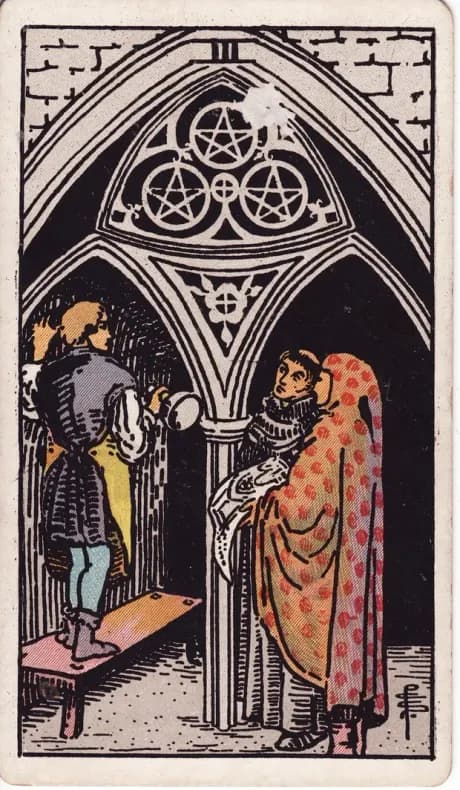
A young craftsman stands on a bench working the stone of a cathedral arch while two people hold up a drawing and wait for his answer. Three of them, three different skills, one building. The card's subject is collaboration where competence is recognised — teamwork, apprenticeship, the stage of a project at which somebody's ability stops being theoretical and starts being paid for.
Upright it says the work is good, the contribution has been seen, and the situation improves by involving other people rather than by working longer alone. Reversed the arrangement breaks down: mismatched effort, an ignored specialist, mediocrity quietly accepted, or a job where nobody has agreed what finished looks like.
Threes in this deck are about a thing becoming real through combination. The Three of Wands watches ships already dispatched, the Three of Cups celebrates, the Three of Swords divides. This is the one where three separate abilities produce an object none of them could have produced alone.
At work it is the moment a job needs a specialist, and the card's instruction is to hire one rather than to learn their trade badly over a weekend. It also covers the less comfortable half of that: being the specialist, and having to trust a drawing somebody else made. Around money it is the honest quote and the fair rate — payment matched to skill, which is why the craftsman in the picture is standing on scaffolding inside a building he will never own.
In creative terms it is the first commission. Something you can do has been noticed by somebody who needs it, and the card is entirely positive about that, with one caveat: it describes a stage, not a summit. The cathedral in the picture is a long way from finished.
Three of Pentacles as a yes or no
As a yes or no, the Three of Pentacles upright is a yes, and one of the more dependable in the deck — with a condition attached that is not decoration. Yes, if the work is shared. It answers questions about whether something can be built with a straightforward affirmative, and it answers questions about whether it will build itself with silence.
The reason it is dependable is that it describes a situation already in progress. The scaffolding is up, the drawing exists, the craftsman is being consulted rather than auditioned. Cards that show work already underway make better yes answers than cards that show hopes, because there is something visible to be right about.
Reversed it is a no, and the no is usually about the arrangement rather than about the goal. The thing being asked about is not impossible. It is currently being attempted by one person, or by people who have not agreed on what they are making. That kind of no changes the moment the arrangement does, which makes it one of the more actionable negatives in the deck.
If you bring this card a question about whether somebody wants you, you will get a poor answer. Ask instead whether they will do the work, because that is the question the picture was drawn to answer, and the distance between wanting and doing is its entire subject.
Three of Pentacles as advice
As advice, the Three of Pentacles says: bring in the other people, and say what you need from them in specific terms. The card is against solo heroics almost as a policy. Whatever you are trying to do will go better with somebody whose skill is different from yours, and the obstacle is rarely availability. It is the reluctance to admit which part you cannot do.
Concretely: name the division of labour out loud. Who does what, by when, and what finished means. Most of the failures this card exists to prevent are not failures of effort — they are two people working hard on slightly different buildings.
Second, let your work be seen. This is the one card in the suit that is explicit about visibility. Doing excellent work nobody knows about is a strategy with no second step. Show the drawing, ask for the review, put your name on it. The craftsman in the picture is on scaffolding, in public, being watched, and that is not an accident of composition.
Third, ask. The card treats a question to somebody more experienced as competence rather than weakness. Twenty minutes with a person who has done it before is worth a month of guessing.
Reversed, the advice reduces to one instruction: stop carrying it alone. Put the tools down and see what happens. Either somebody picks them up, which solves the problem, or nobody does, which answers a question you have been avoiding.
Three of Pentacles as an outcome
As an outcome, the Three of Pentacles is a good result and a partial one. The situation ends with the work underway, recognised and going well — not with the building finished. This is a card of competent progress, and reading it as completion is the most common way people manage to be disappointed by a genuinely favourable answer.
In a question about two people it usually means an arrangement that becomes real: living together, a plan that actually gets executed, a division of effort that both sides accept. The ending is unglamorous and stable. It is also earned rather than lucky, which is why outcomes under this card tend to survive conditions that outcomes under flashier cards do not.
Around work it is the project that goes ahead with the right people on it, the contract signed, the skill acknowledged and paid for. It rarely means fame, and often means a reputation forming among the people who matter to the job.
Reversed as an outcome is not collapse. It is a thing built badly, or built by one person and resented, or stopped halfway because nobody ever agreed what they were making. The difference between the two orientations is almost never talent. It is whether the conversation about who does what happened at the start, or is still being avoided at the end.
What the Three of Pentacles card shows
The 1909 card is set inside a church or monastery and the light is poor. A young craftsman in a workman's tunic and apron stands on a low wooden bench, holding a mallet and a chisel, working the stone of an arch above him. He has stopped mid-task and turned his head toward the two people standing beside him.
They are dressed nothing like him. One wears a monk's hooded robe, plain and dark. The other wears a long patterned garment, elaborate and expensive. Between them they hold an open sheet with a drawing on it, and they are holding it up toward the craftsman rather than studying it themselves. The gesture is a question. Three people, three roles: the one who pays, the one who designs, the one who can actually cut stone.
Above them, in the arch, three pentacles are carved into the masonry. This is the detail that separates the card from the rest of the suit. Everywhere else in Pentacles the coins are held, buried, exchanged or floating. Here they are part of the building — worked into the structure, load-bearing, impossible to pick up and carry away.
The craftsman stands higher than the other two, because of the bench. That is deliberate. He is the youngest and the poorest person in the frame and, for the duration of this job, the one being deferred to.
The stone is grey, the setting is unfinished, and nothing indicates how far along the work has got. What the picture shows is not an achievement. It is the moment before one, when three people who need each other are looking at the same drawing.
Frequently asked
What does the Three of Pentacles mean in love?
+
Teamwork: a relationship built deliberately by two contributors, each doing something the other cannot. It is the strongest foundation the suit offers and the least dramatic. The card cares about who carries what, not about how it feels to carry it.
Is the Three of Pentacles a yes?
+
Yes where both people invest. This card rewards collaboration and punishes solo heroics, so the honest phrasing is yes if the work is shared and no if one person is doing all of it. Reversed, the no is about the arrangement rather than the goal.
Is the Three of Pentacles a yes or a no for a yes-or-no question?
+
Upright, one of the more dependable yeses in the deck, because it describes work already in progress rather than a hope. Reversed it is a no that changes the moment the division of labour does, which makes it among the most actionable negatives available.
What should I do when I draw the Three of Pentacles?
+
Say who is doing what, out loud, with dates. Then make sure your own contribution is visible to the people it affects — this card is specifically about work that gets seen. And ask somebody who has done it before, which the card treats as competence rather than weakness.
Who are the three people in the Three of Pentacles?
+
A young craftsman on a bench with a mallet and chisel, a monk in a hooded robe, and a figure in an expensive patterned garment. The last two hold up a drawing and wait for his answer. They represent money, design and skill, and the card's argument is that the building needs all three.