What Three of Cups means in tarot — and in love
The Three of Cups is love in good company: celebration, friendship warming into romance, a relationship that thrives among people rather than in… As feelings, the Three of Cups means they enjoy you — you're fun, easy, celebratory to be around.
Jump to FAQAt a glance
- Yes or no
- Yes — reversed flips it
- Element
- Water
- Upright, in a line
- celebration, friendship warming into more
- Reversed, in a line
- third-party interference, gossip, overindulgence
Want a yes or no on your own situation rather than this card? Pull one card and get the verdict with the reason behind it.
Ask your own yes-or-no questionIn the Golden Dawn tradition this card rules 10–20° of Cancer. A planet standing at that degree is read through it: Venus in Cancer · Moon in Cancer · Mars in Cancer
Upright in love
The Three of Cups is love in good company: celebration, friendship warming into romance, a relationship that thrives among people rather than in isolation. It can mean meeting someone through friends or a bond that began as friendship raising its glass to become more. Joy is the compass here — go where the laughter is.
What sits underneath the party is a specific and underrated thing: a bond with witnesses. Some connections are built in private, two people behind a closed door, and those can be excellent. This one is not that. It grows in rooms that have other people in them, and the other people are part of why it works. Whether someone's friends like you is not a minor compatibility detail.
In a new connection the card usually means ease rather than intensity, and the ease is not a sign that nothing is happening. You meet at a birthday, a wedding, somebody's kitchen at one in the morning. Nobody is auditioning, so nobody is performing, and you get an accurate look at each other early. Its plainest practical reading is exactly that: this person is already inside your circle, or one step outside it, and the introduction has effectively already happened.
In an established relationship it describes a couple that has kept a world around itself. Friends still come over. There are people you both call. That sounds unremarkable and it carries weight, because two people who fold entirely into each other lose every outside reading of how they are doing. The Three of Cups is that reading arriving in a good mood.
There is a blunter version worth saying. Sometimes the card means the warmth is real and the category is friendship, and the person raising a glass with you is not going to become anything else on their own. That is not a verdict. It is a note that if you want the category to change, somebody has to say so out loud, because this card describes a state comfortable enough to stay in for years.
What it asks is small: accept the invitation. Go to the thing you were going to skip. The card puts the next development in a room, and you have to be in the room.
Reversed in love
Reversed, the Three of Cups sours the party: a third presence in the dynamic — an interfering friend, gossip, or literally a third person. It can also mean too much party and too little 'us.' Check who's been invited into your relationship's business. Some circles need trimming for love to breathe.
The reversal does not cancel the card's warmth. It changes who the group is for. Upright, the people around a couple are support. Reversed, they become an audience, and sometimes a jury. The relationship starts being conducted in public — arguments relayed to friends before the two of you have finished with them, decisions made partly for how they will sound. Nothing here is dramatic. It is just that the private room has been rented out.
The third-person reading is real and it is not automatically infidelity. Far more often it is an ally: the friend who is always consulted, the family member with an opinion about everything, the former partner still on the group chat. The complaint is not that the third person is malicious. Usually they are not. It is that a couple with a permanent third opinion in the room stops learning how to settle anything alone.
There is a second reversal that looks nothing like the first: the party stops. The social life that fed the relationship thins out, and the two of you are left with each other and no outside air. Isolation reads as closeness for a while. Then it reads as pressure.
And the loneliest version, which people recognise instantly when it applies: you are in the circle and not of it. Everyone is having a wonderful time and you are counting the minutes. Reversed, this card is very good at describing a room full of people who do not actually know you.
Three of Cups As feelings
As feelings, the Three of Cups means they enjoy you — you're fun, easy, celebratory to be around. It may still read 'friend' more than 'flame'; the romance grows out of shared joy if given room.
That is the reading people find hardest to place, because the warmth is unmistakable and the direction is not. It is worth taking situation by situation.
If you are single and asking about someone new. They like you and they like being around you, and at this stage those are the same feeling to them. There is real attraction in it, but it is currently indistinguishable from the pleasure of good company, and it will stay that way until something happens outside the group setting. Get them alone once. The card changes character quickly when there is nobody else in the room to talk to.
If you are in a relationship. They feel proud of you. This is the card that shows up when someone enjoys being seen with you — introduces you properly, wants you at the table, talks about you when you are not there. It is affection with a public face on it, and public affection is not shallow. It is a form of commitment that costs them something.
If you are asking about an ex. You come up in conversation. They hear about you and you hear about them, and the mutual friends are doing more work in this connection than either of you is. The feeling is warm and unforced and it has not decided anything, because it does not have to while the news keeps arriving on its own.
If you are asking about someone long-term. The feeling here is gratitude more than heat — they are glad of you, the way people are glad of the things that have kept working. Some read that as a downgrade. It is closer to the opposite.
In every version the card says the same thing: they are happy in your presence. What it never says on its own is whether that happiness has anywhere else to go.
Three of Cups For your ex
For an ex, the Three of Cups often means mutual friends keep the connection alive — updates travel, paths recross at gatherings. A reunion here starts casually, in company. Watch how they act around you when the group is watching.
The specific difficulty is that nothing needs to be decided for contact to continue. Mutual friends keep a low, steady supply of information moving in both directions. You know they changed jobs. They know you were away in June. Neither of you had to reach out for any of it, which means neither of you is finding out anything about the other's actual intentions, and the situation can run in this shape for years without producing a single piece of useful evidence.
This is also the card of the reunion that happens at a party, and reunions that happen at parties are unreliable evidence. Everybody is at their best in company. The version of them you meet at somebody's birthday is the version with an audience, a drink and no responsibility for the morning. That version was probably never the problem.
What to watch is the difference between how they treat you in the group and how they treat you in a message the next day. If those two are the same person, there is something here. If the warmth only exists while other people are watching it, then what you have is a pleasant social arrangement, and it can continue indefinitely without ever becoming anything. Whether you keep attending is a real choice, and it is yours.
What Three of Cups means in general
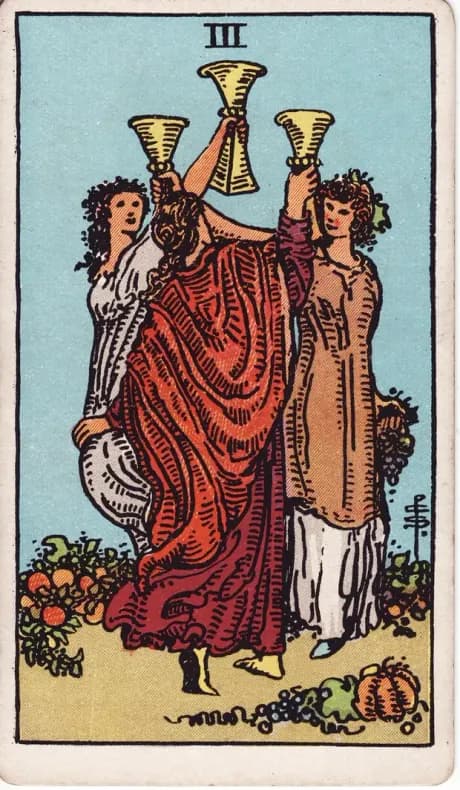
Three figures raise their cups together: the card of shared celebration. Its subject is community — friendship, collaboration, the milestone marked with other people, the relief of being among those who understand the thing you have just been through. Upright it says the situation is supported, that help is available and should be accepted, and that whatever has been achieved deserves acknowledgement rather than immediately being followed by the next task. Reversed the group turns costly: gossip, a third party complicating what worked as two, overindulgence, or the particular loneliness of being surrounded by people who do not actually know you.
Threes in this deck mark the first product of a pair. Two becomes three: the Three of Wands watches ships it has already sent, the Three of Pentacles has three workers building something none of them could build alone, the Three of Swords is what a pair produces when it goes wrong. The Three of Cups is the celebratory one — the same collaboration as the Pentacles card, minus the labour and plus the drink.
At work it is the team that actually likes each other, the project finished and marked rather than absorbed silently into the next one, the introduction made by a colleague that turns into a job. It is also the strongest argument in the deck for telling people what you are doing: almost everything this card describes arrives through somebody who knew you were looking.
In creative work it is the reading, the show, the first time a thing leaves your desk and meets an audience — a different event from making it, and this card insists it is a necessary one. Around money it tends to describe pooled effort rather than solo accumulation: the shared cost, the group buy, the favour returned years later.
The warning inside the card is mild and consistent. Celebration that never stops is avoidance wearing a good outfit, and a group that only assembles to drink is not the same as a group that would show up on a Tuesday. Upright, the card assumes those are the same people. Reversed is what happens when they are not.
Three of Cups as a yes or no
As a yes or no, the Three of Cups upright is a yes, and among the clearest in the suit. It is a card of things arriving — support, invitations, good news marked with other people — and almost nothing in its picture resists movement. Ask it whether to go, whether to say yes to the event, whether the group will be good for you, and the answer is affirmative.
There is a qualification worth knowing, because it changes which yes you are getting. This card says yes to the occasion and yes to the connection continuing. It is less reliable as a yes to exclusivity. A room full of goodwill is not the same as one person deciding about you, and the Three of Cups describes the room.
Reversed it turns to no, but a specific kind. Not disaster: interference. The answer is no because of something in the crowd — an opinion in the way, a rumour, a third party, or simply too much noise around a decision that needed two people and a quiet hour. Occasionally reversed reads as yes with a cost attached: it happens, it happens in public, and you hear about it afterwards from somebody who was not there.
If the question was whether a friendship can become something more, this card answers yes to the possibility and stays silent on the timing, because the deciding step in that particular question is a sentence somebody has to say, and no card can say it for you.
Three of Cups as advice
As advice, the Three of Cups says go where the people are. That is the whole instruction and it is more demanding than it sounds, because the card usually turns up for someone who has been declining things. Say yes to the invitation you were going to skip. Sit at the table. The card locates the next thing that happens to you in a room, and it cannot happen while you are at home.
The second instruction is to tell someone. Not everyone — someone. This is the deck's plainest argument that outcomes travel through people who knew what you wanted. The introduction, the job, the flat, the first date: they arrive through a person who had been told. Nobody can pass you something they do not know you are looking for.
The third is to accept help. The Three of Cups is a card of offered hands, and the people it describes are not being merely polite. If someone has offered twice, they mean it, and refusing a third time is its own small insult.
And mark the thing. If something finished, ended, closed or worked, do not fold it straight into the next task. The card treats acknowledgement as part of the work rather than a reward for it.
Reversed, the advice inverts and gets uncomfortable: leave the party. Not permanently — for now. Something in the circle is costing you more than it returns. That may be one person, or it may be the whole habit of never being alone. Reversed, the card is asking who you are drinking with, and whether you would still call them on a Tuesday.
Three of Cups as an outcome
As an outcome, the Three of Cups ends well and ends publicly. The situation resolves in company: an announcement, a reunion, an occasion with a date on it, a thing that gets celebrated rather than quietly noted. It is one of the warmest outcome cards in the suit and one of the least private.
In a love question it usually means the connection becomes known. It stops being a private arrangement and takes its place among your other people — introduced to friends, present at the birthday, referred to by name. That transition is the outcome, more than any declaration is. Plenty of connections never make it and stay indefinitely in the phase where nobody else has met them.
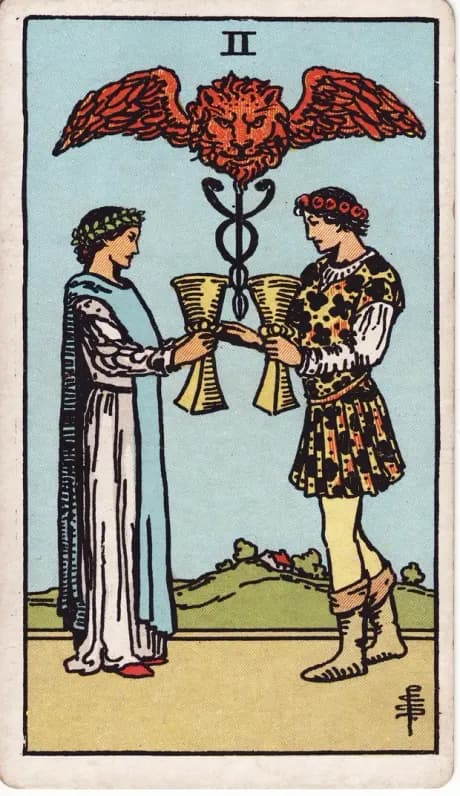
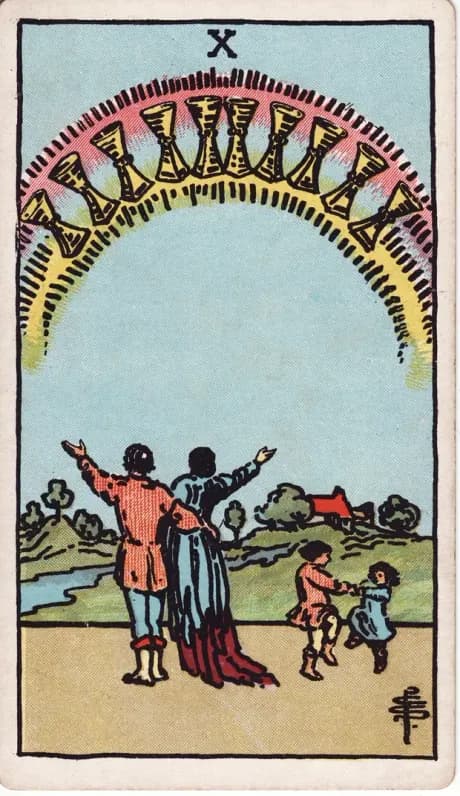
It is not, on its own, an outcome about exclusivity, and this is where it disappoints people. The card shows three cups meeting, not two. Read as an ending it says the thing continues in a happy and slightly undefined way, with other people around it. Whether it narrows to two is a question the surrounding cards answer: the Two of Cups, the Ten of Cups or the Hierophant beside it pull it toward definition.
Reversed as an outcome, the celebration is where the problem shows. The ending is public and slightly sour: the news arrives through somebody else, a third party is standing in the middle of it, or the occasion happens and you leave early. It is rarely catastrophic. It is the outcome where everyone had a lovely time except the person who asked.
What the Three of Cups card shows
The 1909 card shows three young women standing in a garden with their cups raised, tilted inward until the rims nearly touch above them. They are mid-movement — one foot lifted, robes swinging — so the scene reads as a dance rather than a toast held still.
Their dress is deliberately varied: one in white, one in a deep red-orange, one in pale gold. Each wears leaves or flowers in her hair. They are not uniformed, not identical in appearance, and not one figure repeated three times. The picture is saying that the group is made of different people who chose to stand together, which is a different claim from family.
The ground is the argument most people miss. It is thick with harvest — a large gourd, a vine heavy with grapes, spreading leaves. This is not a party held on nothing. It sits on top of something grown, gathered and finished, which is why the card so often marks an achievement rather than a mood. The pleasure in this picture is earned and seasonal.
Look at the shape they make. Three figures in a ring, all facing inward. The circle is closed and complete, and it has no space in it for a fourth. That is the same detail that turns dark when the card is reversed: a circle that includes is also a circle that excludes, and the person standing outside it can see exactly how good it is in there.
The cups themselves are plain gold and are held high rather than drunk from. Nothing in this card is being consumed yet. And the background is open, pale and empty — no walls, no house, no gate. Whatever this celebration is protecting itself from, it is not the world outside it.
Frequently asked
Does the Three of Cups mean friends to lovers?
+
Frequently, yes — connection born in shared joy and friendship. The card describes the stage where both people already enjoy each other and neither has changed the category. The upgrade happens when someone finally says it out loud, and this card is very good at describing situations that stay pleasant and undefined for years if nobody does.
What does the reversed Three of Cups warn about?
+
Third-party interference — gossip, meddling friends, or an actual third person. It also covers the quieter versions: a relationship conducted in public, a social life that has replaced the two of you, or the loneliness of a room full of people who do not know you. Guard the relationship's inner room.
Is the Three of Cups a yes or a no?
+
Upright it is a clear yes, particularly to invitations, offers of help and things continuing. It is a weaker yes to exclusivity, because the card shows three cups meeting and not two. Reversed it reads as no, usually because of interference rather than disaster — an opinion, a rumour or a third person in the way.
What should I do when I draw the Three of Cups?
+
Go to the thing you were going to skip, and tell one person what you are looking for. Almost everything this card describes arrives through somebody who knew. Accept help if it has been offered twice, because they mean it. And if something finished recently, mark it before starting the next thing.
Is the Three of Cups a friendship card or a love card?
+
Both, and it does not distinguish between them, which is exactly why it is frustrating to draw. It describes warmth in company. Warmth in company becomes romance regularly and stays friendship regularly, and the difference is not in the card — it is in whether one of the two people involved says something outside the group.