What Three of Swords means in tarot — and in love
The Three of Swords is the heart pierced honestly: betrayal, rejection, the sentence that broke something. As feelings, the Three of Swords means hurt — they carry pain connected to you: something said, done, or believed.
Jump to FAQAt a glance
- Yes or no
- No — reversed flips it
- Element
- Air
- Upright, in a line
- heartbreak, betrayal, the necessary painful truth
- Reversed, in a line
- healing beginning, forgiveness on the table
Want a yes or no on your own situation rather than this card? Pull one card and get the verdict with the reason behind it.
Ask your own yes-or-no questionIn the Golden Dawn tradition this card rules 10–20° of Libra. A planet standing at that degree is read through it: Venus in Libra · Moon in Libra · Mars in Libra
Upright in love
The Three of Swords is the heart pierced honestly: betrayal, rejection, the sentence that broke something. It marks real grief — an affair discovered, love unreturned, words that can't be unsaid. No spin softens it, and that's its strange mercy: this pain tells the truth. If you asked why it hurts this much — because it mattered. Bleed properly; healing is the next card, not this one.
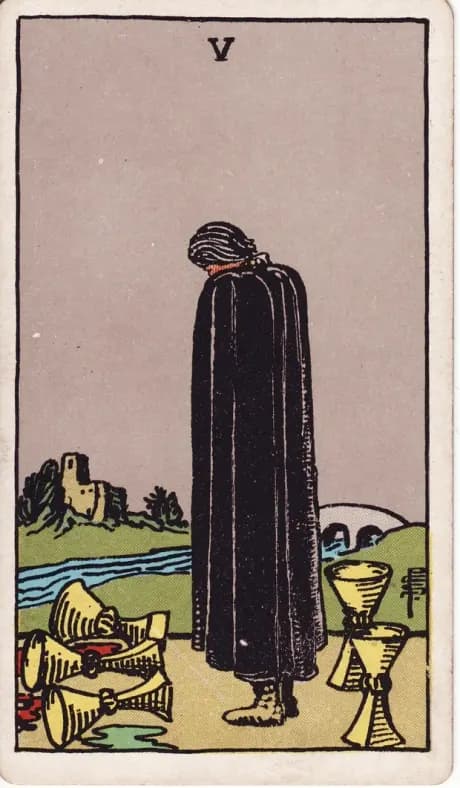
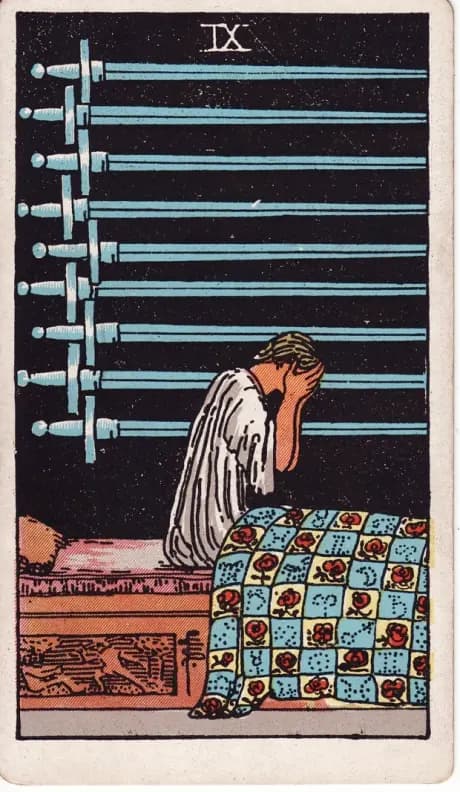
The specific mechanism of this card is information. Something was found out, or said, or finally admitted, and the knowing is what did the damage. That distinguishes it from the other painful cards in the deck. The Five of Cups is grief over what is gone. The Eight of Swords is suffering inside a story. This one is the moment a fact entered the room and could not be made to leave.
In a new connection it is usually the honest no. You find out they are not available, or not interested, or interested in a smaller way than you are. Sometimes it is the discovery that the version of them you were talking to was edited. The pain is real and out of proportion to how long you knew them, and that is normal — hope invested early is still invested.
In an established relationship it is the thing that gets said or found. An admission, a betrayal, a truth about how one person has actually felt for the last two years. What the card insists on, and what people resist, is that the information was already true before it was known. Discovery is not the injury. It is the point at which the injury became something you can respond to.
What this card asks is that you feel it at full size rather than in instalments. Grief handled properly is loud, brief and finite. Grief rationed out to keep functioning takes years and comes back at inconvenient times.
Reversed in love
Reversed, the Three of Swords is the blade being drawn out: forgiveness beginning, pain metabolized, or grief suppressed and leaking sideways. Old heartbreak may still run your choices from backstage. The wound closes when it's finally allowed to speak. Say what broke you — once, fully — then let the tissue knit.
The reversal has two faces and they look nothing alike, so it is worth working out which one you are holding. In the better reading the sharp part is over. The fact has stopped being an emergency and become a thing that happened. You can say it out loud without your voice changing. That is recovery, and it is unglamorous and gradual and mostly consists of ordinary days stacking up.
The other reading is the one that does damage. Here the pain was never processed, only stored, and it now runs quietly underneath current decisions. It shows up as a rule you did not consciously make: never trusting someone who travels for work, ending things at the first ambiguous message, reading ordinary distance as the beginning of the same story. The original wound is not hurting any more. It is legislating.
In a current situation, reversed often means the aftermath rather than the event. The affair or the argument is months back, the relationship continued, and nobody has said the true sentence about it since. That is the state this card describes most often in practice — not fresh injury, but a wound closed over something still inside it.
The distinguishing question is whether you can tell the story plainly. If it still requires a defence, a villain, or a paragraph of context, it has not finished. Say the version with no case attached, once, to somebody who will not argue with it.
Three of Swords As feelings
As feelings, the Three of Swords means hurt — they carry pain connected to you: something said, done, or believed. Behind coldness sits an ache. Address the wound itself; defending the knife reopens it.
If you are single and asking about someone new. They are carrying something that predates you. An ending they have not finished, a betrayal that made them careful, a version of themselves they do not want to be again. What they feel about you specifically may be warm, but it is being filtered through an injury, and the filtering shows up as inconsistency — close, then suddenly not. This is not usually about you and cannot usually be fixed by you.
If you are in a relationship. They are hurt by something you did or something they believe you did, and they have not said it plainly. This card is one of the clearest signals in the deck that a specific grievance exists with a specific shape. Coldness here is not falling out of love; it is a wound being guarded. Ask about the event, not the mood, and do not lead with your own defence.
If you are asking about an ex. It still hurts them. That is all this card says, and people read far too much into it. Pain is not the same as wanting you back, and someone can be genuinely wounded by an ending and still be entirely certain it was right. Read this card as evidence that it mattered, not as evidence that it is unfinished.
If you are asking about someone long-term. There is an old injury inside the shared history that never got treated. It is probably years old, probably small in the telling, and it is still shaping how they respond to a particular kind of moment. They may not connect the reaction to the event any more. You often can, because you were there, and saying so gently is more useful than waiting for them to arrive at it alone.
Three of Swords For your ex
For an ex, the Three of Swords confirms the breakup left real damage on both sides. Contact reopens stitches unless the original wound gets treated with honesty. Reconciliation without addressing what pierced — just scheduled re-injury.
The useful thing this card does is refuse the comfortable story. Most people leave an ending with a version in which the pain was one-directional: you were hurt, or they were, and the other person walked away intact. This card says both of you are carrying something, and that neither of you has an accurate picture of the other's share.
It also says the injury is still live. If contact hurts more than you expected, if a single message rearranges your week, that is not weakness or a sign you are meant to be together. It is a wound that has not been closed, and closing it is separate work from deciding whether to see them again.
Where reconciliation is genuinely on the table, this card names the condition: the specific thing has to be said and heard. Not apologised for in general terms, not covered over with warmth, not resolved by the relief of being in the same room. Named, plainly, by the person who did it, with the details in. Almost every attempt that skips this step arrives back at the same argument within three months, because the argument was never had the first time.
And if the naming is not possible — if they will not, or you cannot — that is information too. Some things are only ever survived, not settled.
What Three of Swords means in general
Three blades through a heart under rain. It is the most literal image in the deck and it means what it looks like. The subject is pain that arrives through information: the thing you found out, the words that landed, a betrayal, a rejection, or a plain unwelcome fact that will not go back into not being known.
Upright it says the hurt is real and clarifying, and that there is no version of the situation where the truth was better left undiscovered. This is the card's argument, and it is a hard one. What it refuses is the idea that ignorance was working. The damage described here was done before it was seen; being able to see it is the beginning of doing something about it.
Reversed the recovery starts — the blades withdrawn, the wound closing, release — or the harder reading: grief held past its usefulness, kept alive because letting it go would mean the event is over and nobody was ever held to account for it.
In work it is the feedback that stings because it is accurate, the contract lost, or the discovery that a trusted arrangement was never what it appeared to be. In money matters it is opening the numbers and finding out. In creative work it is the honest critique, the one that identifies the actual flaw, which is why it hurts more than a hundred vague dismissals.
The suit of air rules thought and speech, and this is where the suit shows its cost. Clarity is not free. The Ace makes the cut, and three cards later the deck shows you what a cut is. It is not a punishment card and not a warning of doom. It is the price attached to knowing, drawn plainly so nobody can claim they were not told.
Three of Swords as a yes or no
As a yes or no, the Three of Swords upright is a no. It is one of the least ambiguous negatives in the deck, and reading it any other way generally means arguing with an answer that has already been given.
The reason is structural. This card describes a fact that has already caused damage, not a possibility that might. When it lands on a question about whether something will work out, whether they will come back, whether the situation will turn favourable, the card's position is that the relevant thing has already happened and cannot be undone by hoping. That makes it a no about the specific question, not a verdict on your whole future.
Reversed it becomes a soft yes, and softness is the operative word. It says the worst part is behind you and recovery has begun, but recovery is not the same as reversal. If you asked whether the pain will ease, yes. If you asked whether the thing that caused it will be undone, the card is still saying no.
There is a better question available and it is worth taking, because the yes-or-no frame wastes this card. It is unusually informative about what actually happened. Ask what the injury was, what has not been said, or what would have to be named for this to close. The deck answers those clearly, and someone drawing the Three of Swords is normally not short of a verdict. They are short of an account.
Three of Swords as advice
As advice, the Three of Swords says: stop managing the pain and have it. Set aside an evening, tell one person the whole thing without editing for how it makes you look, and let it be as big as it is. Grief that is allowed to happen at full volume is surprisingly short. Grief taken in careful daily doses so you can keep functioning lasts for years.
The second instruction is about accuracy. Write down what actually happened — the events, in order, without the interpretation. Most people carrying this card are carrying a story rather than an account, and the story is usually either harsher on themselves than the facts support or built to protect somebody. Neither version heals, because you cannot recover from something you have not looked at directly.
The third is about the sentence you have not said. There is usually one, and it usually has a specific address. Say it once, plainly, to the person it belongs to if that is possible and safe, and to somebody else if it is not. Not to win the argument. Not to make them feel it. Once, for the record, and then stop.
Reversed, the advice shifts to letting it finish. Notice the rules you made after it that you never examined. Check whether a current caution belongs to the current situation or to an old one. And stop rehearsing the event — at some point revisiting it stops being processing and becomes maintenance.
What this card never advises is speed. Nothing here is improved by getting over it faster than it takes.
Three of Swords as an outcome
As an outcome, the Three of Swords means the situation ends in a truth that hurts. Something comes out, or something ends, and the result is grief rather than ambiguity. That is a real ending and it should be read as one — not a warning to steer around, but the shape of where this is going if it continues on its current course.
In a love question it usually means the thing you suspect gets confirmed. A separation happens, an admission is made, a hope is answered with a no. The card is honest about the pain and quiet about the rest, and the rest is the part worth holding on to: this is the outcome of one situation, not a description of your capacity to be happy afterwards.
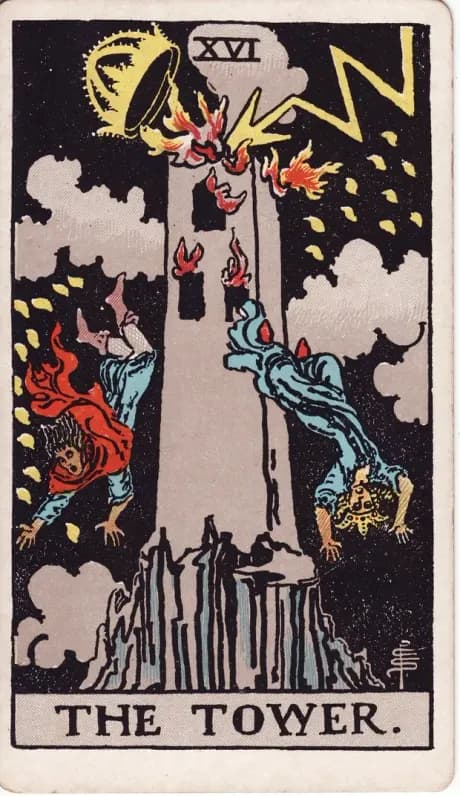
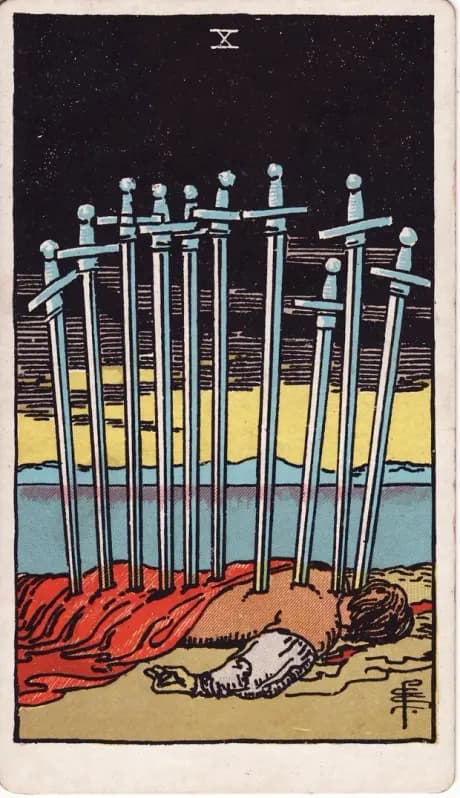
There is a second reading that surfaces more often than people expect. Sometimes the ending is one you will later be glad of — the arrangement that was slowly costing you something ends by being made undeniable. It hurts precisely because it is final and because you were still hoping. Surrounding cards usually distinguish the two: the Tower or the Ten of Swords nearby reads as collapse, while the Eight of Cups or Death reads as a departure you were already halfway through.
Reversed as an outcome, the situation ends in recovery. The pain resolves, the wound closes, forgiveness happens or simply time does its work. It is a slower and less dramatic result than the upright, and a better one. The harder reversed reading is an ending that never properly closes: the event is over, nothing is said about it, and it stays in the record shaping everything that comes next.
What the Three of Swords card shows
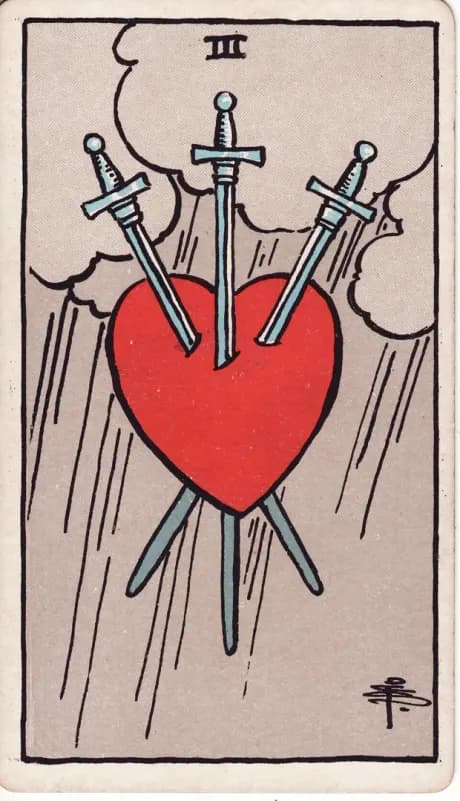
The 1909 card is the plainest picture in the deck and one of the only ones with no person in it at all. A large red heart floats in the centre against a grey sky, and three straight swords are driven through it — one entering vertically from above, two crossing it on the diagonal from either side. Behind them, heavy grey cloud fills the whole background and rain falls in slanting lines across the card.
The first thing worth noticing is what has been left out. There is no ground, no horizon, no figure to identify with, no landscape to escape into. Every other Swords card gives you somebody suffering and a place they are standing. This one removes both. What remains is the injury itself, isolated, with nothing around it to soften the reading or suggest a next step.
The heart is drawn as a symbol rather than an organ — the flat, symmetrical, valentine shape, the kind you would find on a card or a banner. That choice matters. It is not a body being damaged; it is the idea of a heart, the thing people mean when they use the word, which is why the image reads immediately in every language.
The three swords are identical, evenly spaced, and pass cleanly through. There is no violence in the composition, no struggle, no blood. They look placed rather than thrown. Three in this deck is the number of something being made real: the Three of Cups is celebration, the Three of Pentacles is work completed and recognised. Here it is a hurt that has been fully realised — not a threat, not a risk, an accomplished fact.
The rain is the only movement in the picture. It is also the only mercy: rain in this deck is release, and it is falling on a heart that cannot feel it yet.
Frequently asked
Does the Three of Swords always mean heartbreak?
+
It means genuine emotional pain — betrayal, grief or hard truth. Its honesty is the beginning of getting through it. In readings outside love it is just as likely to be accurate criticism, a lost contract, or an arrangement discovered not to be what it looked like. The common element is that the hurt arrived as information.
Can love survive the Three of Swords?
+
Yes, if the wound is faced directly by both people. Ignored, it infects; named, it can heal stronger at the scar. The condition is specific: the actual thing has to be said plainly by the person who did it, with details. Attempts that skip that step usually arrive back at the same argument within a few months.
Is the Three of Swords a yes or a no?
+
Upright it is one of the clearest noes in the deck — it describes damage that has already been done rather than a possibility that might be avoided. Reversed it softens to a qualified yes about recovery: the pain eases, though the event that caused it is still not undone.
What should I do when I draw the Three of Swords?
+
Let the grief happen at full size instead of rationing it, and write down what actually occurred without the interpretation. Then say the sentence you have not said, once, to the person it belongs to or to someone who will hear it. Nothing here is improved by recovering faster than it takes.
Does the Three of Swords mean cheating?
+
Sometimes, but not by default. It means painful information, and infidelity is only one of the things that can be. Rejection, a hard truth said out loud, an ending, or finding out how someone really felt all fit the card equally. Look at what sits beside it: the Seven of Swords or the Devil push it toward betrayal, while the Five of Cups or the Eight of Cups point at loss instead.