What Five of Swords means in tarot — and in love
The Five of Swords is the fight won and the love lost: sharp words that scored points and cost intimacy, victory by scoreboard in a game with no… As feelings, the Five of Swords means resentment — they are keeping score, nursing a grievance, feeling defeated or vengeful about the two of you.
Jump to FAQAt a glance
- Yes or no
- No — reversed flips it
- Element
- Air
- Upright, in a line
- a hollow victory, winning the fight losing the person
- Reversed, in a line
- making amends, ending the cold war
Want a yes or no on your own situation rather than this card? Pull one card and get the verdict with the reason behind it.
Ask your own yes-or-no questionIn the Golden Dawn tradition this card rules 0–10° of Aquarius. A planet standing at that degree is read through it: Venus in Aquarius · Moon in Aquarius · Mars in Aquarius
Upright in love
The Five of Swords is the fight won and the love lost: sharp words that scored points and cost intimacy, victory by scoreboard in a game with no prize. Conflict where someone had to win — humiliation, ultimatums, the last word held like a trophy. If you asked what went wrong: the battle was chosen over the bond.
What makes this card specific is that it is not really about anger. Anger is loud and it passes. This is about the moment a disagreement stops being about the subject and becomes about who is right, and one person notices they can win. From there the argument gets easier for them and worse for everybody. The evidence gets marshalled. The old example gets brought up. By the end there is a winner and a scoreboard, and not one thing either of you actually wanted has moved an inch.
In a new connection it shows up early and small, which is why it gets excused. A correction delivered as a joke. A story told at your expense that is funny and slightly true. A disagreement you find yourself apologising for without being able to reconstruct what you did. Five of Swords behaviour is legible in the first month if you are watching for it, and the reason it gets missed is that each instance on its own is too small to make a point about.
In an established bond the card describes a pattern rather than an incident. The two of you have a shape you fall into, and in that shape the same person always ends up conceding, and the concession is not agreement. It is fatigue. Resentment builds in whoever keeps folding, and whoever keeps winning experiences things as basically fine. That gap is what makes this hard to repair: you are each describing a different situation and both of you are describing it accurately.
What the card asks for is a choice, and it is uncomfortable because both options cost something. Either stop competing, which means losing arguments you could win and saying out loud that you are doing it, or leave the field. What it rules out is another round. Rounds are what this card is made of, and no number of them has ever settled anything.
Reversed in love
Reversed, the Five of Swords is weapons lowered: the apology forming, pride loosening, or a wise walk away from a battlefield disguised as a romance. Reconciliation becomes possible when winning stops being the goal. Forgive, or leave the arena — both beat another round.
The reversal does not undo the fight. It moves you into the part that comes after, which is the part that decides whether anything is left. That can go three ways, and it is worth knowing which one you are in.
The first is genuine. Somebody has run out of appetite for winning. The apology arrives and it is a real one, meaning it names the specific thing that was done rather than the general regret that is felt. This version is quiet, slightly awkward, and looks nothing like a scene from a film. It is also the only version from which repair is actually available.
The second is withdrawal. The fighting stops because one person has decided it is not worth the effort, and that decision is about the whole thing rather than about the argument. From outside it looks like peace. It is a different substance entirely: the silence of somebody who has stopped bothering. Anyone who has been on the receiving end of it recognises the specific chill.
The third is the conflict going underground. The open fighting ends and comes back as coldness, as small withheld things, as an account being kept somewhere you are not shown. Reversed Five of Swords is one of the deck's better indicators for a grudge that has been formally denied.
The practical test is what happens the next time you disagree about something trivial. If the trivial thing stays trivial, you are in the first meaning. If a small thing becomes a large thing within a minute, nothing has been put down. The weapons were only moved out of sight.
Five of Swords As feelings
As feelings, the Five of Swords means resentment — they are keeping score, nursing a grievance, feeling defeated or vengeful about the two of you. Conflict energy instead of connection. Whatever they feel, it is currently armed.
The card does not say which side of the fight they are standing on, and that is the first thing to work out, because the winner and the loser in this picture feel nothing alike.
If you are single and asking about someone new. Interest arriving as competition. They tease a little too accurately, they correct you, they treat conversation as something with a result. Sometimes this is nerves wearing armour. Sometimes it is simply how they operate. There is also a quieter version worth checking: they are bruised from a conflict that had nothing to do with you, and you are standing where the blast lands.
If you are in a relationship. They feel wronged and they are waiting to be told they were right. Underneath the sharpness there is usually one specific unacknowledged thing, and until it is named the fighting will keep attaching itself to whatever is nearest — the dishes, the tone, the timing. They are not angry about the dishes.
If you are asking about an ex. The war is still running inside their head, with you cast in it. This is contempt or grievance rather than indifference, and people often find that encouraging, which is a mistake. Strong feeling here is not warmth that has been mislabelled. It is a case still being prosecuted.
If you are asking about someone long-term. An old grievance has calcified. Nothing is loud any more. It has become a permanent low-level position they hold about you, taken years ago, never revisited, and quietly consulted whenever something goes wrong.
In all four, the feeling is real and pointed in a direction that costs them something to keep pointing.
Five of Swords For your ex
For an ex, the Five of Swords means the breakup was a war and somebody is still on the field collecting swords. Contact tends to reopen combat. Peace requires a disarmament nobody can force — including you.
The hardest part of this card is that it is usually accurate about both people. One of you may have behaved worse, and knowing that does not help, because the ending was still a contest and contests leave both sides with a version of events they can defend. Those two versions are incompatible. Neither will survive contact with the other, and each of you has rehearsed yours enough that it now feels like memory rather than argument.
This is why Five of Swords conversations fail so reliably. The stated purpose is closure. The actual purpose, on at least one side, is to be finally agreed with. That agreement is not coming, and every attempt to extract it hands the other person fresh material.
If you want a practical read: notice whether you are still preparing. Drafting replies to things they have not said, rehearsing the account you would give if a mutual friend asked, running the argument in the shower. That is the card describing you rather than them, and it is worth knowing, because the person still preparing is the person still in it.
The exit is not forgiveness, which cannot be manufactured on demand. The exit is dropping the requirement to be understood by this particular person. It costs something real. It is also the only move on the board that does not produce another round.
What Five of Swords means in general
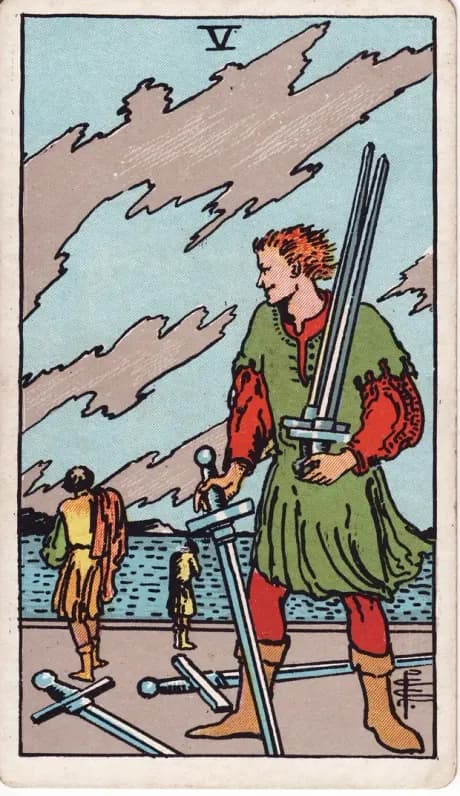
One figure gathers swords from the ground while two others walk away with their backs turned, and the sky behind them is torn into ragged strips. He has won. The card's subject is the victory that costs more than whatever it was fought over — being right at a price nobody counted, the argument that ends with everyone diminished, including the person holding the trophy.
Upright it says the win is available and asks what it will cost. It also quietly offers the other option drawn into the picture: two of the five blades lie on the ground, dropped by people who decided the field was not worth standing on. Walking away is in this card as deliberately as winning is. Reversed the conflict winds down — an apology, a truce, or the recognition that the fight was never winnable — sometimes with resentment left behind on whichever side conceded.
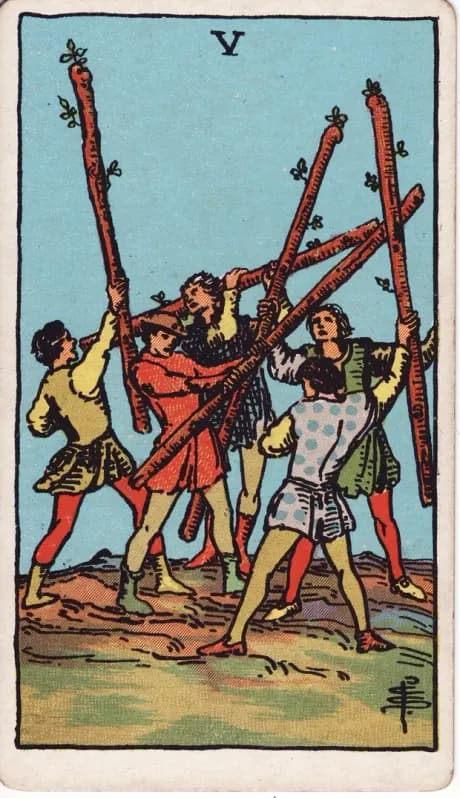
Fives in this deck are all disruptions, and every suit is disrupted differently. The Five of Wands is a scuffle with nothing at stake. The Five of Cups mourns. The Five of Pentacles is shut outside. This is the one that produces a winner, and it is the only card in the group that gets worse the more decisively you succeed at it.
At work it is the negotiation pushed so hard the counterparty never comes back, the meeting won in front of an audience, the colleague corrected in public over something that could have been fixed in a message. Around money it is the dispute pursued well past the point where the sum recovered exceeds the cost of pursuing it. In creative practice it is the criticism delivered accurately and destructively, which ends the discussion and the collaboration in the same sentence.
The question this card asks never changes. After you win, what exactly do you have.
Five of Swords as a yes or no
As a yes or no, the Five of Swords upright is a no, and it is one of the firmer nos in the deck. The reason is not that you fail. It is that the version of success on offer is not worth having. This card frequently appears for questions where the answer is technically yes — you can win the argument, you can force the outcome — and the card's whole job is to say that the technically yes is a no once the cost is included.
Be careful with the wording of what you asked. Will I win reads as yes with this card and answers a question you did not mean. Will this work out, will we be all right, should I do this: all no.
Reversed it softens without becoming a clean yes. For questions about de-escalation, apology or truce, it is a qualified yes: the fighting can stop. For questions about restoring things to what they were before, it stays no, because the reversed card describes a ceasefire rather than a repair. The distinction is worth holding on to, since people routinely read the reversal as forgiveness and it is more often exhaustion.
If the card resists your question, the better question is about cost rather than outcome. What does winning this take from me. What am I actually trying to be told. Who am I still arguing with when there is nobody in the room. The deck answers those well, and they are the questions that decide whether the yes or the no ever mattered.
Five of Swords as advice
As advice, the Five of Swords says concede something. Not everything, and not falsely — pick one point where the other person is right, say so plainly, and do not attach a condition to it. That single act does more to change a Five of Swords situation than any amount of being correct, because the card describes a contest and a contest cannot continue if one side stops competing.
Concretely: stop collecting evidence. Delete the screenshots you were keeping for later. Do not bring up the earlier incident that proves your point, however relevant it is, because relevance is what makes it a weapon. Apologise for one specific thing you did rather than for how they felt, which is the apology that keeps the fight going under better manners.
The card also authorises the other exit, and this matters, because advice about conflict usually assumes the goal is to stay. Two of the five swords are on the ground in the picture. Leaving is a legitimate move here. If the pattern is that one person wins and one person concedes, and you have been conceding for a long time, the card is not telling you to concede once more. It is telling you to stop playing, and stopping can mean stopping the argument or stopping the whole arrangement.
What it rules out is the middle: staying, competing, and hoping the next round goes better. It will not. Rounds are the material this card is made of.
Reversed, the advice narrows to timing. The moment to say the honest sentence is now, while somebody still wants to hear it. Reversed Five of Swords describes a window, and windows close quietly rather than dramatically.
Five of Swords as an outcome
As an outcome, the Five of Swords ends with a winner and a bill. Somebody gets what they were arguing for, and the getting is what does the damage. This is not a card of collapse or catastrophe. Nothing explodes. What happens is that a position is secured and the thing it was secured from is diminished, and the person holding it notices this later than everybody else.
In a question about two people, the usual shape is a resolution nobody is glad about. The argument ends because one side gives up rather than because either was persuaded. Contact continues, and something has been withdrawn — a bit of trust, a bit of willingness, the assumption of good faith. It rarely gets named. It shows up months later as reluctance nobody can trace back to its source.
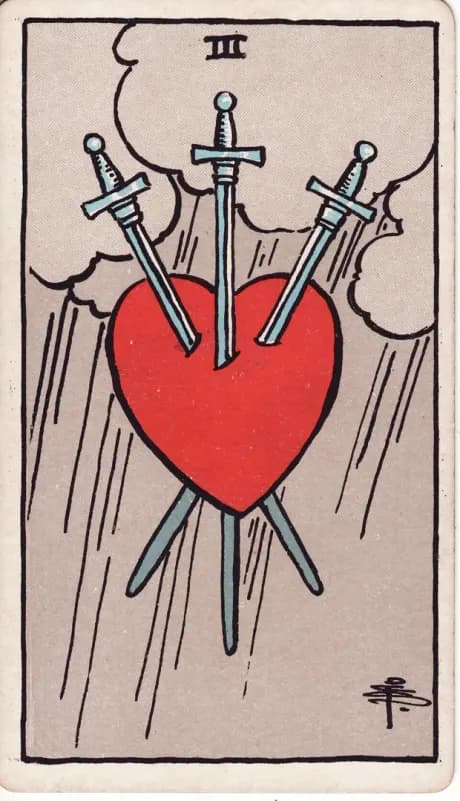
The card is also honest about the surrounding company. Next to grounded, cooperative cards it can read as a hard conversation that clears the air and does not repeat. Next to the Three of Swords, the Nine of Swords or the Tower, it reads as the ending, arrived at by attrition.
Reversed as an outcome is genuinely better, with a limit. It ends in de-escalation: an apology, a truce, or a departure made without a final scene. The limit is that de-escalation is not repair. What you get is the fighting stopping, which is worth a great deal and is not the same as the situation being good again. Whether it becomes good is decided by what happens after the quiet, and this card does not cover that part.
What the Five of Swords card shows
The 1909 card shows five swords, three people and a torn sky. In the foreground a young man stands holding three of the blades — two gripped in one hand, one resting back against his shoulder — and looking over his shoulder with a small, unmistakable smirk. Two more swords lie abandoned on the ground at his feet. His weight is easy. He is not braced for anything, because nothing is coming.
Behind him two figures walk away toward the water, both with their backs turned. One has a bowed head and a hand raised toward the face. Neither is looking back. That composition is the whole argument of the card: the winner has to turn around to see the people he beat, and they will not turn around at all.
The sky is the detail people miss. Pamela Colman Smith drew the clouds in jagged, torn strokes, unlike the soft cloud shapes she used elsewhere in the deck. It looks like fabric ripped along a seam. The water beyond is choppy and grey-green, restless in a way that the water of the Six of Swords deliberately is not.
The two dropped swords matter as much as the three held ones. They belonged to the departing figures, and they were put down rather than taken. The card contains both available moves at once — pick everything up, or set your share down and go — and it does not indicate which of the two is being asked of you.
Nothing in the picture is bloody. There is no wound and no body. What has been lost is not visible, which is exactly the problem: the man in the foreground can see the swords in his arms and cannot see what they cost, and the picture is arranged so that the viewer can see both.
Frequently asked
What does the Five of Swords mean in love?
+
Conflict where winning costs more than the argument was worth — sharp words, kept scores, hollow victories. It usually describes a pattern rather than one bad night: the same person concedes each time, and the concession is fatigue rather than agreement. Disarm or depart, because another round changes nothing.
Does the Five of Swords mean the relationship is over?
+
Not on its own. It means the current fighting mode cannot continue: either the war ends or the bond does. What decides it is whether anyone is willing to lose an argument on purpose. Surrounding cards matter here — cooperative company reads as one hard conversation, the Three of Swords or the Tower reads as the ending.
Is the Five of Swords a yes or a no?
+
Upright it is a firm no, and the reason is worth knowing: often you can get what you asked for, and the card is saying the getting is not worth the price. Reversed it becomes a qualified yes for de-escalation and apology, and stays no for restoring things to how they were.
What should I do when I draw the Five of Swords?
+
Concede one point where the other person is right, say it plainly, and attach no condition. Stop collecting evidence and do not raise the earlier incident that proves your case. If you have been the one conceding for a long time, the card is not asking for one more concession — it is offering the exit instead.
Who is the winner in the Five of Swords?
+
The man in the foreground holding three swords, and the card treats his win as the problem rather than the point. In a reading he is not always the other person. If you are the one still rehearsing arguments and keeping receipts, the smirking figure is a portrait of you, and that is usually the more useful reading.