Mars in Aquarius
Mars in Aquarius goes after things on its own terms and refuses to be predictable about any of it. It pursues by being interesting rather than by being available, argues from principle, and its anger arrives as sudden, articulate coldness rather than as heat.
What this Mars goes after
This Mars will not be moved by pressure, and the more visible the pressure the less it moves. That is not stubbornness in the earth sense, which digs in; it is detachment, which simply stops being present in the conversation.
What it goes after is somebody it finds genuinely unusual, and unusual is not a preference here — it is the whole requirement. This placement can be attracted to a person's mind, politics or refusal to belong to anything long before it registers wanting them at all.
And it needs the pursuit to remain its own idea. Wanting the same thing as everybody else is faintly intolerable to this Mars, so it will complicate a simple situation for no reason except to make sure the decision was not handed to it.
How it makes the first move
Unevenly, and that unevenness is not a tactic. This Mars is intensely engaged for four days and unreachable for six, because its interest runs on genuine absorption rather than on a schedule, and it does not occur to it that the pattern is being read as a signal.
What it offers early is the good conversation and the unexpected angle, and what it withholds is the ordinary reassurance — because ordinary reassurance is exactly the register it distrusts most.
The early failure is going cool the moment something becomes conventional. A relationship acquiring a shape can be enough to cost it this placement, and the reason given afterwards will be principled and will not be the real one.
Inside a relationship
It is astonishingly loyal on its own terms and cannot be made to be loyal on anybody else's. This Mars will stay for decades with somebody who has never once asked it to promise anything, and will leave the identical relationship the month it becomes an obligation.
What it needs is friendship at the base. It has to actually like the person and want their opinion — desire alone does not hold this placement, and a relationship built only on wanting each other goes cold here faster than in any other sign.
Conflict is where the temperature drops. It does not escalate, it disengages: the argument becomes abstract, the tone becomes reasonable, and the other person finds they are debating a position with somebody who has already left the room emotionally.
Where it goes wrong
Detachment used as a weapon. This placement can go unavailable at exactly the moment somebody needs it, describe the withdrawal in entirely reasonable terms, and be genuinely unaware that a decision was made rather than a state observed.
The second failure is contrarianism at the expense of the thing it wants. It will refuse something it actually wants, purely because agreeing at that moment would mean having been steered — and it will construct an excellent principled case for that refusal.
And the ideals get used to avoid the specifics. Real about freedom, honesty and how relationships ought to work in general; unavailable on the question of why it did not answer for two days.
Who it works with
Air and fire keep it engaged. Another air Mars does not need the pattern of absence explained; Aries, Leo and Sagittarius take the independence as a challenge rather than as rejection and come back rather than sulk.
Water is where the cold does damage. Cancer, Scorpio and Pisces read a rational tone during their distress as abandonment, and this Mars is genuinely bewildered by that, because from inside it was being helpful.
Earth is the ballast that mostly works. Taurus, Virgo and Capricorn are unbothered by the theory and pay attention to the behaviour, and being held to what was actually done — without a scene about it — is the one form of pressure this placement respects.
The three cards of this sign
Aquarius is a fixed air sign, so the Swords rule its decans, and the degree decides which of the three carries your Mars.
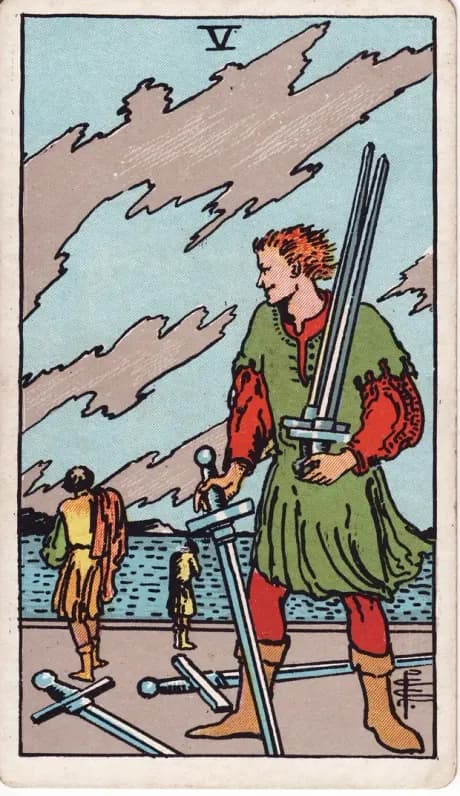
The first ten degrees are the Five of Swords, and the detail is that two blades are still lying on the ground. He has not picked them all up and he is not going to. This placement wins the point and declines the rest of the argument, which is the coldest thing anybody can do in a fight.
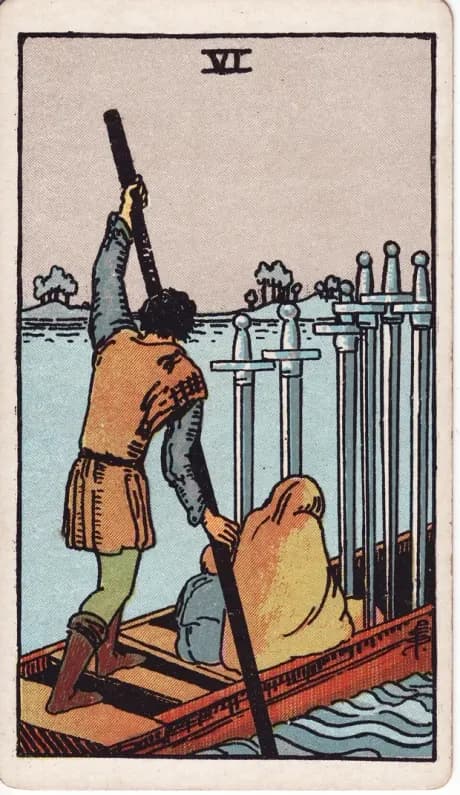
The middle ten are the Six of Swords, and the six swords are standing upright in the boat. Nobody disarmed to leave. This Mars departs a situation without giving anything up, which is why its exits look so composed and so final.
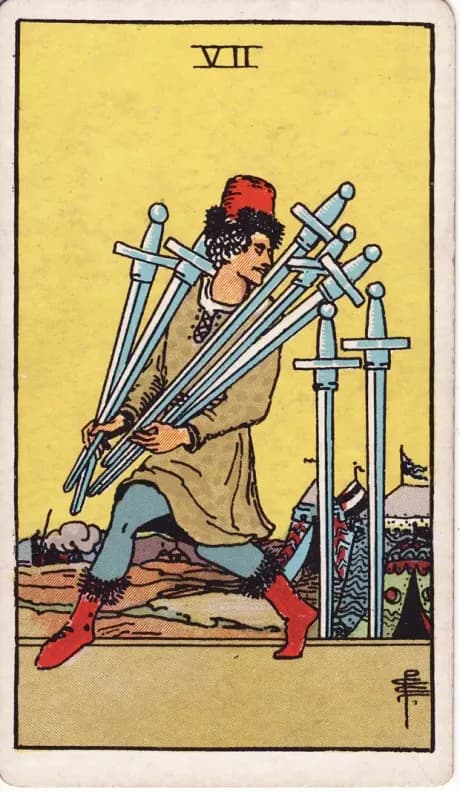
The last ten are the Seven of Swords, and two blades are left standing in the ground behind him. He takes five, deliberately, and leaves two. That is this placement's characteristic move: a partial exit, with a route back kept open and never mentioned.
Questions people bring to the cards
Questions people ask
Why does Mars in Aquarius go cold?
+
Because its response to pressure is disengagement rather than escalation. It stops being emotionally present while still being perfectly reasonable out loud, which is much harder to be on the receiving end of than an argument.
Is Mars in Aquarius afraid of commitment?
+
Not of the relationship — of the obligation. This placement stays for decades where it has chosen to and leaves where it has been required to, and the two situations can look identical from outside.
What attracts Mars in Aquarius?
+
Genuine strangeness and a mind of its own. It is drawn to people who do not belong to a category, and it loses interest almost immediately in anyone whose main quality is being available.
How does Mars in Aquarius handle conflict?
+
By abstracting it. The specific grievance becomes a general principle, the tone stays level, and the actual feeling never enters the conversation — which is the one thing this placement has to learn to do differently.