What The Devil means in tarot — and in love
The Devil is the chain you enjoy: obsessive chemistry, magnetic toxicity, the person you know is bad for you and text anyway. As feelings, the Devil means they want you in a hungry, possessive way — desire, fixation, sometimes control.
Jump to FAQAt a glance
- Yes or no
- No — reversed flips it
- Upright, in a line
- obsession, intense chemistry, attachment that binds
- Reversed, in a line
- breaking free of a toxic tie, reclaiming power
Want a yes or no on your own situation rather than this card? Pull one card and get the verdict with the reason behind it.
Ask your own yes-or-no questionUpright in love
The Devil is the chain you enjoy: obsessive chemistry, magnetic toxicity, the person you know is bad for you and text anyway. It names attachment stronger than judgment — lust, jealousy, need wearing love's clothes. The trick written on the card: the chains are loose. You stay because part of you is fed here. Name that part and you own the key.
The card is not a moral verdict and it is not a warning label attached to a person. It describes a mechanism. Something in this arrangement is paying you — attention, intensity, relief from feeling ordinary, the specific narcotic of being wanted badly — and the payments are real, which is exactly why the reasonable part of you keeps losing the argument with the rest of you.
In a new connection it is the pull that arrives too fast and too strong. The chemistry is genuine and it is not evidence of anything else. What the card asks you to notice is how much of the intensity comes from uncertainty: the waiting for replies, the hot and cold, the sense that you must not lose this. Certainty is calm. If what you feel is not calm, some of that heat is being generated by fear rather than by them.
In an established relationship it describes a pattern both people maintain and neither chose. The same fight in the same words. Jealousy that gets called caring. A dependency in which each person's worst habit is being fed by the other's. Nobody here is the villain, which is the part people resist hardest, because having a villain would make leaving so much simpler.
The instruction is not leave. It is look. Name what you are actually getting, in one plain sentence, without the version that flatters you. Then ask whether you could get it somewhere that charges less. The chains on this card come off over the head — but you cannot lift what you refuse to look at, and the looking is the entire difficulty.
Reversed in love
Reversed, the Devil is the chain breaking: leaving the toxic loop, blocking the number, wanting your own soul back more than their attention. Freedom feels like withdrawal at first — that's how you know it was addiction, not love. Expect one last tug from the chain as you walk. Keep walking.
The reversal is usually good news and it is rarely comfortable. What comes off is not the feeling, which can persist long after the arrangement ends, but the belief that you had no choice. That belief was the actual chain. Everything else is appetite, preference and habit, all of which are survivable and none of which are destiny.
There is a stage nobody warns people about. Immediately after the break the situation looks better than it did while you were in it. The good parts come forward, the bad parts go vague, and you catch yourself building an argument for return using the same mind that got you out. This is not new information arriving. It is the withdrawal doing its work, and it passes if you let it.
A second reading exists and it is harsher. Occasionally reversed means the pattern has been seen and not yet released: the awareness has arrived, the behaviour has not changed, and now you are doing the same thing with full knowledge of what it is. That is a heavier place to stand than ignorance was, and it is also the last stop before the chain actually comes off.
The practical part is unromantic. Reduce the contact. Make the decision once instead of every evening. Fill the hours the thing used to occupy with something dull and physical, because the hours are the real problem and nobody has ever argued themselves out of an appetite at eleven at night.
The Devil As feelings
As feelings, the Devil means they want you in a hungry, possessive way — desire, fixation, sometimes control. It's intense and flattering and not the same as love. Enjoy the fire if you like; just count your exits.
Intensity reads differently depending on what is being asked, so here are the four questions this card usually turns up for.
If you are single and asking about someone new. They want you, physically and specifically, and wanting is not the same as intending. This is one of the strongest desire cards in the deck and one of the weakest commitment cards, and people routinely take the first as evidence of the second. What they feel is real. What it predicts about next month is nothing at all.
If you are in a relationship. Their attachment has a grip in it. That can look like passion and it can look like possessiveness, and often it is both, moving between them depending on how secure they feel that week. The question worth asking is not whether they want you, which is clearly yes, but whether they are comfortable when you have a life they are not standing inside.
If you are asking about an ex. They miss the intensity, and the intensity includes the bad parts. What pulls at them is the habit of you: the body, the fights, the reconciliations, the feeling of being fully awake that the whole cycle produced. It is a strong feeling and it is not a considered one. It tends to arrive late at night and be gone by Tuesday.
If you are asking about someone long-term. The card usually points at dependency rather than desire — two people bound by shared circumstances, money, habit and fear of the alternative, with the wanting long since fused to the needing. That is not nothing. It is also not the same as being chosen, and telling those apart is the work this card is asking for.
Across all four the card is consistent. The feeling is strong, it is honest about being strong, and it is not promising anything.
The Devil For your ex
For an ex, the Devil is the trauma bond talking: they crave the habit of you — the body, the drama, the hold. A Devil reunion replays the same loop with worse lighting. If you go back, go back knowing exactly what's feeding.
What makes this card hard is that the pull is mutual and genuine. You are not imagining their interest and they are not performing it. Two people can want each other badly and be unable to be good to each other, and the deck has a card for exactly that combination rather than treating it as a contradiction that needs resolving.
The returning pattern is recognisable enough to predict. Contact resumes at a strange hour. The reunion is intense and short. Within a few weeks the original problem is back in its original words, because nothing about it was ever addressed — the break was a pause in the cycle rather than an interruption of it. Third and fourth rounds run shorter than the first, and everybody involved notices and nobody says so.
The useful question is not do they still want me. They do. The question is what changed. Something specific has to be different — a habit ended, a circumstance removed, a piece of work one of you actually did and can describe. If you cannot name it in a sentence, nothing changed, and the loop is intact and waiting.
If you decide to go back anyway, do it with your eyes open and a limit written down somewhere. The card does not forbid it and has never been interested in forbidding anything. It insists on one thing only: stop calling the appetite a destiny.
What The Devil means in general
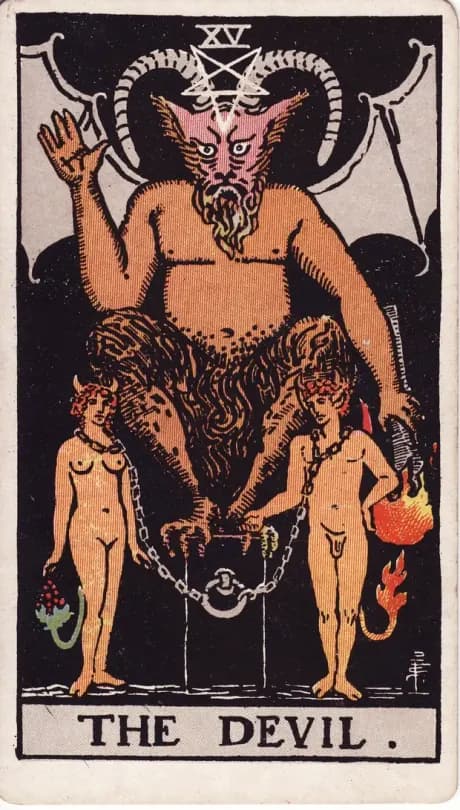
The Devil shows two figures chained to a block, and the chains are loose enough to lift off. That detail is the whole card: the bondage is real and it is also chosen, maintained by appetite, fear or habit rather than by force. His subject is what has you — compulsion, obsession, a bargain that keeps paying out just enough, material fixation, and the shadow you would rather not examine.
Upright he names the mechanism without moralising. There is usually real pleasure in it, and pretending otherwise is why people fail to get free of things: an arrangement that gave nothing back would have been abandoned years ago without anyone needing a card to explain it. He is interested in the exchange rate, not in whether you should feel ashamed of the trade.
Reversed the chains are coming off. The pattern gets recognised, the grip loosens, or an honest look is finally taken at the cost. Reversed can also mean the recognition has arrived and nothing has changed yet, which is uncomfortable and is still progress.
Read on a situation in general, he says something here is not free and you have been treating it as free. A price is being paid, usually in a currency other than money: time, self-respect, options quietly closing one by one. His function is to make the invoice visible.
At work he is the well-paid job that has taken more than it gave for three years, the manager whose approval became the point, the golden handcuffs negotiated in good faith and working exactly as designed. In money matters he is the arrangement whose real cost sits in the small print. In creative work he is the formula that sells: the thing you can do easily, that people want, which has slowly become the only thing you are allowed to make.
One caution about reading him. He describes a pattern, not a diagnosis, and he is no authority on anything clinical. What he does well is name the trade honestly.
The Devil as a yes or no
As a yes or no, the Devil upright is a no. Not because the thing cannot happen — it very often can, and that is precisely the problem — but because getting it costs more than the question assumed. This is the deck's card for a yes with a bill attached, and the honest answer to most questions it lands on is yes, and you will not enjoy the price.
It answers one kind of question with an unambiguous yes: is there strong attraction here, is the pull mutual, is something in this genuinely compelling. All yes. The questions people actually care about — will this be good for me, will it last, is it what I think it is — it answers with a flat no.
Reversed it becomes a yes, and one of the more encouraging reversals in the deck. The chain is coming off, the pattern is being seen, the thing that had you no longer entirely has you. If you asked whether you can get out, reversed says yes. If you asked whether getting out will be pleasant, no card in this part of the deck has ever said yes to that.
The better question when this lands is about cost. What am I paying for this. What would I have to give up in order to keep it. What is it supplying that I have decided I cannot get anywhere else. Those have real answers. Will it work out does not, while this card is on the table.
Treat any yes it appears to offer as conditional on knowing exactly what you are agreeing to. The card has no objection to appetite. It objects to unread contracts.
The Devil as advice
As advice, the Devil says look at the thing you have decided not to look at. Not necessarily leave it — the card is far less interested in your exit than in your honesty. Name what you are getting out of the arrangement, in plain language, without the version that makes you sound noble or trapped.
Concretely: write down the exchange. What comes in, what goes out, and what it would cost to walk away. Most people have never done this on paper, and on paper it is short, and the shortness is the shock. The second exercise is to name the need underneath it, because the arrangement is a supplier, and needs can usually be supplied elsewhere at a better rate once you know which need it is.
The card also advises reducing exposure rather than relying on willpower. Change what is easy and what is hard: distance, timing, access, the specific hour of the evening when the decision always gets made badly. Nobody argues themselves out of an appetite at eleven at night. Structure beats resolve, every time, in every domain this card touches.
Do not accept the framing that you are powerless. The chains come off over the head. That is drawn deliberately, and it is the one piece of hope in the picture: you are held by something you are also helping to maintain, and maintenance can stop.
Reversed, the advice is to keep going and expect the pull. The moment after you loosen something is exactly when it looks most attractive, and the argument for going back arrives fully formed and sounds entirely reasonable. Decide once, in daylight, and let that decision cover all the later evenings when you would decide differently.
The Devil as an outcome
As an outcome, the Devil means the situation continues on its current terms. Whatever holds it together holds. Nothing breaks, nobody leaves, and the arrangement carries on being what it is — which is the result people find hardest to hear, because it contains no event at all to prepare for.
In a question about two people, it usually means the pattern persists: the same cycle, the same intensity, the same recovery, repeated. That is not a prediction of harm. It is a prediction of continuity, and continuity is the actual risk here, because the cost is not paid in one visible moment but in a hundred ordinary ones nobody counts.
There is a narrower version worth checking for. Sometimes the outcome is simply that you end up bound to something material — a place, an obligation, an arrangement — which is not dramatic at all and is genuinely difficult to leave. This card covers ordinary entanglement as well as the burning kind, and the ordinary kind lasts longer.
Neighbours change it more than usual. With the Tower or Death nearby, the arrangement ends, and rarely on your schedule. With the Star, Temperance or the Six of Swords, the result is a slow walk out rather than a collapse. With the Ten of Pentacles or the Four of Pentacles, expect it to be very comfortable and very hard to move.
Reversed as an outcome is one of the cleaner results the deck offers: the hold ends. Someone lifts the chain and walks, an appetite loses its authority, a pattern gets named out loud and stops working once it has been named. It is rarely tidy, it is a real ending, and the freedom it produces usually arrives disguised as an unpleasant few weeks.
What the The Devil card shows
The 1909 card shows a horned figure crouched on a half-cube of black stone, with two naked figures chained to a ring at its base. It all happens against a solid black background: no landscape, no sky, no light source. There is nowhere else to look.
The figure on top is assembled from parts that do not belong together — a goat's head with the horns of a ram, a human torso and arms, the wings of a bat, and the clawed feet of a bird of prey. Between the horns sits a five-pointed star, drawn upside down. He is a composite, and a composite is what a compulsion is: several ordinary appetites fused into one thing that behaves as though it were a creature with its own will.
His right hand is raised, palm out, in a gesture that copies a blessing. His left hand holds a torch pointed downward, and the flame is touching nothing useful. Whatever authority the pose claims, the hands are doing the opposite of what they imitate.
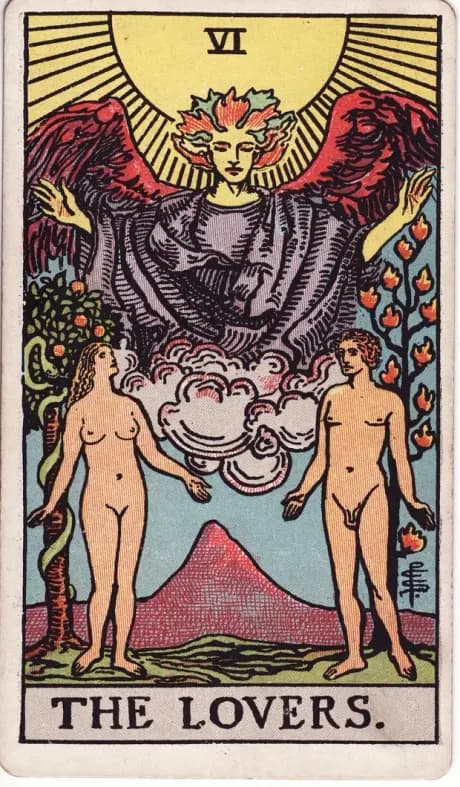
Below him stand a man and a woman, chained by the neck. They are the same two figures who appear on the Lovers card, and comparing the two pictures is the fastest way to read this one: same pair, same posture, different management. Both have grown small horns and tails since then. The man's tail ends in flame, the woman's in a bunch of grapes.
Then the detail the entire card rests on. The chains around their necks are wide. They hang loose, and nothing prevents either figure from lifting one over their head and walking out of the frame. They are not locked in, not held down, and not looking at each other. They are simply standing there.
The half-cube is the last note. A whole cube is complete. Half of one is a partial truth, presented as a floor.
Frequently asked
Does the Devil card mean toxic love?
+
It means attachment with chains — obsession, lust, dependency. Thrilling, binding, and honest about none of it. Proceed with eyes open. The card is describing a mechanism rather than judging a person, and the mechanism works because something in the arrangement is genuinely paying you.
Is the Devil ever positive in love?
+
For raw passion, yes — it's the deck's strongest physical pull. Positive long-term only if the obsession matures into respect, which means the intensity has to survive certainty. If the heat depends on uncertainty, it drops the moment things become secure.
Is the Devil a yes or a no?
+
Upright it is a no, but a specific one: yes it can happen, and it costs more than the question assumed. Reversed it is a yes — the chain is coming off, the pattern is being seen, and if you asked whether you can get out, the answer is that you can.
What should I do when I draw the Devil?
+
Write down the exchange: what you get, what you pay, what leaving would cost. Then change your structure rather than trusting willpower — distance, timing, and the specific hour when the decision always gets made badly. Structure beats resolve every time.
Does the Devil card mean cheating?
+
Usually not. It describes appetite, secrecy and a hold somebody cannot break more than it describes a specific act. When infidelity is genuinely the subject, the Seven of Swords, the Moon or the Three of Swords tend to appear alongside it.