What Knight of Swords means in tarot — and in love
The Knight of Swords is the declaration at full gallop: sudden confessions, intense pursuit, conversations that skip small talk entirely. As feelings, the Knight of Swords means urgent fixation — they've decided about you and feel compelled to act, say, resolve, now.
Jump to FAQAt a glance
- Yes or no
- No — reversed flips it
- Element
- Air
- Upright, in a line
- a fast direct approach, intense declarations
- Reversed, in a line
- words that cut, chaos in the delivery
Want a yes or no on your own situation rather than this card? Pull one card and get the verdict with the reason behind it.
Ask your own yes-or-no questionUpright in love
The Knight of Swords is the declaration at full gallop: sudden confessions, intense pursuit, conversations that skip small talk entirely. Direct, fast, mentally sharp — love as a campaign with objectives. If you asked whether they'll make a move: this Knight doesn't hint, he arrives. Brace for honesty at speed; decide before the dust settles.
The thing to understand about this card is that the speed is sincere. He is not performing urgency to get something out of you. He genuinely thinks at that pace, decides at that pace, and cannot see why anyone would take three weeks to say a sentence that takes four seconds. That is his strength and it is also the entire problem: a decision made in four seconds is still a decision made in four seconds, however honestly it was reached.
In a new connection he is the one who says he likes you on the second meeting, asks the direct question everyone else circles, and wants an answer today. It is flattering and disorienting in equal measure. What you are receiving is real interest moving faster than knowledge — he has decided about you on limited information, which means the decision can reverse just as fast when more information arrives.
In an established relationship this Knight usually shows up as the argument nobody planned. A subject that has been sitting under the table for months gets pulled out at speed, in full, at eleven at night. The content is often correct. The delivery is often terrible. Couples who survive this card are the ones who learn to hold those two facts apart instead of arguing about the delivery for a week.
What the card asks of you is nerve rather than velocity. Do not match his pace to keep up; match his directness. Say the true thing plainly, and say plainly when you need time. This Knight has no capacity to read a hint and no patience for a hedge, and the one thing that reliably works with him is a clear sentence.
Reversed in love
Reversed, the Knight of Swords is speed without steering: words that wound in haste, pressure disguised as passion, arguments charged into before thinking. Or promises delivered at velocity and abandoned at the first wall. Intensity is not intimacy. Slow the horse or exit the track.
The reversal does not make him slower. It removes the aim. Upright, the charge has a direction and a reason. Reversed, the same force is running with nothing in front of it, which is how you end up in a fight about the dishwasher that is somehow about the last four years. The energy is unchanged. What is missing is the target it was supposed to be pointed at.
There is a second reversal and it is quieter. Sometimes the charge simply stops. All that momentum — the messages, the plans, the certainty — evaporates inside a week, and nobody can tell you what happened, including him. Nothing was faked. The conviction was real while it lasted and it did not survive contact with the ordinary friction of an actual arrangement. If someone has vanished after an intense start, this is the card that describes it.
Inside an established relationship, watch for cruelty defended as honesty. The blade is sharp either way up; the difference is whether it is being used to open something or to win something. The sentence "I'm just being honest" said immediately after a remark designed to hurt is this card exactly.
What to do about it: refuse the pace. Not the conversation — the pace. Almost nothing here has to be resolved tonight, and almost everything improves with a night in between. If a person cannot tolerate you saying "I'll answer tomorrow", then the speed was never about you in the first place.
Knight of Swords As feelings
As feelings, the Knight of Swords means urgent fixation — they've decided about you and feel compelled to act, say, resolve, now. It's forceful interest with a plan attached. Passion here talks fast and means most of it.
The word carrying the weight is decided. This card almost never describes someone still weighing you up, which is why it reads so differently depending on where you are standing.
If you are single and asking about someone new. They have made up their mind and are already moving. Expect contact sooner than is comfortable, questions that skip several stages, and a plan they have thought about more than they should have at this point. The feeling is genuine and it is running ahead of what they actually know about you, which is worth remembering when it feels like being chosen.
If you are in a relationship. They are keyed up about something and it concerns you. Frustration, an unspoken grievance, a decision they want made — the feeling has urgency and edges on it. It is not indifference and it is not hidden. Ask directly and you will get an answer directly, and it may arrive louder and faster than you wanted.
If you are asking about an ex. They have reached a conclusion about the two of you and feel a strong pull to state it. Whether that conclusion is "I want you back" or "here is everything I never said" is not something this card decides. What it does say is that the statement is coming in one piece, with force behind it, at a time of their choosing rather than yours.
If you are asking about someone long-term. Here the Knight is restlessness more than devotion: a need to change something, say something, break a pattern that has held too long. The feeling is aimed at the situation rather than at you. You are simply in the room when it lands.
Knight of Swords For your ex
For an ex, the Knight of Swords describes abrupt contact: the sudden call, the essay-length message, the showing up. Momentum over ceremony. Whatever they come to say arrives sharp — meet it with your own clarity ready.
The characteristic feature is that it arrives without warning and fully formed. They have been turning this over in private for a while and you are getting the finished version, at length, at an odd hour. It will not feel like an opening move. It will feel like a verdict being delivered, because on their side of it that is what it is.
The content varies far more than the delivery. It can be an apology that is genuinely overdue. It can be an accusation they have been rehearsing since spring. It can be a request to meet that assumes you are free tomorrow. What the card is consistent about is force and suddenness, not direction, so do not read the intensity as affection by default. Intensity is the one thing this Knight always has.
The useful response is slowness, and it is the only advantage available to you. You do not have to answer at the speed the message was sent. Take a day. Read it again when you are no longer startled. Then say one clear thing back. This Knight respects directness considerably more than he respects agreement, and a plain no lands better with him than a vague maybe, which he will treat as an opening and charge straight through.
What Knight of Swords means in general
A rider in full armour charges across the card with his blade up and no hand on the brake. Knights are the deck's messengers and its motion, and this one carries the element of air at maximum speed: thought converted into action before the thought has finished forming. His subject is conviction in a hurry.
Upright he says the moment rewards nerve. Somebody has to say the unsaid thing, force the stalled decision, take the swing while it is still there to take. That somebody is him, and the card tends to appear when hesitating has begun to cost more than being wrong. He is also truth told bluntly, which is a service and an injury depending on the room.
Reversed the same force loses its aim. Haste that skips the step that mattered, a fight picked for its own sake, sentences that cannot be recalled once they are out. Or the collapse version: enormous momentum that runs three days and stops, leaving everyone who reorganised around it holding nothing.
At work he is the colleague who ends a two-month debate in a single meeting, which is valuable exactly as often as it is destructive. In money he is the impulsive move made on conviction rather than arithmetic. In creative work he is the draft written in one sitting — genuinely better than the version that would have taken six months, and full of errors those six months would have caught.
Between the Page who studies and the King who rules, the Knight is the stage where an idea gets tested by being thrown at something.
The wind in the picture is the point. It is behind him, in his cloak, in the trees, in the driven clouds, and it is not his. Air cards think. This one has stopped thinking and started moving, and the card is honest that the courage and the wreckage come out of the same source.
Knight of Swords as a yes or no
As a yes or no, the Knight of Swords upright is a yes — a fast one, and one that arrives whether or not you were ready for it. This is not the considered yes of the Pentacles court. It is the yes that happens because somebody finally moved.
Two things should be attached to it. The first is that the yes is about action rather than durability: the card says the thing will happen, not that it will last. The second is that it frequently answers a slightly different question from the one you asked. "Will he contact me" gets a strong yes. "Will it go well" gets no answer at all, because this Knight only reports the charge and not the aftermath.
Reversed it is a no, and a messy one. Either the move is made and it goes wrong, or the move is never made and the momentum drains away over a fortnight. Reversed answers to "should I do this now" are the cleanest of all: no, and the objection is to the timing rather than to the plan.
The card handles some questions badly and it is worth knowing which. Anything about whether something will be stable, gentle or slow is a question this Knight cannot answer honestly, because he has no vocabulary for it. If that is what you actually need to know, ask instead what the next thirty days will look like and read what falls beside him. His neighbours will tell you far more about the consequences than he ever does.
Knight of Swords as advice
As advice, the Knight of Swords says go now and say it plainly. Not eventually, not once you have worked out the perfect phrasing — now, in ordinary words, to the person's face. The card turns up when the cost of waiting has quietly overtaken the cost of getting it wrong.
Concretely: send the message you have drafted four times. Ask the direct question instead of the one that lets everybody stay comfortable. Name the thing that is happening. End the arrangement that has been ending for six months. Whatever you have been circling, the instruction is to cut straight through the middle of it.
One condition comes with that, and it is not optional. Decide what you want before you open your mouth. This Knight's disaster is never honesty itself, it is honesty deployed without a destination — a person who says every true thing they can think of and discovers afterwards that they have demolished something they wanted to keep. One sentence of preparation prevents most of it.
Reversed, the advice inverts cleanly. Do not send it tonight. Do not answer while your hands are shaking. The reversed card is the deck's plainest instruction to wait twenty-four hours, and the reason is practical rather than moral: nearly everything you would say at midnight can be said better on Tuesday, and nothing you would say at midnight can be unsaid.
What the card never advises is the hint. If your plan depends on somebody noticing something, this is the wrong card in the wrong position, and the hint will not be noticed.
Knight of Swords as an outcome
As an outcome, the Knight of Swords ends the situation quickly and by force. Somebody acts, something gets said out loud, and the state of suspension you have been living in stops. The card is reliable about the speed and silent about the comfort.
Upright it usually means a clean break in the mechanical sense: the matter resolves because a person finally moved on it. That may be the resolution you wanted or the opposite one, and the card does not distinguish between them. What it does promise is that the ending will be recognisable when it happens. There will be no ambiguity afterwards about whether something occurred.
The neighbouring cards decide the flavour. Beside Pentacles or the Star, the charge builds something and the speed turns out to have been right. Beside the Tower, the Three of Swords or the Five of Cups, that same speed is what causes the damage. In isolation, read it as: it finishes, fast, and there is debris.
Reversed as an outcome is worse than it looks. The situation does not resolve, it burns out. Either everyone braced for a confrontation that then failed to arrive, or the confrontation arrived and settled nothing because nobody had a position, only volume. What remains is the same unresolved thing plus exhaustion, which is the specific cost of a charge with no direction.
On timing, this is among the fastest cards in the deck. Days and weeks, not seasons, and usually sooner than the question assumed.
What the Knight of Swords card shows
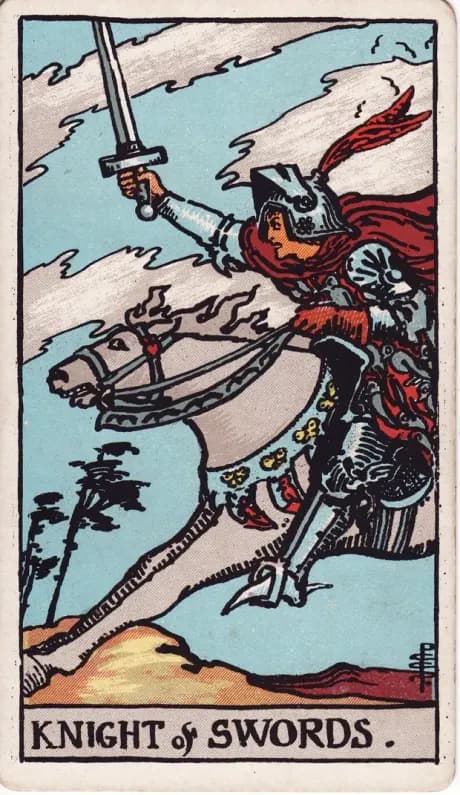
The 1909 card is the most violently animated image in the deck. A knight in full plate charges across it on a white horse, all four hooves off the ground, caught at the instant of maximum speed. Nothing in the picture is still.
The sword is up in his right hand, arm fully extended, blade pointing forward and high. His visor is open — you can see his face, which is a deliberate choice, because a knight actually charging would have it down. He is not protecting himself. He wants to be seen doing this.
Everything trailing behind him gives the wind, and the wind is going his way: the red plume off the helmet, the red cloak, the horse's mane and tail, all streaming back. He is not fighting the weather, he is running with it, and that is the difference between courage and being carried.
The reins are barely held. His left hand has them loose, and the horse's head is down and pulling forward. The animal is setting the pace, not the man.
The horse's harness is embroidered with small yellow butterflies. Butterflies are the air motif that runs through this entire court — they come back on the Queen's crown and again carved into the King's throne. Here they are stitched onto the tack of a running animal.
At the lower left two thin trees bend hard. Behind him the clouds are stretched into horizontal streaks by the same weather. The ground is a bare tan slope with nothing growing on it.
There is no enemy in the frame. He is charging at something the picture does not show, and the picture never tells you it is there.
Frequently asked
What does the Knight of Swords mean in love?
+
Fast, direct, intense pursuit — declarations and decisive moves at speed. Exciting; check the brakes. The interest is real, but it formed on limited information, which means it can reverse just as quickly once more information arrives. Match his directness rather than his pace.
Is the Knight of Swords a good sign?
+
For honesty and action, yes. For patience and gentleness, no — this energy conquers better than it nurtures. He is an excellent card to draw when something has been stalled for months, and a poor one to draw when what you needed was for somebody to be careful with you.
Is the Knight of Swords a yes or a no?
+
Upright, a fast yes: the thing happens, and sooner than expected. Reversed, a no, and the objection is usually to the timing rather than to the plan. Neither answer says anything about how it turns out — this card reports the charge, not the aftermath.
What should I do when I draw the Knight of Swords?
+
Say the thing, in plain words, this week. But decide what you want before you open your mouth, because this card's failure is never honesty, it is honesty with no destination. If the card came up reversed, do the opposite and wait a day.
Does the Knight of Swords mean an argument?
+
Often, yes — a subject that has been under the table for months gets pulled out at speed, at a bad hour, in full. The content is usually accurate and the delivery is usually terrible, and those are two separate facts that are worth keeping separate.