What Knight of Wands means in tarot — and in love
The Knight of Wands is passion on horseback: bold pursuit, irresistible confidence, romance that moves fast and burns bright. As feelings, the Knight of Wands means burning attraction — they want you with urgency and flair.
Jump to FAQAt a glance
- Yes or no
- Yes — reversed flips it
- Element
- Fire
- Upright, in a line
- passionate pursuit, adventure, irresistible energy
- Reversed, in a line
- hot then cold, commitment allergy
Want a yes or no on your own situation rather than this card? Pull one card and get the verdict with the reason behind it.
Ask your own yes-or-no questionUpright in love
The Knight of Wands is passion on horseback: bold pursuit, irresistible confidence, romance that moves fast and burns bright. This is the person who drives two hours on a Tuesday because they wanted to see you. Magnetic, adventurous, impossible to ignore. If you asked about chemistry: it's cinematic. The only question this Knight never answers in advance is "for how long?"
In a new connection he is the best opening act in the deck. Attention arrives in quantity, plans are made quickly, and the pace is genuinely thrilling rather than merely fast. What you are being shown is real — this is not a performance of interest. But speed is not the same as depth, and the card gives you no information about what happens in month four, because the Knight himself does not know.
In an established relationship the Knight of Wands usually marks a return of heat. A trip, a risk taken together, a decision made on impulse that turns out well. He can also mark restlessness: one person wanting motion for its own sake, and mistaking the desire for change with a desire to change partners.
The useful move with this card is to enjoy it without underwriting it. Say yes to the plan, go on the trip, let it be exciting. Just do not make a structural decision — moving in, ending something else, rearranging your life — on the strength of three intense weeks. If the fire is real it will still be there when the structural decision is made calmly.
What the Knight asks of you is that you keep up in your own way rather than his. People who try to match his pace out of fear of losing him usually lose themselves first, and he loses interest in exactly that.
Reversed in love
Reversed, the Knight of Wands is hot-then-gone: intensity that evaporates, commitment allergies, the pattern of arriving like fire and leaving like smoke. Or recklessness — impulsive words, flirtation without borders. Ride the excitement if you like; just don't hand your future to someone still spurring in circles.
The reversal has two distinct readings and they are worth separating. The first is the disappearing act: someone who is genuinely, sincerely intense while present, and simply does not stay. It is easy to read this as deception, and it usually is not. The feeling was real. The capacity to keep feeling it in one direction was not there.
The second reading is friction rather than absence. Here the fire is still present but pointed badly — arguments picked for the energy of them, jealousy performed as passion, risks taken that cost somebody something. A relationship can run on this for a long time and mistake the exhaustion for depth.
Reversed, the card also sometimes describes you rather than them. Chasing at a pace that has stopped being enjoyable, sending the message you already know you will regret, planning a future with someone on the evidence of a weekend. If that reads as familiar, the card is not accusing you of anything — it is pointing at the point where the excitement stopped being fun and started being anxiety with better branding.
The practical instruction is the same for both readings: slow one thing down and see what survives it. Fire that only exists at full speed is not fire, it is momentum, and momentum stops.
Knight of Wands As feelings
As feelings, the Knight of Wands means burning attraction — they want you with urgency and flair. Desire, adrenaline, pursuit. It's the strongest "coming to get you" energy in the deck; duration sold separately.
If you are single and asking about someone new. They are interested and they are not hiding it. This is the card of the person who makes plans rather than hints at them, and whose attention is unmistakable while you have it. What it does not tell you is whether the interest survives ordinary life, because at this stage the interest is partly in the novelty of you.
If you are in a relationship. They still want you, and want you specifically rather than out of habit. That is worth hearing plainly, because long relationships often lose the ability to believe it. There may also be restlessness attached — a wish for something to happen, which is about their life more than about you.
If you are asking about an ex. Heat without a plan. They remember the best of it vividly and are capable of arriving with real conviction. Whether they stay is a completely separate question, and the card deliberately declines to answer it.
If you are asking about someone long-term. Usually admiration mixed with a wish to be more impressive to you than they currently feel. This Knight cares about being wanted back, and a long relationship where he no longer feels that is where he starts looking for a horse.
Across all four: the desire is genuine. What the card never certifies is stamina.
Knight of Wands For your ex
For an ex, the Knight of Wands suggests a sudden, passionate return attempt — dramatic messages, grand plans, heat that feels like proof. Verify the follow-through: this Knight can reconquer beautifully and re-leave identically.
The thing that makes this card difficult is that the return is sincere. He is not manufacturing feeling to get something. He genuinely wants you back, in the moment, with intensity, and he is often very persuasive because he is not lying. That sincerity is precisely what makes the second departure so disorienting.
Watch what the return is made of. Grand statements about the future cost nothing and this Knight produces them easily. What costs something is the unremarkable stuff: showing up on an ordinary Wednesday, having the boring conversation about what went wrong, doing one thing differently than last time. If the reunion is all fireworks and no logistics, the card is telling you the pattern is repeating rather than resolving.
There is a version of this card where the return works. It looks like heat plus a specific changed circumstance — he moved, he left the job, he ended the other thing, something concrete is different now. Without that, you are being invited to watch the same film again and hope for a different ending.
What Knight of Wands means in general
The Knight of Wands rides a rearing horse, which is the point: the energy is genuine and only partly under control. His subject is action taken at speed — adventure, a bold move, charisma that carries a room, and the willingness to leave before the situation is finished.
Upright he is the card of momentum. Something starts, and it starts hot: a project, a journey, a decision made on instinct that turns out to be the right one because the instinct was good and the hesitation would have killed it. The Knight is the deck's argument for acting before you are certain.
Reversed the same energy misfires. Impatience, half-finished work, a temper that arrives faster than a thought, or a scattering of effort across six things that each needed one. The reversal is rarely about laziness; it is about heat with no channel.
Outside the personal, the card behaves consistently. In work it is the person who ships fast and documents nothing, or the reorganisation announced before it was planned. In travel it is literal — this is the most physically mobile card in the suit. In creative life it is the burst that produces a great deal of material in three days and then goes quiet.
Among the Knights, each moves at a different speed: Cups arrives with a declaration, Swords arrives to confront, Pentacles arrives eventually and does not leave. Wands arrives first and asks what happens next while already moving.
The card is not a warning about recklessness. It is a description of what speed is good for and what it is not: excellent at beginning things, indifferent to finishing them.
Knight of Wands as a yes or no
As a yes or no, the Knight of Wands upright is a yes, and one of the more energetic in the deck. Something is going to happen, it is going to happen soon, and the momentum is on the side of the thing you asked about. If the question was whether someone will act, whether a plan will move, whether there is enough interest to produce a result — yes.
The qualification is duration rather than direction. This Knight says yes to the event and says nothing about the aftermath. A yes here can mean the trip happens, the message arrives, the pursuit begins — and it can also mean all of that followed by silence. If your question was "will this last", you asked a question this card is not equipped to answer, and the honest reading is to ask a different one.
Reversed it flips to no, and the flavour is specific: not a refusal but a stall. Things start and do not continue, plans are made and dissolve, someone means it and does not do it. The reversed Knight rarely produces a clean no; it produces a yes that expires.
For timing, this is the fastest card in a suit already known for speed. If the question was when, the answer is sooner than you expect, and the risk is that you are not ready for it.
Knight of Wands as advice
As advice, the Knight of Wands says: go now, and go at full commitment. This is one of the few cards in the deck that actively argues against deliberation. Whatever you have been weighing has been weighed enough, and the information you are still waiting for is not going to arrive before you move.
The specific instruction is usually about a first move. Send the message. Book the thing. Say the sentence you have rehearsed. The Knight is not asking you to be certain; he is pointing out that certainty was never available and that the delay has stopped producing clarity.
There is a second, quieter piece of advice in this card, and it is about how you show up rather than whether. Half-commitment reads badly here. The Knight's power is that he arrives entirely — not carefully, not with an exit prepared. If you are going to do the thing, do it in a way that would be embarrassing to walk back from, because a move made with an escape route built in communicates the escape route more clearly than the move.
Reversed, the advice inverts and gets harder. Stop. Not forever, just long enough to notice whether you are moving toward something or away from sitting still. The reversed Knight is the card of the person who keeps starting because starting feels better than continuing, and the useful action is to finish exactly one thing you already began.
Knight of Wands as an outcome
As an outcome, the Knight of Wands is a situation that resolves fast and hot. Something is going to move, decisively, and in the direction of action rather than stasis. If you asked whether a stalemate breaks, it breaks. If you asked whether anything happens, something happens.
What the card leaves deliberately open is the shape of what comes after. This is an outcome that is itself an event rather than a settlement — the pursuit succeeds, the trip is taken, the offer is made. Whether the thing that follows is durable is not in this card, and reading permanence into it is the single most common way people misread the Knight.
In a love question this often looks like a chase that lands. Someone arrives, and their arrival is unambiguous. The card sitting next to it usually tells you the rest: a Pentacles card alongside suggests the heat found ground under it, another Wands or a Swords court suggests motion continuing rather than settling.
Reversed as an outcome is a stall. The thing that was going to happen fails to happen, or happens and unwinds — a plan cancelled, a pursuit abandoned partway, energy that dissipates before it arrives anywhere. The frustrating quality of this result is that nothing goes wrong exactly. It simply stops, and the stopping has no drama attached to explain it.
What the Knight of Wands card shows
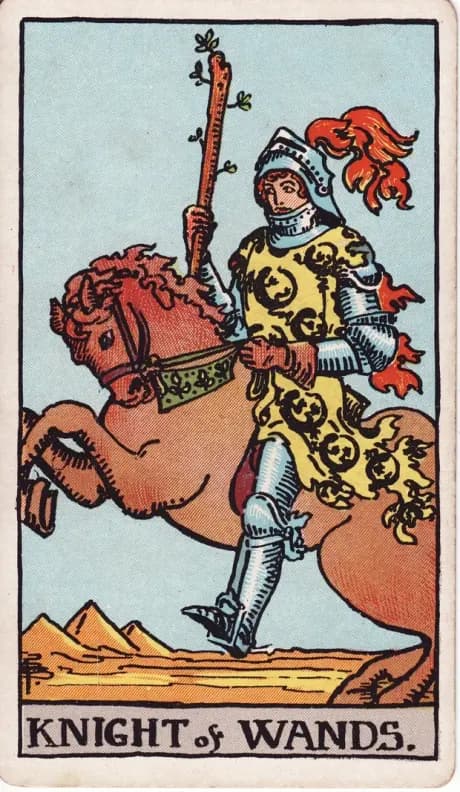
The 1909 card shows a knight in armour on a horse that has reared up on its hind legs, front hooves off the ground. He carries a wand — a living branch with leaves still sprouting from it — held upright rather than levelled as a weapon. He is looking forward and slightly to the side, not at anything in particular.
The horse is the argument of the card. It is the only mount in the four Knights that is fully off the ground, and its posture is not obedience — the animal is doing what it wants and the rider is going along with it. Read literally, that is the card: energy that the rider is riding rather than directing.
His armour and cloak are covered in salamanders, which in this deck's symbolism are creatures of fire. Look closely at them and there is a detail worth noticing: some are drawn as closed circles, tail in mouth, and some are open. The closed ones are complete, the open ones are not. The card is saying, in the decoration, that some of this fire finishes and some of it does not.
The background is three small pyramids on flat desert. It is an empty landscape with nothing to arrive at nearby, which is why the card reads as departure rather than destination — he is leaving somewhere, and where he is going is not in the frame.
His visor is raised and his face is visible. Whatever else this figure is, he is not hiding. The intensity you are being shown is the intensity that is actually there.
Frequently asked
What does the Knight of Wands mean in love?
+
Fast, hot pursuit — someone acting on attraction with real energy and no hesitation. It is the strongest arrival card in the deck for chemistry. It says nothing about duration, which is the question people most want it to answer.
Does the Knight of Wands mean someone is coming back?
+
Often, and dramatically. The return is usually sincere rather than manipulative, which is what makes it convincing. Watch for one concrete changed circumstance alongside the heat — without it, the pattern tends to repeat rather than resolve.
Is the Knight of Wands a yes or a no?
+
Upright it is a yes, and a fast one: something happens and happens soon. Reversed it becomes a stall — a yes that expires, plans that start and dissolve. Note that the upright yes covers the event, not what follows it.
What should I do when I draw the Knight of Wands?
+
Act, and act fully. This card argues against further deliberation and against half-commitment — a move made with an escape route built in communicates the escape route more loudly than the move. Reversed, do the opposite: finish one thing you already started.
Is the Knight of Wands a real person or an energy?
+
Either, and the reading rarely changes. As a person he is charismatic, mobile, impatient and genuinely warm. As an energy he is the pace of the situation rather than anyone in it. If no one in your life fits the description, read it as tempo.