What Knight of Pentacles means in tarot — and in love
The Knight of Pentacles is devotion on schedule: the partner who texts when they said, arrives when promised, loves in maintenance and mileage. As feelings, the Knight of Pentacles means quiet committed certainty — they love you in the unspectacular, load-bearing way: plans kept, needs…
Jump to FAQAt a glance
- Yes or no
- Yes — reversed flips it
- Element
- Earth
- Upright, in a line
- slow, loyal, dependable devotion
- Reversed, in a line
- stagnation, boredom mistaken for safety
Want a yes or no on your own situation rather than this card? Pull one card and get the verdict with the reason behind it.
Ask your own yes-or-no questionUpright in love
The Knight of Pentacles is devotion on schedule: the partner who texts when they said, arrives when promised, loves in maintenance and mileage. No fireworks — infrastructure. It's the most reliable romantic energy in the deck: slow to commit, nearly permanent after. If you asked whether they're worth the patience: this Knight is the one your future self thanks you for.
The card's defining property is that the pace never changes. He does not accelerate when interested and does not slow down when uncertain, which makes him almost impossible to read by the usual signals and completely reliable by the only one that matters — what he actually does, repeatedly, over time.
In a new connection this is frustrating before it is reassuring. There is no sweeping gesture and no rush, and people trained on faster cards read the absence as indifference. It is not. The interest is genuine and it is being expressed at the only speed this figure has.
In an established relationship he is the load-bearing wall. Things get handled. Promises made two years ago are still operative. The relationship does not generate stories and it does not fail.
The risk the card carries is not betrayal but stasis. Reliability that never renews itself becomes routine, and routine is comfortable enough that neither person notices it hardening. The instruction, where you have this energy, is to introduce one thing on purpose — a change, a plan, something unnecessary — because this Knight will never generate it himself and does not object to it at all.
Reversed in love
Reversed, the Knight of Pentacles is reliability decayed into rut: love as routine without renewal, boredom read as safety, stubbornness blocking every change the relationship requests. Or plain stagnation — a bond idling in place for years. Dependability needs occasional surprise to stay alive. Service the engine or admit it's parked.
The rut version is the most common and it rarely has a villain. Two people who like each other doing the same week repeatedly until the week is the relationship. Nothing is wrong, which is precisely why nobody raises it, and the years accumulate.
The stubbornness version is sharper. Here reliability has become refusal: a partner who will not move, will not try the different thing, will not consider the change being asked for, and who frames all of that as steadiness. Reversed, this Knight's virtue becomes an argument for never doing anything differently.
There is a third reading worth checking: slowness that has stopped being pace and become avoidance. The commitment that is always coming and never arrives, the plan perpetually being prepared. Upright this Knight is slow and does arrive. Reversed, the arrival is indefinitely deferred, and the deferral is disguised as thoroughness.
The distinguishing question between the second and third versions is whether anything has moved in the last year. If the answer is no, the card is not describing patience. It is describing a parked vehicle, and the card's own phrasing applies: service it or admit it.
Knight of Pentacles As feelings
As feelings, the Knight of Pentacles means quiet committed certainty — they love you in the unspectacular, load-bearing way: plans kept, needs remembered, presence guaranteed. It won't trend; it will last.
If you are single and asking about someone new. They are interested and they are going to move slowly, and the slowness is not hesitation about you. This card describes someone who does not do anything fast, ever, and who tends to be underestimated at the exact stage where people decide whether to keep paying attention.
If you are in a relationship. Settled, durable, unshowy commitment. They are not going anywhere and it would not occur to them to say so, because to them it has been established and established things do not require restating.
If you are asking about an ex. Feelings persist in a slow, stubborn register. This is not the card of the dramatic return; it is the card of someone who has not really moved on and also has not done anything about it, possibly for a long time.
If you are asking about someone long-term. Loyalty as a fact rather than a feeling. Comfortable and easy to take for granted, on both sides.
Across all four, the feeling is real, constant, and almost entirely unexpressed in language. The evidence is in the calendar and in the small things that keep getting done without being mentioned.
Knight of Pentacles For your ex
For an ex, the Knight of Pentacles means feelings persist in their slow, stubborn register — they don't rebound, they ruminate. A return would be gradual and deliberate: coffee, then consistency. If steadiness is what broke you two, require proof the pace now includes growth.
The characteristic pattern is a long, quiet persistence. This is not the ex who arrives with a grand gesture at two in the morning; it is the one who is still, months later, in the same position, having neither moved on nor acted. That constancy is genuinely touching and it is also the problem, because it can continue indefinitely without producing anything.
If a return does happen, it will be incremental and it will be real. Coffee, then a second coffee, then something regular. This Knight does not reappear dramatically and does not disappear afterwards, which makes him one of the few courts where a slow reunion is a good sign rather than a hedge.
The caution in the second half is the important one. If the relationship ended because nothing ever changed, then constancy is not evidence of anything — it is a repetition of the exact quality that failed. What you would need to see is one thing done differently, and this figure is the least likely in the deck to produce it spontaneously. Asking directly is not unromantic here. It is the only mechanism available.
What Knight of Pentacles means in general
The Knight of Pentacles sits on a stationary carthorse holding one coin — the slowest knight in the deck by a considerable margin, and the only one who finishes what he starts. His subject is reliability: routine, method, promises kept because keeping them is simply what one does.
Upright he is the card of steady work and completed tasks. Unspectacular, thorough, and correct. In any situation where the question is whether something will actually get done, this is the most favourable court card available.
Reversed he becomes inertia. Stubbornness, resistance to any change, work continued past the point of usefulness, or a situation stuck so thoroughly that nobody remembers it moving. The reversal is rarely dramatic and is frequently long.
Outside the personal, the card is literal. In work he is the person who ships on time and never surprises anyone. In money he is the boring strategy that outperforms the exciting one. In health he is the routine maintained. In projects he is the phase where nothing interesting happens and everything gets finished.
Among the four Knights, each moves differently: Wands charges, Swords attacks, Cups arrives with a declaration. Pentacles proceeds — and he is the only one of the four whose horse has all four hooves on the ground, standing still.
The card's underlying argument is one the deck makes nowhere else this plainly: consistency beats intensity over any long period, and most things that fail do so not because the effort was insufficient but because it was not repeated.
Knight of Pentacles as a yes or no
As a yes or no, the Knight of Pentacles upright is a yes — a slow, dependable one. The thing happens. It happens later than you would like, on a schedule you do not control, and it does not get withdrawn once it starts. Of all the yeses in the deck this is the least exciting and the most likely to actually materialise.
That makes it a poor card for a question with a deadline and an excellent one for a question about reliability. Will they follow through: yes. Will they follow through this week: probably not.
For relationship questions the translation is specific. If you asked whether someone is serious, the answer is yes. If you asked whether they will act soon, the answer is no, and the two together are the whole reading rather than a contradiction.
Reversed it becomes a no of stagnation. Not a refusal — a stall so complete that it functions as one. Nothing moves, and continuing to wait produces more of the same. The reversed Knight is one of the deck's clearest signals that patience has stopped being a virtue in a given situation, and it is worth saying plainly, because everything about this card's upright meaning trains a querent to wait longer.
For timing: the slowest card in the slowest suit. Months.
Knight of Pentacles as advice
As advice, the Knight of Pentacles says: do the boring thing, on schedule, until it is done. No shortcuts, no bursts, no waiting for the motivation to arrive. The card's counsel is method over inspiration, and it is correct far more often than it is followed.
Concretely: pick the pace you can sustain on your worst week rather than your best one, and hold it. This Knight's advantage is not speed and not talent; it is that he is still going when everyone faster has stopped. Where a querent is exhausted from intensity, this card is frequently the whole answer.
The second instruction is about reliability as a form of communication. Keep the small promises exactly — the message when you said, the arrival when you said. In relationships this card argues that consistency reads as care more legibly than any declaration does, and that people believe patterns rather than statements.
Reversed, the advice inverts. Change one thing on purpose. The reversed Knight describes a situation that has been stable so long that stability has become the problem, and no amount of continued reliability fixes it. Do something unnecessary, unscheduled and slightly out of character, specifically because it is none of those things you would normally do.
Knight of Pentacles as an outcome
As an outcome, the Knight of Pentacles is a situation that resolves slowly, steadily and durably. The thing gets built. It takes longer than the question anticipated and it does not fall apart afterwards, which is a trade most people would accept if offered it explicitly.
In love questions this usually means a relationship that becomes solid without ever becoming dramatic. It arrives by accumulation: more time together, more things shared, a gradual thickening that nobody can point to a start date for. People receiving this card sometimes want to know when it becomes official, and the card's honest answer is that it will not have a moment, it will have a period.
It can also mean an outcome that is functionally certain and emotionally muted. Reliable, correct, and lacking the thing the querent was actually hoping for. Where that is the reading, the surrounding cards usually show it — this Knight beside the Four of Cups or the Two of Swords is a different result from this Knight beside the Ten of Cups.
Reversed as an outcome is stagnation: the situation does not resolve, it persists. Nothing breaks and nothing progresses, for a long time. That is a real result and the hardest kind to act on, because there is never a moment that forces a decision.
What the Knight of Pentacles card shows
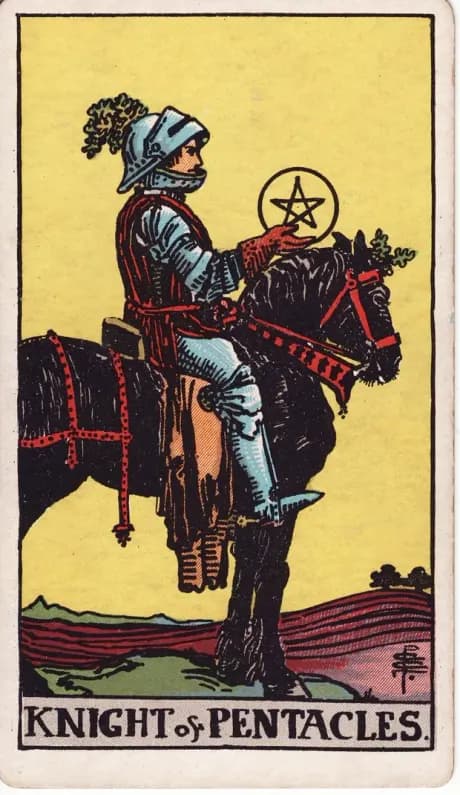
The 1909 card shows an armoured knight on a heavy black horse, holding a single golden coin out in front of him with both the coin and his gaze level. He is the only Knight in the deck whose horse is completely still — all four hooves planted, head lowered, standing.
The horse is a carthorse rather than a charger: thick-legged, broad, built for load rather than speed. Compare it to the Knight of Wands' rearing animal and the whole difference between the two cards is in the breeding of the horse.
Both the knight's helmet and the horse's head carry a sprig of green foliage — oak leaves. Growth attached to the heaviest, slowest figure in the deck is the picture's argument: this is not stasis, it is slow life.
He holds the coin out on an open palm rather than gripping it, examining it, level with his own eyes. He is looking at what he has rather than at where he is going.
Behind him is a ploughed field, freshly furrowed in even lines, running to a low treeline. It is the only cultivated agricultural land under active work in the four Knights' backgrounds, and the furrows are perfectly regular.
His armour is dark and plain, without decoration, and unlike the other three Knights his visor is down. The face is not visible. Whatever this figure feels is not part of the information the card is offering.
Frequently asked
What does the Knight of Pentacles mean in love?
+
Devotion expressed as reliability — plans kept, promises operative years later, presence guaranteed. The pace never changes, which makes him unreadable by the usual signals and completely reliable by the only one that matters: what actually gets done, repeatedly.
Is the Knight of Pentacles boring?
+
That is exactly the risk the card names, and it is not betrayal but stasis. Reliability that never renews becomes routine, and routine hardens without anyone noticing. This figure will never introduce change himself and does not object to it at all.
Is the Knight of Pentacles a yes or a no?
+
A slow, dependable yes — the least exciting in the deck and the most likely to actually materialise. If you asked whether someone is serious, yes. If you asked whether they will act soon, no. Both together are the reading.
What should I do when I draw the Knight of Pentacles?
+
Pick the pace you can sustain on your worst week and hold it. Keep the small promises exactly, because patterns are believed and statements are not. Reversed, do one unnecessary, unscheduled, out-of-character thing on purpose.
Will the Knight of Pentacles come back after a breakup?
+
Possibly, slowly, and by increments — coffee, then consistency. He ruminates rather than rebounds. But if nothing ever changing is what ended it, constancy proves nothing, and this is the figure least likely to produce a difference without being asked directly.