What King of Pentacles means in tarot — and in love
The King of Pentacles is love as a finished estate: a generous, established partner who provides without fanfare — commitment measured in stability,… As feelings, the King of Pentacles means settled, protective devotion — they consider you a permanent holding: provided for, defended, planned around.
Jump to FAQAt a glance
- Yes or no
- Yes — reversed flips it
- Element
- Earth
- Upright, in a line
- a provider, stable committed abundance
- Reversed, in a line
- possessiveness, worth measured in things
Want a yes or no on your own situation rather than this card? Pull one card and get the verdict with the reason behind it.
Ask your own yes-or-no questionUpright in love
The King of Pentacles is love as a finished estate: a generous, established partner who provides without fanfare — commitment measured in stability, loyalty and the mortgage he'd co-sign. The suit's patriarch energy: slow to choose, wholly reliable once chosen. If you asked about long-term potential: this is what secure attachment looks like with a portfolio. Enjoy being invested in.
The quality he actually has is unglamorous and easy to undervalue. He does what he said he would do, on the day he said it, for years, and not as a grand gesture — as a baseline. People who grew up around intensity often read that as an absence of feeling. It is the opposite. Building something that holds is how this King says the thing other people say out loud.
In a new connection he moves slowly and does not pretend otherwise. He will not declare anything in the second week. What he will do is turn up, notice practical detail, remember what you mentioned you needed and quietly arrange for it to exist. Courtship here looks like logistics. If you are waiting for a dramatic signal before you believe any of it, you can misread months of clear evidence.
In an established relationship he is the load-bearing wall. The household runs. Bills are handled, plans are kept, and a bad year does not become a catastrophe because margin was built into everything in advance. The risk hidden inside that, even upright, is that providing starts to stand in for being there. A man can be completely dependable and completely absent at the same time, and the dependability makes the absence hard to name without sounding ungrateful.
What the card asks of you depends on which side of it you stand. If this is your partner, say what you want in plain specific terms, because he responds to specifics and will otherwise keep solving the problem he assumes you have. If this is you, notice that not everything owed to the people closest to you can be paid in provision. Sitting with someone when there is nothing to fix is a separate skill, and it is the one this King has usually never practised.
Reversed in love
Reversed, the King of Pentacles is wealth mistaken for worth: possessiveness, status-love, affection expressed only in objects while presence stays unavailable. Or stubborn materialism grinding romance into accounting. Gifts are not intimacy. If the relationship's dividends are all financial, the emotional books are being cooked.
The reversal does not take away the competence, which is what makes it so hard to argue with. He still provides, still turns up, still handles whatever needs handling. The providing has simply become the terms of an arrangement rather than an expression of care, and one of the two people involved has not been told that the conversion happened.
Control is the common form, and it is rarely loud. It is budgeting. Decisions made alone and announced afterwards, because he carries the weight and therefore holds the vote. Money used as a lead rather than a gift. The test is whether your independence is treated as a good thing or as a threat to the structure — a partner who is glad you have your own income behaves very differently from one who mentions the cost of things.
Stubbornness is the other form and it looks duller from outside. Nothing ever changes, because the current arrangement works — for him. Suggestions get absorbed politely and nothing moves. Years can pass like this, and afterwards neither person can point to a single event that went wrong.
There is a version of the reversal that is about exhaustion rather than character, and it deserves separating out. Somebody has been carrying the whole thing alone for a long time, the warmth has been spent down to nothing, and only the duties are still being performed. That version is repairable, and the repair is not romantic. It is redistribution. Take something real off his plate and see whether the person comes back into the room.
King of Pentacles As feelings
As feelings, the King of Pentacles means settled, protective devotion — they consider you a permanent holding: provided for, defended, planned around. Unpoetic and unshakable. When he says 'taken care of,' he means forever.
If you are single and asking about someone new. They have assessed you and approved, and approval from this card is not a small thing, because he does not do provisional. What you get is practical attention instead of declarations: an offer to fix something, a plan with an actual date on it, a question about your work that gets remembered a month later. He is unlikely to state how he feels until he considers the matter settled, and by then he will assume it was obvious.
If you are in a relationship. This is ownership in the good sense and occasionally in the bad one. You are inside the perimeter, and what is inside the perimeter gets defended without discussion. The feeling is deep and almost entirely expressed through action, which is generous and does mean you can go a long time without hearing it said. Asking directly works. He will answer plainly and be faintly puzzled that it needed asking.
If you are asking about an ex. You are filed rather than forgotten. Warm, closed, respectful. He has counted what happened, decided what it cost, and put it away in good order. Whatever remains is stable and is not moving by itself, which means there is no pressure building that will eventually push him into an impulse.
If you are asking about someone long-term. Feeling that has stopped being examined because it became part of the furniture. He would say it has not changed in years and he would be telling the truth, and that is exactly the risk: a thing nobody checks can go unrepaired for a very long time without anyone noticing.
Across all four the same principle holds. With this card, what somebody builds for you is the statement. Waiting for a second statement in words usually means missing the one already standing in front of you.
King of Pentacles For your ex
For an ex, the King of Pentacles means their view of you is filed under long-term value — respect persists even through silence. Returns are deliberate, practical, often triggered by life restructuring. Expect an offer with terms, not tears.
Nothing about this card returns on impulse. There will be no bad night that produces a message at one in the morning. If contact comes, it will have been considered for weeks, and it will arrive with a purpose attached: a specific proposal, a practical reason, a plan already thought through to the end. From the receiving side that can feel cold. It is not. It is how this person demonstrates that he means it.
He will also have kept the accounts. What he contributed, what it cost him, who did what — none of it is forgotten, and all of it informs whatever happens next. If the ending involved a broken promise rather than a slow fade, he is slow to reopen anything, because to him a promise is infrastructure, and infrastructure that failed once gets inspected before it is used again.
What moves him is evidence rather than feeling. Demonstrated change over months, a stable situation, something visible that is different from what was there before. Appeals to the past will not work on him. He already knows what the past contained and has priced it accurately.
If the card falls reversed, read it colder. Then the interest is in what you represent rather than in who you are — the shared property, the convenience of the familiar, the cost of dismantling things. A return on those terms is the restoration of an asset, not a reconciliation, and it is worth knowing which one is being offered before you answer it.
What King of Pentacles means in general
The King of Pentacles closes the Minor Arcana in the traditional order, and he reads like an ending. The suit of earth has been carried from a single coin held in a cloud all the way to a man sitting in a garden he planted, on top of an enterprise that no longer needs his attention to keep running. His subject is material mastery: resources built, held and managed well enough that the building is finished.
Upright he describes competence that has been proven rather than promised. He is the founder still running the company twenty years in, the landowner, the craftsman whose work is boring and never fails, the one everybody consults because he has actually done the thing rather than read about it. He counsels the long view, patience with anything that compounds, and stewardship over acquisition. Where the Knight of the suit grinds away and the Queen tends what is alive, this King has arrived. His characteristic strength is that novelty does not impress him and hurry does not reach him.
Reversed, the mastery turns inward and sours. Wealth becomes the only measure of any question. Generosity becomes leverage. A man who used to build spends his energy defending instead. Stubbornness is the quiet failure: an arrangement that works is never reviewed again, and any improvement gets treated as risk. Corruption is the loud one, where resources are controlled for the sake of controlling them, or a success is maintained long after everyone forgot what it was originally for.
In a general situation he says the ground is solid and the sensible move is the unhurried one. At work he is the senior figure whose judgement outweighs his job title, the operator rather than the visionary. In material questions he describes what already exists rather than what is hoped for. In creative life he is the difficult one: he finishes things and distrusts inspiration, which makes him excellent at production and poor at experiment. His real weakness is not laziness. It is that a man who has built something safe can spend the rest of his life guarding it.
King of Pentacles as a yes or no
As a yes or no, the King of Pentacles upright is a yes, and one of the most solid available. It is also one of the slowest. The card almost never promises that something will happen quickly. It promises that when it does happen it will be built properly and will still be standing in five years, which for most of the questions people actually bring is the more useful guarantee.
He answers some shapes of question far better than others. Will this hold, is this person dependable, is the foundation real, can I count on it in a bad month — yes, and the yes rests on something that already exists rather than on optimism. Will this be exciting, will it move soon, will something finally change — those get an unsatisfying reply, because the nature of the card is that it does not move fast and does not regard that as a fault.
Reversed it is a no, and the reason is usually specific rather than general. Either the thing being asked about carries a price that has not been stated out loud, or it is being held together by control rather than by agreement. A reversed no here is rarely a collapse. It is more often a situation that technically works and quietly costs more than it returns, which is why people sit inside one for years.
If the yes or no is not helping, the question this card answers best is what the thing is actually built on, and who is paying to maintain it. That has a real answer, and the King gives it readily.
King of Pentacles as advice
As advice, the King of Pentacles says: build the boring thing. Whatever you are asking about, the move he recommends is the unglamorous one that will still be standing in a year. Not the leap. The next brick.
Concretely, that means finishing something before starting the next thing. It means converting an intention into a dated commitment that another person also knows about, because this King treats a plan nobody else has heard as a wish. It means handling the practical layer of a problem before the emotional one — not because feelings are unimportant, but because a great deal of what feels unmanageable turns out to be three unfinished tasks wearing a costume.
He also advises using what you already have. The resources for this are far more likely to be present and unnoticed than genuinely missing: a skill you stopped counting, a contact you have not asked, an arrangement that could simply be extended. Take the inventory before you go looking for something new.
The instruction most people skip is the one about giving. This card gives from surplus without making a performance of it, and the specific form is worth copying: give the thing that is actually useful to the other person, not the thing that would look generous. Ask what would help. Then do it, on a date, and never mention it again.
Reversed, the advice narrows sharply. Loosen the grip. Something is being held too tightly — money, a decision that should not be yours alone, a standard nobody else ever agreed to — and holding it now costs more than letting it go would. Then look at whatever you have stopped reviewing on the grounds that it works.
King of Pentacles as an outcome
As an outcome, the King of Pentacles means the situation ends solid. Not dramatic, not fast, and not in doubt afterwards. Whatever you are asking about arrives at a state that holds: a settled arrangement, a secure position, something with foundations under it that nobody has to keep propping up.
In a love question this usually looks like commitment expressed in concrete terms rather than in declarations. Living together. Plans that quietly assume years. Money and logistics merged without an argument about it. If you were hoping for a moment, be warned that this card does not really do moments, it does states, and the change often arrives so gradually that afterwards there is no single evening you can point to.
There is a version where the solidity belongs to the situation rather than to another person. The outcome is that you end up materially steady and difficult to knock over, whatever anyone else decides to do. That is a genuine result and often the more valuable one, because it does not depend on somebody else's behaviour to stay true.
Reversed as an outcome is the more interesting failure, because nothing collapses. The structure survives and the life inside it thins out: an arrangement kept because dismantling it would be expensive, comfort with nothing moving in it, a position held long past the point where anyone remembers why they took it. The tell is that everything looks fine from outside and nobody inside would describe themselves as happy. If that is the trajectory, the intervention is not a dramatic exit. It is changing one fixed thing deliberately, early, while changing things is still cheap.
What the King of Pentacles card shows
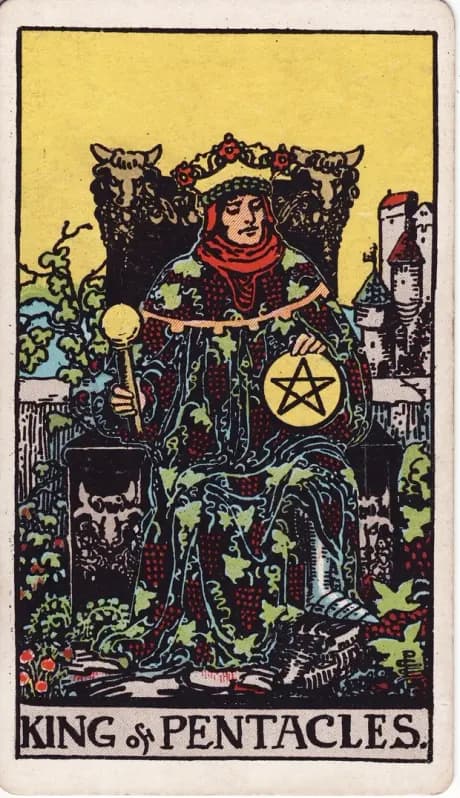
The 1909 card seats him on a heavy stone throne carved with bulls' heads, at the corners of the back and again on the arm. The bull is the emblem of fixed earth, and it is the only ornament on the throne that is not a plant. Everything else in the picture is growing.
His robe is the detail most people walk past. It is dark and patterned all over with vine leaves and heavy clusters of grapes, and grapes are the crop in the deck that requires the most years before it produces anything at all. Nobody in a hurry plants a vineyard. He is wearing the proof of his own patience.
He holds a sceptre upright in one hand, and a large pentacle rests against the other, propped on his knee. His head is inclined and his gaze is lowered toward the coin. Compare the King of Wands, who looks out past the edge of the frame. This King's attention is close in, on the object itself, which is the habit of a person who owns something rather than a person who wants something.
Under the hem of the robe you can see armour on his leg and foot. It is the quietest fact on the card and one of the most important: the man sitting in the garden is dressed for war underneath. What he built, he is equipped to defend.
Behind him to one side stands a castle with battlements, finished and occupied. Around and in front of him the garden is dense with flowering vines, so overgrown that the base of the throne is half buried in it. His crown is topped with flowers rather than spikes.
The whole scene sits low and heavy in the frame with very little sky in it. He is not going anywhere, and nothing in the picture suggests that this is a criticism.
Frequently asked
What does the King of Pentacles mean as feelings?
+
Deep committed security — love expressed through providing, protecting and permanence. He is unlikely to say it until he considers the matter settled, and by then he assumes it was obvious. If you have gone months without hearing it in words, look at what has been built for you instead, then ask him directly. He will answer plainly.
Is the King of Pentacles a good partner card?
+
For stability and loyalty, among the best in the deck. This is the person who keeps plans, handles the practical layer without being asked, and does not become a crisis in a bad year. Reversed, verify presence behind the presents: someone can be completely dependable and completely absent at the same time, and the dependability makes that hard to name.
Is the King of Pentacles a yes or a no?
+
Upright, a strong yes — slow, unexciting and likely to still be true in five years. He is most reliable on questions about whether something will hold, and least useful on questions about whether it will happen soon. Reversed, a no, usually because there is an unstated price attached or the thing is held together by control rather than agreement.
What should I do when I draw the King of Pentacles?
+
Do the unglamorous version. Finish what is already started, put a date on the intention and tell someone about it, and use a resource you already have rather than hunting for a new one. If the card is reversed, loosen your grip on whatever you are holding too tightly, and review the arrangement you stopped reviewing because it works.
Does the King of Pentacles always mean a wealthy or older man?
+
Not necessarily. He describes a quality rather than a bank balance or a birth date: proven competence, resources under control, someone who finishes things. He can be a person of any age or gender in your life, an institution, a business, or a description of you at your most grounded. When he does point at a person, the reliable markers are patience and follow-through, not money.