What King of Wands means in tarot — and in love
The King of Wands is passion with a plan: a bold, charismatic partner who leads with vision — decisive in love, generous with energy, allergic to… As feelings, the King of Wands means confident, decisive desire — they see you, want you, and consider the matter largely settled.
Jump to FAQAt a glance
- Yes or no
- Yes — reversed flips it
- Element
- Fire
- Upright, in a line
- bold leadership in love, a visionary partner
- Reversed, in a line
- domineering heat, promises bigger than plans
Want a yes or no on your own situation rather than this card? Pull one card and get the verdict with the reason behind it.
Ask your own yes-or-no questionUpright in love
The King of Wands is passion with a plan: a bold, charismatic partner who leads with vision — decisive in love, generous with energy, allergic to small dreams. He signals commitment lived as adventure: building a big life together, not just a comfortable one. If you asked about someone's intentions: this King doesn't audition; when he chooses, everyone knows.
What separates this card from the other fire courts is that the heat has a direction. The Knight of Wands burns and moves on. The King burns and builds something, and the thing he builds is usually visible to other people. That is worth knowing before you read this card as pure romance. He is warm, but he is warm the way a project is warm. Being chosen by him often means being enrolled in something.
In a new connection he moves fast and openly. There is no ambiguity phase, no slow reveal, no wondering whether he is interested — he says so, plans something, and expects an answer. That directness is the best thing about him and the first thing to test. Bold declarations cost nothing to make. Watch what he does in the second month, when the novelty has burned down and the plan needs maintaining.
In an established relationship he shows up as the one steering. He has ideas about where the two of you are going and he is usually right about the direction and careless about the detail. Life with this energy is rarely dull and rarely restful. The failure mode is not coldness, it is scale: he keeps proposing the next big thing while the current one is still half-built, and the person beside him ends up doing the building.
What the card asks of you is to be a second architect rather than a good audience. Say what you want out loud, in specifics, early. This King responds well to being met and badly to being managed quietly from underneath.
Reversed in love
Reversed, the King of Wands is charisma with a control setting: arrogance in the relationship, promises scaled beyond delivery, heat used to dominate rather than warm. Or your own fire dampened by leadership battles. Vision is only love when both people appear in it. Check whose dream you're being cast in.
The reversal does not turn a good man bad. It turns conviction into insistence. Upright, he believes in something and invites you into it. Reversed, he believes in something and cannot tolerate that you might not. The tell is what happens when you disagree — whether the disagreement is interesting to him or intolerable.
In a new connection the reversed King is the grand opening that never becomes a business. Big talk, big plans, big future described in detail on a second date, and then a slow discovery that the description was the whole product. He is not necessarily lying. Men with this energy often believe every word at the moment of saying it. The gap is between the saying and the doing, and only time shows you the gap.
In an established relationship the reversed card is most often about a slow takeover. Decisions stop being made together. Your preferences get treated as details to be worked around. The word for this is not always cruelty; sometimes it is simply that he moves faster than the conversation and stopped waiting. It corrodes the same either way.
There is a second reading and it points at the reader. Reversed, this card can mean your own drive has gone underground to keep the peace — that you have become quiet, agreeable and low-grade resentful because the household has room for one person's ambition. That version is fixable, but only by saying it, which is exactly the thing the arrangement was built to avoid.
King of Wands As feelings
As feelings, the King of Wands means confident, decisive desire — they see you, want you, and consider the matter largely settled. Big, warm, directive energy. Expect initiative bordering on strategy.
If you are single and asking about someone new. They are interested and they are not hiding it. This is not a card of secret feelings or slow-burning uncertainty; if you cannot tell whether they like you, that is worth noticing, because this energy is usually legible. What they feel is attraction plus intent — they have already imagined a version of the two of you and found it appealing. The caution is that the imagining ran ahead of knowing you. They are drawn to what you represent as much as what you are, and the difference shows up later.
If you are in a relationship. They feel proud of you and sure of the two of you, and they may express both by doing rather than saying. Plans, introductions, projects, the future described in the plural. If it has gone quiet, the usual cause is not fading interest but distraction — attention pulled toward something that is currently on fire elsewhere. This person's warmth is real and badly rationed.
If you are asking about an ex. They remember you with heat rather than regret. Nothing about the feeling is small or resolved, and if they come back they will come back suddenly and at full volume, having decided alone. What they rarely feel is doubt, which means their side of this has never been the obstacle.
If you are asking about someone long-term. Settled certainty. You are not a question they are still asking, and there is real security in that. It also has a cost: certainty stops looking closely, and this King can be entirely sure of a person he has not actually checked on in a while. If you want to be seen again rather than assumed, you will have to say something he does not already expect.
King of Wands For your ex
For an ex, the King of Wands suggests they still view you through ambition's lens: the one that got away from the empire. Returns are decisive and dramatic. Negotiate as a partner, not a province.
This card rarely describes an ex who quietly wonders. When this energy comes back, it arrives whole — a call, a plan, a specific proposal, often with no warning and no groundwork. He has thought about it alone, reached a conclusion alone, and now presents it as a decision already made. That can be genuinely moving. It can also be the same behaviour that ended things, wearing better clothes.
The useful question is whether anything has actually changed or only the intensity has. The King of Wands does not usually lose interest and forget you; he loses the argument about how two lives fit together, and unless that argument got resolved somewhere in the meantime, a reunion restarts it at the same point. Heat was never the shortage.
If you want him back, meet the return with terms rather than gratitude. Say what would have to be different, concretely, in plain sentences, before the momentum makes it awkward to say anything at all. He can hear that. What he cannot do is guess it, and he will not slow down on his own to find out.
If you do not want him back, be direct once. Softness reads as an opening to this card, and an opening is all it needs.
What King of Wands means in general
The King of Wands is vision that has learned to delegate: the entrepreneur, the founder, the one who sets direction and expects other people to carry it. His subject is leadership by conviction — a bold long-range decision made and stood behind, and the ability to make other people believe in something that does not exist yet.
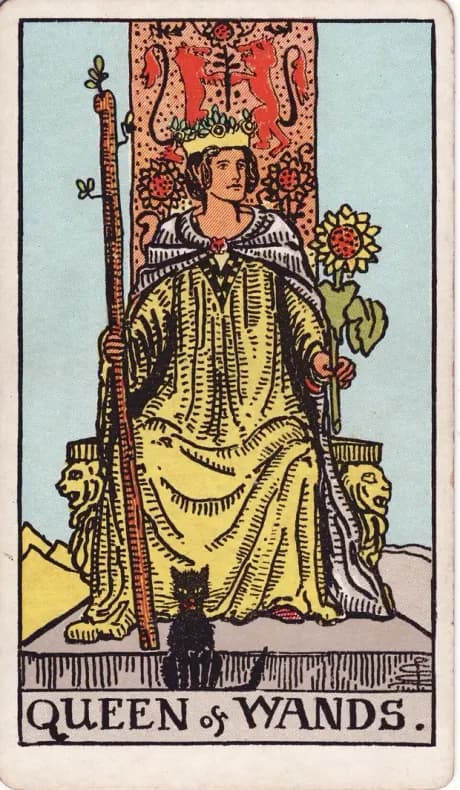
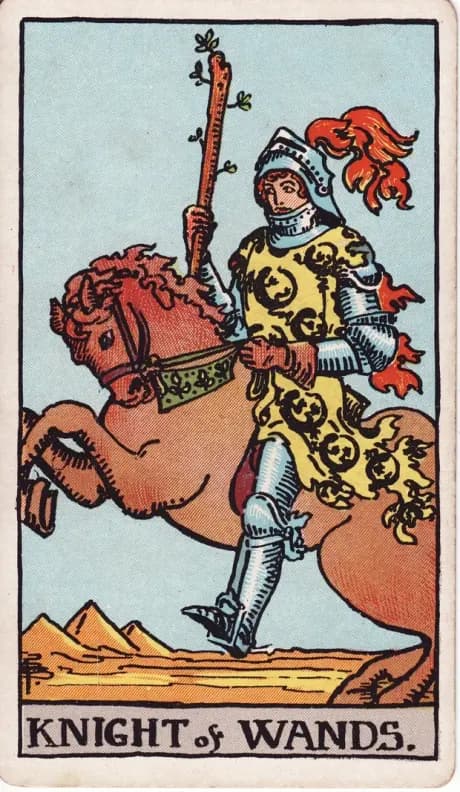
Upright he says the situation needs someone to commit to a direction publicly, and that boldness will be repaid. He is the mature end of the fire suit: the Ace is a spark, the Knight is speed without a destination, the Queen is magnetism held in place, and the King is the one who names where everyone is going and takes the consequences of being wrong. Authority here comes from having staked something, not from a title.
Reversed the conviction curdles into ego. Impatience with detail, promises the follow-through cannot match, a leader who cannot bear to be contradicted, or force applied where persuasion was available. The reversed card also covers a quieter failure: the visionary who keeps starting and never finishes, whose energy is real and whose output is a graveyard of beginnings.
In business he is the founder rather than the operator — strongest at the moment a direction has to be set, weakest once the thing needs administering. In money matters he backs the bold option and is genuinely better at making the bold option work than most people would be, which is not the same as the bold option being safe. In creative work he is the one who declares the project before knowing how to make it, and then makes it, because the declaration created the pressure.
As a description of a situation rather than a person, the card says the same thing: this needs someone to decide out loud and be accountable for the decision.
King of Wands as a yes or no
As a yes or no, the King of Wands upright is a strong yes. Few cards are more affirmative. It answers with movement, confidence and a decision already halfway made, and it usually means the thing you are asking about does not need more deliberation from you — it needs someone to act, and the card says act.
The reason the yes is strong is that this card describes a person or a force that does not sit on the fence. Wands is the suit of will and fire, and the King is will that has become authority. When he lands on a yes-or-no question, the answer tends to arrive already in motion. If you are asking whether someone is interested, whether an approach will land, whether the bold version is better than the careful version: yes, and sooner rather than later.
Reversed it turns to no, but the shape of the no matters. It is rarely the door closing. It is more often a yes that costs too much — the thing happens, and it happens on terms set by someone who will not negotiate them. That is a different warning from a plain refusal, and reading it as simple rejection loses the useful part.
The card is honest in this format, so there is no need to reframe the question. The one adjustment worth making is to ask about your own move rather than theirs. This King answers questions about action far better than questions about waiting, because waiting is the one thing he has no opinion about.
King of Wands as advice
As advice, the King of Wands says: decide out loud and put your name on it. Not hint, not test the water, not arrange things so the other person has to guess. Say the thing, propose the specific plan, name the date. The card's whole argument is that clarity of intention creates momentum that clarity of feeling never does.
The practical form depends on the question. If you want a relationship defined, define it yourself instead of waiting to be defined. If there is something you want to build with someone, describe it concretely enough that they could say no to it — a vague future cannot be agreed to. If you have been circling a decision for weeks, this card says the circling is now the problem, not the decision.
There is a second instruction folded in, and it is the one people skip. Having declared a direction, you are now responsible for it. This King's authority is not free; it comes from carrying the thing he announced. Advice from this card is never permission to make promises and hand the delivery to somebody else.
Reversed, the advice inverts precisely. Stop talking and start finishing. Reduce the size of what you are promising until it matches what you can actually do this month. Notice where you have been steering something that was supposed to be shared, and hand the wheel over for long enough to find out what the other person would have chosen.
What this card never advises is patience for its own sake. Waiting to be sure is not one of the moves it recognises.
King of Wands as an outcome
As an outcome, the King of Wands means the situation resolves through someone taking charge of it. Not through time passing, not through mutual drift into agreement, but through a decision made and announced. Often the deciding person is you. Where the card sits at the end of a spread, it says the ambiguity ends because somebody finally ends it.
In a love question this usually looks like definition arriving fast. A conversation happens, a position is stated, a plan gets made with actual dates in it. The result is generally favourable, because this card does not describe someone taking charge in order to walk away — it describes commitment expressed as direction. The relationship that comes out of it tends to be visible, active and pointed at something.
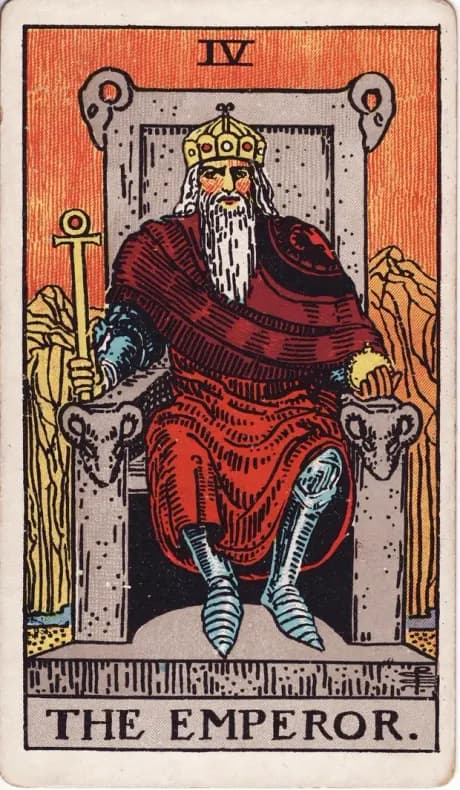
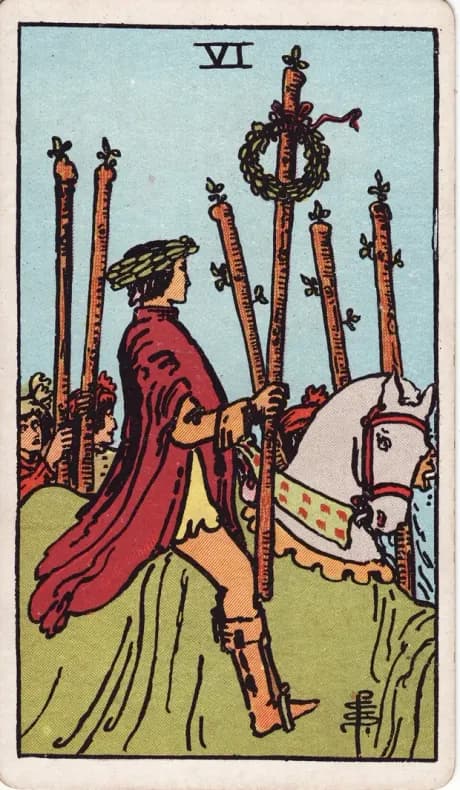
The honest caution is about whose plan wins. This outcome can arrive as a partnership or as an annexation, and the surrounding cards usually say which. Supportive company (the Two of Cups, the Four of Wands, the Six of Wands) reads as shared momentum. Harder company (the Five of Wands, the Emperor reversed, the Seven of Wands) reads as one person driving and one person coping.
Reversed as an outcome, the situation ends in overreach. The plan turns out to be bigger than the resources behind it, or the person steering loses the room by refusing to listen. Sometimes it is simply an ending that was declared rather than discussed — the decision was made alone, and the announcement was the first anyone heard of it. It is not a catastrophic result, but it leaves a bill: whatever was decided this way has to be renegotiated later by the people who were not asked.
What the King of Wands card shows
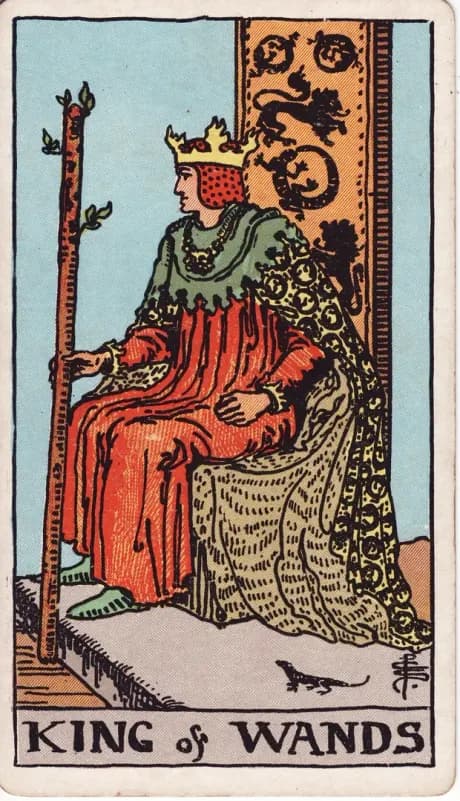
The 1909 card shows a crowned king on a stone throne, turned to one side rather than facing you. He holds a tall staff in his right hand, its end resting on the ground, and the staff is alive — green leaves sprout from the wood. That detail matters. Every wand in this suit is a living branch, and the King's is the one that has been carried longest and is still growing.
His robe is orange and gold, patterned with salamanders. Salamanders were believed to live in fire and survive it, which is why they belong to this suit, and several of them on the cloth are drawn with their tails in their mouths, forming closed rings. A live salamander crouches on the ground beside the throne, small and alert. The closed ring is completion; the creature on the ground is the same force still loose in the world.
The throne back carries lions and more salamanders — fire doubled, authority and appetite together. Behind and around him there is nothing else. No sea, no garden, no landscape at all, only flat warm colour. The other three Kings sit in a world: water, wheat, cultivated ground. This one sits in his own heat, and the emptiness reads as a place not yet built on.
His crown is shaped in points like flames, and beneath it he wears a cap of maintenance, the padded cap of rank that all four Kings wear. His posture is the most telling thing on the card. He is not settled back into the seat. He is angled forward and to the side, looking away from the viewer at something outside the frame, one foot placed as though he is about to stand. Kings in this deck usually sit still. This one is halfway out of the chair.
Frequently asked
What does the King of Wands mean as feelings?
+
Decisive passionate certainty — they want you and intend to act on it. Leadership-flavoured attraction, expressed by doing rather than pining. If someone feels this way about you, you generally know: this card is not about hidden feelings, and hidden feelings are the one thing it does not describe well.
Is the King of Wands a good partner card?
+
Excellent for passion, vision and drive, and reliable in the sense that he says what he intends. The thing to check is whether the big life being built has two architects. This energy does not usually stop caring; it stops asking, which over years amounts to something similar.
Is the King of Wands a yes or a no?
+
Upright it is one of the clearest yeses in the deck, and a yes with speed attached — the answer usually involves acting rather than waiting. Reversed it becomes a no, though more often a yes that costs too much: the thing happens on terms set by someone who will not discuss them.
What should I do when I draw the King of Wands?
+
Say the thing out loud and attach a specific to it — a plan, a date, a stated position. The card describes situations that resolve when somebody takes responsibility for a direction, and it is telling you that the somebody is available. Then carry what you announced, because that is where this card's authority actually comes from.
Does the King of Wands represent a specific person?
+
Often, but not always a man and not always someone older. Traditionally he points to a confident, driven, persuasive person who leads — the founder type, the one everyone defers to in a room. He can equally describe a role you are being asked to take, or the quality the situation needs from whoever is standing closest to it.