What The Magician means in tarot — and in love
The Magician says you have every tool on the table: the words, the timing, the charm, the will. As feelings, the Magician means they feel capable of winning you — confident, intentional, switched on around you.
Jump to FAQAt a glance
- Yes or no
- Yes — reversed flips it
- Upright, in a line
- manifesting the connection you want, real initiative
- Reversed, in a line
- manipulation, charm without substance
Want a yes or no on your own situation rather than this card? Pull one card and get the verdict with the reason behind it.
Ask your own yes-or-no questionUpright in love
The Magician says you have every tool on the table: the words, the timing, the charm, the will. In love it means manifestation — the connection you focus on tends to materialize. If you want them, act like it: text first, plan the date, say the true thing. Chemistry here isn't luck; it's made, deliberately, by someone willing to move.
The uncomfortable part of this card is that it removes an excuse. Most situations it appears in are not blocked by circumstance. They are blocked because nobody has done the obvious thing yet, and the obvious thing is usually one sentence long. The Magician is the deck's least mystical card in practice: it says the gap between where you are and what you want is an action, not a mystery.
In a new connection it usually means the momentum is available and currently unclaimed. Whoever moves first sets the shape of it. That is not a warning about losing a race — it means the person who acts becomes the one the story is about, and passivity at this stage does not read as intrigue, it reads as absence.
In an established relationship the card points somewhere less romantic and more useful. It says you already have what the relationship needs: the history, the knowledge of what actually comforts them, the ability to change the temperature of an evening on purpose. Long relationships stall when both people wait for a mood to arrive. The Magician says produce the mood. It is fully within your reach and always has been.
What it asks for is directness with a plan attached. Not grand gestures — specificity. Name the date, name the feeling, name what you want to happen. Vagueness is the failure this card is diagnosing, and vagueness usually introduces itself as patience.
Reversed in love
Reversed, the Magician is charm without substance — smooth talk hiding empty hands. Someone may be performing love rather than practicing it, or manipulating the story to keep control. If promises keep appearing and results keep not appearing, this card is your answer. Watch the hands, not the mouth.
The reversal has two forms and it is worth knowing which one you are looking at, because the remedies are opposite.
The first is aimed outward. Someone is skilled at the surface of connection — the good text, the memorable line, the way of telling you about their life that leaves them the protagonist of it. None of it converts. Plans are made and dissolve. The tell is not lying; the tell is a persistent gap between the emotional temperature of what is said and the practical content of what happens. Reversed, this card says stop grading the performance and start counting the appointments kept.
The second is aimed at you, and it is more common. You have every tool and are using none of them, which the reversed Magician refuses to treat as bad luck. Knowing exactly what to say and not saying it is a choice. Waiting to be chosen is a choice. The power here is not missing, it is unused, and calling that timing is a story you are telling yourself.
There is a third, quieter reading. Sometimes it marks scattered energy — real ability spread across too many aims, so nothing gets the force it needs. The fix is the same in every version: pick the one thing and put the whole of it there.
The Magician As feelings
As feelings, the Magician means they feel capable of winning you — confident, intentional, switched on around you. There's desire here with a plan attached. They know what they're doing, which is exactly what to keep an eye on.
Because this card describes feeling with intent already inside it, the four common situations read quite differently.
If you are single and asking about someone new. They are interested and they are strategizing. Expect the timing of their messages to be considered, the choice of place to be considered, the version of themselves you are meeting to be the well-lit one. None of that is dishonest. It means they want this to work and are applying effort to it. The thing to watch is whether the effort continues past the point where it has succeeded.
If you are in a relationship. They feel active toward you rather than settled about you. This card as feelings often turns up when someone has privately decided to fix something or start something — they are not drifting, they are working. It reads as attention, and it is one of the better feelings cards for a long partnership precisely because it is not passive.
If you are asking about an ex. They believe they still have influence over you. Sometimes that is warmth and sometimes it is ego, and the card does not distinguish, which is its own kind of information. What it does say is that they feel far from powerless about the situation, whatever they are showing you on the surface.
If you are asking about someone long-term. They still feel like the author of this rather than a passenger in it. That is worth more than it sounds. The feeling underneath is that what you have is something they are making, not something that happened to them.
The Magician For your ex
For an ex, the Magician suggests they believe they could get you back if they tried. Whether they try is another matter. If they do reappear, look for changed actions, not upgraded vocabulary.
That belief is the important detail, and it is usually not arrogance. It rests on evidence: they know how you work, what you respond to, which conversation ends an argument. That knowledge does not expire when a relationship does, and the Magician is the card of knowing precisely which tool to reach for.
This is why a returning ex under this card can be extremely persuasive. The approach will be well-timed and well-judged, and it will address the specific objection you actually have rather than a generic one. Feeling understood in that moment is real, and it is also the thing they are good at. Both are true at once.
The test is boring and it works. Separate what has been said from what has been done, and give the said column no weight at all for a month. An ex operating under the upright Magician can produce changed behaviour on request, because the ability is genuinely there. An ex operating under the reversed one produces a better explanation instead, and then another one.
One more thing worth saying plainly. Skill is not the same as intention. This card says they could. It says nothing whatsoever about whether they should, or about whether the second version would be any different from the first.
What The Magician means in general
The Magician is the card of resources meeting will. On the table in front of him lies one of each suit — fire, water, air and earth — meaning everything the situation requires is present, and what has been missing is the decision to use it.
Upright it is the most active card in the deck. Intention translated into a concrete act. Skill applied at the moment it matters. Persuasion that works because there is something real behind it. His raised hand and his lowered hand describe the whole method: draw from above, direct it below, and be the channel between an idea and its execution.
Reversed it becomes technique without substance — manipulation, a convincing surface over nothing, or the commoner failure of holding every instrument and playing none of them while calling that preparation.
Read on a general situation, this card says the inventory is complete. It is a strong answer to any question shaped as do I have enough, and a poor answer to any question hoping conditions will improve by themselves. Nothing external is arriving to unlock this.
In work it is the pitch, the demonstration, the meeting where competence becomes visible instead of described. It rewards preparation that ends in performance and is unkind to preparation that has become a hiding place. In money it is earning through applied craft rather than through waiting, and it never recommends staking what you cannot afford to lose. In creative practice it is the moment technique stops being homework and turns usable — the writer who can finally hear their own sentences, the musician whose hands no longer need supervision.
Aces and ones across the deck are seeds. The Magician is the seed that already knows what it intends to become.
The Magician as a yes or no
As a yes or no, the Magician upright is a yes, and one of the more reliable in the deck — with a condition attached that the card states plainly. It is yes if you act. This is not a hedge. The Magician describes situations whose outcome is decided by whether somebody does the thing, and if nobody does, the answer converts to no without any external event having caused it.
That makes it a poor card for questions about other people's decisions and an excellent one for questions about your own. Will they call is the wrong use of it. Should I call is exactly what it answers, and the answer is yes, today, in plain language.
Reversed it is a no, and the reason matters. Either the capability is being faked — a yes promised repeatedly and delivered never — or the capability is real and idle, which produces the same no by a completely different route. In both cases the situation as it currently stands does not resolve in your favour, and in the second case that is entirely reversible by you.
One practical note. When the Magician answers yes, it tends to mean sooner rather than later. It is the card of the moment when the conditions happen to be right, and its warning is that such moments do not stay open indefinitely. If you are waiting for a better one, this card's position is that this is the better one.
The Magician as advice
As advice, the Magician says use what you already have. Not acquire, not wait, not prepare further — use. The card's premise is that the missing ingredient is not an ingredient at all, and the fastest way to test that premise is to attempt the thing with the equipment currently on the table.
In practice this means being direct in a specific way. Say what you want in a sentence that could be answered yes or no. Ask for the meeting. Name the number. Make the offer concrete enough that someone could accept it. Most stalled situations are stalled because nothing has been proposed clearly enough to be agreed to, and this card's whole method is to make agreement possible by making the request legible.
The second instruction is about aim. The figure holds one wand, though four tools lie in front of him. Scattered ability produces nothing. Choose the single objective for this week and put everything behind it, then choose the next one. Doing three things adequately is how this card's energy gets wasted most often.
Third, close the gap between what you say and what you do, in that direction. This card is dangerous when it becomes talk. The remedy is to speak slightly less than you deliver, which is unglamorous and builds the only kind of credibility that survives contact with time.
Reversed, the advice is to stop rehearsing. You know the sentence. You have known it for a while. Rehearsal has quietly become the activity, and the card is unsympathetic about it.
The Magician as an outcome
As an outcome, the Magician is a situation that resolves because somebody makes it resolve. It does not describe an ending that arrives — it describes one that is produced, usually by a decisive action taken at a specific moment, and often by you.
Upright, the result is favourable and it has your fingerprints on it. Things that were stuck become unstuck. A conversation happens that has been overdue for months, and afterwards the situation has a shape it did not have before. This card as an outcome frequently indicates that you get what you were asking about, which is worth saying plainly, but the mechanism is always the same: you get it because you went and got it.
There is a subtler version. Sometimes the Magician as outcome means the situation ends with you having gained a capability rather than an object — you come out of it able to do something you could not do before. That is a real result and a durable one, and it tends to be undervalued at the moment it happens.
Reversed as an outcome is disappointment with a specific flavour. Either a great deal was promised and the delivery never came, and the ending is the moment that becomes undeniable, or the situation ends with everything still lying on the table, untouched. The second is the sadder reading. Nothing failed. Nothing was attempted. The tools were all there at the end exactly as they were at the beginning, and the only thing that moved was the date.
What the The Magician card shows
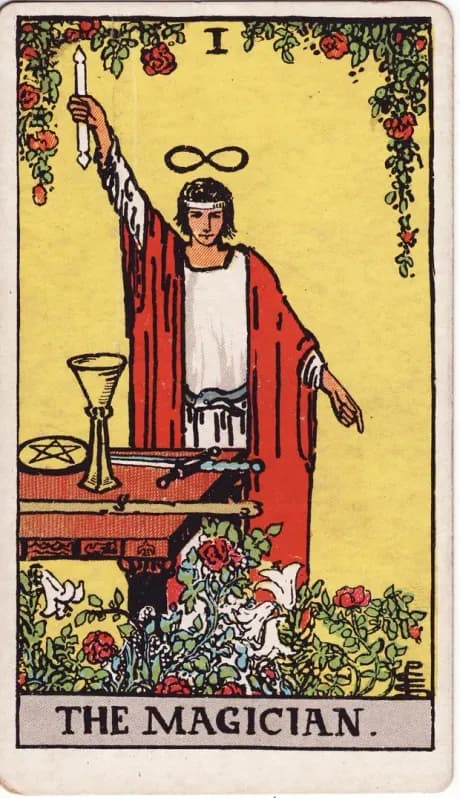
The 1909 card shows a figure standing behind a table in a garden, one arm raised straight overhead holding a white wand, the other arm lowered with a finger pointing at the ground. Above his head floats a lemniscate, the sideways figure eight. The number at the top is a one.
The two arms are the argument of the card. The raised hand takes, the lowered hand delivers, and the body between them is the only mechanism in the picture. He is not the source of anything. He is the route it takes to arrive somewhere useful, which is why this gesture survives unchanged in every serious version of the image.
The wand he holds is white and lit at both ends. It is not a weapon and not an instrument of force. It is a conductor, drawn deliberately without ornament.
On the table lie four objects: a cup, a coin marked with a five-pointed star, a sword and a wand. One from each suit of the deck, which means every kind of resource is already present and none of them is being used at this instant. Nothing on that table has been picked up.
He wears a white robe under a red cloak. White for the intention, red for the doing, and the two are worn together rather than chosen between. Around his waist is a serpent holding its own tail.
Roses and lilies grow around the table and hang in a garland along the top edge of the card. Red roses for desire, white lilies for clarity, drawn in the same bed. The garden is cultivated rather than wild. Somebody planted it, which is the quiet claim the whole card is making.
Frequently asked
Is the Magician a yes or no in love?
+
Yes — with your participation. The Magician rewards initiative and wastes completely on passive waiting. If your question was whether to make the first move, this is about as close to an instruction as the deck gives. If it was whether someone else will move, the card is answering the wrong question.
Does the Magician mean manipulation?
+
Upright, rarely. It is skill and intention, and skill applied honestly looks a lot like charm. Reversed, yes: watch for someone managing your perception instead of meeting your needs. The reliable test is the same either way — count what has been delivered, not what has been described.
Is the Magician a yes or a no?
+
Upright it is a strong yes, conditional on action. The card describes situations decided by whether somebody does the thing, so if nobody does, the yes quietly converts to no. Reversed it is a no, either because the capability is being faked or because it is real and sitting unused.
What should I do when I draw the Magician?
+
Make one concrete, specific request today, phrased so that it could be answered yes or no. Name a time, a place or a feeling rather than gesturing at it. The card's diagnosis is almost always that nothing has been proposed clearly enough to be agreed to.
Does the Magician mean they will make the first move?
+
Sometimes, but that is not its main claim. This card is about whoever is willing to act, and it draws attention to that person regardless of which side of the situation they are on. If you drew it while asking about your own move, read it as being about you.