What The Fool means in tarot — and in love
The Fool in love is the leap: a new person, a first message, a spark that asks you to jump before you feel ready. As feelings, the Fool is butterflies — someone feels excited, playful and slightly terrified by you.
Jump to FAQAt a glance
- Yes or no
- Yes — reversed flips it
- Upright, in a line
- a fresh start in love, leaping before looking
- Reversed, in a line
- recklessness with someone's heart, fear of starting over
Want a yes or no on your own situation rather than this card? Pull one card and get the verdict with the reason behind it.
Ask your own yes-or-no questionUpright in love
The Fool in love is the leap: a new person, a first message, a spark that asks you to jump before you feel ready. It signals fresh romantic energy without baggage — beginnings taken on faith rather than guarantees. If you're asking about someone new, this card says the door is open and the story hasn't been written yet. Walk in curious, not careful.
What people usually want from this card is a promise, and it does not have one. The Fool is the moment before information exists. Nobody has disappointed anybody yet, no pattern has established itself, and the reason it feels light is that nothing has been carried into it. That lightness is real and it is temporary, and treating it as proof that this one will be different is the most common way to misread the card.
In a new connection it is close to a green light. The risk you are weighing is probably smaller than it feels, because what you are actually risking is embarrassment rather than damage. Send the message. Say the thing at the end of the evening instead of driving home composing it. The Fool describes situations where waiting for certainty costs more than being wrong would.
In an established relationship the reading shifts, and it is one of the better things this card can say. It means something between you is allowed to start again — a habit broken, a conversation you have both been circling, a plan neither of you has said out loud because it sounded too young to say. Long relationships accumulate settled positions. The Fool is the card that says one of them is not settled after all.
The instruction is not recklessness. It is to move before you feel qualified. You will not feel qualified. The Fool's whole argument is that the qualification arrives from having gone, and cannot be assembled in advance from the doorway.
Reversed in love
Reversed, the Fool warns of recklessness with hearts — yours or theirs. Someone may be playing at love without thinking about where the fall ends, or you may be so afraid of looking foolish that you refuse to start at all. Check whether you're avoiding commitment or avoiding honesty. The leap still matters; the landing needs eyes open.
Reversal does not turn this card into a warning against beginnings. It turns it into a question about which failure you are currently committing, because there are two and they look nothing alike from the inside.
The first is jumping repeatedly. New person, new intensity, new certainty, and then the same exit at the same point every time. The energy is genuine and the pattern is the problem: starting is being used as a way of never arriving. If you have had three beginnings this year and no middles, this is your reading.
The second is the opposite, and it is more common than people admit. The cliff edge has been examined for months. Every possible humiliation has been rehearsed. Nothing has been risked, and the not-risking has been renamed as maturity, standards, or timing. Reversed, the Fool is unsentimental about this: the caution is fear wearing better clothes.
In an existing relationship it often points at one person carrying all the spontaneity while the other holds the brakes, with both of them resenting an arrangement they built together.
What changes between upright and reversed is not the value of the leap. It is where you are standing. Upright you are about to go. Reversed you are either going constantly to avoid staying, or standing still and calling it thinking.
The Fool As feelings
As feelings, the Fool is butterflies — someone feels excited, playful and slightly terrified by you. It's attraction without a plan: they want the adventure of you, even if they can't name where it leads.
The card is honest about what it does not contain, which is why it is worth splitting by situation rather than leaving it as one warm line.
If you are single and asking about someone new. They feel drawn to you and they have not thought past the next few days. This is not a lack of interest — the interest is bright and slightly nervous, the kind that makes people check their phone more often than they would admit. What is missing is a frame. They have not decided what you are to them, and pressing them to decide this early usually produces a smaller answer than waiting would have.
If you are in a relationship. They feel the return of something early. Often this shows up as wanting to do things with you rather than talk about things with you — a trip, a plan, an evening with no agenda. It is affection expressed as appetite. If the last few months have been heavy, the Fool here is a good sign, because it means they still associate you with lightness.
If you are asking about an ex. They remember the beginning fondly and think about it without weight. That is the specific shape of it: warm, unburdened, and attached to no intention at all. The version of you they are feeling toward is the version from before it got complicated.
If you are asking about someone long-term. It usually means they want to be surprised by you again, and are aware that they have stopped expecting to be. That awareness is not a complaint. It is closer to hope, and it responds to almost anything unscheduled.
The Fool For your ex
For an ex, the Fool suggests they remember the beginning — the fun, unburdened version of you two. If they return, they'd want a clean slate, not a resumed argument. Ask yourself if a restart is truly new, or the same loop in new shoes.
The clean slate is the part worth examining, because it is offered sincerely and it is usually impossible. What the Fool describes here is real feeling attached to a real memory, and the memory is of a period when neither of you had yet done the specific things you later did. They are not remembering a person so much as a condition, and the condition was inexperience.
That does not automatically make a return worthless. People do change, and second attempts sometimes work. But they work when both people can name what went wrong, which is exactly what the clean slate proposes to skip. A restart that begins with an unspoken agreement never to discuss the ending is not a restart. It is the same story with the first act played again.
The practical test is simple and unromantic. Ask what is different. Not what feels different, not what has been promised — what is materially different about the circumstances, the habits or the terms. If the only answer is that you both missed each other, the Fool is describing an impulse, and impulses are strong and short.
If it does go somewhere, expect it to be genuinely new rather than resumed. That is the version of this card that works: not a continuation, but two people starting something with each other while knowing exactly how the last one ended.
What The Fool means in general
The Fool is card zero, the one that stands outside the numbered sequence because it is the traveller who walks through all of them. Its subject is beginning without a map: the step taken before the evidence is in, on faith and appetite rather than a plan.
Upright it says the situation is genuinely open. Nothing has hardened yet, the cost of trying is lower than it looks from where you stand, and inexperience is temporarily an asset, because you have no habits to unlearn and no reputation to defend. Reversed the same energy curdles two ways: recklessness that ignores a real cliff edge, or a paralysis dressed up as prudence — standing at the brink indefinitely and calling it thinking it over.
As a comment on a situation in general, the card marks the difference between preparation and delay. Both look identical from outside and feel identical from inside. The Fool is the deck's argument that at some point the only remaining way to learn anything is to go.
In work it is the first day, the career change, the job you are underqualified for and should apply to anyway. It is also why beginners occasionally outperform specialists on a genuinely new problem: they do not know which approaches are supposed to fail. In money it is capital put toward something unproven, and the card is neutral about the result — it describes willingness, not profit, and it never recommends staking what you cannot afford to lose. In creative work it is the blank page treated as an invitation instead of a verdict, the draft written badly on purpose, because a bad draft can be fixed and an unwritten one cannot.
The white dog at his heels is not a warning. It is the part of you that came along, still delighted, still barking, still going wherever you go.
The Fool as a yes or no
As a yes or no, the Fool upright is a yes — but a specific kind, and the specificity matters. It says go, not it works. The card is about the decision to begin and has nothing to say about the ending, so reading it as a promise of success is reading in something that is not there.
That still makes it a yes for most questions people actually ask. Should I message them, should I take the chance, should I say it — yes, and the card is close to impatient about it. What it will not confirm is a question shaped like will this last, because the Fool is standing at the start of a road and cannot see the end of it.
Reversed it reads as no, and it is worth separating which no you are being handed. Sometimes it means not like this: the intention is fine but the approach is careless, and the card is pointing at the cliff rather than at the walk. Sometimes it means the opposite — you decided no months ago and are asking the deck to relieve you of having to say it.
If the card resists your question, the fix is usually to make the question smaller. The Fool answers should I start well and answers will it work not at all. Replace the second with the first and you get something usable, which is more than most yes-or-no phrasings manage to extract from card zero.
The Fool as advice
As advice, the Fool says go now and work the rest out on the way. Not eventually, not once conditions improve — now, in whatever half-prepared state you are in, because the preparation you are waiting to finish is not going to finish.
Concretely, that means the smallest irreversible action available. Send the message rather than drafting it. Book the thing rather than researching it further. Say the sentence out loud to the person it concerns instead of to three friends who agree with you. The Fool's method is to convert a decision into a fact quickly, so that reality can start correcting you, which it does faster and more accurately than any amount of forecasting from the doorway.
The second piece of advice is the part people skip: travel light. The figure on the card carries one small bag. Whatever you are about to start, do not load it with everything from the last one. Bringing a full set of expectations built out of an earlier situation guarantees you will experience the new one as a repeat.
Third, accept looking foolish as the price rather than the risk. It is not a possible bad outcome to be avoided. It is the fee, payable in advance, for doing anything you have not done before. People who never look foolish are people who only do what they already know how to do.
Reversed, the advice narrows to one line: look down once. Not to reconsider the whole thing, just once, at the specific ground under the specific next step. That is the difference between a leap and a fall, and it costs about a minute.
The Fool as an outcome
As an outcome, the Fool is an opening rather than a conclusion. The situation ends with something beginning, which is a real result and an unsatisfying one if you came for a verdict. Whatever you asked about resolves into a start: a new phase, a new face in the story, a door that was not there when you asked.
Upright, this is a good outcome and a genuinely unpredictable one. It tends to arrive as a change of circumstances rather than a change of feeling — a move, an introduction, an offer, a chance meeting that reorganises the question you were asking. The card does not describe the result of the beginning, only that a beginning is where this arrives. If you want to know what happens next, the cards around it carry that information and the Fool does not.
There is a version worth naming because people find it disappointing. Sometimes the Fool as outcome means the current situation simply ends and you walk on, lighter, without resolution. Nobody gets the conversation they wanted. Nothing is concluded, it is left. That reads as a loss on the day and often does not stay one.
Reversed as an outcome splits the way this card always splits. Either it ends badly through carelessness — a step taken without looking, a thing said that cannot be unsaid — or it ends by never having started, which is the commoner of the two and much harder to see, because a beginning that did not happen leaves no evidence behind. Nothing happened. That is the outcome.
What the The Fool card shows
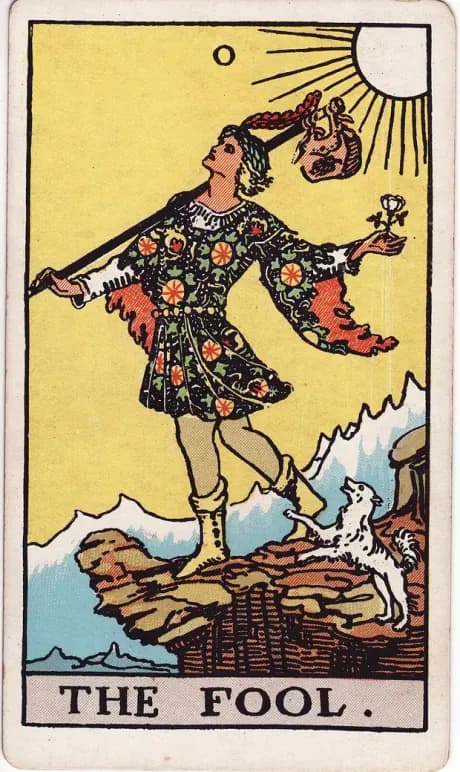
The 1909 card shows a young figure in a patterned tunic stepping toward the edge of a rocky ledge, face tilted up and away from the ground. The number at the top is a zero. Above and behind, a white sun sits in a pale yellow sky, throwing straight rays across the whole scene. The light in the picture is morning light.
The posture is the first thing to read. The forward foot is at the brink and the weight is already committed. He is not looking down. His eyes are on the sky, and the card is untroubled by this — nothing in the drawing suggests alarm, and the sun is drawn as approval rather than as warning.
One hand holds a white rose, held out loosely, almost forgotten. White throughout this deck is the colour of a thing not yet formed. The other hand carries a staff over the shoulder with a small embroidered bag hanging from the end, and the bag is very small. Everything he owns fits inside it, which is either poverty or freedom depending on where he is going.
He wears a green wreath with a red feather in it, and yellow boots. The tunic is dark and covered in red flower-wheels and vines: elaborate clothing on someone with almost no possessions. The mountains behind him are jagged and snow-capped, drawn small and far away. That is where he has come from, or where he is heading, and the card declines to say which.
At his heel a small white dog leaps up, barking. It is the most argued-over detail on the card. It is not warning him back and it is not pushing him off. It is going with him, which is the only thing in the picture that is entirely certain.
Frequently asked
Is the Fool a yes or no for love?
+
Leaning yes — it favours starting, trying, and saying the thing out loud. What it will not do is promise how the story ends. The Fool opens doors and makes no claim about the room behind them, so read it as permission to move rather than as a forecast.
What does the Fool mean for a new relationship?
+
A green light for beginnings. It is the energy of a first date that feels like a small adventure, and it says the risk you are weighing is smaller than it feels. Enjoy that without forcing a five-year plan onto week two — this card is describing the first step, not the destination.
Is the Fool a yes or a no?
+
Upright it is a yes to acting and silent on outcomes, which makes it strong for should I questions and weak for will it last questions. Reversed it is a no, either because the approach is careless or because you already decided against it and want the deck to say so for you.
What should I do when I draw the Fool?
+
Take the smallest irreversible step available today. Send the message instead of editing it, book the thing instead of researching it. The card's entire method is converting a decision into a fact fast, so that reality can start correcting you instead of your imagination.
Does the Fool mean someone is not taking me seriously?
+
Not usually. It means they have not thought past the near future, which is different from being dismissive. The feeling is real and the frame is missing. If you need to know where you stand, the Fool suggests you will have to ask, because this card will not decide it on its own.