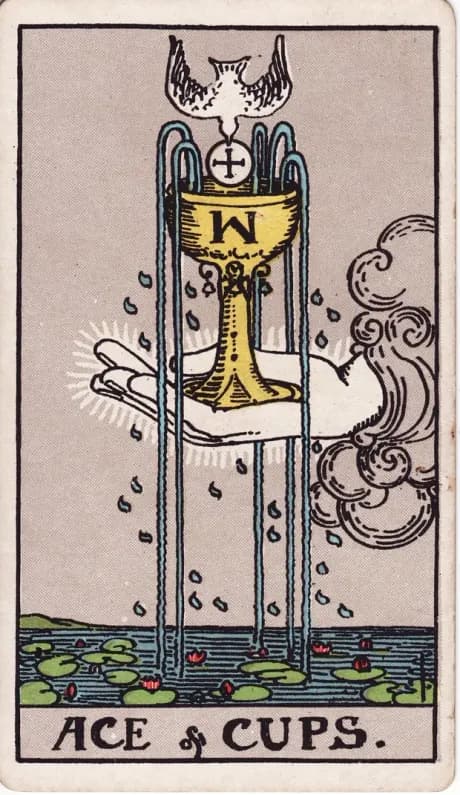
What Ace of Cups means in tarot — and in love
The Ace of Cups is the heart refilling: new love arriving, feelings overflowing, an emotional beginning with nothing stale in it. As feelings, the Ace of Cups means fresh, genuine emotion — they're catching feelings in real time and it feels new even to them.
Jump to FAQAt a glance
- Yes or no
- Yes — reversed flips it
- Element
- Water
- Upright, in a line
- new love overflowing, an open heart
- Reversed, in a line
- blocked feelings, love not poured out
Want a yes or no on your own situation rather than this card? Pull one card and get the verdict with the reason behind it.
Ask your own yes-or-no questionUpright in love
The Ace of Cups is the heart refilling: new love arriving, feelings overflowing, an emotional beginning with nothing stale in it. It's the first 'I like you,' the first vulnerable text, the moment attraction becomes feeling. If you asked about someone new — the cup is full and tilted your way. Hold yours out instead of hiding it.
Aces are offers, and that is the part people skip. The card does not show a full cup sitting on a table. It shows a hand holding one out. Nothing on this card has been accepted yet. The feeling is present, available and entirely unspent, which is why the Ace is both the most hopeful card in the suit and the one that changes least on its own.
In a new connection it means exactly what it looks like. Something real has started, early, before either of you has decided anything about it. The mistake people make here is treating an Ace as a promise and getting ahead of it, planning a year from a week. The other mistake is treating it as too fragile to touch. It is neither. It is a beginning, and it will become whatever it is fed.
In an established relationship the Ace is more interesting, because it means the capacity has returned. Not a new person — a new opening inside the existing one. Tenderness after a hard stretch. Wanting to talk again. Something you assumed had been used up turning out to have been dormant rather than gone. Long relationships get this card more often than new ones do, and readers misread it every time as a sign of somebody else.
What the card asks for is disclosure, first and slightly too early. Say the warm thing before you are certain it is safe. The Ace of Cups is a hand extended, and the entire meaning of an extended hand depends on somebody taking it. A cup nobody reaches for is just a cup. The risk is real and it is the smaller risk of the two available to you.
Reversed in love
Reversed, the Ace is a blocked heart: love available but not poured — feelings suppressed, affection withheld, or self-protection so good nothing gets in either. Someone's cup is full and sealed. Ask what you're afraid would spill. An unexpressed feeling helps no one, including its owner.
The reversal does not empty the cup, and that detail is worth holding on to. The feeling is present in exactly the quantity the upright card describes. What has failed is the pouring. This is a card about a blockage, not an absence, and blockages can be cleared in a way that absences cannot.
It shows up in a few forms. Somebody who feels a great deal and communicates entirely in logistics. Somebody hurt recently enough that openness reads as danger rather than as risk. Somebody who says it constantly and means less each time, which is the overflow version — a cup tipped so casually that nothing lands anywhere.
There is also a reading aimed at nobody in particular, and it is the most common one when the reader has been alone for a while. The block is not directed at a person. It is a general numbness, the sense that this part of you has been switched off. The card in that position is not a diagnosis. It is a note that the water is still in there.
Reversed also warns about the timing of disclosure. Not everything unexpressed should be expressed immediately. Something poured over somebody who did not ask for it is a different mistake from something never poured at all. The question the card is really putting is what you are protecting, and whether it still needs protecting or whether the protection has outlived the event that caused it.
Ace of Cups As feelings
As feelings, the Ace of Cups means fresh, genuine emotion — they're catching feelings in real time and it feels new even to them. Tender, unjaded, slightly overwhelming. The good kind of beginning.
It is the least ambiguous feelings card in the deck, which is exactly why it is worth reading closely. All the ambiguity sits in what happens next, not in what is felt.
If you are single and asking about someone new. They like you and the liking has surprised them. This is the card of an unguarded first feeling, which usually means they have not yet built any strategy around it. Expect sincerity and expect clumsiness. People handling a new Ace of Cups tend to say things slightly wrong at slightly the wrong time, because they are not managing anything yet.
If you are in a relationship. Something has softened. The Ace here often follows a stretch that was flat or difficult, and it marks the point where the feeling comes back rather than the point where it starts. If they have been warmer recently and you have been waiting for the catch, this card says there is no catch. It says they are relieved.
If you are asking about an ex. The feeling is fresh rather than residual, and that distinction is the whole reading. The Ace is not the card of somebody who misses the old version of things. It is the card of somebody whose feeling has renewed itself into something present tense. Whether they act on it is a separate question, and this card does not answer it.
If you are asking about someone long-term. The card describes an opening rather than a change of temperature. They want to say something. There is a conversation sitting just under the surface and it is a warm one, because the Ace does not carry bad news. What it carries is a full cup and no certainty that the moment is right.
Across all four the feeling is genuine and unfinished. Nobody in this card has decided what to do with what they feel, and that is not a warning. It is simply where the card sits.
Ace of Cups For your ex
For an ex, the Ace suggests feelings could begin again — but as a new pour, not reheated leftovers. If they return under this card, they're offering a genuinely fresh emotional start. Judge the new cup on new behavior.
The difference between a new feeling and a revisited one is the entire reading here, and it is testable. A revisited feeling talks about the past. It references the good period, the way things were, what the two of you used to do. A new feeling asks questions. It wants to know who you are now, which is a strange thing to want from somebody you already know.
The Ace is generous and it is not evidence. It says something has genuinely opened on their side. It says nothing about durability, and Aces on their own are famously easy to spend. What follows an Ace of Cups reunion gets decided by the Two, the Three or the Five that comes after it, and none of those is visible yet.
If contact has not happened, this card usually means it will, and that it will be warmer than you expect. The practical advice is unromantic: let them pour first, and let the pouring last longer than one message. A feeling that is real at the moment of sending is not the same as a feeling that survives a week of ordinary life, and the only way to tell them apart is to give it the week.
One more thing this card does not say. It does not say they have understood what went wrong. The Ace is feeling, not insight. For the reckoning you would want Judgement, and Judgement is not what turned up.
What Ace of Cups means in general
Aces are the seed of a suit, and Cups is the suit of water: what people feel, what they intuit, what connects them to each other. So the Ace of Cups is potential in its emotional form, undirected and undiminished, before anything has been done with it.
The subject is an opening at the level of the heart, in a broad sense that covers far more than one kind of attachment. A friendship starting. Compassion returning where there had been only efficiency. A creative impulse that arrives with real appetite behind it instead of obligation. Gratitude, unexpectedly. The recovery of an ability to be affected by things, after a stretch of not being able to.
Upright the vessel is full and being held out. Aces are always offers, and that is their limitation as much as their promise: nothing on this card has happened yet, and an offer nobody takes expires quietly. Reversed the container is blocked, sealed or tipped over — emotion that cannot find an outlet, an opening declined out of self-protection, or feeling spilled so freely it stops meaning anything.
In work it is the project you actually want to do, distinguishable from the rest by the fact that you think about it without being paid to. In money it is generosity, or the start of something whose value is not yet countable. In creative life it is the source: the hour before the first draft, when the intention is intact and no compromise has been made with reality.
What the Ace never supplies is duration. It is a beginning and it behaves like one. What becomes of the water afterwards is the business of the numbered cards that follow it.
Ace of Cups as a yes or no
As a yes or no, the Ace of Cups upright is a yes, and specifically a warm one — the kind that concerns feeling rather than outcome. Something is being offered, the offer is sincere, and no hidden condition is attached to it. If the question was whether the feeling is real, the answer is yes without qualification.
The limit of that yes is worth stating, because it is the most common misreading of the card. An Ace answers questions about what is present, not questions about what will last. Do they feel something is a yes. Will it work is a question this card cannot reach, because it is the first moment of a story and that answer lives several cards further along.
Reversed it is a no, and a soft no rather than a hard one. The material is there and it is not moving. Somebody is holding back, protecting themselves, or waiting for a signal that has not come. Reversed Aces are among the more reversible no answers in the deck, which is a strange sentence and an accurate one: what blocks them is usually a decision rather than a fact.
If the yes-or-no format is fighting you here, ask about the pour instead of the cup. Not whether they feel it. Whether they will say it, when, and to whom. That is answerable, and it is almost always what the question was really about.
Ace of Cups as advice
As advice, the Ace of Cups says offer it first. Do not wait for a safe moment, a matching signal or proof that it will be received. The card is a hand holding out a cup, and the hand moves before anybody knows the answer. That is the whole instruction and everything else follows from it.
Concretely: send the message you have drafted and not sent. Say the sentence you keep converting into a joke. Tell somebody what they have meant to you, in plain terms, without the softening clause at the end that lets you take it back. If the feeling is warm, express it warmly. This card has no interest in strategy and gets nothing useful out of restraint.
It also advises receptivity, which most people find harder than expression. If something is being offered to you, take it. Do not audit it first and do not treat kindness as a bill. A great many blocked Aces are not blocked by the person who is not speaking. They are blocked by the person who cannot accept.
There is a third reading, for when the question was not about anybody else at all. Then the advice is to restore the water: do the thing that used to make you feel something, on purpose, without needing it to be productive. Numbness does not get repaired by insight. It gets repaired by contact.
What the card never advises is protecting yourself. That is what the reversal is for, and the reversal is not the better card.
Ace of Cups as an outcome
As an outcome, the Ace of Cups means something begins. That is the honest reading and it is smaller than most people want it to be. The situation you asked about resolves into an opening rather than into a conclusion — a feeling declared, a connection made, a door that was shut standing open at the end of the story.
This is a genuinely good outcome and a genuinely early one. Aces do not describe where things end up. They describe the point at which something becomes possible, which means that drawing this card in an outcome position tells you the story you asked about is not the story that matters. The real one starts here.
In practice it often looks like a conversation. Somebody says the thing. The temperature changes. What was ambiguous becomes explicit, usually with more warmth than the situation appeared to contain. Whether that leads anywhere gets decided afterwards, by choices, not by the card.
Reversed as an outcome, the beginning does not get made. The feeling exists at the end of the story exactly as it did at the start, and nothing is poured. This is the quietest bad result in the deck: nothing goes wrong, nobody is hurt, and a thing that could have existed simply does not. If that is the reading, the useful question is who is holding the cup, because reversed Aces are almost always waiting on one specific person to move, and sometimes that person is the one asking.
What the Ace of Cups card shows
The 1909 card shows a hand coming out of a grey cloud on the left, palm up, holding a large chalice from beneath. The hand is not grasping the cup. It is presenting it, and that posture is the card.
The cup is broad and pale, and on its face is a shape usually read as a letter W, or as an M turned upside down. Waite left it unexplained. Water pours over the lip in steady streams. The drawing shows five, although Waite's own text says four, and the discrepancy has been argued over ever since. Five is normally read as the five senses: feeling arriving through the body rather than through the mind.
Above the cup a white dove descends with its wings spread, carrying a round wafer marked with an equal-armed cross, about to drop it into the water. The dove is entering the cup rather than leaving it. Whatever is being given arrives from outside the scene.
Around everything, small drops fall on all sides. They are drawn in the shape of the Hebrew letter yod, the same drops that fall in the Tower and in the Moon, and they mark this as a moment when something is being poured out generally rather than aimed at anyone.
Below, a still pool is covered in flat lily pads with white flowers open on the surface. The water the cup overflows into is already there. This is the detail most readers miss: the Ace does not create the feeling. It adds to a body of water that existed before the hand appeared.
The background is plain and pale. Nothing else is happening. There is no landscape, no second figure and no context, because an Ace is a beginning and beginnings do not have scenery yet.
Frequently asked
Is the Ace of Cups a yes?
+
A warm yes. New feeling and emotional openness are flowing toward you, the offer is sincere, and there is no hidden condition in it. The limit is that an Ace answers what is present rather than what will last, so it says the feeling is real without saying anything about how long it holds.
What does the Ace of Cups mean as feelings?
+
New real feeling, at its freshest, before fear or history has touched it. Usually it has surprised them too, which means there is no strategy around it yet — expect sincerity and expect awkwardness in roughly equal measure. It says nothing about what they will do next, only that what they feel is genuine and unguarded.
Is the reversed Ace of Cups a no?
+
Yes, but a soft one. The feeling is still in the cup; what has failed is the pouring. Somebody is holding back, protecting themselves, or waiting for a signal that has not arrived. What blocks a reversed Ace is usually a decision rather than a fact, which makes it one of the more changeable no answers in the deck.
What should I do when I draw the Ace of Cups?
+
Say the warm thing first, before you have proof it is safe. Send the message, make the offer, tell somebody plainly what they mean to you and leave off the clause that lets you take it back. Then practise the harder half: if something is being offered to you, accept it without auditing it.
Does the Ace of Cups mean pregnancy?
+
This is one of the most common questions about the card and it is one we do not answer. Love Oracle does not read for pregnancy, health, money or legal matters, and no card in any deck is a substitute for a doctor. For everything else, the Ace means an emotional beginning: something opening, being offered and not yet accepted.