What Ace of Pentacles means in tarot — and in love
The Ace of Pentacles is love with roots showing early: a new connection with real-world potential — reliable, tangible, built to survive outside the… As feelings, the Ace of Pentacles means grounded interest — they see real potential in you: someone to build with, not just text with.
Jump to FAQAt a glance
- Yes or no
- Yes — reversed flips it
- Element
- Earth
- Upright, in a line
- a solid new beginning, real-world potential
- Reversed, in a line
- a shaky start, opportunity slipping
Want a yes or no on your own situation rather than this card? Pull one card and get the verdict with the reason behind it.
Ask your own yes-or-no questionUpright in love
The Ace of Pentacles is love with roots showing early: a new connection with real-world potential — reliable, tangible, built to survive outside the honeymoon lighting. It favors solid beginnings: consistent effort, plans kept, a person whose interest you can verify in behavior. If you asked about someone new: this seed grows if planted. Water it with actual dates, not discourse.
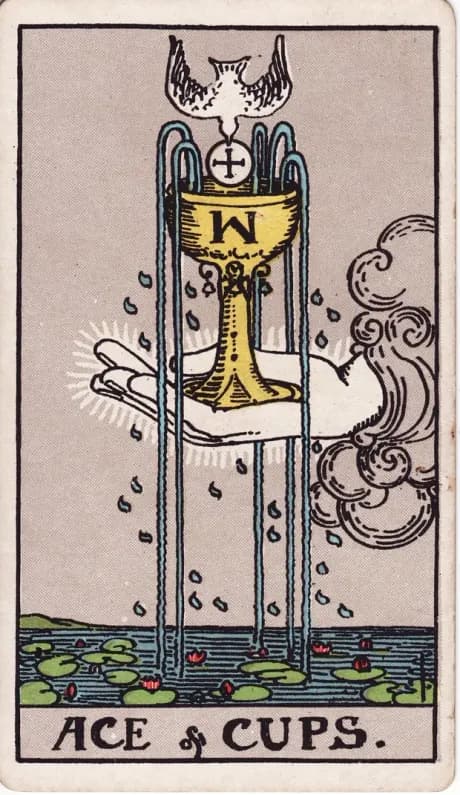
What distinguishes this Ace from the other three is that the promise is checkable. The Ace of Cups offers feeling, the Ace of Wands offers a spark, the Ace of Swords offers clarity — all of which are real and none of which leave evidence. This one leaves evidence. Plans happen. Times are kept. The thing exists in the calendar.
In a new connection it usually looks unexciting at first, and that is the card rather than a flaw in the situation. Pentacles beginnings are quiet. They do not produce the vertigo people have learned to read as chemistry, and they are considerably more likely to be there in a year.
In an established relationship the Ace marks a new foundation being laid: moving in, a shared account, a decision that converts a feeling into an arrangement. It is the card of the moment a relationship becomes materially real.
The instruction attached is about follow-through, and it is the whole card. An Ace of Pentacles that nobody acts on becomes nothing at all — not a loss, just an absence. The offer is genuine and it has a shelf life, and what closes the gap is unglamorous action: the date booked, the visit made, the thing actually arranged.
Reversed in love
Reversed, the Ace warns of a fumbled opportunity: a promising start neglected, insecurity (financial or emotional) delaying commitment, or a connection that stays theoretical. The seed is viable; the gardening isn't happening. Someone must invest — attention, time, presence — or the sprout dies in its packet.
The most common version is a good beginning that nobody watered. Not rejected, not broken — simply not attended to, until enough time passed that attending to it became awkward. This is the card of the person you got on with genuinely well and did not message for three weeks.
The second version involves circumstances rather than will. Money, distance, timing, a life that has no room in it right now. The feeling is real and the ground is not ready, which is a materially different problem from a lack of interest and calls for a different response: not persuasion but patience, and honesty about how long you are prepared to be patient.
There is a third reading worth naming: a beginning that looks solid and is not. A promise of stability made by someone who cannot deliver it, or a plan whose foundation is thinner than presented. Reversed Pentacles cards are the deck's clearest warnings about substance, and this one is specifically about substance claimed early.
The action across all three is the same and it is concrete. Do one real thing this week, or acknowledge that you are not going to and stop counting it as a possibility.
Ace of Pentacles As feelings
As feelings, the Ace of Pentacles means grounded interest — they see real potential in you: someone to build with, not just text with. It's attraction with a savings plan. Slow, sincere, material.
If you are single and asking about someone new. They are thinking about you in a practical register: whether you would fit, whether this could work, what it would actually look like. That is a much more serious form of interest than intensity, and it is much less visible, which is why it gets missed.
If you are in a relationship. They feel settled about you, in the good sense. Not bored — secure. There may also be a specific plan forming, because this card frequently marks the point where someone privately decides to build something and has not announced it yet.
If you are asking about an ex. They see a version of this that could work, usually attached to a changed circumstance. It is not longing. It is an assessment that has come out favourably, and assessments move slowly toward action in this suit.
If you are asking about someone long-term. Steady investment. This card describes the least dramatic feeling in the deck and one of the most durable: someone who has quietly decided you are worth arranging a life around.
Across all four the feeling is unspectacular and load-bearing, and it will not announce itself. You verify it by watching what gets done.
Ace of Pentacles For your ex
For an ex, the Ace of Pentacles suggests a chance to rebuild on new foundations — practical circumstances shifting (city, job, maturity) that make a fresh attempt materially possible. New soil exists; old habits will kill it again if replanted unchanged.
The important word is new. This card does not describe resumption; it describes a different attempt made possible by something that has actually changed in the world. The move back to the same city, the job that ended, the years that made someone able to do what they could not do before.
That gives you a clean test. If you can name the changed circumstance in one sentence and it is external and verifiable, the card is describing a real opportunity. If the change being offered is a stated intention — they say they have grown, they say it will be different — then what you have is the Ace reversed, and the card's own warning applies: the seed is viable and nobody is gardening.
Where it is real, this is one of the more hopeful ex-cards in the deck, precisely because it is unromantic. It does not promise that the feeling returns. It says the ground is now capable of holding something, and that whatever is built has to be built rather than resumed.
What Ace of Pentacles means in general
Pentacles is the suit of earth: money, work, body, and everything that has to exist in the physical world to count. The Ace is a hand holding out a single coin over a garden — an opportunity with substance behind it. Its subject is a beginning that can be verified.
Upright it means a real offer. A job, a sum, a resource, a chance whose value does not depend on anyone's enthusiasm about it. Of the four Aces this is the least exciting and the most reliable, and its characteristic quality is that it survives being examined.
Reversed the opportunity is missed, delayed, or thinner than it appeared. Either nobody acted on it, or the substance turns out not to be there. Reversed Pentacles are the deck's most consistent warnings about things that were represented as solid.
Outside the personal, the card is literal. In work it is the offer, the contract, the funding. In health it is the beginning of a physical improvement rather than a decision to make one. In creative life it is the commission — the version of the idea that has money and a deadline attached, which is what turns an intention into an object.
Among the four Aces, each opens a different register: Cups opens feeling, Wands opens desire, Swords opens understanding. Pentacles opens the possibility of something existing, and it is alone among them in producing evidence.
The card's single instruction is unchanging across every context. Take it out of the air and put it in the ground, because an unplanted seed is indistinguishable from no seed at all.
Ace of Pentacles as a yes or no
As a yes or no, the Ace of Pentacles upright is a yes, and it is among the most dependable in the deck. Not the most enthusiastic — that belongs to the Wands and Cups Aces — but the one least likely to be withdrawn. If you asked whether something is real, whether an offer is genuine, whether there is substance here, the answer is yes.
The qualification is conditional rather than doubtful. This yes is contingent on action. The card describes an opportunity that exists and does not describe anyone taking it, so a querent who reads the yes as a prediction and does nothing will frequently find it did not come true. The yes is to the availability, not to the outcome.
Reversed it becomes a no, and the no has a specific flavour worth reporting accurately: a missed yes. Not refusal — the thing was possible and did not get done, or the substance behind it was not what was claimed. That is the difference between "this will not work" and "this did not get started", and querents deserve to hear which one they are being told.
On timing, this suit is the slowest in the deck. Where the question is when, the answer is later than you want and on a schedule you can rely on.
Ace of Pentacles as advice
As advice, the Ace of Pentacles says: start something small and real this week. Not plan it, not research it, not decide in principle — do one concrete thing that leaves a trace. The card's entire argument is that intention and action look identical from the inside and completely different from the outside.
The specific form depends on the question, and it is always modest. Book the date rather than agreeing that you should meet up. Send the actual message rather than deciding to. Put the small amount of money in rather than working out the ideal amount. This suit does not reward the grand version; it rewards the version that happens.
There is a second instruction about verification, and it points both ways. Judge other people by what they do rather than what they say, and accept being judged the same way. Under this card, offers and promises count for very little and behaviour counts for everything, which is uncomfortable if you are currently offering more than you are doing.
Reversed, the advice becomes salvage. Something good is sitting unattended and it has not expired yet. Go back to it — the connection you let lapse, the opportunity you meant to answer, the thing you began and did not continue. The reversed Ace is rarely about a door that closed; it is about one nobody walked through.
Ace of Pentacles as an outcome
As an outcome, the Ace of Pentacles is a beginning that holds. The situation you asked about ends with something real being established — a foundation rather than a conclusion. It is one of the few outcome cards that describes a start rather than a finish, and reading it as an ending is a common mistake.
In love questions it means a connection becomes actual. Not necessarily declared or defined, but materially present: seen regularly, factored into plans, part of the shape of a week. The card promises substance rather than intensity, and the people who receive it are sometimes disappointed by exactly the quality that makes it durable.
It can also mean a practical resolution to something that had been emotional — the money arrives, the living situation is settled, the plan becomes real. In questions where the difficulty was never really about feeling, this card is the good news.
Reversed as an outcome is an opportunity that lapses. Nothing dramatic happens; the situation simply does not get built, and afterwards there is a thing that could have existed and does not. That is a quiet result and a genuinely bad one, because it produces no event to grieve and nothing to learn from. If you get it and can still act, this is the card that says act now rather than well.
What the Ace of Pentacles card shows
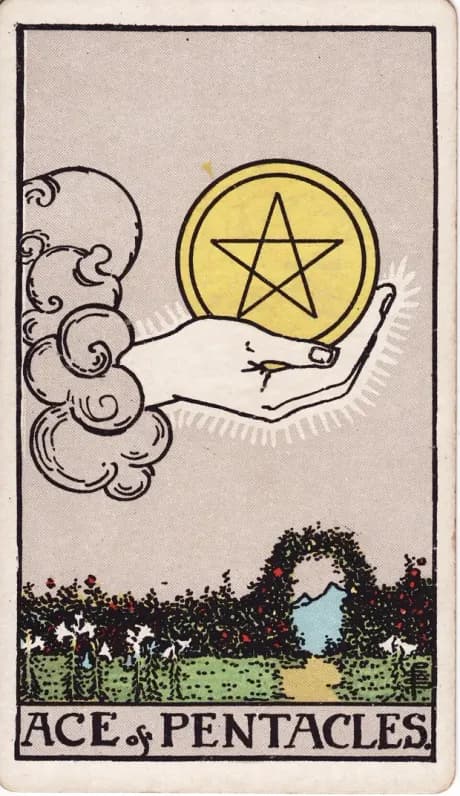
The 1909 card shows a large hand emerging from a grey cloud, palm open and flat, holding a single golden coin marked with a pentagram. The hand does not grip the coin — it is offered, balanced on an open palm, and could be taken or not.
Below the hand is a garden. There is a hedge of white lilies in flower, green ground, and a low wall or archway cut through the hedge. Beyond that archway a path leads away toward mountains in the distance.
The archway is the detail worth noticing, and it is why this Ace differs from its three siblings. The other Aces are pure offer — a cup, a wand, a sword held out in an empty sky. This one is drawn with somewhere to go. There is a gate, a path through it, and a destination visible at the far end, which is the picture's way of saying that this opportunity connects to somewhere rather than existing in isolation.
The lilies are purity and the garden is cultivated rather than wild: this is ground that someone has already worked. Nothing here is untouched nature. Substance in this suit is always something built.
The coin itself is the only one in the whole suit drawn suspended rather than held, carried or displayed. It is at the moment before it is taken.
The mountains at the horizon are distant and hard, which is the honest part of the picture: the path leads somewhere worth reaching and the walk is long.
Frequently asked
What does the Ace of Pentacles mean in love?
+
A beginning with substance — a connection that can be verified in behaviour rather than felt in intensity. It usually looks unexciting at first, which is the card rather than a flaw, and it is far more likely than the other Aces to still exist in a year.
Does the Ace of Pentacles mean a relationship will last?
+
It means the foundation is capable of lasting, not that anyone will build on it. The offer is genuine and conditional on action — an Ace of Pentacles nobody acts on simply becomes nothing, which is what the reversed card describes.
Is the Ace of Pentacles a yes or a no?
+
One of the most dependable yeses in the deck — not the most enthusiastic, but the least likely to be withdrawn. The yes is to the availability rather than the outcome. Reversed it is a missed yes: possible, and not started.
What should I do when I draw the Ace of Pentacles?
+
Do one small concrete thing this week that leaves a trace. Book the date rather than agreeing you should meet. This suit rewards the version that happens rather than the grand version, and intention looks identical to action from the inside only.
Why is there a gate in the Ace of Pentacles?
+
Because unlike the other three Aces, this one is drawn with somewhere to go. There is an archway through the hedge, a path beyond it and mountains at the end. The picture is saying the opportunity connects to a destination rather than floating in isolation.