What Ace of Swords means in tarot — and in love
The Ace of Swords is the truth arriving on schedule: sudden clarity about a person, a conversation that finally names things, the fog cut in one… As feelings, the Ace of Swords means mental fixation — they think about you with unusual clarity or are approaching a decisive realization about what…
Jump to FAQAt a glance
- Yes or no
- No — reversed flips it
- Element
- Air
- Upright, in a line
- clarity cutting through, the truth spoken
- Reversed, in a line
- confusion, a truth avoided or twisted
Want a yes or no on your own situation rather than this card? Pull one card and get the verdict with the reason behind it.
Ask your own yes-or-no questionUpright in love
The Ace of Swords is the truth arriving on schedule: sudden clarity about a person, a conversation that finally names things, the fog cut in one stroke. In love it favors defining the relationship, honest declarations, seeing someone accurately at last. If you asked 'what should I do?' — say the true sentence. It costs once; confusion bills monthly.
The card describes a specific moment rather than a mood: the second something becomes clear. Not gradually clear, not clear on reflection. Clear the way a light switching on is clear. That moment can be wonderful or awful, and the Ace does not care which, because its subject is the arrival of the fact, not the comfort of it.
In a new connection it usually means the guessing is about to end. Somebody says what this is. Somebody asks the direct question, or one piece of information lands and reorganises everything you thought about a person. If you have been reading tea leaves in message timings for weeks, this card says the answer is available and closer than the leaves — one sentence, asked plainly, gets it.
In an established relationship the Ace of Swords is the conversation you have been circling. It is often the one you rehearse in the shower and never start, and the card's position is that the rehearsal has now cost more than the conversation would. What comes out of it is not necessarily agreement. It is definition, which is what the relationship has actually been short of.
What the card asks is simple and unpleasant: pick the true sentence and say it without decoration. No softening clauses, no three qualifiers in front, no asking a smaller question hoping the bigger one gets answered by accident. The Ace is a blade because a clean cut heals better than a torn one, and the way people usually hurt each other here is by being vague for too long.
Reversed in love
Reversed, the Ace of Swords is the blade dropped: miscommunication, half-truths, clarity available but avoided because it would demand action. Arguments about words instead of meanings. The confusion here is usually a choice someone keeps making. Ask the direct question — the one you've been decorating.
Reversal does not remove the truth. It removes access to it. The fact still exists, fully formed, and everyone involved is arranging their behaviour around not touching it. That is why this card feels so much heavier than simple misunderstanding — a misunderstanding wants to be resolved, and this does not.
In a new connection the reversed Ace is the situation nobody will name. Weeks of contact with no definition, conversations that get close and then swerve, a question you keep almost asking. Sometimes the other person is being deliberately unclear because clarity would end their advantage. More often both people are protecting the same thing: a pleasant ambiguity that neither has to be rejected inside.
In an established relationship it is the argument that is not about what it says it is about. You are fighting over a tone, a message, a chore, and the actual subject is underneath and has been for months. The reversed card also covers truth used as a weapon — honesty aimed to wound, delivered at the worst possible moment, technically accurate and entirely about winning.
There is a milder reading worth holding on to. Sometimes reversed simply means the clarity has not arrived yet and forcing it now produces a false answer. If you have been demanding a definition from someone who genuinely does not have one, the card can be telling you to stop interrogating and let the thing declare itself. The test is whether the vagueness is being maintained or is just early.
Ace of Swords As feelings
As feelings, the Ace of Swords means mental fixation — they think about you with unusual clarity or are approaching a decisive realization about what you are to them. Less butterflies, more verdict forming.
If you are single and asking about someone new. They have been thinking, and thinking is the operative word. This is not a card of helpless attraction; it is a card of someone working something out about you and getting close to a conclusion. The conclusion could go either way, which is the uncomfortable part. What it does mean is that they are not confused about their own feelings, whatever those feelings turn out to be, and that they are likely to say something soon rather than let it drift.
If you are in a relationship. Their feelings have sharpened into a position. Something has clarified — about the future, about what they want, about a thing that has been unresolved between you. Expect a conversation. This card rarely describes someone who reaches a realisation and sits on it quietly, and it is often a good sign even when it is frightening, because definition is what the situation has been missing.
If you are asking about an ex. They see the whole thing clearly now, including their own part in it. That clarity can come with regret, but the Ace is cold: understanding what happened is not the same as wanting it back. Do not read insight as longing.
If you are asking about someone long-term. A truth has surfaced that has been sitting under the surface for a while. It is usually not a secret and rarely dramatic — more often a plain fact about what they need that they have finally let themselves say. Ask directly and you will get an answer, because this card does not lie when it is asked properly.
Ace of Swords For your ex
For an ex, the Ace of Swords means truth wants the floor: the honest conversation that never happened is the actual unfinished business. Any real reunion begins with words that cut clean — apologies with specifics, not vibes.
Most breakups end without a real account of what happened. There is a version each person tells, and the two versions never get put in the same room. This card is the moment they might be. That is the whole offer here — not reconciliation, not closure as a feeling, but the facts of it laid out plainly by two people who are no longer trying to win.
Expect it to be less warm than you want. The Ace is air, not water. Clarity about an ex often means finding out something you would rather not know, or finally admitting something you already did. It can also mean the reason arrives at last — the real one, not the one you were given at the time — and that the reason turns out to be smaller and duller than the story you built around it.
If you want the conversation, ask for it cleanly. One direct message, specific, without a paragraph of framing in front. What this card cannot survive is the approach that pretends to be about something else: the practical excuse, the returned object, the birthday text designed to open a door. That approach reads as strategy and gets a strategic answer.
If you get the truth and it closes the door, that is still the card working. An answered question stops charging rent.
What Ace of Swords means in general
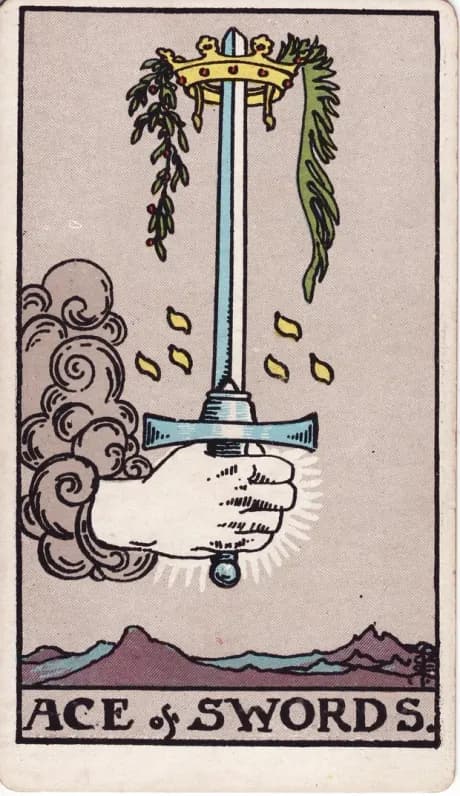
Swords is the suit of air: thought, language, judgement and the damage each can do. The Ace is a hand emerging from cloud, holding a single upright blade through a crown — mental force in its undiluted form, before it has been aimed at anything.
Its subject is the breakthrough. The fact that reorganises everything, the idea that arrives whole, the decision finally made, the sentence said aloud that cannot be unsaid. Aces are beginnings, and this one begins with an act of separation: naming a thing divides it from everything it is not. That is what a blade does and what a definition does, and the card treats them as the same gesture.
Upright it says the situation is ready to be cut cleanly and that accuracy will serve better than tact. It favours the plain statement, the diagnosis, the contract read properly, the problem correctly identified after months of treating symptoms. Reversed the blade is misused or unused — an argument won at the cost of the point, information withheld, a verdict delivered to hurt, or clarity avoided because of what acting on it would require.
In work it is the moment the actual problem gets named in a meeting and the room goes quiet, or the strategy that finally makes sense of a year of drifting. In money matters it is reading the real numbers rather than the comfortable estimate. In creative work it is the ruthless edit: the idea rescued by deciding what it is not.
Across the deck, air cards describe a mind doing something. The Ace is the first cut, before the mind has learned what its own sharpness costs — which is the story the rest of the suit tells.
Ace of Swords as a yes or no
As a yes or no, the Ace of Swords upright is a yes, and a particular kind: a yes that is already true whether or not you accept it. It does not describe permission being granted. It describes a fact becoming visible, and the fact was there before you asked.
That makes it one of the more useful cards in this format. When it lands on a question, the answer usually exists and is available cheaply — one direct question, one honest look, one document actually read. The card's implicit instruction is that you do not need the deck for this. You need a conversation you have been avoiding.
Reversed it turns to no, but the no is about access rather than outcome. It says the answer is being obscured, by someone else or by you, and that anything you decide right now rests on incomplete or distorted information. That is different from the situation being hopeless. Acting on a reversed Ace usually means acting on a version of events that will not survive the month.
There is a version of this card that resists the format, and it is the version people most often draw. If the question was really "will they tell me what I want to hear", the Ace answers a different question and answers it honestly: you will find out where you stand. Whether where you stand is where you wanted to be is not a thing this card weighs in on. Ask what is actually true rather than whether it is good, and this card is one of the most reliable answers in the deck.
Ace of Swords as advice
As advice, the Ace of Swords says: say the true sentence, once, without decoration. Pick the plainest version of the thing you mean and use it. Not the softened version, not the version that leaves you an exit, not the smaller question you were going to ask instead in the hope that the answer covers the bigger one.
The practical form is usually one of three moves. Ask the direct question you have been rephrasing for weeks. State your own position, so that the other person is responding to something real rather than guessing. Or get the information — read the message, check the fact, have the conversation that would settle it — instead of continuing to reason from assumptions you have never tested.
The card also advises a specific discipline about how. A clean cut is not the same as a swing. Say it early, say it calmly, say it when you are not angry, and stop talking afterwards rather than filling the silence with qualifiers. Most people who follow this card's advice badly do so by delivering truth at the moment it will do most damage and calling that honesty.
Reversed, the advice reverses. Do not send it yet. Find out what is actually going on before you act on what you assume. Notice whether the argument you are in is about its stated subject. If you have been sharpening a sentence for someone, ask what you want it to accomplish, because a sentence designed to win is a different tool from one designed to clarify.
What this card never advises is waiting for the right moment. The right moment is a story confusion tells about itself.
Ace of Swords as an outcome
As an outcome, the Ace of Swords means the situation ends in clarity. Something gets named, decided or found out, and after that the ambiguity is gone. That is the whole result, and it is worth taking seriously as a result: it does not promise the outcome you wanted, it promises you will know.
In a love question this usually looks like definition. The conversation happens. A position is stated, a label agreed or refused, a truth surfaces that changes what everyone is working with. Read alongside warm cards it is the moment a relationship becomes official. Read alongside cold ones it is the moment somebody says the thing that ends it. Both are the same card doing the same job.
There is a reason this outcome is generally worth wanting even when it stings. Undefined situations do not stay still; they cost attention continuously and quietly, and they tend to end anyway, later, with more accumulated damage. The Ace as outcome converts an ongoing tax into a single payment.
Reversed as an outcome, the situation ends without resolving. The conversation happens and misses. The definition gets deferred again, or arrives distorted — a version of events assembled to protect somebody, which everyone then has to live inside. Sometimes it means an ending delivered cruelly, where the truth was accurate and the delivery was the point. The reversed outcome is not usually permanent. It means this attempt did not land, and that a second, plainer attempt is the thing that will.
What the Ace of Swords card shows
The 1909 card shows a single hand coming out of a grey cloud on the right side, gripping the hilt of a sword that points straight up. The hand is bare and the grip is firm, and there is no arm and no body behind it. Aces in this deck are all drawn this way: a gift offered from somewhere outside the scene, not yet belonging to anyone.
The blade is upright and the point is dead centre in the top half of the card. It is the straightest line in the deck. Nothing about this image is curved or ambiguous — where the Ace of Cups overflows and the Ace of Wands sprouts, this one simply stands, and the sword's edge divides the sky behind it.
A golden crown rests on the point of the blade, and two branches hang from it, one on each side: an olive branch and a palm. Peace and victory, held by the same weapon. They are not resting comfortably; they are hooked over the crown and hanging, which reads as conditional rather than earned. Six small yellow marks fall through the air around the crown, sometimes read as sparks of thought and sometimes as the letter yod, the mark of divine intervention that appears in several cards in this deck.
The background is bare sky with a small grey cloud around the wrist. Below the cloud, at the very bottom of the card, a range of jagged mountains runs across the horizon. The mountains belong to the whole suit. They are the cold, unwelcoming country that thought produces when it has nothing else in it, and every Swords card in the deck is either standing in that landscape or heading toward it. On the Ace they are far away and small, which is honest: at the start, the cost of clarity is not yet visible.
Frequently asked
What does the Ace of Swords mean in love?
+
Breakthrough clarity and honest words — the moment truth defines the relationship one way or the other. It is a card of definition rather than feeling: a conversation that names things, a fact that lands, a question finally asked plainly. What it defines is not always what you were hoping for, but the ambiguity ends.
Is the Ace of Swords a yes or no?
+
It is a yes, of the kind that was already true before you asked — the answer exists and is available cheaply, usually through one direct question. Reversed it becomes a no about access rather than outcome: the information you are working from is incomplete or is being obscured.
What should I do when I draw the Ace of Swords?
+
Say the plainest version of the thing you mean, once, and then stop talking. Ask the direct question you have been rephrasing. Get the fact instead of reasoning from an assumption. Say it calmly and early rather than at the moment it would do the most damage — a clean cut is not the same as a swing.
Does the Ace of Swords mean bad news?
+
Not by itself. It means true news. The card is neutral about whether the truth is welcome, which is why it feels ominous to people hoping for a particular answer. Drawn beside supportive cards it is a definition you will be glad of; beside harsh ones it is a fact you would rather not have had.
Does the Ace of Swords mean an argument?
+
It can, though more often it means the conversation that prevents one. Arguments in this suit belong to the Five of Swords and the reversed cards. Upright, the Ace describes clarity used well: a position stated once, not a point won. If it arrives with the Five of Swords or the Three of Swords, read the confrontation reading.