What Justice means in tarot — and in love
Justice weighs the relationship and returns the honest bill: what's fair, what's owed, what's been unbalanced. As feelings, Justice means they're evaluating — weighing you, the history, the rights and wrongs, before their heart signs anything.
Jump to FAQAt a glance
- Yes or no
- No — reversed flips it
- Upright, in a line
- karmic balance, honesty, getting what is fair
- Reversed, in a line
- unfairness, dishonesty, accountability avoided
Want a yes or no on your own situation rather than this card? Pull one card and get the verdict with the reason behind it.
Ask your own yes-or-no questionUpright in love
Justice weighs the relationship and returns the honest bill: what's fair, what's owed, what's been unbalanced. It favors truth-telling conversations, accountability, and karmic returns — people getting what their actions ordered. If you asked about an outcome: expect exactly what's deserved, on both sides. Bring receipts and be ready to see your own.
The part people skip is the second half of that. Justice is not a card that takes your side. It weighs, and you are on the scales too, and readings that arrive under this card are noticeably less comfortable than the ones people were hoping for. That discomfort is the card working correctly.
In a new connection it says the terms are being set right now, quietly, by what each of you does rather than what either of you says. Justice is the card of the person who is fair rather than the person who is exciting, and it usually turns up to point at somebody consistent whose behaviour matches their words. It also warns about the reverse. If someone is already being slightly dishonest about small things this early, that is not nerves. That is the rate.
In an established relationship it names an imbalance out loud. Who does more, who apologises first, who bends, who is always the one to make the call after a fight. These accounts run for years without being read, and Justice is the moment somebody reads them. The conversation that follows is not pleasant and it is almost always overdue, and couples who have it tend to do better afterwards than couples who keep the ledger private.
What the card asks is simple to say and hard to do. Put the honest number on the table, including the part that does not flatter you. Justice does not respond to arguments. It responds to accounts.
Reversed in love
Reversed, Justice is the unfair chapter: double standards, blame dodging, one person carrying the emotional invoice. Someone refuses accountability — possibly with a lawyer's skill. You can't argue someone into fairness; you can decide what you'll no longer subsidize. Balance restores itself when you stop overpaying.
What reverses is not the fairness of the outcome. It is the honesty of the weighing. Reversed Justice describes a situation where the facts on the scales are wrong — not disputed, wrong. Somebody is presenting an edited version and enough of it is true that arguing about it goes nowhere.
The most common form is the double standard, and it survives because it is never stated. One person's lateness is a personality trait and the other person's is disrespect. One person's silence is processing and the other person's is punishment. Nobody agreed to these rules and both people are following them, and the moment they are said out loud they stop being defensible.
The second form is the skilled avoider. This is the reading the original line points at, and it deserves the warning. Some people are genuinely good at this: every accusation gets reframed, every complaint gets answered with a different complaint, and you end up apologising for the conversation you started. Recognise it by the outcome rather than the argument. If you consistently leave discussions feeling like the problem, the discussions are not the point of the discussions.
There is a version of this reversal that points at you, and honesty requires naming it. Sometimes the unfair accounting is yours: a grievance kept on the books long after it was settled, or a running total of everything they owe you that they have never once been shown.
The move is the same either way. Stop litigating and start deciding. You cannot argue somebody into fairness. You can decide what you will no longer pay for.
Justice As feelings
As feelings, Justice means they're evaluating — weighing you, the history, the rights and wrongs, before their heart signs anything. It's love under review: honest treatment now moves the verdict more than grand gestures. What that means in practice depends on the question you asked.
If you are single and asking about someone new. They like you and they are checking. This is not coldness and it is not a game; it is somebody who has been wrong before and has decided to look at evidence this time. Their feelings are real and are being deliberately held one step behind their judgement until the two agree. Consistency moves this. Intensity does not, and a large gesture at this stage reads as an attempt to skip the review.
If you are in a relationship. They are keeping an account, and you may not know it is open. Justice as feelings inside a couple usually means somebody has been quietly tallying for a while — not out of malice, but because something has felt uneven and they have not found a way to say it. The feeling has not gone. It is conditional now, and it is waiting for a change it has not asked for out loud.
If you are asking about an ex. They feel that something was owed. Sometimes by you, sometimes by them, and either way it stands between the affection and any action. This is the card of the person who cannot move toward you until an apology exists in the world, and who may not be able to explain that clearly enough to ask for it.
If you are asking about someone long-term. Their feeling has settled into something measured and durable, closer to regard than to heat. That is not a decline. Long partnerships that last tend to run on this exact feeling, and the card is describing somebody who has decided you are worth the arrangement.
Under Justice, honesty is the only thing that changes the number.
Justice For your ex
For an ex, Justice deals in karmic accounting: apologies owed, truths unsaid, consequences arriving on schedule. If they wronged you, the lesson finds them. If reunion happens, it starts with a very honest conversation, not flowers.
The card is unusually specific about what unlocks this one. Not time, which people rely on and which does nothing here. Not proximity, and not the gradual softening that comes from missing somebody. What unlocks a Justice ex is the thing that was never said being said, by whoever owes it.
That cuts in your direction as often as theirs, which is the part nobody enjoys. If you are hoping for an apology, the card agrees one is outstanding. It also tends to point at a second item on the other side of the ledger, and any reconciliation under this card involves both of them being read aloud. Reunions here begin with an uncomfortable hour, not a good evening.
On consequences: Justice is the card people cite when they want to be told that somebody will get what is coming to them. It does say that, and it says it in the least satisfying way available. Consequences under this card arrive privately, on their own schedule, and usually out of your sight. You will very likely not be there to watch. The card promises the accounting, never the viewing.
If you are deciding whether to make contact, there is a clean test. Can you say the true version of what happened, including the part that reflects badly on you, in plain sentences and without heat? If yes, the conversation is worth having. If no, you are not going for resolution. You are going to win, and Justice does not hand out that outcome.
What Justice means in general
Justice is the eleventh trump in this deck, and its subject is consequence. A seated figure holds a level pair of scales in one hand and an upright sword in the other: weigh first, then cut. The accounting it describes catches up with what was actually done, as distinct from what was intended, claimed or remembered afterwards.
Upright it says the situation will resolve on its merits. Truth is the operative currency, a decision is required, and the decision has to be made with the head rather than the appetite. It also covers agreements and formal matters in the literal sense, though on any real legal question the card is not a source of advice and neither are we.
Reversed the scales are off. Something is being dodged, a conclusion is being drawn from incomplete information, or the figures on one side of the ledger were never honest to start with. There is a harsher reversal that people miss entirely: an outcome that is completely fair and still lands badly, because fairness and comfort are separate measurements and only one of them is on the card.
Outside the personal questions it is among the easier cards to recognise. At work it is the review, the audit, the thing done quietly in March arriving in August with your name attached. In creative work it is the edit — the decision about what to cut, made against the work itself rather than against your attachment to it. In money it is reconciliation in the plainest sense: opening the file and looking at the actual number instead of the remembered one.
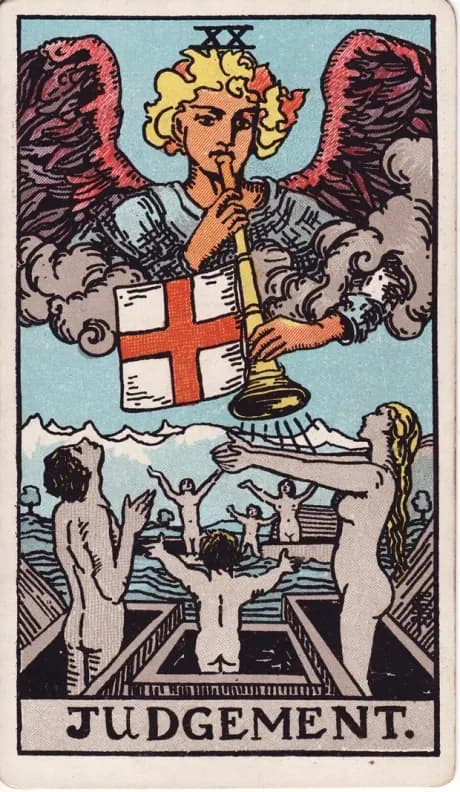
It is worth separating from Judgement, which people confuse with it constantly. Judgement is a call and a rising, a summons you answer. Justice is a measurement. One asks what you will do next. The other adds up what you have already done.
Justice as a yes or no
As a yes or no, Justice does not really answer the question, and pretending otherwise misses what the card is for. It returns a verdict on the merits: yes if the merits support it, no if they do not. The card's actual reply is that the outcome will be whatever is deserved, which is either reassuring or alarming depending on information you already have and may not want to consult.
Upright, treat it as a conditional yes. If you have dealt honestly, if the arrangement is genuinely balanced, if what you are asking for is proportionate to what you have put in, then yes. Justice is one of the most reliable cards in the deck when the ground under the question is solid. It is also the card least willing to grant a favour, and if the foundation is tilted, the upright card will say no with the same calm face.
Reversed it is a no. Something is dishonest, hidden, or being weighed on bad information, and outcomes built on that do not hold even when they briefly go your way. A reversed Justice yes is worth less than an upright Justice no.
Because this card resists the format, there is a better question available and it is unusually productive. Instead of will this happen, ask what am I actually owed here and what do I actually owe. Justice answers that pair precisely and without flattery, and the answer generally makes the original yes-or-no question redundant, because once the accounts are visible most people can see the ending themselves.
Justice as advice
As advice, Justice says tell the truth first, including the part that costs you something. Not the diplomatic version, not the version arranged to lead somewhere. The plain account of what happened and what you did in it.
The concrete form is usually written. Take the situation and write two columns: what you have actually done, and what they have actually done. Behaviour only. Not feelings, not intentions, not what anybody meant. Most people find that the exercise settles the question before the second column is finished, and that the settled answer is not the one they were arguing for.
If a wrong is outstanding on your side, the advice is to name it without conditions. An apology that arrives with an explanation attached is not an apology, it is a defence with a polite opening. Say the thing, stop talking, and let it sit. This is the single most reliable action under this card and almost nobody wants to take it.
If the wrong is on the other side, the advice is different and less satisfying. Ask once, clearly, for the specific thing you want acknowledged. Once. Then decide based on the answer rather than on repeated attempts to get a better one. Justice never advises litigation of a personal matter, because the person who keeps arguing has already lost the argument they are actually having.
There is also a decision folded into this card, and it wants making with the head. Whatever you are weighing, take the appetite out of it for one afternoon and ask what you would advise somebody else in exactly this position. The gap between that answer and the one you have been giving yourself is the whole subject of the card.
Justice as an outcome
As an outcome, Justice means the situation resolves according to what is actually there. Not what was hoped for and not what was argued, but what the record supports. That makes it one of the most predictable outcome cards in the deck, on condition that you are honest with yourself about the record.
Upright, the ending is fair and it is final. Whatever has been out of balance gets corrected, and the correction tends to arrive through a decision rather than through drift — somebody says something, a line is drawn, a matter is settled. If you have been dealing straight, this outcome is good, and it usually comes with the specific relief of a thing finally being named. If you have not, the same card delivers the same fairness in the other direction and it will not feel like fairness at the time.
There is a quality to Justice outcomes that is worth knowing in advance. They are clean and they are cold. Nothing about this card produces a warm ending. What it produces is a correct one, and warmth, if it comes at all, arrives later and from a different card.
Reversed as an outcome, the imbalance persists. Either nobody names it and the situation continues at the same tilt, or a conclusion gets reached on faulty information and everybody involved lives with a result that was never true. This is the outcome that quietly poisons things over years, because an unresolved account does not close on its own. It just stops being mentioned.
The cards around it usually explain the mechanism: swords nearby point at the conversation that does it, pentacles at the practical arrangement, cups at the apology.
What the Justice card shows
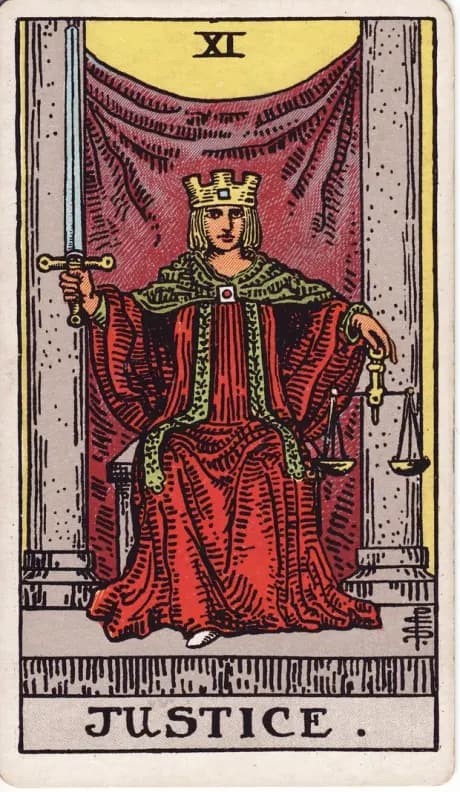
The 1909 card shows a crowned figure seated on a plain stone throne between two grey pillars, with a purple veil hung across the space behind. The veil is the first thing worth noticing. On the High Priestess the same kind of curtain is patterned and hints at what lies behind it; here it is solid and tells you nothing. There is no context available in this picture, no landscape, no background story to appeal to. What is on the scales is all there is.
In the right hand, raised and vertical, is a double-edged sword. The doubling is deliberate. A sword with two edges cuts in both directions, and the figure holding it is not on anybody's side. It is held upright rather than levelled, so nothing is being threatened; it is being held ready. In the left hand hang golden scales, level and even, and empty in the sense that nothing has been placed on them yet.
The robe is red, the mantle over it green, fastened at the throat with a square clasp. The crown is gold with three points and a small square blue stone set in the front. Squares recur across the card, which is the visual language of something fixed and measured rather than something that flows.
From under the hem, one white shoe is visible. It is a small detail with an outsized meaning: the figure is not a statue and not an abstraction. There is a foot under there, and it is pointing forward, which reads as somebody about to act rather than somebody permanently seated.
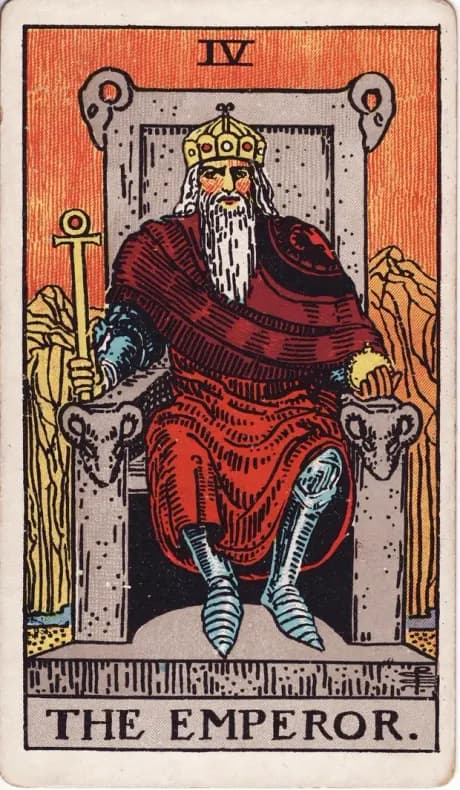
The face looks straight out of the card at you. Very few figures in this deck do that. The Priestess looks past you, the Emperor looks off to the side, most of the rest are absorbed in what they are doing. This one meets your eye, and the meaning of that is not subtle: the thing being weighed is on your side of the picture.
Frequently asked
Is Justice a yes or no in love?
+
It's an 'exactly what's fair' — yes if you've both dealt honestly, no if the foundation was tilted. The scales don't do favors. That makes it very reliable on solid ground and completely unwilling to grant an exception on shaky ground, which is why people find it either reassuring or alarming.
What does Justice mean for getting back with an ex?
+
Reconciliation only through accountability: wrongs named, amends made. No sweeping under rugs — Justice checks under rugs. Time does nothing here, and neither does missing each other. The thing that unlocks it is the unsaid thing being said, usually by both people rather than one.
Is Justice a yes or a no?
+
Upright it is a conditional yes: yes when the merits support it, no when they do not, decided on the record rather than on hope. Reversed it is a no, because something is hidden or the weighing is being done on bad information, and outcomes built that way do not hold.
What should I do when I draw Justice?
+
Write two columns — what you have done and what they have done, behaviour only, no intentions. Most people settle the question before finishing the second column. If something is owed on your side, say it without an explanation attached. If it is owed on theirs, ask once and then decide on the answer.
What is the difference between Justice and Judgement?
+
They are two different cards and the confusion is understandable, since both sound like a verdict. Justice is number eleven and it is a measurement: it adds up what has already been done and returns the honest total. Judgement is number twenty and it is a summons: figures rise to a call and something in the past is finished with so a new phase can start. One looks back and settles the account. The other looks forward and asks whether you will answer.