What Wheel of Fortune means in tarot — and in love
The Wheel of Fortune spins your love life into a new chapter: chance meetings that feel scripted, timing finally clicking, a cycle completing. As feelings, the Wheel means their emotions are in motion — what they felt last month isn't what they feel now, and next month is genuinely open.
Jump to FAQAt a glance
- Yes or no
- Yes — reversed flips it
- Upright, in a line
- fate turning, a destined meeting, cycles shifting
- Reversed, in a line
- bad timing, repeating the same romantic cycle
Want a yes or no on your own situation rather than this card? Pull one card and get the verdict with the reason behind it.
Ask your own yes-or-no questionUpright in love
The Wheel of Fortune spins your love life into a new chapter: chance meetings that feel scripted, timing finally clicking, a cycle completing. What was stuck starts moving — often through events outside your control. If you asked 'will things change?' — yes, and soon. Your only job is to be ready when the wheel stops on your number.
The useful thing to understand about this card is that it deals in timing, not in merit. It is not saying you have earned a change or that somebody else has been punished. It is saying the season is turning, and seasons are indifferent to how hard anyone tried. That cuts both ways, which is why the Wheel is one of the few genuinely good cards that still makes experienced readers careful.
In a new connection it usually means the meeting happened because of something neither of you arranged. A job that moved, a friend who cancelled, a flat that fell through. The Wheel is the card of connections that begin sideways, through circumstance rather than intention, and they often carry a particular feeling of inevitability that is really just the strangeness of the route. That feeling is not evidence of anything. Enjoy it and verify the person separately.
In an established relationship it marks a chapter ending, and the chapter is not necessarily the relationship. A move, a job, an illness in a family, a child leaving home, the end of a long stretch where everything was the same. Whatever the two of you built for the last phase now needs rebuilding for the next one, and couples who assume the last arrangement will keep working are the ones the turn catches.
What the card asks is unusually specific. Act inside the window. The Wheel hands out openings, not outcomes, and an opening that nobody walks through closes on schedule and does not reopen because you were nearly ready.
Reversed in love
Reversed, the Wheel means fighting the turn: clinging to a phase that's ending, repeating the same romantic cycle with new faces, blaming fate for patterns you keep choosing. The loop breaks when you do something different — same swipe, same type, same fight equals same result. Change your input.
There are two reversals here and they need separating, because one is about you and the other genuinely is not.
The first is the loop. Different person, identical relationship. The same argument arriving at week nine, the same withdrawal at month four, the same ending with a different name attached. This is the reading people resist hardest, and the resistance is understandable, because the pattern always looks like bad luck from inside. The way to tell is boring and reliable: write down how the last three ended. If the sentences rhyme, the variable that stayed constant was not the other people.
The second is delay, and it carries no lesson at all. Sometimes the turn is simply late. Circumstances have not moved yet, the timing is wrong through nobody's fault, and the honest reading is that this is not the season. That version of the reversed Wheel is not asking you to change anything. It is asking you to stop reading a pause as a verdict.
The third possibility is the one that stings: the phase that is ending is one you liked. Reversed, the Wheel sometimes describes somebody holding the rim still with both hands — staying in a relationship whose season closed, or trying to reproduce a year that is over. Nothing gets preserved this way. The turn happens anyway, later, and with more force for having been leaned on.
What unlocks all three is the same move. Change one input you actually control, and change it for long enough to see what happens.
Wheel of Fortune As feelings
As feelings, the Wheel means their emotions are in motion — what they felt last month isn't what they feel now, and next month is genuinely open. Destiny-flavored attraction, but unstable ground. Catch them at the turn. How that lands depends on which question you brought.
If you are single and asking about someone new. Their interest is real and it is young, which means it is still being decided by things that have nothing to do with you. What is happening in the rest of their life right now has more influence on this than anything you say or do. That is not a reason to hang back. It is a reason not to read a quiet week as a message, and not to read an intense one as a promise.
If you are in a relationship. Something in how they feel is shifting, and shifting is not the same as cooling. The Wheel here usually attaches to a change in circumstance rather than to a change in you: a new job, a new city, a phase of their own life closing. Their feelings are being reorganised around a different set of facts, and the outcome is genuinely open in both directions.
If you are asking about an ex. They think about you in cycles, and the cycles are triggered from outside. A song, an anniversary, a street. The feeling is real each time it comes round and it is not continuous, which is why their behaviour looks so inconsistent from where you are standing. Nothing is being calculated. It simply comes back and goes away.
If you are asking about someone long-term. Their feeling is entering a new phase rather than fading. Long relationships have several distinct versions, and the Wheel marks the moment one version ends. Couples who expect the old feeling to return exactly as it was are usually the ones who miss the new one arriving.
In all four, the card refuses to describe anything fixed. Whatever it shows you is a photograph of something moving.
Wheel of Fortune For your ex
For an ex, the Wheel is the card of paths recrossing: reunions triggered by chance — a song, a city, a mutual friend's party. Whether the second spin lands better depends on whether either of you changed since the first.
This is one of the strongest reunion cards in the deck and one of the least reassuring, because it says contact is likely and says nothing about the result. Circumstance brings people back together all the time. Circumstance has no opinion about whether they should be.
The question the card actually puts to you is whether anything is different. Not whether you feel differently, which changes weekly, but whether the specific conditions that ended it have moved. If somebody moved away and has now moved back, that is a real change. If somebody was not ready and has since done the work, that is a real change. If the only thing that changed is that time passed and you both miss each other, the wheel is offering you another turn on the identical loop, and second attempts on identical loops end faster than the first, not slower.
Timing is the other half of it. The Wheel is the card most likely to bring somebody back at an inconvenient moment — when you have just started something else, or just stopped waiting. That is not the universe testing you. It is just what an unscheduled event looks like when it lands in a life that kept moving.
If contact comes, the practical move is to slow it down. The card supplies the opening. It supplies nothing else, and nothing about a chance meeting obliges you to treat it as a sign.
What Wheel of Fortune means in general
The Wheel of Fortune is the tenth trump and the deck's card of cycles. Its argument is that circumstances turn on their own schedule. What is rising will crest, what sits at the bottom will not stay there, and a great deal of what happens to a person is timing rather than merit or fault. Pretending otherwise is expensive in both directions: it makes good fortune into proof of virtue and bad fortune into proof of failure.
Upright it marks a turn already in motion. An unexpected opening, a run of luck, a chapter closing because its season ended rather than because anybody ended it. This is the deck's strongest argument for moving when the moment appears, since the moment is not waiting to hear whether you are ready. Reversed the wheel is stuck or turning against you: bad timing, a delay with no lesson in it, or a loop repeating because whatever it was meant to teach has not been taken yet.
Notice where it sits in the sequence. The Hermit comes before it and is entirely about effort you control. Justice comes after it and is entirely about consequence you earn. The Wheel is wedged between them as the part of a life that is neither: the accident, the coincidence, the thing that happened because somebody you barely know changed jobs.
Everywhere else it behaves the same way with different furniture. At work it is the opportunity that arrives through a person you had lunch with once, or the industry reorganising under you while you were doing everything right. In creative work it is the fallow stretch that ends for no visible reason, and the productive one that does the same. In money it is the cycle nobody in the room caused and everybody in the room is subject to.
The card is not fatalism. Nothing on it says the turn decides the result. It says the turn decides the timing, and what you do inside the window decides the rest.
Wheel of Fortune as a yes or no
As a yes or no, the Wheel of Fortune upright is a yes, with a qualification that matters more than usual. It is a yes to change. It is not necessarily a yes to the specific thing you asked for, because the card describes movement rather than direction, and movement can arrive in a shape nobody requested.
Read literally, the upright answer is that the situation will not stay as it is. For most questions people bring to this card, that alone is the good news, since the thing being asked about is usually stuck. Where it gets misread is in questions of the form will this particular person do this particular thing. The Wheel does not answer those well. It answers will something happen, and it answers it with an unambiguous yes.
Reversed it reads as a no, and the flavour is delay rather than refusal. The turn is late, or it is being fought, or the same cycle is due to run once more before anything new is available. Reversed, the honest translation is not now, and the follow-up question is whether you are waiting on circumstances or standing on the rim yourself.
One practical note that comes up constantly with this card. It is a poor timing card despite everybody using it as one. Upright it means sooner than you think, which is genuinely what it usually means, but sooner has no units attached. If timing is the actual question, ask instead what has to change before this can move, and read the surrounding cards for the answer. The Wheel is the only card in the deck that will confidently tell you something is coming and refuse to say what.
Wheel of Fortune as advice
As advice, the Wheel of Fortune says take the opening. Not the perfect one, and not the one you had planned for. The one that is actually in front of you this month, in the shape it happens to have arrived in.
The concrete version depends on which way the card is pointing. If something has opened up — an invitation, a message, a coincidence that puts you near somebody — the advice is to answer it within days rather than weeks. Openings under this card are dated goods. The card is not promising the opening is good. It is telling you that finding out is time-limited and waiting is a decision.
If nothing is currently moving, the advice reverses into something more demanding: change one input. The Wheel's whole argument is that outcomes follow conditions, so alter a condition. A different room, a different night, a different opening sentence, a different type of person entirely. Not everything at once, which produces noise. One variable, held long enough to read the result.
There is also an instruction about attitude, and it is not decorative. Stop grading your circumstances. A great deal of what has happened to you recently was timing, and treating it as a verdict on your worth is both inaccurate and expensive, because it makes people cautious exactly when the card is asking them to move.
What the card advises against is preparation as a strategy. There is a version of waiting that presents itself as getting ready — one more month of work on yourself, one more thing sorted out first — and the Wheel is unusually blunt about it. Readiness is not what determines whether the opening comes. It only determines whether you are standing near enough to reach it.
Wheel of Fortune as an outcome
As an outcome, the Wheel of Fortune means the situation changes, and changes through something outside the frame of your question. Not through persuasion, not through effort applied to the current problem, but through a shift in conditions. Somebody moves. A job ends. A third party does something unrelated and the ground under the question quietly rearranges.
Upright, that change is usually favourable, and the reason is worth stating rather than assuming. The Wheel improves stuck situations because stuck situations have nowhere to go but sideways. If what you asked about has been frozen for a while, this card as the outcome is close to the best available answer. If what you asked about is currently good, the same card is a warning wearing the same face, because the turn does not stop when it reaches a nice position.
The timing is faster than most outcome cards and the shape is less predictable. Expect the change to arrive at an angle. Very few Wheel outcomes look like the thing the person was hoping for, and a good number of them turn out to be better than the thing they were hoping for, which is only visible afterwards and is no comfort at all in advance.
Reversed as an outcome, the situation returns to where it started. The cycle completes and begins again, unchanged, with the same characters and the same argument. That is a real ending and a genuinely disappointing one, and it is also the most preventable outcome in the deck, since a loop breaks the moment anybody in it does something different.
What sits alongside it decides the tone. Grounded company like the Emperor, the Four of Pentacles or the Hierophant slows the turn. Volatile company like the Tower or the Eight of Wands makes it fast and sharp.
What the Wheel of Fortune card shows
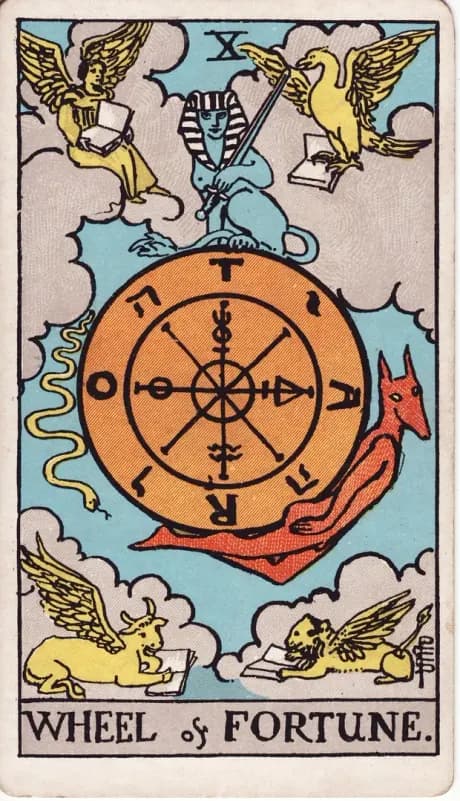
The 1909 card has no person in it at all. That is the first and most important thing to notice: every other card in this part of the deck gives you somebody to stand next to, and here there is nobody, only a wheel in a pale sky with clouds under everything. Nobody is turning it and nobody is watching it turn.
The wheel itself is a circle inside a circle. Around the outer rim run four letters, T, A, R and O, spaced so they can be read round and round as TARO, ROTA, the Latin word for wheel, or several other arrangements. Between them sit four Hebrew letters spelling the divine name. Inside, on the spokes, are alchemical signs for mercury, sulphur, water and salt. The design says the same thing three times in three different alphabets, which is the point: the turning is a law, not an event.
Three figures ride the wheel. A yellow snake slides down one side, head first. On the other side a jackal-headed figure rises. At the very top sits a blue sphinx, upright and still, holding a sword across its body. Everything on this card is either going up or going down except the sphinx, and the sphinx is the only one holding a weapon.
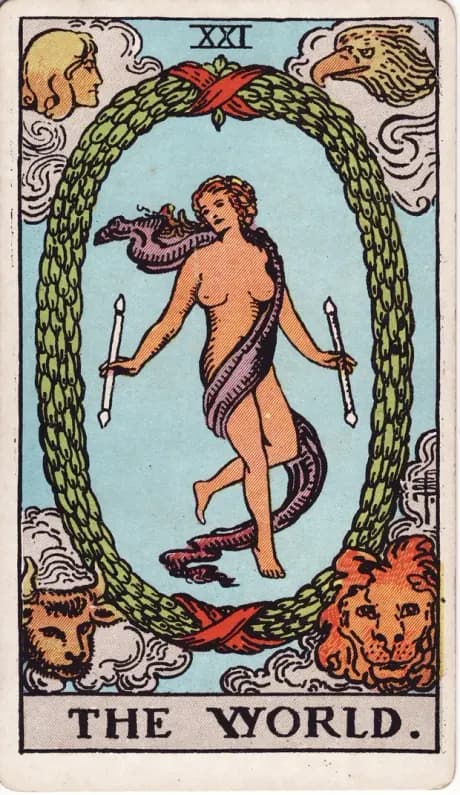
In the four corners, resting on clouds, are four winged creatures, each with an open book. A robed man or angel and an eagle are above; a bull and a lion are below. They appear again on the World, and both times they are doing the same thing, which is reading rather than participating. They are outside the wheel and they are not turning.
There is no ground anywhere in the picture. No landscape, no horizon, no place to stand. Whatever this card describes is not happening in a location, and there is nothing in it you could reach up and hold.
Frequently asked
Is the Wheel of Fortune a yes?
+
Yes for change and luck in love — the situation will move. Whether it lands where you hope depends on choices made when it does. It answers 'will something happen' far better than it answers 'will this particular person do this particular thing'.
Does the Wheel of Fortune mean destiny in love?
+
It means timing and cycles doing their work. Call it destiny — just don't use destiny as a reason to stop steering. The feeling of inevitability that comes with these meetings is usually the strangeness of the route rather than proof of anything about the person.
Is the Wheel of Fortune reversed a yes or a no?
+
Reversed it is a no in the sense of not now. The turn is late, or it is being resisted, or the same cycle has one more run in it before anything new becomes available. Upright the same card is a clear yes to movement, which is why the reversal reads as delay rather than refusal.
What should I do when I draw the Wheel of Fortune?
+
If something has opened up, answer it within days — openings under this card are dated goods. If nothing is moving, change one thing you control and hold the change long enough to read the result. And stop treating recent luck, good or bad, as a verdict on you.
How soon does the Wheel of Fortune mean things will change?
+
Sooner than the situation suggests, which is honestly as precise as this card gets. It is used as a timing card constantly and it is a poor one: it will tell you confidently that something is coming and refuse to say what or when. If timing is the real question, ask what has to change first and read the cards around it.