What Six of Pentacles means in tarot — and in love
The Six of Pentacles is love's ledger balanced fairly: generosity flowing both directions — support given, care received, no one keeping invisible… As feelings, the Six of Pentacles means giving-love — they want to provide for you, help you, be useful to your happiness.
Jump to FAQAt a glance
- Yes or no
- Yes — reversed flips it
- Element
- Earth
- Upright, in a line
- generosity, giving and receiving fairly
- Reversed, in a line
- strings attached, a lopsided ledger
Want a yes or no on your own situation rather than this card? Pull one card and get the verdict with the reason behind it.
Ask your own yes-or-no questionIn the Golden Dawn tradition this card rules 10–20° of Taurus. A planet standing at that degree is read through it: Venus in Taurus · Moon in Taurus · Mars in Taurus
Upright in love
The Six of Pentacles is love's ledger balanced fairly: generosity flowing both directions — support given, care received, no one keeping invisible invoices. It can flag a dynamic where one gives and one receives; upright, the exchange is honest and warm. If you asked whether it's fair: currently yes. The healthiest love audits itself occasionally and forgives the rounding errors.
Fairness in this card is not measured week by week. Almost every couple is uneven at any given moment — one person is ill, one is broke, one is carrying the emotional weight of a bad year. What the upright card says is that the unevenness is temporary, visible to both people, and not being recorded as debt. Equality here is a long average, not a daily balance.
In a new connection the card is about the roles being set. Early generosity is not neutral: whoever pays, drives, rearranges their schedule and solves the problems is quietly deciding what kind of pair this will be. Upright, that is fine, because the giving runs in both directions and the currencies simply differ. Watch one thing only — whether you are allowed to give back. A person who accepts nothing is not being modest. They are keeping the scales.
In an established relationship this is the card of a season where one of you carries more. Upright it says the arrangement is working, and it usually says so because both of you have named it. The couples who survive an uneven year are the ones who said out loud that the year was uneven. The ones who do not say it discover, two years later, that somebody has been keeping a total.
What the card asks is small and slightly uncomfortable. Say the ledger out loud. Ask what your partner actually wants to receive instead of giving them what you enjoy giving. And accept something — a favour, money, help, an evening of being looked after — without immediately repaying it. Receiving well is the harder half of this card.
Reversed in love
Reversed, the Six of Pentacles is charity with strings: affection doled out as reward, support that purchases obedience, one person perpetually in emotional debt to the other. Power posing as generosity. Love priced is love leased. Settle accounts and renegotiate as equals or close the ledger.
The reversal does not mean the giving stopped. That is what makes it hard to see. The generosity is often still flowing, still visible to everyone outside, still genuinely useful. What changed is that it acquired a price, and the price is usually not money. It is compliance, gratitude on demand, or the understanding that certain subjects are now closed because of what was paid for.
The tell is the reminder. A gift that gets mentioned later was not a gift; it was a deposit. Listen for the sentence that begins with everything I have done for you. It can arrive in an argument, or gently, or as a joke, and it means the same thing in all three deliveries: there is an account open, and you are on the wrong side of it.
There is a second version that looks like the opposite and works the same way. Some people refuse everything. No help, no money, no favours, nothing they cannot repay by the end of the week. That is not independence. Staying out of anyone's debt is a way of staying above them, and a partner who is never allowed to give you anything will eventually stop trying.
And there is the plain, tired version: one person has stopped contributing at all, and the other has stopped expecting them to. Reversed, the card asks for a renegotiation with actual terms — what each of you gives, what each of you needs, said in daylight. If that conversation is not possible, the imbalance is not a phase. It is the structure.
Six of Pentacles As feelings
As feelings, the Six of Pentacles means giving-love — they want to provide for you, help you, be useful to your happiness. Genuine care with a benefactor accent. Confirm they also know how to receive; givers who can't accept eventually control.
How that lands depends entirely on where the two of you are standing, so it is worth taking the four common situations separately.
If you are single and asking about someone new. They feel warm toward you and they express it by being useful. Expect offers before declarations — a lift, a recommendation, a problem solved before you asked for help. This is real feeling, not a strategy. The thing to watch is whether they can also be helped. Someone who only ever arrives with something in their hands is more comfortable being needed than being known.
If you are in a relationship. Their feeling has a role attached to it. They may feel like the provider and be quietly tired of it, or feel cared for and quietly indebted. Either way the affection is genuine, and the arrangement has become the shape of the affection, which is why it is worth naming before it hardens.
If you are asking about an ex. They are running an audit. Their feeling is tangled with a sense of what they gave and what they got, and one of those two numbers is larger in memory than it ever was in life. Warmth is present. So is a grievance, or a debt they have not forgiven themselves for.
If you are asking about someone long-term. The care has become infrastructure — the bills, the lifts, the arrangements nobody thanks anybody for. That is not coldness and it is not the absence of feeling. It is feeling converted into maintenance, and it stops being visible to the person receiving it long before it stops being done.
Across all four, the constant is this: with the Six of Pentacles the feeling is expressed as an exchange. That is sincere. It becomes a problem only when one of you is never allowed to be on the other side of it.
Six of Pentacles For your ex
For an ex, the Six of Pentacles asks who owed whom: the relationship's imbalance is what memory keeps auditing. A return works only at eye level — debts forgiven, roles retired. No one re-enters as the charity case.
The shape is usually familiar. One of you financed the relationship — with money, or with planning, or with the emotional labour of holding both moods steady — and the other one knew it. The person who gave more remembers being taken for granted. The person who received more remembers being managed. Both are partly right, and both memories are obstacles to a clean return.
If contact resumes, watch how they open. Gifts, offers of help, insisting on paying for something: this is the most common way this ex apologises, and it is not always manipulation. Sometimes it is the only language they have. But an apology delivered as a payment leaves the account open rather than closing it, and the next argument will be conducted in the same currency.
The useful question is not what they are offering now. It is whether anything has changed in how they handle giving and receiving. Ask about the other parts of their life — who helps them, what they accept, whether anyone is allowed to do something for them. If the answer is still nobody, you would be returning to the same ledger with a new date on it.
A return at eye level means each of you can name what you took, and neither of you is charging for it.
What Six of Pentacles means in general
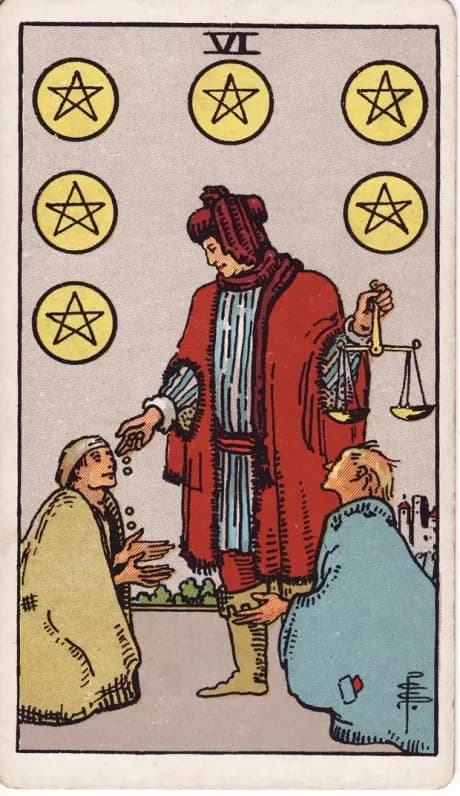
A merchant in a red robe stands holding a balance in one hand while the other drops coins into the palms of a kneeling man. A second beggar kneels beside the first and receives nothing. The card's subject is the economics of giving and receiving — charity, patronage, debt, and the authority built into all three.
Upright it says the exchange is currently fair and the flow is real: help arrives, resources move, someone with more gives to someone with less and does it without a hook in it. It also asks a question the picture makes unavoidable. Which figure are you in this scene, and who is holding the scales?
Reversed the balance goes wrong in one of three directions. Generosity acquires conditions. Dependence becomes permanent, so that the giving no longer helps anybody. Or somebody refuses every offer of assistance, which looks like strength and is usually a way of staying out of everyone's reach.
In working life this is the raise, the grant, the mentorship, the internal budget decision — anything where one party sets terms and the other says thank you. In money questions it describes resources moving between people rather than being earned, which is why the card turns up so often around family support, loans and inheritances. In creative work it is the patron: funding that arrives with a preference attached, and the quiet cost of taking it.
The sixes across the deck are cards of the settling point after a struggle. The Six of Wands is public recognition, the Six of Swords is passage to calmer water, the Six of Cups is memory. This one is the settlement itself — the moment resources are distributed and somebody decides how much each person gets.
The card carries no verdict on whether charity is good. It insists only that giving is never neutral. Every gift moves a small amount of power along with it, and the card asks you to know which direction it went.
Six of Pentacles as a yes or no
As a yes or no, the Six of Pentacles upright is a yes, and it is a specific kind of yes: the answer is favourable and it depends on somebody else. Help arrives, the request is granted, the resource is released. But look at the picture — the coins move because the man holding the scales decided they should.
That makes it a strong yes for questions about receiving. Will support come, will they help, will the thing be given: yes. It is weaker for questions where you need to be the one deciding, because the card puts the decision in another pair of hands.
Reversed it is a no, and usually a no with an explanation attached. The answer is refused, or granted on terms you would not accept, or given and then held over you afterwards. Occasionally the reversed card answers yes to a question you did not want answered — yes, they will help, and yes, it will cost you something that is not money.
The better question with this card is almost always about price. Instead of asking whether it will happen, ask what comes attached to it. Instead of asking whether they will help, ask what help from that particular person has historically cost. The Six of Pentacles answers questions about terms far better than it answers questions about outcomes, because terms are what it is actually looking at.
Six of Pentacles as advice
As advice, the Six of Pentacles says to look at the ledger honestly and then act on what you find, which is two separate jobs. Most people only do the first.
Start with the count. Over the last month, who gave what — money, time, attention, logistics, apologies, the labour of keeping the peace. Write it down rather than feeling your way to an answer, because the felt version comes out shaped by whoever is more tired.
If you are the one giving more, the advice is not to stop. It is to ask for something specific and let them provide it. Not a gesture, not a change of attitude: one concrete task that is theirs. People who are never asked for anything eventually conclude they are not needed.
If you are the one receiving more, contribute in a currency you can actually afford. It does not have to match. Somebody who cannot pay half the rent can still be the one who handles every difficult phone call. What ends an imbalance is not equal value, it is visible effort.
If you are holding the scales — you set the terms, you decide what counts as fair, the resources are yours — hand them over once. Let the other person define what a fair arrangement looks like, and then agree to it. This is the hardest instruction on the card and the one that changes the most.
And forgive the rounding errors. An audit run to the last unit stops being fairness and becomes a way of winning.
Six of Pentacles as an outcome
As an outcome, the Six of Pentacles upright is a settlement. The situation ends with resources moving to where they were needed and the arrangement accepted by both sides. Something is granted. Someone is helped. It is a calm, workable ending rather than a triumphant one, and it frequently involves a third party or an authority who decides.
In a question about two people, upright often means the imbalance gets addressed rather than removed. One of you will still give more. The difference at the end is that both of you know it, agreed to it, and stopped pretending otherwise. That is a better result than it sounds — most of the damage in an uneven pair comes from the pretending, not from the unevenness.
Reversed as an outcome is the imbalance hardening into a structure. The giving continues and so do the conditions. The help arrives with terms attached, or arrives too late, or the person who has been receiving stops making any attempt to contribute and everybody accepts the new arrangement in silence. Nothing dramatic happens. That is the point: the reversed outcome is a bad arrangement becoming permanent because nobody wanted the conversation.
There is a cleaner reversed reading worth mentioning. Sometimes it means the account is finally closed — the giver stops giving, the ledger is torn up, and the connection ends because the only thing holding it together was the debt. Bleak in the moment. Accurate more often than people want it to be.
What the Six of Pentacles card shows
The 1909 card shows a merchant in a red robe standing at the centre of the scene. In one hand he holds an even-armed balance, raised to shoulder height. With the other he drops coins into the cupped hands of a man kneeling at his feet. A second man kneels on the other side of him, hands out, receiving nothing.
The vertical arrangement is the whole argument. One figure stands and two kneel, and the card does not soften that. The merchant's robe is red, the colour Pamela Colman Smith uses throughout the deck for worldly appetite and action, and his clothing is intact while both cloaks at his feet are worn through.
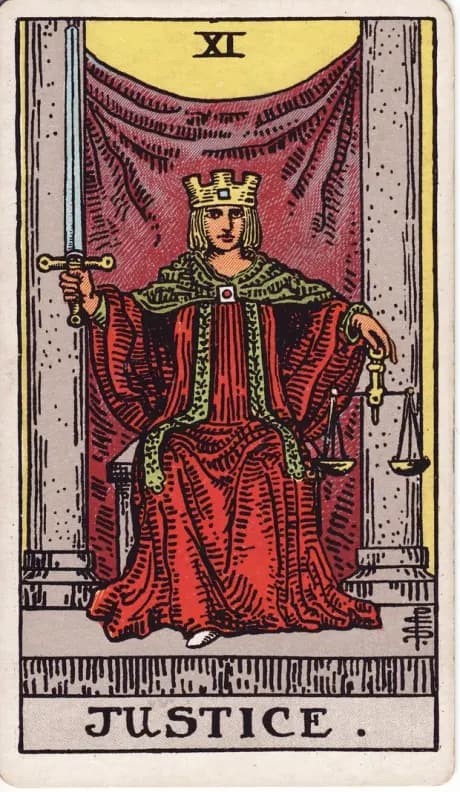
The balance is the detail people miss. A scale is the instrument of Justice, and in the Justice card it is held by a seated figure who represents the law itself. Here it is held by a private individual, in his own hand, over his own transaction. The arms are level, so the distribution is fair — fair by his measure, weighed on his instrument, and he can lower either side without anyone being able to object.
Only one of the two kneeling men receives anything. The card gives no reason. Nothing in the picture marks one as more deserving than the other, which is precisely what makes the image uncomfortable and precisely why it is accurate about charity.
Six pentacles hang in the air behind the group, evenly spaced and unattached to anything — a tally rather than a treasure. Behind them stands the outline of a walled town. The ground is flat and bare. There is no altar, no crowd and no witness. Whatever is being decided here is being decided in private, by the person with the money.
Frequently asked
What does the Six of Pentacles mean in love?
+
Generosity and fair exchange — support flowing honestly in both directions, with no hidden invoice. It often marks a pair where one person gives more right now, and upright it says that is fine, because both of you know it and neither is charging interest. Reversed, the giving has strings and somebody is keeping score.
Does the Six of Pentacles mean an unequal relationship?
+
It examines exactly that: who gives, who receives, and at what unspoken price. Inequality on its own is not the problem, since almost every couple is uneven at some point. The card is asking whether the imbalance is named and temporary, or hidden and permanent.
Is the Six of Pentacles a yes or a no?
+
Upright it is a yes, especially for questions about receiving help, support, or a decision going your way. The catch is that the yes belongs to somebody else — the resource arrives because a person holding more of it chose to release it. Reversed it is a no, or a yes on conditions you would not have agreed to in advance.
What should I do when I draw the Six of Pentacles?
+
Audit one month honestly, then change one thing. If you give more, ask for something concrete and let them do it. If you receive more, contribute in whatever currency you actually have — it does not have to match theirs. If you are the one setting the terms, let the other person set them once instead.
Am I the giver or the receiver in the Six of Pentacles?
+
Usually both, in different currencies. The card deliberately draws three figures and refuses to tell you which one you are, because the honest answer rarely fits a single label: people who give money often receive patience, and people who give patience often feel poor. Work out what you supply that nobody has thanked you for. That is the side you are standing on.