What Seven of Pentacles means in tarot — and in love
The Seven of Pentacles is the growth review: pausing to assess what the relationship yields against what you've planted — patience with slow seasons,… As feelings, the Seven of Pentacles means evaluation — they're weighing what you two could yield: is this worth more investment, patience,…
Jump to FAQAt a glance
- Yes or no
- No — reversed flips it
- Element
- Earth
- Upright, in a line
- patience, waiting to see what grows
- Reversed, in a line
- effort without return, time to reassess
Want a yes or no on your own situation rather than this card? Pull one card and get the verdict with the reason behind it.
Ask your own yes-or-no questionIn the Golden Dawn tradition this card rules 20–30° of Taurus. A planet standing at that degree is read through it: Venus in Taurus · Moon in Taurus · Mars in Taurus
Upright in love
The Seven of Pentacles is the growth review: pausing to assess what the relationship yields against what you've planted — patience with slow seasons, honesty about barren ones. Long-term love grows unevenly; this card asks whether it's growing at all. If you asked "should I keep waiting?" — evaluate like a farmer, not a gambler. Harvests take time; deserts take excuses.
The distinction the card is drawing is between patience and stalling, and they look identical from inside. Patience is waiting for something that is visibly growing. Stalling is waiting because stopping would mean admitting the years. The card does not tell you which one you are in — it insists that you look.
In a new connection this usually means a natural pause a few months in, where the initial momentum has run out and what remains has to be assessed on its merits. That pause is normal and it is not a warning sign. What it asks is a real question: is this becoming something, or has it simply not ended yet.
In an established relationship the Seven is the honest inventory. What has this given, what has it cost, what has changed in the last year. Most people avoid conducting it, which is why the card so often arrives when it is overdue rather than when it would have been useful.
The instruction is to measure against a period rather than a mood. Compare this year to last year, not this week to last week. Weeks are noise. On the scale of a year, whether something is growing is usually obvious and rarely ambiguous, which is exactly why the annual view is the one people avoid taking.
Reversed in love
Reversed, the Seven of Pentacles is sunk-cost gardening: years invested guarding a plant that never fruits, effort mistaken for progress, waiting as a lifestyle. The time spent doesn't obligate the future. Reallocate your seasons — some fields simply aren't yours, no matter how long you've watered them.
The reversal names one specific error precisely: treating what you have already spent as a reason to spend more. Three years invested is not an argument for a fourth. It feels like one, powerfully, and the feeling is what the card is pointing at.
The second version is impatience rather than sunk cost — pulling something up to check the roots, repeatedly, and killing it in the process. Demanding definition from a connection every few weeks, testing it, requiring reassurance at a rate no relationship can supply. Some things genuinely are growing and cannot survive being inspected that often.
There is a third and quieter reading: effort in the wrong place. Enormous work going into a relationship, all of it aimed at something that was never the actual problem. This is the person doing everything right about the thing that does not matter, and the card is asking them to check what they are watering.
The move in all three cases is a decision with a date attached. Not "I will leave" and not "I will wait" — a specific period, after which you will look again, chosen in advance while you are calm. Open-ended waiting is the exact state this card describes.
Seven of Pentacles As feelings
As feelings, the Seven of Pentacles means evaluation — they're weighing what you two could yield: is this worth more investment, patience, exclusivity? Not cold; agricultural. Their pause is calculation, and calculations can land in your favor.
If you are single and asking about someone new. They are assessing rather than hesitating. There is a difference: hesitation is anxiety, assessment is a process with an end. They are working out whether this fits their life, which is a serious form of interest and an unromantic one.
If you are in a relationship. They are taking stock. This can be uncomfortable to hear and it is not a warning by itself — long relationships get reviewed periodically by anyone paying attention. What matters is whether the review is happening out loud or privately.
If you are asking about an ex. They are looking back at what it was worth. Not with longing exactly, and not with resentment — with something closer to accounting. That process can end in an approach, and it moves at the speed of this suit, which is slow.
If you are asking about someone long-term. Patience with a question in it. They are committed and they are also aware that something has not been growing, and they have not decided what to do about that.
Across all four, the feeling is real and currently under review. Reviews conclude.
Seven of Pentacles For your ex
For an ex, the Seven of Pentacles means they review the relationship's returns from a distance — what it gave, what it cost, whether replanting makes sense. Slow deliberation precedes any approach. Meanwhile, tend your own field visibly.
The characteristic timeline of this card is long. Where other cards describe an impulse or a decision, this one describes a season of thinking, and the person doing it is genuinely not going to arrive at a conclusion quickly. Waiting for it actively — checking, hoping, reading signals — is the worst available use of that period.
What the review actually weighs is not the feeling but the shape of the thing. Whether it worked. Whether it could work differently. Whether what went wrong was a circumstance or a structure. Those are answerable questions and this card describes someone taking them seriously rather than reacting.
The advice in the second half is not a strategy and it is the practical core. Build your own life visibly during the period. Not to be seen doing it, though this card notices — because open-ended waiting on someone else's deliberation is precisely the sunk-cost trap the reversed card describes, and being on the receiving end of it is no better than being the one doing it.
What Seven of Pentacles means in general
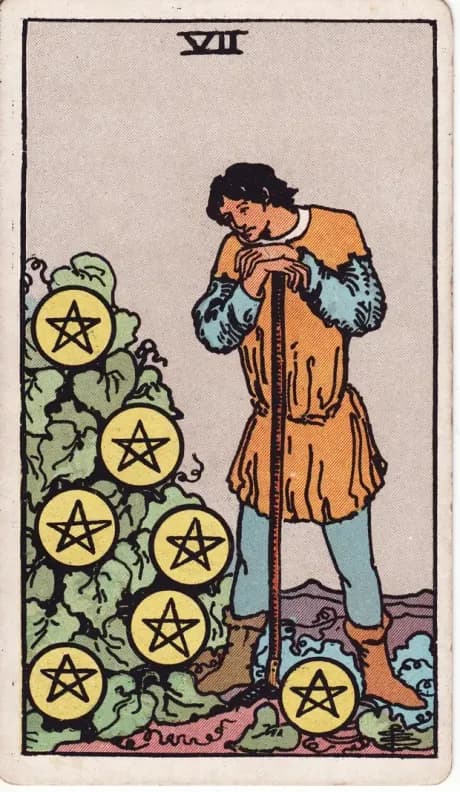
A figure leans on a hoe looking at a bush he has grown, coins hanging from it, none of them picked. The card's subject is the pause for assessment partway through a long investment — patience, reviewing the return, deciding whether to continue or redirect.
Upright it is the moment of honest evaluation. Work has been done, results are partially visible, and a decision is due about whether the strategy is producing. It is one of the deck's few cards about the middle of a process rather than its start or end.
Reversed it is the same moment mishandled. Either sunk cost — continuing because of what has been spent — or impatience that pulls things up before they can fruit. Both are failures to assess accurately rather than failures of effort.
Outside the personal, the card is unusually literal. In work it is the project review at the halfway point, or the year where results have not yet justified the investment and the question is whether to fund another. In money it is the long position examined. In skill it is the plateau, where practice continues and improvement has become invisible.
Among the Sevens across the deck, all four are about testing. Wands defends a position, Swords takes a shortcut, Cups fails to choose between illusions. Pentacles is the one that stops and measures — and it is the only one of the four that produces useful information.
The card's core claim is that effort and progress are different quantities, and that the only way to tell them apart is to look at output over a period rather than at how hard the work has felt.
Seven of Pentacles as a yes or no
As a yes or no, the Seven of Pentacles is a not-yet rather than either. If forced to one side it leans yes, because the card describes something that is genuinely growing — but the yes arrives later than the question wants, and reporting it as a clean yes misleads.
That makes it a card about timeframe more than outcome. If your question had a deadline in it, the honest answer is that the deadline is too soon. If your question was whether something will eventually work, the answer is probably, on a schedule you do not control.
The card also frequently answers a question the querent did not ask: whether it is worth continuing. Where that is the live issue, the upright card says the investment is sound and the return is late, which is different from saying it will never come.
Reversed it becomes a no, and the reason is specific rather than fated. The thing is not growing, and continuing to wait is the error rather than the solution. The reversed card is one of the few in the deck that actively recommends stopping, and it is worth delivering plainly rather than softening — it is telling somebody that the fourth year will resemble the third.
For timing, this is among the slowest cards in the slowest suit. Seasons, not weeks.
Seven of Pentacles as advice
As advice, the Seven of Pentacles says: measure before you decide, and measure over a long enough window to mean something. Not how it feels this week — what has actually changed since last year. The card's specific instruction is to replace an impression with a comparison.
Concretely: write down where things stood twelve months ago and where they stand now. This applies to a relationship, a job, a skill, a project. The exercise takes twenty minutes and is unpopular precisely because it produces an unambiguous answer, and unambiguous answers require action.
The second piece of advice is about the decision that follows. Set a date. The card's characteristic failure is open-ended waiting, and the antidote is not a deadline for the other person but one for yourself — a point at which you will look again, chosen now while you are calm rather than later while you are hurt.
Reversed, the advice is blunter: stop. Not out of anger, and not permanently in every case — stop the specific activity you have been calling patience. The reversed card describes someone whose effort has become a habit disconnected from any result, and the only thing that interrupts that is ceasing the effort long enough to see whether anything actually changes.
Seven of Pentacles as an outcome
As an outcome, the Seven of Pentacles is a situation that is still in progress when the question closes. Nothing concludes. What you get is a checkpoint: partial results, visible growth, and a decision waiting to be made rather than an event that resolves it.
That is a genuinely unsatisfying outcome to receive and it is honest information. If you asked whether something will be settled by a certain point, this card says it will not be, and that the state you will be in is evaluating rather than knowing.
In love questions it usually means a relationship that is neither ending nor arriving. Real, slow, and requiring a decision from you at some point that nobody else is going to make. The card frequently accompanies situations where waiting has become the default and would continue indefinitely if not interrupted.
There is a better version. Sometimes the outcome is a harvest that is close but not yet — the work paying off on a delay, with the payoff genuinely coming. The surrounding cards distinguish these: Pentacles and any Ace nearby favour the real harvest, while Swords or the Eight of Cups nearby favour the stall.
Reversed as an outcome is the wasted season: the investment does not return, and the ending is a decision to stop rather than a failure that announces itself.
What the Seven of Pentacles card shows
The 1909 card shows a young man standing in a cultivated field, leaning both hands and his chin on the handle of a hoe. Beside him grows a tall green bush or vine, and seven golden coins are attached to its leaves. One more coin lies on the ground at his feet, separate from the rest.
His posture is the whole card. He is not working — the hoe is being used as something to lean on. His head is tilted down and his weight is entirely on the tool, in the stance of somebody who has been standing there for a while.
He is looking at the plant and not at the single coin near his foot. That detail is easy to miss and it is deliberate: something has already been produced, and his attention is on the crop still attached rather than on what he has.
The plant is heavy and healthy and the coins are still on it. Nothing has been picked. This is the card's central image — value that exists, is visible, and has not yet been taken, because taking it too early is how you get nothing.
The ground is worked earth with green growth across it, and the background is plain sky with no horizon feature at all. There is nowhere else to look and nothing else happening. The picture has removed every distraction so that the only available activity is assessment.
His clothes are ordinary working clothes, brown and blue, and his boots are on the ground. Nothing about the figure is symbolic beyond what he is doing: standing still, looking at his own work.
Frequently asked
What does the Seven of Pentacles mean in love?
+
An honest review of what a relationship is yielding against what has been invested. It draws the line between patience and stalling, which look identical from inside, and insists you actually look rather than telling you which one you are in.
Does the Seven of Pentacles mean I should wait?
+
Only if something is measurably growing. The card's test is a comparison over a year rather than a feeling this week. Reversed, it says the opposite plainly: the thing is not growing, and continuing to wait is the error rather than the solution.
Is the Seven of Pentacles a yes or a no?
+
A not-yet. It leans yes because something is genuinely growing, but the yes arrives later than the question wants. If your question had a deadline in it, the honest answer is that the deadline is too soon.
What should I do when I draw the Seven of Pentacles?
+
Write down where things stood a year ago and where they stand now, then set a date to look again — chosen while you are calm rather than later while you are hurt. Open-ended waiting is the exact state this card describes.
Why is one coin on the ground in this card?
+
Because something has already been produced and he is not looking at it. His attention is entirely on the seven still attached to the plant. The picture is about value that exists, is visible, and has not been taken yet.