What Seven of Wands means in tarot — and in love
The Seven of Wands is love defended: protecting the relationship from doubters, holding your standards under pressure, or being the one who fights for… As feelings, the Seven of Wands means defensiveness — they guard their heart around you, feeling challenged or protective of what you two have.
Jump to FAQAt a glance
- Yes or no
- No — reversed flips it
- Element
- Fire
- Upright, in a line
- defending your relationship or your standards
- Reversed, in a line
- exhaustion from fighting for it alone
Want a yes or no on your own situation rather than this card? Pull one card and get the verdict with the reason behind it.
Ask your own yes-or-no questionIn the Golden Dawn tradition this card rules 20–30° of Leo. A planet standing at that degree is read through it: Venus in Leo · Moon in Leo · Mars in Leo
Upright in love
The Seven of Wands is love defended: protecting the relationship from doubters, holding your standards under pressure, or being the one who fights for 'us' when it gets contested. It's high-ground energy — you have something worth keeping and the will to keep it. If you asked whether to hold on: hold, but notice who's on the hill beside you.
The useful detail is that the card never shows the attackers. Six staves come up from below the edge of the frame and no hands are visible, which is exactly how this kind of pressure tends to feel. It is rarely one named opponent. It is a mother's tone of voice, a friend who keeps asking whether you are sure, a gap in age or money or nationality that nobody has said out loud, and your own private suspicion that some of them may have a point.
In a new connection it means the thing is being contested before it has had a chance to establish itself. Somebody disapproves, somebody older has an opinion, an unfinished situation from before is still making claims. The card says the position is defensible. It does not say the defence is free. You will spend energy here that you would much rather have spent on the person.
In an established relationship it is usually about boundaries. Holding a standard you have already stated: about how you are spoken to, about a family member's behaviour, about a habit somebody agreed to change and has not. The tiring part is that this kind of defence has no decisive moment. It is repetition, and repetition without backup turns into resentment quickly.
What the card asks for is a headcount. Look beside you. If the person you are defending is standing there, defend. If you are alone on the hill and they are somewhere below among the six, you are not protecting a bond, you are performing one. That distinction is the whole card, and it is settled in an afternoon by asking them to say the thing out loud that you have been saying for both of you.
Reversed in love
Reversed, the Seven of Wands is defense exhausted: tired of fighting for a place in someone's life, worn down by criticism, ready to drop the staff. A relationship you must constantly defend alone isn't a fortress — it's a siege. Put the stick down and see who defends you for a change.
The reversal changes exactly one thing: the staff comes down. Whether that is defeat or relief depends on what you were holding it for, and the card does not decide that for you. It only reports that the holding has stopped.
The bad version is attrition. You have been defending something alone long enough that the defending has become the thing itself, and there is no version of this that ends with the other person noticing on their own. People adapt to being defended. It stops registering, the way you stop hearing a fan in the next room.
In a new connection reversed it usually means you are auditioning: explaining yourself, softening yourself, making the case again in slightly different words. Nobody has ever been argued into wanting somebody. If the case has to be made a second time, the first answer was the answer.
The good version deserves naming because most readings skip it. Sometimes the reversal is you deciding the hill was not worth it. A family opinion you stop fighting. A rule you stop enforcing. An argument you concede because winning it cost more than losing it. That is not surrender, it is triage, and it releases an enormous amount of energy that had been going into holding a position nobody was still attacking.
Either way the instruction is the same and it is not comfortable. Put it down for a week and watch. If it holds without you, it was never under threat. If it falls over immediately, you have just found out what you were carrying alone.
Seven of Wands As feelings
As feelings, the Seven of Wands means defensiveness — they guard their heart around you, feeling challenged or protective of what you two have. Walls here signal wounds plus worth: what's inside matters enough to defend.
Defensiveness is not indifference, and reading it as indifference is the standard mistake with this card. Nobody defends an empty field.
If you are single and asking about someone new. They feel something and are braced against feeling it. Expect mixed signals that are not games: warmth followed by a step back, a good evening followed by two quiet days. Something in their history made openness expensive, and you are being assessed for whether you are likely to be another instalment of it. Consistency moves this card. Pressure does not.
If you are in a relationship. They feel protective, and often the protection is aimed outward rather than at you. They are defending the two of you against an opinion, a family, a work situation, a person who wants your time. It can read as tension in the room when it is actually tension about something outside the room, and asking directly usually gets a straight answer, because this card is not secretive. It is just busy.
If you are asking about an ex. They feel justified. Their version of what happened is finished, edited and defended, and revisiting it means giving up the position they have been standing on since it ended. That is why conversations go nowhere: nobody is lying, both people are holding ground.
If you are asking about someone long-term. The guarding has become habitual. The original threat is long gone and the posture stayed, which shows up as being contradicted reflexively, or as an odd resistance to small requests. It is not a verdict on you. It is a reflex that outlived its cause.
Seven of Wands For your ex
For an ex, the Seven of Wands means positions are entrenched: pride defended, blame deflected, nobody descending the hill first. Reunion requires someone to lower the staff voluntarily. Ask if the hill is worth the years.
The specific difficulty with this card is that both accounts are sincere. This is not a situation with a liar in it. Two people constructed two workable explanations of the same events, and each explanation is load-bearing: it holds up somebody's sense of having behaved reasonably. Asking either of them to drop it is asking them to be, retrospectively, the one who was wrong.
So contact tends to stall in the same place. It goes well for ten minutes, reaches the subject, and both of you return to your prepared ground. Nothing new is said because nothing new can be said from up there.
If you want the situation to move, the move is unilateral and it is not fair. Somebody concedes a piece of their own account without being asked to, and without trading it for a concession back. Not the whole thing — one specific piece. That is the only thing that has ever ended this pattern, and it works because it removes what the other person was defending against.
And there is a question worth asking before you do any of that: is the hill worth the years. Some positions were correct at the time and are simply not worth continuing to hold. Standing down from a fight nobody is watching is not losing it, and this is a card that badly needs somebody to say that out loud.
What Seven of Wands means in general
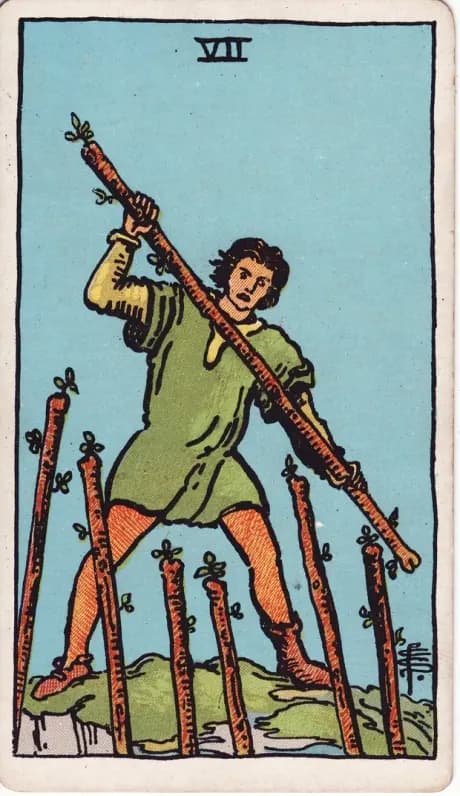
One figure on high ground holds off six staves rising from below. The subject is keeping a position that has already been won: a boundary, an unpopular decision, territory somebody else now wants a share of. Notice what the picture leaves out. No opponents are drawn. You see the staves and never the hands, which is how contested ground usually feels from the inside.
Upright it says the ground is worth keeping and elevation is a genuine advantage, but the work is attritional rather than decisive. Nothing here is settled by a single confrontation. It is settled by still being there next month.
Reversed the position is given up. Sometimes that is collapse: outnumbered, worn out, no reserves. Sometimes it is judgement, in which the hill gets examined and turns out never to have been worth the siege. The second is not a failure, and confusing the two is the commonest misreading of this card.
In business it is the incumbent under pressure from newer competitors, the founder defending a decision the board dislikes, the researcher whose result is being questioned. In money it is holding an asset while everybody advises selling. In creative work it is the third draft, where the criticism has arrived and the temptation is to sand the thing down into something nobody could object to.
The sevens across the deck test what was built at six. Seven of Pentacles assesses and waits. Seven of Cups fails to choose. Seven of Swords takes what it can carry and leaves. Seven of Wands stays and argues.
Its practical instruction matches its composition exactly: keep the height. Most of what looks like an argument on this card is an invitation to come down and fight on level terms, where numbers decide the outcome. The elevation is the entire advantage. Everything else is even.
Seven of Wands as a yes or no
As a yes or no, the Seven of Wands upright is a conditional yes. Not the comfortable kind. It says the thing you want is available and that you will have to keep it rather than simply receive it, and that the keeping is the actual content of the answer.
This is the difference between this card and the Six of Wands one step earlier. The Six delivers a result. The Seven says the result has to be held against pressure, and answers yes only for as long as you are willing to hold it. Cards that promise something free do not look like this one.
So the honest phrasing is: yes, if you persist. Yes, if you do not descend to argue on someone else's terms. Yes, if you can accept that the confirmation will not arrive as a single satisfying moment but as the slow absence of the thing you were afraid of.
Reversed it turns to no, and the reason matters. Sometimes the no means you run out of energy before the situation resolves, which is a genuine forecast and not a judgement about your character. Sometimes it means the answer is no because you stop wanting the yes — you look at what defending this costs and decide it is not a good trade. Reversed cards that describe letting go are frequently answering a question the person has already half-answered privately.
If the reversed card lands and the no feels wrong, ask a better question: not whether you will keep this, but whether it is worth the terms on which it is being offered.
Seven of Wands as advice
As advice, the Seven of Wands is unusually concrete: hold the position, and stop justifying it.
Those are two separate instructions and the second is the one people skip. Every time you explain the boundary again, you reopen it for negotiation. A boundary that gets argued once a month is not a boundary, it is a recurring meeting. State it once, in plain words, and then simply keep behaving as though it exists. The card's whole geometry is about not coming down to argue on level ground.
Second, get a headcount before you commit to the fight. Who is actually beside you here? If the person this concerns has never once said the thing to their own family, their own friends, their own colleagues, you are not defending a shared position. You are holding a position by yourself and calling it shared. That is worth finding out this week rather than next year.
Third, choose the hill deliberately. This card will happily defend anything you point it at, including things not worth defending. Write down what you are actually protecting, in one sentence, without abstractions. If the sentence turns out to be about being right rather than about something you want to keep, put the staff down.
Fourth, accept the cost honestly. Defence is expensive and expense is survivable when it is budgeted and corrosive when it is denied. Decide how long you will do this before you review it. A defence with no review date turns into a siege, and sieges are lost by the side that forgot they had a choice.
Seven of Wands as an outcome
As an outcome, the Seven of Wands ends with you still standing and still holding. That is a real result and worth reading precisely: you keep the thing. You are not comfortable, nothing is fully resolved, and the pressure has not disappeared, but the position is yours at the end of the period you asked about.
In a question about a connection, it usually means the bond survives whatever is testing it. The disapproving family does not get its way. The competing situation does not win. What it does not promise is that the testing stops, and that omission is deliberate rather than pessimistic. This card ends in a held position, not a peace treaty.
In a question about a decision, it means you will be proved right and will have to keep being right in public for a while before anybody agrees. The vindication is slow and arrives without ceremony.
The practical warning in the upright outcome is fatigue. You arrive at the end of this with the thing intact and less energy than you started with, so plan for what you will need afterwards rather than assuming the finish restores you.
Reversed as an outcome, the position is not held. Sometimes that is loss: you are worn down, outnumbered, and it goes. Sometimes it is the cleaner ending, in which you decide it is not worth it and step off the hill on your own terms. Those look identical from outside and feel nothing alike from inside, and the surrounding cards usually tell you which one you are looking at. Exhaustion cards nearby point to the first. Cards of movement and choice point to the second.
What the Seven of Wands card shows
The 1909 card shows a young man standing on high ground, gripping a staff diagonally across his body. Six more staves rise from the bottom edge of the card, angled up toward him. Nobody is holding them. The hands, the bodies and the faces of whoever is attacking are entirely outside the frame.
That omission is the most important thing in the picture. You are shown one side of a conflict and asked to take the threat on trust, which is exactly the situation the card describes: pressure that feels enormous and cannot quite be identified. Six wands could be six people, one persistent person, or an atmosphere.
His footwear is the detail everybody eventually notices. He is wearing two different shoes, one on each foot. The usual reading is that the attack came before he was ready and he dressed in whatever was nearest. It is a small, slightly comic piece of realism in a card that would otherwise look heroic, and it changes the tone of the whole scene. This is not a champion. It is somebody who was interrupted.
His stance is wide and braced, one foot forward, weight low. He is not swinging the staff. He is blocking with it, holding a line rather than pressing an advantage, and the difference is visible in the arms.
The ground under him is green and uneven, and it is higher than the wands coming toward him. Every tactical fact in this card is contained in that height. The sky behind is pale and empty, no landscape, no buildings, nobody watching. Unlike the Six of Wands with its crowd, this fight has no audience at all, which is why the card so often shows up for people defending something in private that nobody has thanked them for.
Frequently asked
What does the Seven of Wands mean in love?
+
Defending the bond, or defending your own standards under pressure. It says the thing is worth holding and that holding it will take sustained effort rather than one decisive conversation. The question the card really asks is whether you are the only one holding it.
Is the Seven of Wands a yes?
+
A fighting yes: you can keep what you value if you stand your ground, and persistence is the price on the label. It never promises anything free. Reversed it becomes a no, either because the energy runs out or because you decide the position was not worth the cost.
Is the Seven of Wands a yes or a no?
+
Upright, a conditional yes — the outcome depends on whether you keep going, which makes it one of the few cards that hands the decision back to the reader. Reversed, a no. If the reversed no feels wrong, ask instead whether the thing is worth the terms it is being offered on.
What should I do when I draw the Seven of Wands?
+
Three things. State the boundary once and stop re-explaining it, because every explanation reopens the negotiation. Check who is actually standing beside you. Then write down in one sentence what you are defending — if the sentence is about being right rather than about something you want to keep, put it down.
Why is the man wearing two different shoes on the Seven of Wands?
+
It is a deliberate detail in the 1909 artwork and the usual reading is that he was caught unprepared and put on whatever was closest. It keeps the card from being heroic. He is not a champion who chose this fight, he is somebody who was interrupted and is now defending a position anyway.